
What Is Pastoral Theology? A Ministry Guide

At its very core, pastoral theology is where the rubber meets the road—it’s the art of applying profound theological truth to the messy, beautiful reality of people’s lives. It acts as a bridge, connecting what we know about God to the actual work of shepherding His people through their highest joys and deepest sorrows. This is where faith moves out of the classroom and into the hospital room, the counseling office, and the family living room.
The Art of Soul Care
Think of a good doctor for a moment. They've spent years immersed in anatomy, biology, and chemistry—the "theology" of the human body, so to speak. But their real calling isn't just to ace exams; it's to sit with a patient, listen carefully, and then apply all that knowledge to bring about healing.
That’s exactly how pastoral theology works for the soul.
This isn’t a discipline focused on formulating new doctrine from scratch. It’s about applying established doctrine with incredible wisdom and deep compassion. A pastor skilled in this art doesn’t just know the biblical texts on grief; they know how to sit quietly with a grieving widow, offering comfort that is both theologically solid and genuinely human. They know how to shepherd a congregation through a painful conflict or celebrate a new birth with true spiritual insight.
Bridging Doctrine and Daily Life
Pastoral theology answers the all-important question: "So what? How does my faith actually work on a Monday morning?" It’s what connects the dots between the eternal truths of Scripture and the everyday grind. This intensely practical focus is what sets it apart from its academic cousins.
Systematic Theology is like the architect's blueprint, organizing and explaining biblical doctrines in a coherent system.
Biblical Theology is like the grand narrative, tracing God's big-picture story from Genesis to Revelation.
Historical Theology is like the family album, studying how Christian beliefs have developed and been understood over centuries.
Pastoral theology, in contrast, grabs the wisdom from all these fields and puts it to work. It’s all about the care and cure of souls—a practice the early church fathers called cura animarum.
Pastoral theology isn’t just a ministry toolkit. It’s a deep, theological reflection on the very practice of ministry. It forces us to ask how we can faithfully embody Christ's love and truth in the middle of messy human relationships and real-world problems.
This hands-on, relational dynamic is what makes pastoral theology so indispensable for anyone called to lead in the church. It equips ministers to be more than just teachers; it trains them to be shepherds who know how to guide, protect, and genuinely care for their flock with both skill and grace.
Before we go further, it helps to see how the different dimensions of pastoral theology fit together. This table breaks down its core components:
Key Dimensions of Pastoral Theology
Component | Description | Example in Ministry |
|---|---|---|
Pastoral Care | Providing spiritual and emotional support during life's challenges and transitions. | Sitting with a family in the hospital after a difficult diagnosis or visiting a new mother at home. |
Pastoral Counseling | Offering biblically-grounded guidance to individuals, couples, or families facing specific relational or personal struggles. | Leading a pre-marital counseling session or helping a member work through a crisis of faith. |
Homiletics & Worship | The art of preaching, teaching, and leading corporate worship in a way that is theologically sound and spiritually nourishing. | Crafting a sermon series on the book of James that connects its themes to the congregation's daily work life. |
Spiritual Formation | Guiding and mentoring believers in their personal journey of becoming more like Christ. | Discipling a new believer, leading a small group, or teaching spiritual disciplines like prayer and fasting. |
Each of these areas requires a pastor not only to know the right theology but to apply it with the right heart and the right skill in real time. It's a demanding but incredibly rewarding calling.
The Historical Roots of Pastoral Care
Pastoral theology isn't some newfangled idea hatched in a seminary classroom. Its roots run deep, drawing life from the soil of Scripture and the long, winding road of church history. Over thousands of years, this discipline has been shaped and reshaped, always adapting to meet the real-world spiritual needs of God's people. Its story begins with one of the most powerful and enduring metaphors for spiritual leadership in the entire Bible.
Think about the image of a shepherd caring for their flock. This is the earliest and most profound model we have for pastoral care. We see it beautifully painted in Psalm 23, where God is portrayed as a shepherd who guides, protects, and provides for His sheep.
Later, Jesus picks up this very same image in John 10, declaring, “I am the good shepherd. The good shepherd lays down his life for the sheep.” This wasn't just a nice story; it was a powerful statement that set the standard for every Christian leader to come. The ideal was established: leaders are shepherds, responsible for the spiritual health and safety of their community.
As the church grew, early leaders like Gregory the Great wrote extensively about what it meant to be a "pastor." He understood that the role demanded both deep spiritual maturity and a ton of practical wisdom. He famously called pastoral ministry the "art of arts", a delicate dance of teaching, guiding, and personally caring for people. His work laid a critical foundation for what we understand pastoral leadership to be today.
From Integrated Practice to a Formal Discipline
For centuries, caring for people wasn't seen as a separate "subject." It was just woven into the fabric of theology, right alongside doctrine and ethics. It wasn't until a period of widespread spiritual crisis that the church realized it needed a more intentional approach.
The journey of pastoral theology is all about connecting what we know to what we do. It's about building a bridge from solid biblical and theological truth to the messy, beautiful reality of people's lives.
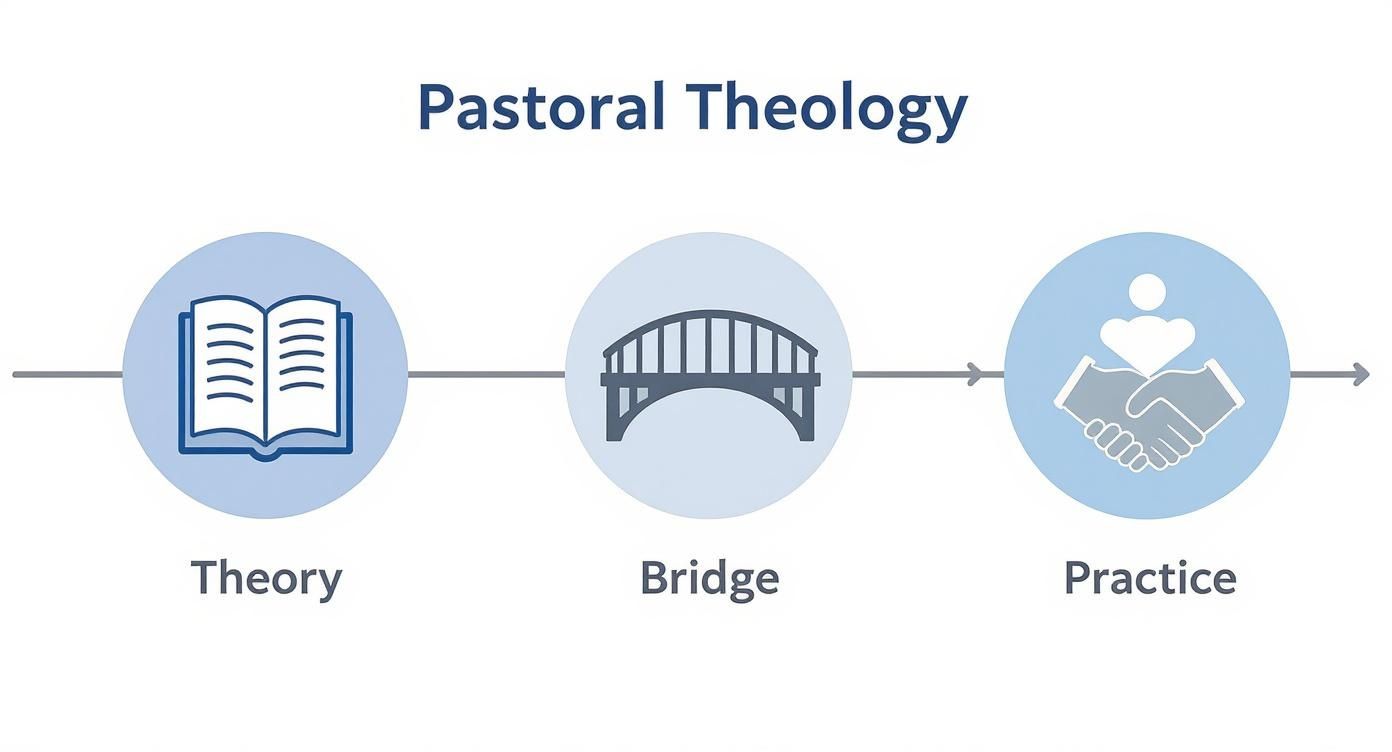
Effective ministry isn't about choosing theory or practice; it's about faithfully connecting the two.
A huge turning point came during the Counter-Reformation in the late 15th and early 16th centuries. History tells us that many clergy had simply checked out, neglecting their duties and creating a huge gap between them and the people they were supposed to serve. The church had to respond.
This crisis sparked a movement to formalize pastoral training. What was once just an assumed skill was now becoming a structured discipline taught in seminaries. The goal was to equip clergy to be effective "ministers of Christ" in the real world—preaching, administering the sacraments, and offering genuine soul care. For those interested in the details, you can explore a detailed history of this transformation and its impact on the church.
The Modern Evolution of Pastoral Theology
The conversation didn't stop there. As we moved into the modern era, key thinkers continued to challenge and refine the church's approach to ministry. One of the most important voices was the 19th-century theologian Friedrich Schleiermacher, often called the "father of modern theology."
Schleiermacher argued that practical theology, which includes pastoral care, should be seen as the crown of all theological studies—the point where all other disciplines find their ultimate purpose and application.
He was passionate that theology had to be fundamentally concerned with the actual life and leadership of the Christian community. His perspective helped cement pastoral theology’s place as a central and respected field in seminary education. He drove home the point that knowing doctrine is worthless if you can't apply it with wisdom and compassion in the lives of real people.
This journey through history reveals a vital truth: pastoral theology is a living, breathing tradition. It has always been shaped in response to the needs of the church and the world. From the ancient shepherd metaphor to the structured courses in today's seminaries, the core mission has never changed: to equip faithful leaders to care for God's people with wisdom, compassion, and skill.
The Four Pillars of Modern Ministry

If pastoral theology is the bridge connecting belief to real-world action, then it stands on four sturdy pillars. These aren't just separate job functions a pastor juggles; they are deeply interconnected disciplines that truly define the essence of modern ministry.
Grasping what each pillar involves is key to seeing what pastoral theology actually looks like on the ground. Each one represents a core competency that a pastor must cultivate to effectively shepherd a congregation, requiring a blend of theological depth, emotional intelligence, and practical, hands-on skill.
Let's break down these foundational areas.
Pastoral Care and Counseling
At its heart, pastoral care is the art of being present with people—in their joy and in their pain. It’s the quiet hospital visit, the patient listening ear after a job loss, and the genuine celebration of a new marriage. This is the shepherding role in its most direct and personal form.
Counseling takes this a step further by offering biblically grounded guidance for specific life challenges. It involves helping individuals, couples, and families navigate conflict, grief, or a crisis of faith with wisdom and grace. Recognizing the complex needs of today's world, many ministers are exploring frameworks like trauma-informed care to better serve their communities.
This pillar is fundamentally relational. It’s all about creating a safe space where people feel seen, heard, and spiritually supported.
Homiletics and Preaching
Homiletics is the craft of preparing and delivering sermons that are both faithful to Scripture and deeply relevant to the lives of the people listening. It’s so much more than public speaking; it’s the sacred task of interpreting God’s Word in a way that informs the mind, stirs the heart, and moves the will.
A well-crafted sermon connects ancient texts to modern anxieties, questions, and hopes. It answers the real-world question, "What does this passage mean for me, today?" This demands careful study, clear communication, and a genuine understanding of the congregation's unique context.
The goal of preaching is not merely to convey information, but to facilitate a genuine encounter between the congregation and the living God. It is theology made audible and applicable.
Effective homiletics brings the Bible to life, making its truths accessible and compelling. Week after week, it shapes the theological understanding of an entire community.
Worship Leadership
Leading worship goes far beyond just picking songs or planning a service order. It's the skill of curating a corporate environment where people can truly encounter God. This involves weaving together prayer, music, Scripture reading, and sacraments into a coherent, powerful, and meaningful experience.
A strong worship leader understands the "why"—the theology—behind each element of the service. They know how to guide a congregation on a journey of adoration, confession, thanksgiving, and dedication. This pillar requires both spiritual sensitivity and sharp organizational skills.
Spiritual Formation
The final pillar is spiritual formation, the intentional process of guiding people on their journey toward Christian maturity. While God alone brings the growth, the pastor’s role is to create a fertile environment for that growth to happen. This means teaching spiritual disciplines, fostering authentic community, and providing mentorship.
This work happens through many different avenues:
Discipleship: Walking alongside individuals to help them understand and apply their faith in practical ways.
Small Groups: Creating spaces for believers to connect, study Scripture, and genuinely support one another.
Teaching: Equipping the congregation with knowledge of prayer, fasting, Scripture meditation, and other classical spiritual practices.
Ultimately, spiritual formation is about helping people become more like Christ. It’s the long-term, often quiet work of nurturing souls. Strong leadership is essential here, which you can learn more about at https://www.thebibleseminary.edu/post/choosing-church-leadership-structure-models. Together, these four pillars—care, preaching, worship, and formation—provide a complete framework for understanding what is pastoral theology and how it is lived out.
How Seminaries Forge Effective Ministers
So, how does someone actually learn the art of caring for souls? The journey from a deep sense of calling to becoming an effective minister isn't accidental. It’s a deliberate path forged within the walls of a seminary, a place designed to bridge the huge gap between knowing theology and practicing it with wisdom and grace.
Think of a seminary curriculum as a carefully constructed blend of deep academic study and intensive, hands-on experience. You have to build a solid foundation before you ever start putting up the walls of the house. This ensures that when a pastor eventually faces a real-world crisis, they’re operating from a place of profound biblical understanding, not just good intentions.
This foundational knowledge is everything. Seminaries play an instrumental role in shaping future ministers, providing crucial training in areas like mastering expository sermon preparation to faithfully communicate God's Word. Without it, ministry can easily become shallow, reactive, and disconnected from the deep truths of the faith.
Building the Theological Engine
Before a pastor can apply truth to someone's life, they first have to know that truth deeply themselves. This is where foundational coursework comes in, serving as the theological engine that powers all future ministry. These aren't just abstract academic exercises; they provide the essential "why" behind every pastoral action.
Key areas of study typically include:
Systematic Theology: This organizes the major doctrines of the Christian faith—God, humanity, salvation, the church—into a coherent whole, giving students a solid framework for their beliefs.
Biblical Studies: Courses in Old and New Testament survey, exegesis, and hermeneutics teach students how to interpret Scripture faithfully and accurately. It's about learning to handle the Word correctly.
Church History: Understanding how the church has navigated theological debates, cultural shifts, and internal challenges for over 2,000 years provides priceless wisdom and perspective for today's ministry.
These disciplines give future pastors the tools to think theologically about any situation they might run into. The goal is to cultivate a mind and heart so saturated with Scripture that their pastoral instincts become sharp, sound, and biblically informed.
The Ministry Residency: Where Theory Meets Reality
If coursework is the engine, then practical experience is the road test. This is where pastoral theology moves out of the classroom and into the messiness of real life. Just like a medical student has to complete a residency, a seminary student must immerse themselves in real ministry settings to learn the art of care under seasoned supervision.
The supervised ministry experience is where a student truly learns to integrate their head knowledge with their heart knowledge. It’s where they discover how to be present, listen deeply, and apply theological truths with compassion and nuance in the lives of real people.
These hands-on components are non-negotiable for forming effective ministers. They usually take two primary forms:
Internships and Practicums: These placements within a local church or parachurch organization let students serve alongside veteran pastors. They get direct experience in preaching, teaching, leading worship, and providing pastoral care, all within a supportive environment.
Clinical Pastoral Education (CPE): Often taking place in hospitals, hospices, or prisons, CPE is an intensive program focused on developing self-awareness and advanced skills in crisis care. Students learn to minister to people from all walks of life during their most vulnerable moments.
This powerful combination of rigorous academics and supervised practice is what forges a capable minister. It's an intentional process designed to produce leaders who are not only theologically knowledgeable but also pastorally skillful and spiritually mature. For those considering this path, a great next step is to explore the curriculum of programs like the Master of Divinity.
Diverse Career Paths in Pastoral Ministry

When most people think of a seminary degree focused on pastoral theology, they picture someone standing behind a pulpit. And while leading a local church is a vital and primary calling for many, this training cultivates a unique skill set that throws open the doors to a whole world of service-oriented careers.
The core of this discipline—things like deep empathy, crisis management, and clear, compassionate communication—is incredibly valuable in countless other settings. At its heart, pastoral theology teaches you how to shepherd souls, and that's a calling that extends far beyond the traditional church walls, wherever people need guidance, hope, and care.
Serving on the Front Lines as a Chaplain
One of the most powerful applications of pastoral theology is found in the world of chaplaincy. Chaplains are spiritual caregivers dropped into high-stress, often secular environments where people are grappling with profound, life-and-death questions. Theirs is a ministry of presence, offering comfort and counsel to people from any faith background—or none at all.
It’s demanding work that requires tremendous emotional resilience and a rock-solid theological foundation. Common chaplaincy roles include:
Hospital Chaplains: They walk with patients and their families through the chaos of illness, injury, and grief, acting as a calm spiritual anchor in a storm of medical uncertainty.
Military Chaplains: These men and women provide spiritual support to service members and their families, addressing the unique moral and emotional burdens that come with military life.
Hospice Chaplains: Specializing in end-of-life care, they help individuals and their loved ones find peace, meaning, and dignity in their final days.
In every one of these roles, the ability to listen deeply and respond with genuine compassion isn't just a skill; it's everything. Chaplains embody pastoral care in some of the most intense human situations imaginable.
Leading with Purpose in the Nonprofit World
The skills of a pastor are also a perfect fit for leadership in the nonprofit sector. A background in pastoral theology provides a strong ethical framework and a deeply human-centered approach to community development and social outreach.
A leader trained in pastoral theology understands that effective community work is not just about programs and budgets; it’s about nurturing human dignity, fostering reconciliation, and inspiring hope.
Whether it’s running a local food bank or directing an international relief agency, these positions demand the ability to cast a compelling vision, manage teams with integrity, and care for both the people being served and the staff doing the serving. The organizational and relational skills honed in ministry are directly transferable to leading any mission-driven organization.
Taking the Mission Across Cultures
Finally, the field of cross-cultural missions is a natural home for someone trained in pastoral theology. Missionaries are, at their core, pastors to a new and different community. Their challenge is to apply timeless biblical truths in a way that is sensitive and relevant to a culture that isn't their own.
This requires incredible adaptability and a profound understanding of how to communicate the heart of the gospel without getting tangled up in cultural trappings. It involves planting churches, equipping local leaders, and offering care in a way that respects and honors the local context. In every sense, the missionary is a pastoral pioneer, building a spiritual home in a new land.
Exploring Your Calling to Ministry
If this deep dive into pastoral theology has stirred something within you, the natural next question is, "What now?" Moving from a quiet curiosity to real clarity about your calling isn't passive; it's a journey of intentional discernment. The best way forward is to blend thoughtful reflection with practical, boots-on-the-ground exploration.
First, just immerse yourself in the world of pastoral care. Start reading the foundational books on the subject, listen to podcasts from ministers who've been in the trenches for decades, and just soak up the wisdom of those who have walked this path before you. This helps build a realistic picture of both the incredible joys and the inevitable challenges, moving you past any romanticized ideas about ministry.
Next, you've got to get involved. Theory is essential, but nothing puts a calling to the test like hands-on experience.
Practical Steps for Discernment
Volunteering in a ministry at your local church is a fantastic place to start. It pulls back the curtain, letting you see the day-to-day realities of pastoral work up close. You'll gain an invaluable perspective that no textbook can ever provide.
Another crucial step is to simply talk to current pastors. Ask if you can buy them a coffee and have an honest conversation about their journey. Find out what parts of their work bring them the most life and which aspects are the most draining. Hearing their stories—the good, the bad, and the unexpected—will give you a grounded view that is vital for your own discernment.
Discerning a call to ministry isn't a passive activity. It's an active pursuit of wisdom, one that involves studying, serving, and seeking counsel from those who are faithfully living out that very calling.
Finally, begin looking into seminary programs that feel like a good fit for your personal and theological convictions. Check out their curriculum, get to know the faculty, and understand their philosophy of ministry. Exploring different degree options can really help clarify which path best aligns with where you feel God is leading. A guide on finding your calling in Master of Divinity programs is a great resource to get you started at this stage.
These actions—reading, serving, connecting, and researching—create a powerful framework for discovery. They help you turn a small flicker of interest into an intentional journey, giving you the confidence to discern whether God is calling you to this unique and incredibly rewarding work.
Got Questions? We’ve Got Answers.
Stepping into the world of theological education can feel a little overwhelming. It's only natural to have questions. Here are some straightforward answers to the questions we hear most often about pastoral theology, designed to help you see its unique role and how it plays out in real-world ministry.
What Is the Main Difference Between Pastoral and Systematic Theology?
This is a great place to start. Think of it like the difference between an architect and a master builder.
Systematic theology is the architect. It carefully organizes and explains all the core doctrines of the Christian faith into a coherent, solid blueprint. It’s focused on answering the question, "What is true?"
Pastoral theology, on the other hand, is the master builder who takes that blueprint and constructs a livable home. It’s all about applying those truths in the messy, beautiful reality of people’s lives. Its focus is answering the question, "How does this truth help people right now?"
Both are absolutely essential, but pastoral theology is defined by its hands-on, relational application of God's Word.
Is a Degree in Pastoral Theology Only for Senior Pastors?
Not at all. While senior pastors certainly need this training, the skills you learn are foundational for a huge range of ministry roles. This field equips anyone whose calling involves spiritual care, guidance, and leadership.
Youth Pastors use it to counsel students navigating some of the toughest stages of life.
Worship Leaders apply it to craft services that are not just emotionally resonant, but theologically rich.
Chaplains rely on it daily to provide comfort and care in high-stress places like hospitals and military bases.
Missionaries use it to shepherd new believers in completely different cultural contexts.
Basically, if God has called you to shepherd souls in any capacity, this is for you. It’s the heart of relational ministry.
How Much of Pastoral Theology Is Psychology?
This is a fantastic and important question. Pastoral theology and psychology often address similar human struggles—grief, anxiety, conflict—but they start from completely different places. Psychology works from a clinical and scientific framework, while pastoral care works from a biblical and theological one.
Modern pastoral care absolutely recognizes the valuable insights psychology offers into human behavior. However, its ultimate goal isn't just mental health, but spiritual wholeness rooted in a person's relationship with God.
Many effective pastors integrate psychological awareness into their ministry, but their primary tools will always be Scripture, prayer, and the wisdom of the Christian tradition. The two fields can complement each other, but they aren’t the same. One focuses on the mind and behavior; the other focuses on the soul and its standing before God. Pastoral theology is uniquely concerned with applying God's truth to bring about spiritual healing and growth.
Are you ready to turn your calling into a skilled and compassionate ministry? At The Bible Seminary, we provide the rigorous, Bible-centered education you need to serve effectively. Explore our graduate programs and discover how we can equip you for a lifetime of impactful service.
