
Choosing Church Leadership Structure Models

Church leadership models are just the formal systems a faith community uses for governance—the frameworks that define authority, decision-making, and accountability. This framework, often called polity, dictates how a church actually operates, from managing its finances and staying on mission to the nitty-gritty of daily ministry. For any leader trying to build a healthy and effective church, getting a handle on these models is non-negotiable.
Understanding the Four Primary Church Leadership Models
How a church is structured is so much more than an org chart; it’s a theological statement about what you believe about authority, community, and mission. Every model offers a different answer to some foundational questions: Who has the final say? How do we identify and appoint leaders? And to whom are those leaders accountable?
While you'll find countless variations out there, most church governance systems fall into one of four main camps. Each comes with its own biblical rationale and very real, practical implications for the life of the church.
Choosing or refining a structure isn’t just an administrative task. It forces leaders to weigh their deeply held theological convictions against the realities of their ministry context. Get it right, and the model can empower the congregation and bring incredible clarity to its mission. But a poor fit can breed confusion, spark conflict, and stall growth in its tracks.
Core Differences in Governance
When you boil it all down, the biggest difference between these models is where the ultimate authority lands. Does it rest with the local congregation? A regional body of elders? A single bishop who oversees a territory? Or a small group of local elders? That one distinction shapes everything else.
A church’s polity is the practical expression of its theology. It reveals what a community truly believes about leadership, discipleship, and the nature of the Church itself. Getting the structure right isn’t just about efficiency; it’s about faithfulness.
The table below offers a quick, high-level look at the four main church leadership structure models. Think of it as a cheat sheet to help you grasp the core DNA of each approach.
Model | Source of Authority | Key Decision-Makers | Accountability |
|---|---|---|---|
Episcopal | Hierarchical; flows from the top down. | Bishops and appointed clergy. | Clergy are accountable to bishops. |
Presbyterian | Representative; flows from the congregation up to elders. | Elected elders (presbyters) in local and regional bodies. | Elders are accountable to presbyteries. |
Congregational | Autonomous; resides within the local church members. | The congregation, typically through member votes. | Leaders are accountable to the congregation. |
Elder-Led | Plurality of Elders; resides in a group of local elders. | A board or council of elders (pastors and lay leaders). | Elders are mutually accountable to each other. |
These aren't just administrative preferences picked out of a hat. They represent centuries of theological wrestling and practical church life, each offering a distinct path for organizing the body of Christ to fulfill its mission. As we dig into each one, start thinking about how its principles might align with your own church’s vision, values, and culture.
Comparing the Four Primary Governance Models
It’s one thing to talk about church leadership models in theory, but putting them side-by-side is where you really see how they operate. Each model gives a different answer to the foundational questions of power, accountability, and just how much say the members get. A direct comparison helps cut through the noise so you can see which structure truly fits your church's DNA and ministry goals.
This isn't just a simple pros-and-cons list. We're digging into the operational DNA of each model—looking at where the authority comes from, who makes the final call, and how accountability actually works. This gives a much clearer picture of how day-to-day life and big-picture decisions play out in each system.
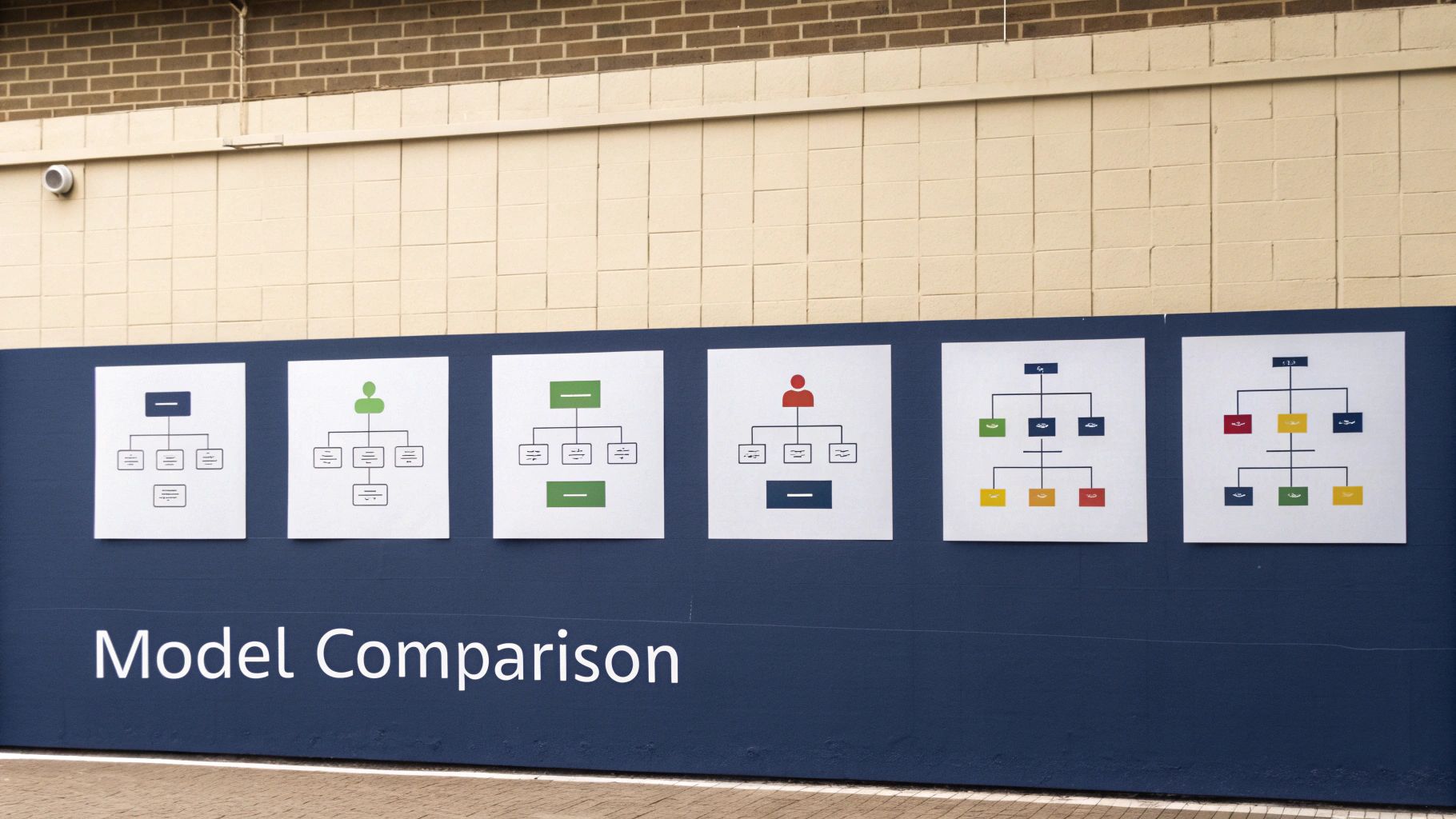
Authority And Decision-Making Dynamics
The biggest dividing line between these four models is the ultimate source of governing authority. This one factor shapes everything, from hiring a pastor and approving the annual budget to setting the long-term vision for the church.
In the Episcopal model, authority is strictly top-down. Bishops, who are in charge of a geographical region (a diocese), hold the real power. They ordain clergy, guard the doctrine, and provide oversight to the local churches. The big decisions, especially about clergy appointments or major theological stances, are made at the diocesan level, not by the congregation.
On the complete opposite end of the spectrum, the Congregational model puts authority right into the hands of the local church members. It's the most democratic structure you'll find. The congregation itself is the final human authority, and major decisions—from budgets to bylaws—are made by member votes in business meetings. This model is a direct expression of the "priesthood of all believers."
The Presbyterian model works on a system of representative government. Authority starts with the congregation and flows up to elected elders (the presbyters), who govern on their behalf. A local board of elders, called the Session, makes decisions for the individual church, but that group is accountable to a regional body of churches (the Presbytery). It creates a powerful system of mutual accountability that reaches beyond the four walls of one church.
Finally, the Elder-Led model places authority with a select group of qualified elders at the local church level. This team, usually made up of both pastoral staff and lay members, is responsible for the church's spiritual oversight and governance. The key difference from the Congregational model is that the final say rests with this elder council, not the entire membership.
The fundamental difference isn't about having leaders; it's about where those leaders derive their authority. Does it come from a bishop's appointment, a congregational vote, a representative body of peers, or the mutual submission of a local elder team?
Roles Of Clergy And Laity
How pastors and lay members work together and share responsibility looks dramatically different across these structures. The balance of power is a direct reflection of the underlying philosophy of governance.
Episcopal Structure: This model draws a very clear line between ordained clergy and the laity. Priests are appointed by and answer to the bishop, not hired by the congregation. While a lay leadership team (often called a vestry) might manage the church's finances and property, the priest has the primary spiritual and liturgical authority.
Congregational Structure: Here, that distinction is blurred. The pastor is often viewed as a "first among equals," called to their role by the congregation that employs them. Lay members have the most direct involvement, with the power to hire and fire staff and approve all major ministry initiatives.
Presbyterian Structure: This system creates a partnership between clergy and laity through the elder system. Ruling elders (lay leaders) and teaching elders (pastors) govern together with an equal voice and vote in the Session and the Presbytery. It’s a true partnership where pastoral leadership is respected but held in check by the congregation's elected representatives.
Elder-Led Structure: Much like the Presbyterian model, this structure elevates qualified lay leaders to govern alongside pastors. The main difference is that these elders are often selected or affirmed by the existing elders rather than elected as representatives, placing the emphasis on spiritual qualification over democratic process.
To help you see these differences clearly, the table below breaks down the core components of each model.
At-a-Glance Comparison of Church Leadership Models
This table summarizes the core characteristics of each primary church governance model for quick reference and comparison.
Model | Source of Authority | Key Decision-Makers | Clergy Role | Accountability Flow |
|---|---|---|---|---|
Episcopal | Denominational Hierarchy | Bishops, Diocesan Councils | Appointed by Bishop | Upward: Clergy accountable to Bishop. |
Congregational | Local Congregation | Voting Members | Called by Congregation | Downward: Leaders accountable to Members. |
Presbyterian | Representative Elders | Session & Presbytery | Called by Session, approved by Presbytery | Outward & Upward: Session accountable to Presbytery. |
Elder-Led | Local Elder Board | Council of Elders | Hired by Elders | Inward: Elders mutually accountable to each other. |
This comparison brings a critical tension to the surface. Both the Episcopal and Presbyterian models offer external accountability, which is a great safeguard against a local church drifting into error or unhealthy leadership. But that safety often comes at the price of local autonomy.
On the other hand, the Congregational and Elder-Led models champion local control, which allows a church to be incredibly nimble and tailor its ministry to its specific context. The risk, of course, is isolation. With no external body for appeal or oversight, internal conflicts can fester, and there's a higher potential for unchecked authority, whether from a popular majority or a dominant elder board. Choosing the right structure means you have to honestly weigh these trade-offs.
The Theological Roots of Church Governance
A church's governance model is never just an org chart; it's a living, breathing expression of its deepest theological convictions. Every one of the primary church leadership structures grows out of a unique reading of Scripture, wrestling with foundational questions about authority, spiritual order, and the very nature of the Church itself.
Choosing a model isn't about finding the most efficient business structure. It's a theological statement. It declares how a community understands the roles Christ gives to his people, the authority he delegates, and how the Holy Spirit moves through the body of believers. Getting this right means a church’s daily practice is in lockstep with its core beliefs.
Congregationalism and the Priesthood of All Believers
The Congregational model is anchored firmly in the Reformation principle of the priesthood of all believers. Its proponents lean heavily on passages like 1 Peter 2:9, which calls the Church "a royal priesthood, a holy nation." They see this as a clear mandate, giving spiritual authority and responsibility to every single believer, not just a select few with seminary degrees.
This theological conviction naturally leads to an autonomous, democratic structure. If every member is a priest before God, then the gathered wisdom of the congregation—guided by the Holy Spirit—is the final human authority on earth. Major decisions are made by the whole body, flowing from the belief that Christ leads his church most directly through his people.
"In a congregational church, the buck doesn't stop with the pastor or a board. It stops with the congregation itself, gathered under the headship of Christ. The whole structure is a direct result of believing every member has a priestly role to play."
This approach also highlights texts that seem to emphasize the local church’s independence. Think of the instructions given to entire church bodies in the New Testament epistles. The authority to discipline a wayward member (Matthew 18:17) or to select deacons (Acts 6:3-5) is understood to belong to the local faith community, not an outside body.
The Episcopal Model and Apostolic Succession
In sharp contrast, the Episcopal model finds its theological footing in the idea of apostolic succession. This view holds that Christ gave unique spiritual authority to His apostles, who then passed it down through an unbroken line of bishops. The structure is unapologetically hierarchical, which supporters believe reflects a divinely ordained order.
Scriptural backing is often found in Jesus’ commissioning of the apostles and in Paul's letters to Timothy and Titus. When Paul tells Titus to "appoint elders in every town" (Titus 1:5), proponents see this as evidence for a higher, trans-local authority figure responsible for leadership and doctrinal purity across a region.
This model prioritizes unity, good order, and theological consistency, which advocates argue are best protected by a clear chain of command descending from the bishops. The bishop isn't just an administrator; they are seen as a successor to the apostles, a guardian of the faith tasked with shepherding a flock much larger than any one congregation.
The Presbyterian System and Representative Rule
The Presbyterian model builds its theological case on the New Testament pattern of plural eldership. You can think of it as a representative republic. Authority is given to elders (or presbyters) who are elected by the congregation to govern on their behalf.
The go-to biblical text for this model is Acts 15, which describes the Jerusalem Council. Here, apostles and elders came together to settle a major issue affecting multiple churches—a clear prototype for regional presbyteries. Passages like 1 Timothy 5:17, which commends elders who "rule well," and the repeated references to "elders" (plural) in local churches (Acts 14:23) also form the bedrock of this shared, representative governance.
Shared Authority: No one person holds all the power.
Mutual Accountability: Elders hold each other accountable, and they also answer to regional bodies (presbyteries).
Doctrinal Unity: The connectional nature of the system helps maintain theological alignment across many churches.
This entire framework is designed to create a system of checks and balances. It provides accountability both inside the church (among the local elders, or Session) and outside it (through the presbytery), striking a balance between congregational input and qualified, structured leadership.
Adapting Governance with Modern Hybrid Structures
Fewer and fewer churches today stick rigidly to one of the four traditional leadership models. The truth is, modern ministry is complex. You’ve got multi-site campuses, highly specialized outreach programs, and digital ministries that didn't exist a generation ago, all demanding more flexible and adaptive governance. This reality has given rise to some really innovative hybrid structures.
These blended models are all about taking the best elements from traditional church polities and marrying them with proven principles from the nonprofit and even corporate worlds. The goal isn't to compromise but to build a structure that’s both theologically solid and operationally sharp, tailored to a church's specific context—its unique mission, size, and culture.

Blending Models for Greater Effectiveness
Let’s be clear: creating a hybrid structure isn’t about abandoning theological conviction. It’s about applying those convictions in practical, context-sensitive ways. Think of it as a strategic effort to find the sweet spot between accountability, agility, and genuine congregational engagement.
A common example I see is a large, multi-site church. They might operate with a central leadership team that functions a lot like an Episcopal model, setting the vision, doctrine, and handling resource allocation for the whole organization. But at the local level, each campus might run with a Congregational-style council, giving them significant autonomy over their community outreach, local events, and volunteer teams. This approach masterfully provides both consistency and contextualization.
Another popular adaptation is pulling corporate board principles into an Elder-Led model. The elders, of course, retain ultimate spiritual authority, but the church might adopt a framework like Policy Governance to bring incredible clarity to everyone’s roles.
The Board (Elders): They focus only on the big picture—high-level policy, vision, and accountability. They set the "what" and the "why."
The Lead Pastor (CEO): This leader is then empowered to manage the staff and all ministry operations to hit the goals the board has set. They figure out the "how."
This creates crystal-clear lines of authority and, crucially, prevents the elder board from getting bogged down in the weeds of day-to-day management. It frees them up to do what they’re called to do: shepherd the flock.
The Rise of Team-Based and Staff-Led Approaches
What's driving this trend? A big piece of it is a generational shift in pastoral leadership. Younger leaders today often gravitate toward collaborative, team-based models, moving away from the top-down, single-pastor approaches of the past. This reflects a broader cultural shift in how we understand authority and decision-making, naturally leading to more distributed leadership structures that empower both staff and lay leaders.
This has led to the emergence of what’s often called a staff-led, elder-protected model. In this setup, the elder board’s primary role shifts from direct management to spiritual guardianship. Their job is to ensure the church stays on mission, maintains doctrinal purity, and provides accountability for the senior pastor. Meanwhile, an empowered senior leadership team of staff pastors actually directs the church's day-to-day ministries.
A hybrid model is not a compromise of conviction, but an acknowledgment that mission-effectiveness in the 21st century requires both theological integrity and organizational intelligence. It’s about building a structure that serves the mission, not forcing the mission to fit a rigid structure.
This approach works especially well in larger churches where the sheer complexity of ministry demands specialized expertise. The elders protect, and the staff leads. The result is a structure that allows for faster, more nimble decision-making by leveraging the professional skills of the staff, while the elders provide that crucial layer of spiritual oversight and wisdom. You end up with a governance system that is both agile and accountable, able to respond quickly to new opportunities while staying firmly anchored in its core beliefs. For many churches navigating today's world, that kind of flexibility isn't a luxury—it's a necessity for healthy, sustainable growth.
Choosing a new leadership model is a huge step, but the real work starts when you try to make it stick. Shifting your church’s governance is about more than just updating a document; it’s a deliberate process. It demands that you clearly define roles, communicate with intention, and—most importantly—cultivate the very leaders who will serve in the new system. Any structure is only as healthy as the people within it.
The first practical step is to get the changes down in writing. This means drafting or completely overhauling your church’s constitution and bylaws to match the new model. Vague role descriptions are a guaranteed recipe for conflict, so take the time to create detailed job descriptions for elders, deacons, pastors, and key committee members. A little clarity at this stage prevents a lot of confusion and power struggles down the road.
Once the framework is on paper, communication becomes everything. Your leadership team has to cast a compelling vision for why this change is happening, tying it directly to the mission and health of the church. You can't just assume the congregation is tracking with the rationale.
Host town hall meetings to lay out the plan and openly field questions.
Create FAQ sheets to get ahead of the most common concerns.
Share testimonials from leaders about why they're personally invested in the new direction.
Transparency is the currency of trust, and you'll need plenty of it to navigate any big organizational shift.
Building a Lasting Leadership Pipeline
A new structure, no matter how brilliant, will eventually crumble without a strategy for developing future leaders. You can't just vote people into new positions and hope they figure it out. The long-term vitality of any church leadership model hinges on a sustainable pipeline of equipped, spiritually mature individuals ready to step up.
A church’s governing documents might describe its leadership structure, but its leadership development culture determines its future. A healthy model isn't just implemented; it's constantly populated with prepared hearts and minds.
This means you have to move beyond simply filling empty slots on a committee. It's about fostering an intentional culture of discipleship and mentorship. A solid leadership development plan should include formal training in theology, governance, and practical ministry skills. You can explore some powerful insights on what it takes to foster this kind of growth in this article on leadership that reflects godly living.
The Shift Toward Internal Training
More and more, churches are taking ownership of this development process. We're seeing a major shift toward creating in-house training programs designed to equip the next generation from within. Among churches with an attendance of 5,000 or more, an incredible 92% now have a residency, internship, or another formal leadership program.
This internal pipeline ensures that future leaders are not only skilled but also deeply aligned with the church’s unique vision and culture. You can learn more about this trend and what it signals for the future of church leadership. This focus on raising up leaders from your own ranks is one of the most powerful ways to sustain any church leadership structure, ensuring a legacy of health and faithfulness for years to come.
Choosing the Right Governance for Your Church
Picking a leadership structure is easily one of the most critical decisions any church will ever make. This isn't just about theory or charts on a whiteboard; it shapes the day-to-day reality of ministry, how you pursue your mission, and the overall health of your community. Let's be clear: there is no single “best” model. The right structure is the one that lines up best with your church's unique DNA and theological convictions.
A good starting point is to simply ask if what you're doing now is working.
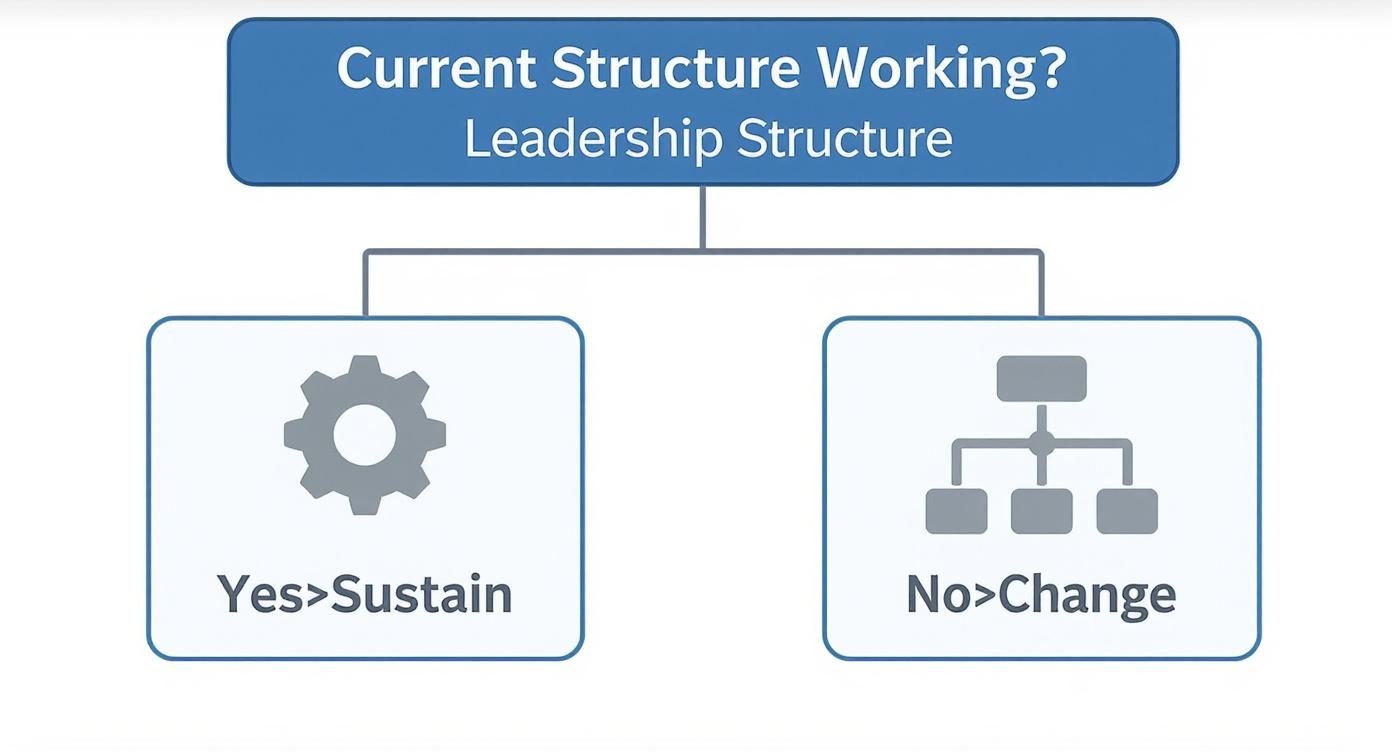
This really gets to the heart of it. The first question every leadership team must wrestle with is this: is our current model bearing good fruit, or is it creating friction? The answer tells you whether to focus on sustaining what's healthy or to begin the hard work of change.
Key Questions for Your Context
To figure out the best fit, your leadership team has to be brutally honest about your specific situation. A one-size-fits-all approach almost never works because every congregation has its own personality, history, and calling.
Here are a few diagnostic questions to get the conversation started:
Church Size and Complexity: Are you a small, tight-knit church plant or a large organization with multiple staff members? A simple Elder-Led model can be perfect for a small church, but it could easily become a bottleneck in a larger one that might need the high-level clarity of a Policy Governance board.
Congregational Culture: Does your congregation value having a direct vote and a democratic process, or are they more comfortable delegating governance to trusted, qualified leaders? Your structure has to honor the cultural DNA of your people.
Mission and Vision: What are you ultimately trying to do? A church focused on rapid church planting might need a more agile, nimble structure than one focused on maintaining a historic, steady presence in its community.
Denominational Ties: Are you part of a denomination that already prescribes a specific polity? If so, your job is to learn that model inside and out and execute it with excellence.
Selecting a governance model isn't just an administrative task; it's a spiritual discernment process. The goal is to choose a structure that releases ministry, not one that restricts what God has called your church to do.
For independent churches, this freedom is a gift, but it also demands incredible wisdom. It means you'll have to carefully weigh the benefits of empowering the congregation against the need for decisive, clear leadership. To see what a well-defined governance framework looks like in practice, The Bible Seminary’s board handbook is an excellent resource detailing the kind of responsibilities and clarity a board needs to navigate.
Ultimately, the best church leadership structure models are the ones that are biblically faithful, contextually appropriate, and missionally effective. They're the ones that create clarity, build trust, and empower both leaders and members to serve God’s kingdom together.
A Few Common Questions About Church Governance
Figuring out the right leadership structure often sparks some tough but necessary questions. It’s a constant balancing act between deep theological convictions and the practical, day-to-day realities of ministry. Let’s tackle some of the most common questions that come up.
What Does the Bible Say About Church Structure?
This is the big one, isn't it? The truth is, the Bible doesn’t hand us a one-size-fits-all organizational chart. What it does give us are foundational principles and clear descriptions of leadership roles like elders, deacons, and overseers. This is precisely why different denominations land in different places—they're each building on specific scriptural precedents.
For instance, churches that embrace a Presbyterian model will point to the clear mentions of plural eldership in passages like Acts 14:23 and Titus 1:5. On the other hand, those who feel called to a Congregational model find strong support in the "priesthood of all believers" (1 Peter 2:9) and moments where the entire church community participated in key decisions, like selecting leaders in Acts 6. The goal isn't to find a single perfect blueprint, but to build a structure that’s faithful to biblical principles of servant leadership, accountability, and good order.
How Can a Church Change Its Governance Model?
Shifting a church's governance is a massive undertaking, and it requires far more than a simple vote. You're not just tweaking a flowchart; you're initiating a cultural shift that needs prayerful consideration and broad support from the congregation.
The journey usually unfolds in stages:
Prayer and Assessment: The leadership team has to start by prayerfully and honestly asking why the current structure isn't working anymore. What’s holding the church back from its mission?
Education: Leaders must first educate themselves on the biblical and practical reasons for a new model. Only then can they begin to teach and share that vision with the entire congregation.
Communication: This is critical. You have to build trust. Holding town halls, Q&A sessions, and small group discussions creates space for people to ask questions and voice concerns openly.
Formal Adoption: Finally, the change has to be officially adopted by amending the church’s constitution and bylaws, following whatever procedures are already in place.
Shifting a church's governance structure is a journey of discernment, not just a destination on an organizational chart. It requires patience, humility, and a deep commitment to the church's long-term health over short-term comfort.
How Should Disagreements Within Leadership Be Handled?
Conflict is just a part of life and ministry. A healthy governance model doesn't pretend disagreements won't happen; instead, it provides a clear, biblical process for handling them. The "how" often depends on the structure itself.
In an Episcopal system, a bishop might be called in to mediate or make a final decision. In a Presbyterian church, a tough local issue that can't be resolved could be appealed to the regional presbytery, which offers a layer of external accountability.
For autonomous churches, like most Congregational or Elder-Led models, the process is handled internally. Healthy elder boards lean heavily on their established bylaws and a commitment to mutual submission, just as Scripture calls for in places like Ephesians 5:21. The ultimate aim is always to pursue unity and reconciliation, prioritizing godly wisdom over anyone's personal preference.
At The Bible Seminary, we equip ministry leaders with the theological depth and practical wisdom needed to build healthy, effective churches. Our graduate programs provide a rigorous, Bible-centered education to help you lead with conviction and clarity. Learn more about our degree programs and how we can prepare you for faithful ministry.