
How to Study the Bible Effectively and Deepen Faith

Studying the Bible is more than just an academic exercise or a box to check on your to-do list; it’s about preparing your heart and mind for a genuine encounter. To really get the most out of it, you need a plan. That means creating a consistent routine, finding a good spot, and choosing a Bible translation that actually works for what you’re trying to do.
You'd be surprised what a difference even 15 minutes of focused daily study can make. It’s far more impactful than trying to cram in a long, infrequent session.
Preparing Your Heart and Mind for Study
Before you even crack open your Bible, your approach can make or break the experience. A lot of people want to learn how to study Scripture effectively but skip over the simple, crucial steps that get your head and heart in the right space.
True understanding doesn't start with complex theological tools—it begins with being intentional and ready to listen. This initial prep work is the foundation for everything else. Without it, even the most advanced techniques can feel empty or like you’re just going through the motions. The goal here is to shift from being a passive reader to an active participant in a conversation.
Creating a Sustainable Study Habit
When it comes to Bible study, consistency is everything. It’s so much better to commit to a short, daily practice than to attempt marathon sessions that just lead to burnout. Think of it like working out: a daily 15-minute walk does more for your long-term health than one grueling gym session a month.
To build this kind of rhythm, try a few practical things:
Schedule It: Just like you would a meeting, block out a recurring time in your calendar. Maybe it’s with your morning coffee, on your lunch break, or right before bed. Make it an appointment.
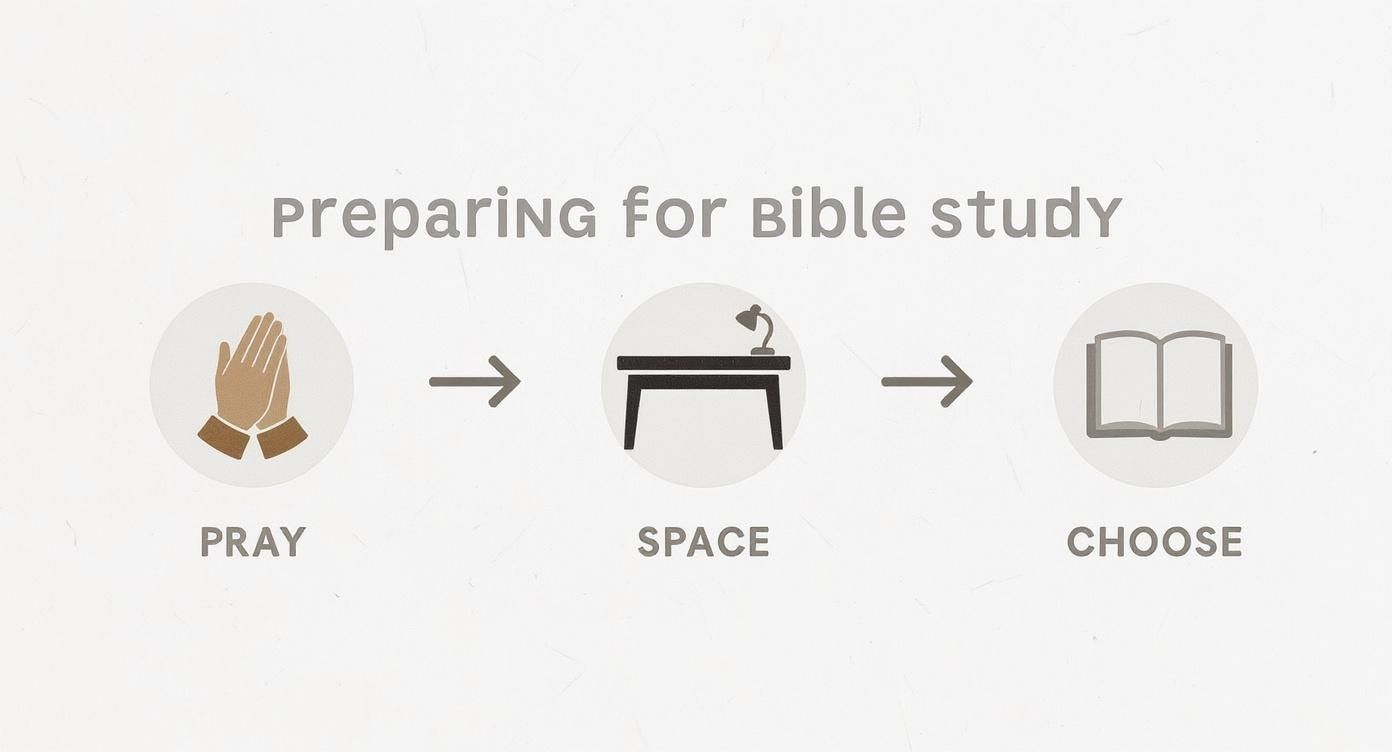
Find Your Spot: Designate a place in your home that’s as free from distractions as possible. A comfortable chair, a clear desk, or even a quiet corner can signal to your brain that it’s time to focus.
Start with Prayer: Before you start reading, just take a moment to pray. Ask for guidance, an open heart, and a clear mind. This simple act changes your posture from a student analyzing a text to a participant in a sacred conversation.
The aim isn't perfection, it's persistence. If you miss a day, don't sweat it. Just pick it back up the next. The habit itself is what creates the fertile ground for growth.
And this commitment to regular study is catching on. Recent data shows that weekly Bible reading among U.S. adults has climbed back up to 42%. What’s really interesting is that this trend is even stronger among younger generations, with nearly half of Millennials and Gen Z digging into Scripture every week. You can see more of these Bible reading trends on Barna.com.
Choosing the Right Bible Translation
Walking into a bookstore and seeing a whole wall of Bible translations can feel overwhelming, but it gets a lot simpler once you understand the basic approaches. Generally, translations fall somewhere on a spectrum from "word-for-word" to "thought-for-thought."
Neither approach is automatically better; they just serve different purposes. A more literal translation is fantastic for deep, analytical study where every word counts. A more dynamic one is often better for devotional reading or just getting the big-picture narrative. Many of us who have been studying for years use both side-by-side to get the fullest possible picture.
To help you sort through the options, here’s a quick breakdown:
Choosing Your Bible Translation
Translation Type | Examples | Best For |
|---|---|---|
Word-for-Word | New American Standard Bible (NASB), English Standard Version (ESV), King James Version (KJV) | Deep exegetical study, original language analysis, and precise theological work. |
Thought-for-Thought | New International Version (NIV), New Living Translation (NLT) | Devotional reading, small group discussion, and understanding the overall story flow. |
Paraphrase | The Message (MSG), The Living Bible (TLB) | Reading for narrative impact and fresh perspective, but not recommended for primary study. |
Ultimately, the "best" translation is the one that you will actually read and that serves your specific purpose for that moment of study. Don't be afraid to have a couple of different versions on your shelf.
A Practical Framework for Understanding Scripture
Ever feel like you're reading the Bible but not quite getting it? It happens. Moving from just reading the words on the page to genuinely understanding them requires a solid approach. Without a reliable method, it’s easy to get lost or, worse, misunderstand what God is trying to say.
A proven framework can make all the difference, guiding your study so you're not just taking in information but having a real conversation with the text. The one we teach and trust breaks down into three interconnected stages: Observation, Interpretation, and Application. This isn't just a formula; it's a repeatable process that builds your confidence and helps you dig into the Word in a way that truly changes you.
The Art of Careful Observation
First things first, you have to slow down and simply see what’s there. This is Observation. It’s all about answering one simple question: "What does the passage actually say?" It sounds basic, I know, but you’d be surprised how many people jump straight to looking for personal meaning and miss what the text is communicating on its own terms.
To get good at observation, try reading a passage several times, each time with a different focus. Ask yourself pointed questions like:
Who are the people involved? Who is speaking, and who is being spoken to?
Where and when is this happening? What’s the setting—the place, the time, the culture?
What words, ideas, or phrases are repeated? Authors repeat things for a reason. It’s their way of flagging what’s most important.
How is this written? Is it a story, a poem, a letter, or prophecy? The genre shapes how we read it.
Think of yourself as a detective arriving at a crime scene. You wouldn't immediately decide who did it. You’d meticulously gather every single piece of evidence first. That's what observation is all about—gathering the facts from the text before drawing any conclusions.
This initial preparation, both in your heart and in your study space, is key to being able to focus and observe well.
Discovering the Original Meaning Through Interpretation
Once you’ve gathered all your evidence, you can move on to Interpretation. Now, the question changes to, "What did this mean to the people who first heard it?" This step is absolutely crucial. While the Bible was written for us, it wasn’t written directly to us. Every book was addressed to real people living in specific times and places.
Understanding the original context isn't just an academic exercise; it's the bridge to responsible application. It prevents us from imposing our modern ideas onto the ancient text.
Interpretation is where you start connecting the dots from your observation. For instance, you might have observed that Paul uses the word "flesh" over and over in his letter to the Galatians. Interpretation pushes you to find out what "flesh" meant in his Jewish and Greco-Roman world, which is a bit different from our modern usage. Getting these foundational principles right is a big deal, and we cover it more in our guide on how to read the Bible for all it's worth.
Bridging the Gap with Application
Finally, we arrive at Application. This is where the rubber meets the road. The question becomes, "How does this timeless truth change my life, right here, right now?" This is the goal, of course, but trying to apply Scripture without the hard work of observation and interpretation first is a recipe for disaster. It leads to pulling verses out of context to fit what we already believe.
But after you’ve done the foundational work, you’re ready to ask some deeply personal questions:
Does this passage reveal something about God’s character I need to trust or worship?
Is there a command I need to obey? An example to follow or to avoid?
Does it expose a sin in my heart that I need to confess and turn away from?
How can this truth reshape my thoughts, my words, or my actions this week?
Take the Parable of the Good Samaritan. After observing the details and interpreting what it meant in Jesus' context, application isn't just "knowing the story." It's asking, "Who is the 'neighbor' in my life that I’ve been ignoring?" and then doing something about it. This three-part rhythm—Observe, Interpret, Apply—is a trustworthy guide for engaging Scripture in a way that is both intellectually honest and spiritually transformative.
Going Deeper with Advanced Study Techniques
Once you’ve built a solid routine of observation, interpretation, and application, you’re ready to start uncovering even richer layers of meaning. This is the point where you shift from understanding individual passages to seeing how the entire biblical narrative weaves together.
These advanced techniques aren't about becoming an academic overnight; they are practical tools that can genuinely deepen your theological grasp and strengthen your personal faith. Moving into more advanced study can feel a bit overwhelming, but learning effective strategies for reading complex texts—much like a scholar tackles a scientific paper—can make a huge difference in your understanding.
Let's explore a few powerful ways to dig deeper.
Tracing Themes Across Scripture
Think of a thematic study as following a single, colorful thread through the grand tapestry of the Bible. Instead of camping out in one book or chapter, you pick a concept—like 'grace,' 'redemption,' 'covenant,' or 'justice'—and trace its path from Genesis to Revelation.
This approach is fantastic for showing how God progressively reveals key aspects of His character and His plan over time.
For instance, a study on 'covenant' would start with God’s promise to Noah, move to the covenant with Abraham, explore the Mosaic Law, and ultimately land on the New Covenant established through Jesus. When you connect those moments, you see a magnificent, unified story unfold.
To get started, use a concordance or a digital Bible app to find every mention of your chosen theme. As you go through each passage, ask yourself a few questions:
How is this theme presented in this specific context?
Does its meaning evolve or deepen from the Old Testament to the New Testament?
What does this theme reveal about God's nature and His relationship with humanity?
This method helps you build a robust, biblically-grounded understanding of major theological concepts, protecting you from forming ideas based on just a handful of isolated verses.
Unpacking Key Words and Phrases
Have you ever read a familiar word in the Bible and wondered if it meant something more to its original audience? A word study lets you explore the punch packed into key terms in their original Greek or Hebrew, and you don’t need to be a language scholar to do it.
Many free online tools, like the Blue Letter Bible or Bible Gateway, give you access to Strong's Concordance. This amazing resource assigns a unique number to every word in the original text, allowing you to see its definition, how it's used elsewhere in Scripture, and its subtle nuances.
Take the Greek word doulos, often translated as "servant." A quick word study reveals it more accurately means "bond-servant" or "slave"—a person wholly owned by and devoted to their master. When the Apostle Paul calls himself a doulos of Christ, this deeper meaning adds a powerful layer of understanding to his identity. It wasn't a job; it was total allegiance.
A word study isn't about finding secret meanings. It's about recovering the full weight and color of the words the biblical authors carefully chose, bringing a new level of clarity to the text.
Using Commentaries and Dictionaries Wisely
As you go deeper, reference tools like Bible commentaries and theological dictionaries become incredible assets. A commentary offers verse-by-verse insights from scholars who have dedicated their lives to studying a particular book. A good theological dictionary can unpack complex concepts like 'atonement' or 'sanctification' in great detail.
The key, however, is to use these resources as guides, not crutches. They should supplement your study, not replace it.
Here’s a practical way to use them well:
Do Your Own Work First. Always go through the process of observation and interpretation on your own before you crack open a commentary.
Consult for Clarity. If you get stuck on a confusing passage or an obscure historical detail, turn to a trusted commentary to see how others have wrestled with it.
Gain Broader Perspective. Use these tools to check your own conclusions and see perspectives you might not have considered.
Think of commentaries as conversations with wise mentors who have walked this path before you. By engaging with their insights after you’ve engaged with the text yourself, you can refine your understanding and continue to grow in your ability to study the Bible.
Building Your Personal Bible Study Toolkit
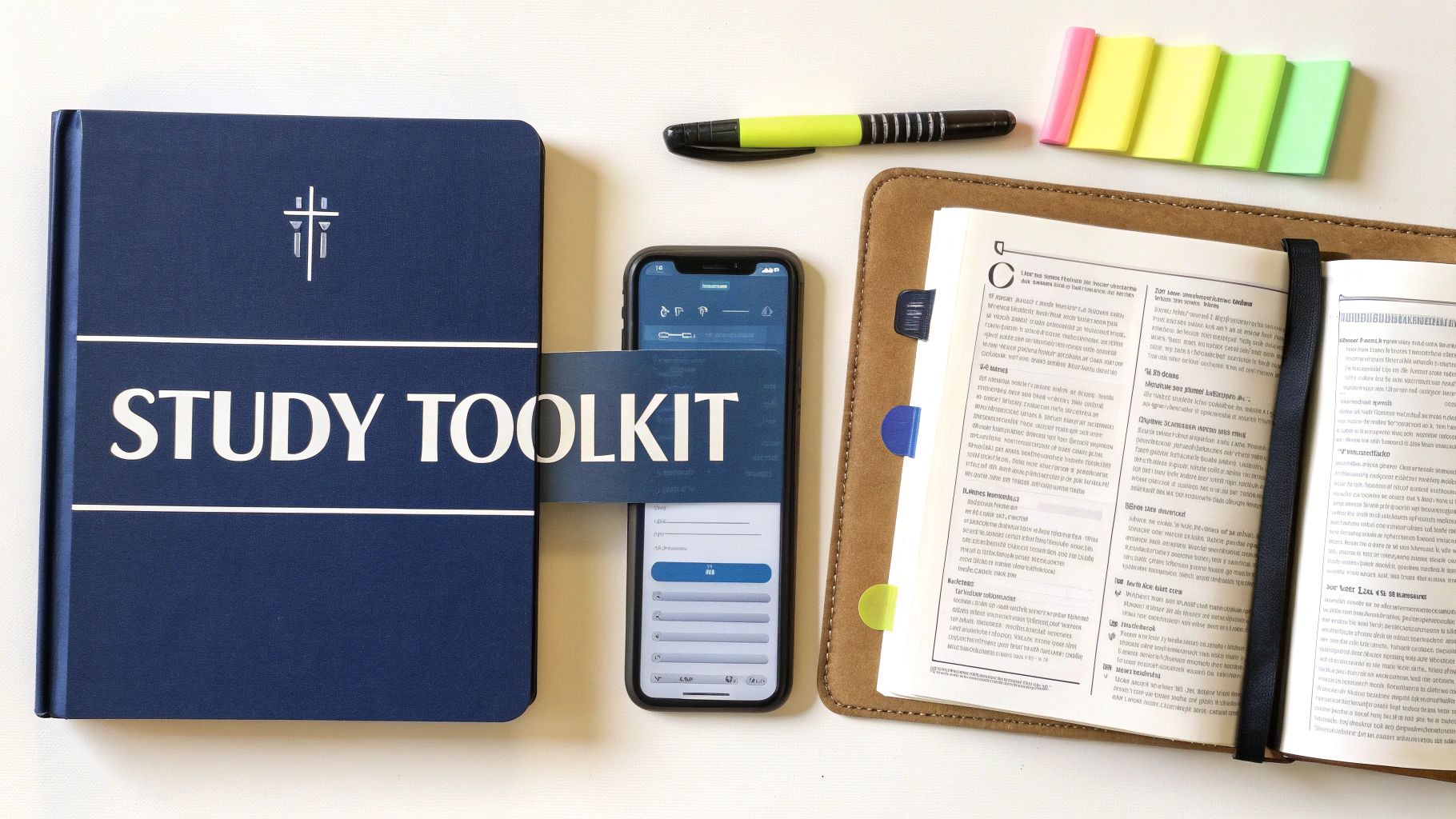
While your heart and mind are the most important instruments for study, the right tools can make all the difference. They can untangle complex passages and breathe life into the biblical world. Putting together your personal toolkit doesn't require a huge budget; it’s about strategically picking resources that fit your learning style and goals. Just a few well-chosen aids can make your time in the Word more focused, insightful, and frankly, more productive.
Think of these tools as skilled guides on your journey. A good study Bible can offer immediate historical context right at your fingertips, while a digital app can help you perform a quick word study in seconds. The goal is to find a balance that supports your personal discovery without overwhelming you or—and this is key—replacing your direct engagement with Scripture.
The Indispensable Study Bible
If you invest in only one physical resource, make it a high-quality study Bible. This isn't just a Bible with wide margins for notes. A true study Bible is a comprehensive reference library in a single volume, packed with supplemental materials written by scholars to illuminate the text.
Here are the key features you'll want to look for:
Book Introductions: These are gold. Before you even start reading, they provide crucial context on the author, date, audience, and major themes of each book.
In-Depth Footnotes: Verse-by-verse notes explain difficult phrases, clarify cultural practices you'd otherwise miss, and highlight theological significance.
Cross-References: This system is powerful. It links verses across the entire Bible, helping you trace themes and see how Scripture interprets itself.
Concordances and Maps: A good concordance lets you find every occurrence of a specific word, while detailed maps bring the geography of biblical events into sharp focus.
Learning to use these features is a skill in itself. For example, before diving into a prophet like Jeremiah, spend ten minutes on the book's introduction. Understanding the political turmoil he was addressing can transform your reading from a collection of warnings into a powerful, coherent message.
Navigating Digital Bible Study Tools
Today’s technology offers an incredible array of powerful Bible study resources, many of them completely free. These tools can perform tasks that once required a shelf full of heavy, expensive books, making deep study more accessible than ever before. The key is knowing which tool to use for which task.
Here’s a quick look at some of the most popular digital options:
Tool | Primary Use | Best For |
|---|---|---|
YouVersion Bible App | Daily reading & devotionals | Building a consistent reading habit with its numerous plans and user-friendly interface. |
Blue Letter Bible | Word studies & commentaries | Quickly accessing original Greek and Hebrew meanings with its interlinear tools and Strong's Concordance. |
Logos Bible Software | In-depth academic research | Serious students and ministry leaders who want a powerful, integrated library for exegesis and sermon prep. |
The accessibility of these resources is a modern marvel. In the past, translating the Bible was a painstaking, lifetime endeavor for one person. Now, technology allows a single translator to produce a New Testament in five languages in a fraction of that time, dramatically expanding global access to Scripture and study aids. You can discover more insights about the Bible's global impact on TheBibleChat.com.
Your toolkit should serve your study, not complicate it. Start with one or two key resources—like a good study Bible and a versatile app—and learn them well before adding more.
Building your toolkit is an ongoing process. As your knowledge grows, you might find yourself exploring different resources to answer new questions. You can explore our guide on 10 essential Bible study topics for adults to get ideas for your next deep dive. Ultimately, the best tools are the ones you’ll actually use—the ones that consistently draw you deeper into the Word.
The Unique Power of Studying in Community
While so much of our spiritual growth happens in the quiet moments alone with God's Word, something irreplaceable happens when we study alongside other believers. Learning the Bible in community isn't just a nice social activity; it’s a biblical model for growth that sharpens our understanding in ways we just can't get to on our own.
Studying together provides accountability, sure, but it also brings encouragement and a rich diversity of perspectives. This is where our own assumptions get gently challenged and our blind spots are revealed. It’s one thing to read a passage by yourself; it’s another thing entirely to hear how that same text landed with someone from a different background, life stage, or culture. Their insights can flip a switch, illuminating the text in a completely new light.
Finding and Nurturing a Healthy Study Group
The goal is to find a group that's truly committed to discovery, not just a club for reinforcing what everyone already thinks. A healthy group dynamic is built on mutual respect, active listening, and a shared hunger to understand the text faithfully. As you look for a group, keep an eye out for a few key things:
A Shared Goal: Is the main point to understand Scripture better, or is it purely social? You need a good balance, but the gravitational pull should always be toward the text itself.
Humble Leadership: A great facilitator guides the conversation with thoughtful questions rather than just lecturing. Their job is to create space for everyone to contribute, not to dominate the discussion.
Commitment to the Text: The conversation should always circle back to the passage. The primary question isn't, "What does this mean to me?" but rather, "What is the text actually saying?"
Engaging in group Bible study significantly boosts comprehension and retention. It moves learning from a private, internal process to a dynamic, shared experience where insights build on one another, creating a richer understanding for everyone involved.
The power of this dynamic isn't just anecdotal. Research shows that Christians who study the Bible in groups are 40% more likely to report a deeper understanding of Scripture than those who only study alone. It's a widespread practice for a reason—globally, over 60% of Christians in some regions participate in group study. You can read the full research about community-based learning for a deeper dive.
Navigating Discussions and Disagreements
Sooner or later, disagreements will pop up. That’s not a bad thing! When handled with grace, differing interpretations can push everyone in the group to look more closely at the text and re-examine their own conclusions. The goal isn't about winning an argument; it's about pursuing truth together.
Let’s take a real-world scenario. Imagine your group is studying James 2. One person might argue that our works are the basis of salvation, while another insists it's by faith alone. Instead of devolving into a debate, a healthy group would shift into investigation mode, asking clarifying questions:
How does James's point here connect to what Paul says in Romans?
What exactly does the word "faith" mean in this specific context?
How do the surrounding verses shape our understanding of this tricky passage?
This approach transforms a potential conflict into a productive, collaborative exploration of Scripture. By fostering an environment of curiosity and respect, you create a space where everyone feels safe to share, question, and ultimately, grow together in their knowledge of God.
Common Questions About Studying the Bible
Even the most seasoned Bible student hits a wall sometimes. It’s inevitable. Questions will pop up, your motivation might take a nosedive, and some passages can feel downright impossible to understand. Trust me, that’s a completely normal part of the journey.
Knowing how to push through these common hurdles is the key to building a study habit that actually lasts and bears fruit. Let’s tackle some of the most frequent questions we hear and offer some real, practical advice to help you press on.
How Do I Stay Consistent When My Schedule Is So Busy?
This is probably the biggest one we hear. The biggest mistake people make is thinking they need these huge, uninterrupted blocks of time to study. That’s just not realistic for most of us.
Here’s the truth: consistency beats duration every single time. A focused 15-minute study every day will do more for you spiritually than a two-hour cram session once a month.
Find a small, doable slot in your day and guard it. Maybe it's over your morning coffee, on your lunch break, or right before you turn out the lights. Using a reading plan or a Bible app with reminders can be a huge help in cementing that new habit.
The goal here is a sustainable rhythm, not flawless perfection. If you miss a day, don't let guilt get the best of you. Just pick it back up the next day. No judgment.
This approach builds incredible momentum. Over time, that small daily investment compounds into a deep, rich, and lasting understanding of God's Word.
What Should I Do When I Read a Passage I Don't Understand?
First, take a breath. You're in good company—this happens to everyone, from brand-new believers to seminary professors. An obscure passage isn't a stop sign; it's an invitation to dig a little deeper.
Here are a few practical things you can do right away:
Try a different translation. Sometimes just reading the passage in a more dynamic, "thought-for-thought" translation like the NIV or NLT is all it takes for the lightbulb to go on. A fresh wording can make all the difference.
Examine the context. Don't just stare at the one confusing verse. Zoom out. Read the paragraph before it and the one after it. What’s the bigger picture of the chapter? The immediate context often holds the key.
Consult your toolkit. This is the perfect moment to crack open a good study Bible and read the footnotes for that passage. Or, look up the verse on a trusted online commentary or Bible dictionary.
And you know what? Sometimes the best move is to just write down your question and keep moving. It's amazing how often the Holy Spirit brings clarity later as you continue to read other parts of the Bible.
Is There a Right Way to Interpret a Passage?
While Scripture can apply to our lives in countless ways, sound interpretation isn’t a free-for-all. Our goal should always be to understand what the original author intended to communicate to their original audience. That principle is the bedrock of solid Bible study.
This means we have to ground our interpretation in the historical, cultural, and literary context of the text, not just in our modern assumptions or how a verse makes us feel. A "wrong" interpretation is usually one that:
Completely ignores the surrounding context.
Flat-out contradicts other clear teachings in Scripture.
Gets twisted to justify behavior the Bible clearly condemns.
Using a reliable study method like Observation, Interpretation, and Application is your best defense against veering off course. It keeps you tethered to the text itself. For anyone wanting to really sharpen these skills, exploring if Bible seminary courses can help you understand your faith better is a fantastic next step. Formal training gives you the tools to handle God's Word with greater confidence and accuracy.

