
What Is Church History? a Guide to Its Periods and Value

If church history is mainly a story of European councils and reformers, where do the churches of Africa, Asia, and Latin America belong? That question reveals why learning names and dates, though useful, isn't enough. For someone considering biblical education, understanding the church's past means learning to connect Christian beliefs, ordinary believers, and changing communities across the world.
Table of Contents
What Church History Means in Plain Terms - A Council as a Worked Example
The Major Periods and Their Defining Themes - Reading the Periods Without Building Walls
How Historians Read the Church's Past - From an Old Document to a Defensible Claim - Testing Turning Points
Why Church History Is a Global Story - What the Shift Means for Learning
Why Church History Matters for Ministry Today - Teach With Greater Precision - Understand Belonging Without Easy Explanations
Choosing Your Next Step in Church History Study - Match the Study to the Responsibility
What Church History Means in Plain Terms
Church history is the study of Christianity's development from the first-century apostolic movement to today's worldwide, diverse Christian community. It examines what Christians believed, how they worshiped, how they organized their communities, and how they responded to the societies around them.
Think of the church as a river. Church history maps its channels, floods, and changes of course, not only its springs. Studying its beginnings matters, but so does understanding how communities carried Christian teaching into new languages and settings.
A Council as a Worked Example
The First Council of Nicaea, convened in 325 CE by Roman Emperor Constantine I at Nicaea, in present-day Iznik, Turkey, is recognized as the first ecumenical council intended to address the church as a whole, according to Encyclopaedia Britannica. It confronted Arianism, which treated Christ as a created being rather than fully divine, and affirmed through the term homoousios that Christ is of the same substance as the Father.
A beginner might see only an unfamiliar theological word. A historian asks why that word mattered, how participants interpreted Scripture, what role imperial authority played, and how regional disagreements affected the discussion.
Church history asks both what Christians confessed and how they arrived at that confession.
The council didn't settle every later dispute. Its importance includes the pattern of addressing questions of doctrine, authority, and unity through representative councils.
That makes church history broader than institutional biography, but it doesn't make the subject shapeless. You can approach it through concrete questions:
Read the periods: Locate a person or controversy within a broader historical setting.
Check the sources: Ask how we know what happened and whose perspective survives.
Identify ministry connections: Explore why a turning point matters for teaching, worship, or leadership today.
The Major Periods and Their Defining Themes
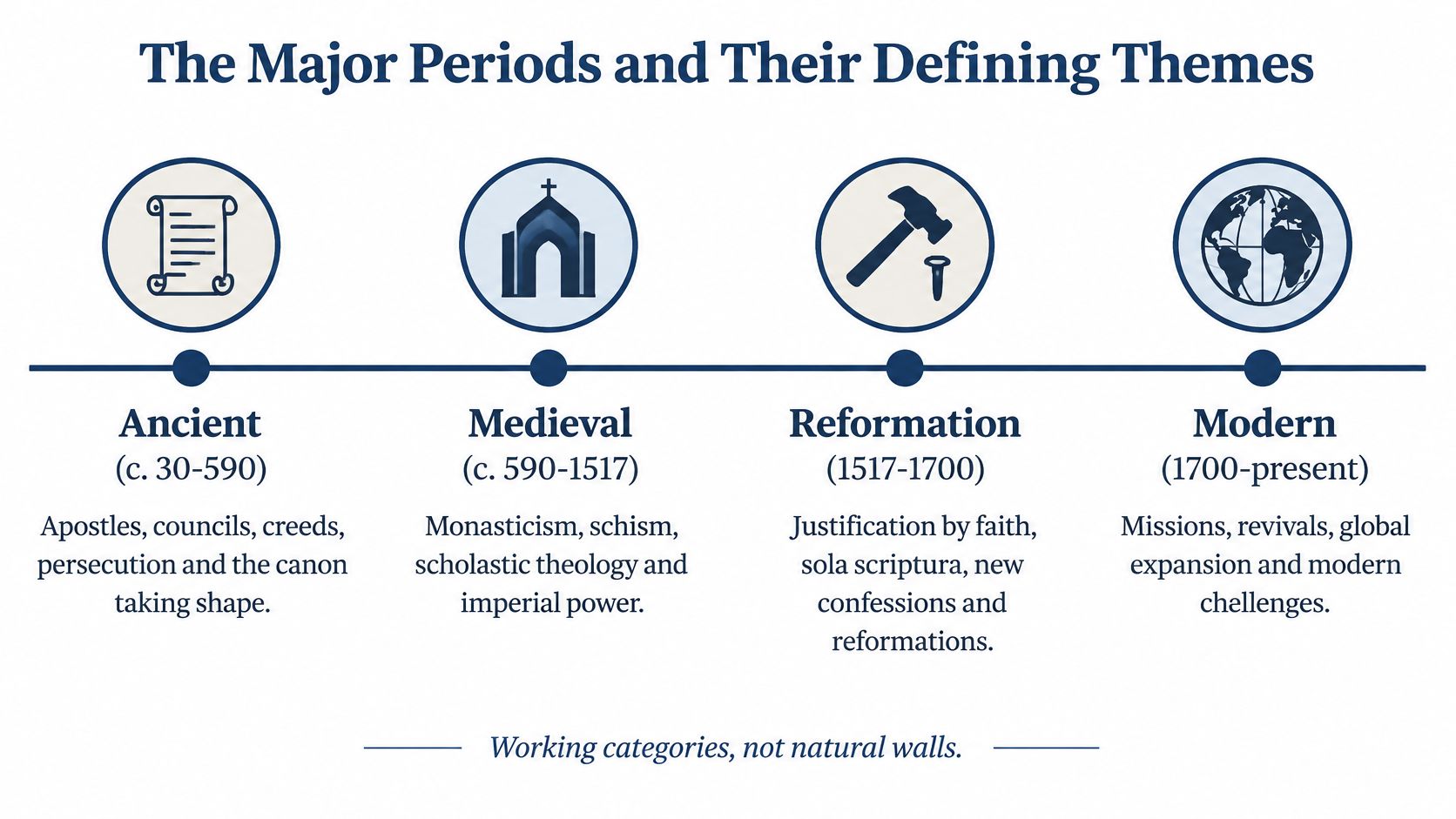
The major periods of church history provide a working map, not a set of sealed compartments. The table identifies recurring themes without suggesting that every Christian community experienced the same transitions at the same time.
Major periods of church history
Period | Defining Events | Dominant Theme |
|---|---|---|
Ancient church | Apostolic witness, Nicaea (325), Constantinople (381) | Doctrine and canon take shape |
Medieval church | Church and empire, monastic and papal development, Great Schism (1054) | Institutional authority and learning |
Reformation era | Luther's reforming challenge, the Council of Trent, and new confessional traditions | Confessional division and renewal |
Modern church | Revival and mission movements, Enlightenment critique | Expansion, mission and critical scholarship |
Global church | Rapid growth in Africa, Asia and Latin America | Worldwide, diverse centers of Christianity |
The timeline offers another way to visualize these transitions.
Reading the Periods Without Building Walls
The ancient church introduces the apostolic witness, persecution, and the development of shared doctrinal language. Questions about Christ's identity and the recognition of authoritative writings belong here, but their consequences extend throughout Christian history.
The medieval church brings relationships among church leaders, rulers, monasteries, and centers of learning into focus. Don't reduce this period to a gap between the apostles and the reformers. Study how Christians understood authority, preserved learning, and ordered communal life.
The Reformation era emphasizes disagreements over authority, salvation, worship, and practice. Reforming movements produced distinct confessional traditions, while Roman Catholic leaders pursued reform within their own institutions. Calling the period renewal, rupture, or both already involves interpretation.
The modern church draws attention to revival, mission, and critical engagement with Christian claims. The global church category changes the geographical emphasis rather than naming a completely separate era. Christians outside Europe weren't absent earlier; this category helps readers notice communities that a Western-centered outline can marginalize.
Reading principle: A period label tells you where to begin asking questions. It doesn't tell you whose interpretation to accept.
Eastern Orthodox, Roman Catholic, and Protestant accounts frame the Great Schism and the Reformation differently. Their accounts may agree that a division occurred while disagreeing about its causes, responsibilities, and theological meaning.
Choose the period closest to your interest, then widen the frame. If you're studying a confession, investigate its political setting; if you're studying a mission movement, include the people who received, translated, and taught its message.
How Historians Read the Church's Past
Primary sources come from the people or institutions being studied. They include creeds, conciliar decisions, liturgical texts, letters, inscriptions, manuscripts, archaeological remains, and administrative records. Secondary sources interpret that evidence later.
Historical study involves more than finding an old document. The distinction between theological developments, historical settings, and broad eras is a useful starting point in Ligonier Ministries' general church history guide. Responsible reading then requires examining how a source was produced and what kind of claim it can support.
From an Old Document to a Defensible Claim
Suppose a bishop's letter describes how a congregation should conduct worship. That letter gives evidence of the bishop's expectations, but it doesn't automatically establish what every congregation did. An instruction against a practice may even suggest that some people continued doing it.
Check the source's date, provenance, genre, transmission history, and rhetorical purpose. In plain terms, ask when and where it originated, what kind of writing it is, how it reached us, and what its author wanted readers to think or do.
Then triangulate. Compare the letter with independent testimony, surviving worship texts, administrative records, or material evidence where available.
A rule about behavior is evidence of what someone prescribed, not proof that everyone obeyed.
Archaeological remains require similar care. A building's layout may help answer questions about space and use, but it can't independently explain every belief held by the people who gathered there.
Testing Turning Points
At Nicaea, approximately 318 bishops traditionally attended, although historical accounts differ about the number; their creed affirmed Jesus Christ's full divinity, and its formulation became the basis for the Nicene Creed later expanded at Constantinople in 381, as Vatican News explains. A historian distinguishes the surviving doctrinal formulation from uncertain details about attendance and from the council's later reception.
The biblical canon offers another test. Christian scribes increasingly used the codex during the second and third centuries CE, while Jewish communities generally retained Scripture scrolls; communities gradually narrowed their authoritative lists using criteria that weren't identical everywhere, according to Bible Odyssey's account of biblical writing and transmission. This evidence doesn't support the popular shortcut that a single universally documented meeting selected the entire Bible.
The Reformation requires comparisons among confessions, sermons, correspondence, and institutional decisions. Ask what a reformer argued, how opponents described that argument, and whether local congregations adopted it in the same way. Don't treat a hostile summary as an adequate substitute for someone's own writing.
For each turning point, ask what question was answered and what remained open. This also helps distinguish historical theology from organizing doctrine by topic, a distinction explored in historical theology versus systematic theology.
Use this checklist when evaluating a historical claim:
Identify the author: Who produced the evidence, and for whom?
Locate the context: What controversy or practical need prompted it?
Separate claim from inference: What does the source establish?
Compare witnesses: Do independent sources support the interpretation?
State uncertainty: Which details remain disputed or undocumented?
Why Church History Is a Global Story
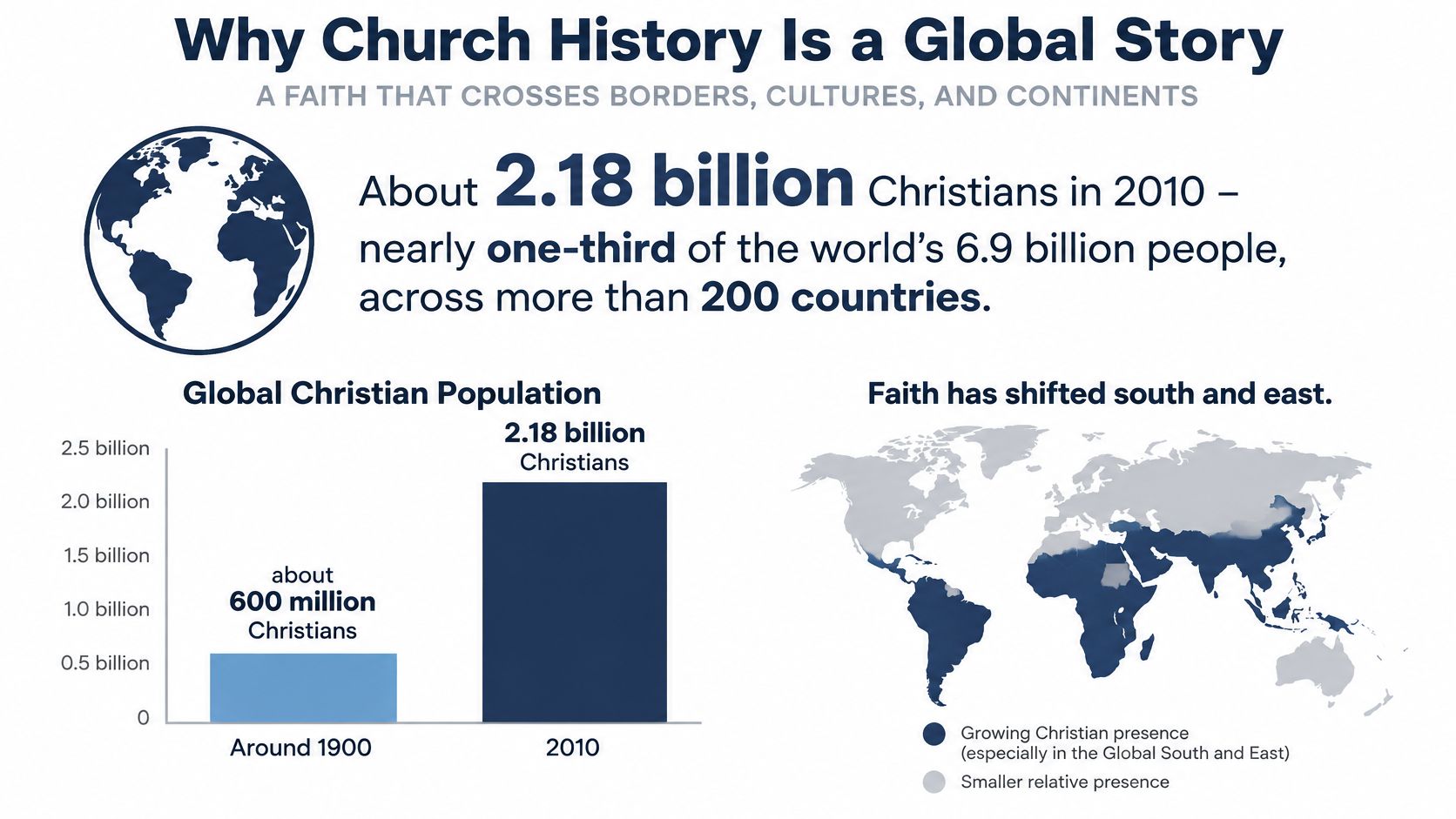
Christianity's geographical distribution has changed profoundly. Pew Research Center's account of Christian population change contrasts approximately 600 million Christians in 1910 with approximately 2.18 billion in 2010, when Christians represented nearly one-third of the world's 6.9 billion people across more than 200 countries.
The following comparison uses the historical estimates summarized by Pew; cells marked “Not specified” avoid supplying figures that those estimates don't establish.
Christianity's global shift, 1910 to 2020
Measure | 1910 | 2010 | 2020 |
|---|---|---|---|
Global Christians | About 600 million | About 2.18 billion | About 2.3 billion |
Share of world population that is Christian | Roughly one-third | About 31% | 29% |
Share of Christians living in Europe | About two-thirds | About 26% | 22% |
Christians as share of sub-Saharan Africa population | About 9% | About 63% | Not specified |
The historical estimate for Christianity's worldwide share is also discussed in the Journal of Mission and Evangelism's demographic overview, while Pew's global religious change report places Europe's share of the world's Christians at 22% in 2020, compared with 31% in sub-Saharan Africa.
The visual emphasizes the scale of worldwide expansion. For the historical comparison, use the table's baseline year.
What the Shift Means for Learning
Population growth and population share aren't the same measure. A religious community can increase in number while representing a smaller proportion of humanity when other populations grow faster.
Migration, mission activity, local leadership, translation, and cultural adaptation all belong in explaining these changes. Readers should ask who taught, organized congregations, translated texts, and developed leaders, rather than assuming that Christianity spread only through outside missionaries.
A worldwide account therefore includes African, Asian, Latin American, and Middle Eastern Christians as historical actors, not supplementary examples. Their worship, theological questions, and institutional experiences belong alongside the ancient Mediterranean and modern Europe.
Why Church History Matters for Ministry Today
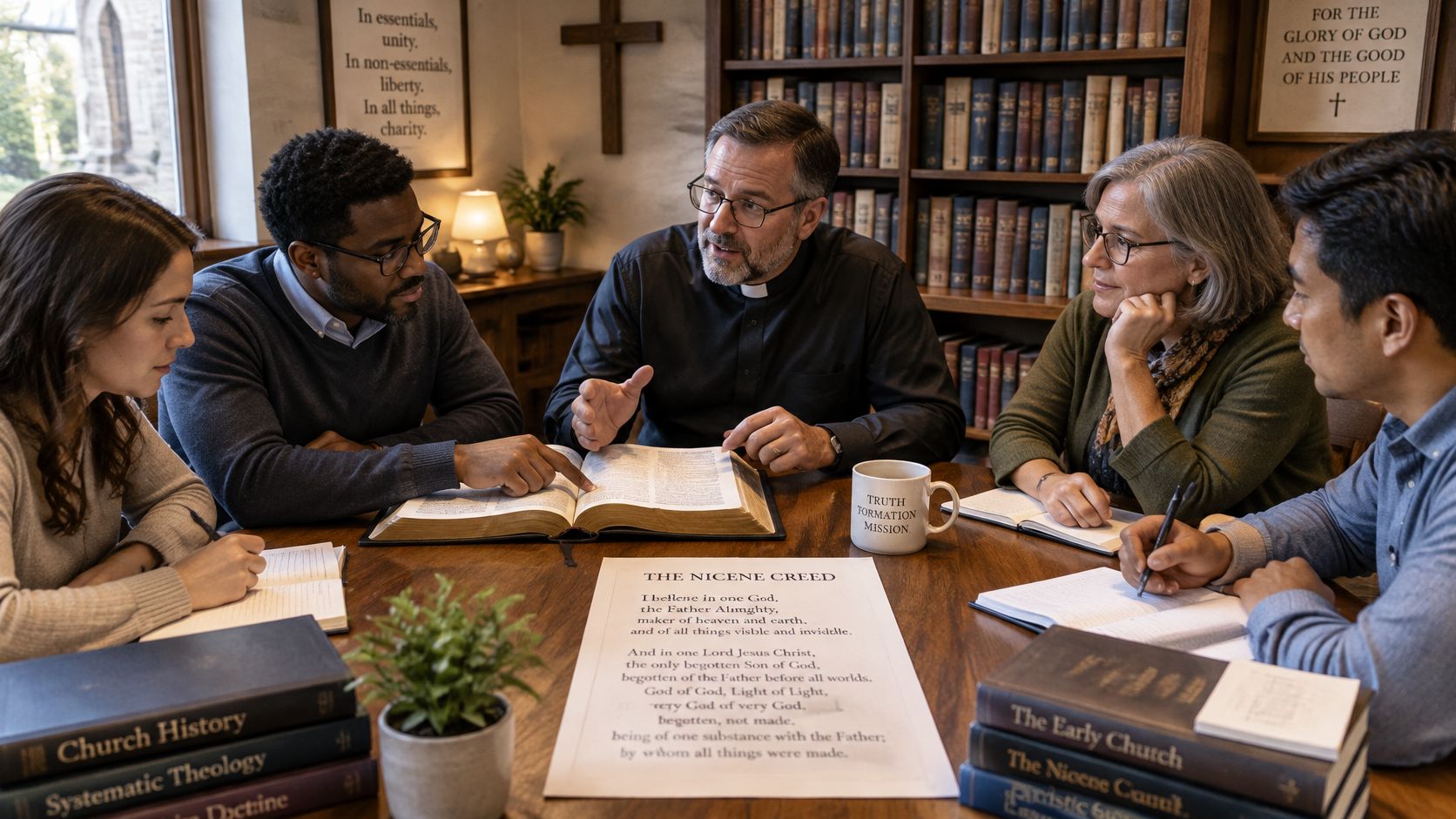
Church history helps ministry leaders teach carefully, interpret their surroundings, and respond to disagreement with perspective. Studying together can begin with a concrete text, such as a creed, rather than an abstract debate about tradition.
Teach With Greater Precision
First, historical knowledge improves explanations of doctrine. A teacher can distinguish the biblical passages Christians interpreted from the terminology they later used to express their conclusions. That prevents a lesson from confusing Scripture, a confession's wording, and a denomination's interpretation.
For example, when teaching about Christ's identity, identify the theological question before explaining the technical vocabulary. Students need to understand what a confession affirms, rather than memorize its terminology.
Understand Belonging Without Easy Explanations
Second, history gives context for present patterns of religious identity. Pew's 2025 study of 36 countries found that Christianity experienced some of the largest losses through religious switching, including net losses equivalent to at least 20 percentage points of the adult population in 11 surveyed countries, according to its international religious switching report. The report also found especially high retention in the Philippines, Hungary, and Nigeria, while 51% of South Koreans raised Christian still identified as Christian.
Those differences resist a single worldwide story of growth or decline. Historical experiences involving colonialism, state churches, revivals, migration, education, political conflict, and secularization provide questions to investigate, not automatic explanations for every individual decision.
Consider these questions alongside the video resource.
Third, historical study encourages proportion and humility. A congregation's familiar customs shouldn't automatically be treated as universal Christian practice. Leaders can examine how a practice developed before deciding whether to retain or change it.
Christians differ over the authority of tradition and its relationship to Scripture. Roman Catholic, Eastern Orthodox, and Protestant Christians don't resolve that relationship identically. At TBS, we affirm the Bible as the fully true Word of God and the Lordship of Christ; historical study serves careful biblical understanding rather than replacing biblical authority.
Fair interpretation means representing another tradition accurately while evaluating its claims. You don't have to erase disagreement to learn from Christians whose conclusions differ from your own.
Choosing Your Next Step in Church History Study
Choose your next step according to what you need to do with your learning. Personal curiosity, preparation to teach, and vocational ministry may call for different levels of structure. The best starting point is a clear learning question, not the largest possible reading list.
For personal study, select a period and pair an introductory history with a primary source. You might compare a creed with an explanation of the controversy behind it, or read a reformer's writing alongside a response from an opponent. Keep notes that separate the author's argument from your own assessment.
Match the Study to the Responsibility
If you teach regularly, choose a question that affects your congregation. Preparing a lesson about Christian unity, for example, calls for understanding both shared convictions and genuine disagreements. Write a short explanation suitable for your learners, then identify which claims still need checking.
For structured graduate study, our Certificate of Theological Studies provides 27 credit hours of graduate-level education for anyone serving in vocational or volunteer leadership. Consider how structured learning fits your responsibilities, available study time, and need for academic assessment.
Understand enrollment terminology before making a decision:
Credit study: Coursework earns academic credit within the requirements of a defined program.
Auditing: Attendance doesn't earn academic credit; confirm the applicable participation expectations.
Noncredit learning: Participation carries no academic credit and shouldn't be assumed to count toward a degree or certificate.
Compare current official descriptions rather than assuming that similarly named options have identical requirements. Confirm tuition, admissions requirements, delivery arrangements, and course availability before committing.
Decision test: Choose a learning path that helps you explain Scripture and Christian history more responsibly to the people you serve.
Bring a specific question to an admissions conversation: What preparation best fits your intended ministry responsibility? That gives the discussion a clearer purpose than asking which credential is most impressive.
The Bible Seminary offers Bible-centered graduate education that connects historical and theological study with ministry preparation. Visit The Bible Seminary to explore programs and request information about a study path suited to your interest in church history and your ministry responsibilities.