
7 Schools for Pastors: What to Compare First

What's the most expensive mistake you can make when choosing a school for pastors? Many assume it's picking the wrong school. The costlier error is answering the wrong question first. The right school is the one whose doctrine, degree structure, and delivery format fit the ministry you're preparing for, not the one with the best-known name on the diploma.
Five filters do the work in this list. Accreditation tells you whether the degree will be recognized where you plan to serve. Degree and credit-hour structure tells you how long the commitment runs and what it demands. Delivery format decides whether you can stay in your current ministry while you study. Denominational and doctrinal fit decides whether you'll be formed in a tradition you can serve for decades. Total cost covers tuition, fees, travel, intensives, and the income you give up.
The seven entries are ordered by the decision a candidate faces, not by reputation, starting with the cheapest ways to test a school, moving through broad ministry training, and ending with the most clearly confessional options. Every confessional claim below comes from the institution's own published material, credit hours appear only where the school publishes them, and Scripture is quoted in context with the translation named.
The goal is a shortlist of two or three schools worth contacting, not a ranking.
Table of Contents
1. The Bible Seminary - What you can test before you apply - The confessional benchmark, stated plainly - Where character outranks the transcript
3. Asbury Theological Seminary - The travel line in the budget
4. SMU Perkins School of Theology - The financial picture is better than most
5. Fuller Theological Seminary - Why global capacity shapes a local decision
7. The Southern Baptist Theological Seminary - What pastors say about the return
How the Seven Schools Compare on Location, Credit Load, and Delivery Format
1. The Bible Seminary
How much theological education should you commit to before deciding whether a seminary fits? The Bible Seminary in Katy, Texas, gives candidates several paths to consider, from a graduate-level certificate to a full Master of Divinity. It is an independent, non-denominational Christian institution incorporated in Texas in 2010.
The school offers nine graduate majors, with in-depth study of all 66 books of Scripture alongside historical, theological, and practical disciplines. The Certificate of Theological Studies is 27 credit hours for people serving in vocational or volunteer leadership. Dual Degree Completion pairs a Bachelor of Arts in Christian Studies with a TBS master's degree. The 84-credit-hour MDiv is a three-year program focused on all 66 books.
What you can test before you apply
If you want a smaller commitment first, ask whether auditing a course or attending an on-demand seminar fits your goals. The seminary offers both options, along with certificate programs. Use that conversation to establish which courses match your intended ministry and what the full degree would require.
The trade-off is clear: the MDiv represents a substantial time commitment, while the certificate offers graduate-level study with fewer credit hours. TBS also commits to graduating alumni with zero ($0) seminary debt. Ask admissions how that commitment applies to your circumstances and what costs to plan for.
The confessional benchmark, stated plainly
The seminary describes its education as Bible-centered and explicitly Christian. That focus makes it a candidate for ministry leaders seeking theological study grounded in Scripture. It is not a fit for someone seeking secular or interfaith religious studies.
Where character outranks the transcript
Pastoral formation extends beyond coursework. The pastoral qualifications in 1 Timothy 3 and Titus 1 include character, household stewardship, and the ability to teach. In the English Standard Version, 1 Timothy 3:2 calls an overseer “above reproach,” “self-controlled,” “hospitable,” and “able to teach”; Titus 1:9 emphasizes holding firmly to the trustworthy word (1 Timothy 3 and Titus 1, ESV). Formal study can sharpen teaching, but it does not replace those responsibilities.
TBS builds experiential education through classroom instruction, study tours, hands-on ministry training, and community-based training with ministry professionals. The 3J Museum offers visitors a journey through biblical history with nearly 200 artifacts, over 90% of them authentic, drawn from Khirbet el-Maqatir near Jerusalem. Ask how these experiences fit the program you are considering, and request a clear breakdown of tuition and fees before applying.
2. Denver Seminary
Denver suits candidates ready to commit to a full MDiv and who want room to focus their training. The program takes three to four years of full-time study. Consider that commitment against the ministry role you're pursuing, not as a credential you need to qualify as a pastor.
Its concentrations include biblical preaching, chaplaincy, spiritual formation, pastoral care and counseling, leadership, and theology. Denver Seminary's program pages describe on-campus, online, and hybrid options for relevant programs, along with other master's degrees, certificates, and auditing opportunities for some learners.
The National Survey of Religious Leaders, a nationally representative study of 1,600 clergy conducted in 2019 to 2020, found that 48% of pastors had earned a Master of Divinity or equivalent professional ministerial degree, while 38% of evangelical pastors held an MDiv. Those figures put the degree in perspective: graduate study is common in evangelical ministry, but it is not universal.
Three questions to put to admissions
Which format does your concentration use? Confirm the course sequence before planning a move or changing your work schedule.
What does auditing include? Ask how auditing differs from degree-seeking study, including which courses and requirements apply.
What is the full annual cost? Add housing and travel to tuition if you plan to study on campus.
Denver's trade-off is the time and money required for a full degree. That commitment may fit candidates pursuing chaplaincy or counseling, where focused preparation supports the intended role. If you are still testing a call, ask admissions whether a certificate offers a more suitable first step.
3. Asbury Theological Seminary
Asbury's 96-credit-hour MDiv is the longest on this list. The Association of Theological Schools standards define MDiv equivalency as 72 graduate semester hours across theology, biblical studies, and ministry, and state that ministry experience alone does not equal a master's degree. Asbury therefore requires 24 more credits than that benchmark.
The program is offered in residential and hybrid formats. Hybrid courses combine mostly online study with short in-person sessions at the Kentucky campus or extension sites in Memphis, Tulsa, Orlando, and Tampa. Asbury's program pages also list certificates and master's programs in pastoral care, leadership, and biblical and theological foundations.
The travel line in the budget
Hybrid study still requires travel. Price flights, lodging, and time away from your church before enrolling.
Asbury's MDiv is 21 credits longer than Perkins's 75-hour program. Add regular travel, and the time commitment becomes a real vocational cost. Published tuition and scholarship information can help you estimate expenses, but awards vary and are not guaranteed. Build your plan around the published tuition, and treat any scholarship as a reduction.
Choose Asbury if you want extensive coursework, Wesleyan-inflected formation, and regular in-person community without relocating to Kentucky. If you need a faster route into a bi-vocational role, the 96-credit requirement makes this a poor fit.
4. SMU Perkins School of Theology
Perkins is a university-based school of theology, a structure that can shape both campus life and the degree. For a clearer basis of comparison, see how seminaries and divinity schools differ.
Its MDiv combines academic study with supervised ministry experience. Hybrid and online study includes required in-person components, so this is not a fully remote option. Concentrations include pastoral care, chaplaincy, Baptist studies, African American church studies, and theology and science.
The financial picture is better than most
Perkins offers substantial scholarship aid, which can reduce the cost of a private university education. Confirm what aid applies to your situation and compare the resulting cost with the full published price.
The Association of Theological Schools reported that total enrollment across reporting institutions rose 1.7% in fall 2024 compared with fall 2023. That broad figure gives context for theological education, but it does not predict enrollment or aid at Perkins.
The main trade-off is flexibility: required in-person components rule out a fully remote path. Perkins may suit students whose denominational background and theological approach align with the school; read the catalog and assess that fit before applying.
5. Fuller Theological Seminary
Fuller's MDiv blends biblical, theological, ministry, mission, and interdisciplinary study, and it offers the widest set of delivery routes in this list: fully online, on campus in Pasadena, or cohort-based hybrid. Fuller Theological Seminary's program pages also list a Texas cohort for students who want regional in-person community and a Spanish-language MDiv through Centro Latino for bilingual students.
Why global capacity shapes a local decision
The International Council for Evangelical Theological Education reports roughly one trained pastor for every 230 people in the United States, against about one trained pastor for every 450,000 people in majority-world churches. That imbalance explains why mission-shaped schools keep building online and cohort routes instead of waiting for students to move to campus. It also means your classmates may be serving where trained leaders are scarcest.
Fuller's weakness is scheduling complexity. Cohort models trade flexibility for community, and the in-person commitments need checking against your work and family obligations before you accept an offer. Total cost depends on course level and program structure, so ask for a per-term figure rather than an annual estimate. The Spanish-language MDiv requires proficiency in both English and Spanish, which is obvious once stated and easy to overlook when applying.
6. Southwestern Baptist Theological Seminary
Southwestern is the right next step if you want a preaching-and-pastoral MDiv and you already know you can live with Southern Baptist commitments. Reputation is the wrong sorting tool here. Decide the commitment first, then the degree structure, then whether you can sign the confession.
The MDiv covers biblical studies, theology, church history, pastoral ministry, preaching, evangelism, and missions. Concentrations run through preaching, pastoral ministry, chaplaincy, biblical counseling, church leadership, and missions. Southwestern's program pages list three delivery paths: on campus in Fort Worth, online, and hybrid-modular, including accelerated eight-week online courses and a Spanish-language online MDiv.
Independent and bi-vocational pastors are the students those shorter, remote formats serve. Keep the church job if the modular calendar fits your preaching week. Move to Fort Worth only if campus formation is the commitment you want, not because a brochure implies it will cost less.
Price the degree as a vocation, not a credit hour. The 2025 study in Mental Health, Religion and Culture found financial stress among 59% of surveyed clergy, rising to 79% among pastors classified as distressed. Lost ministry income belongs in that total. Get a written cost for your exact format before you compare offers.
Read the covenant and the doctrinal statement before you apply.
Southern Baptist identity will not fit every student or denomination. If those statements match how you already preach, the structure is a strong fit. If they do not, choose a school whose confession you can sign without hedging.
7. The Southern Baptist Theological Seminary
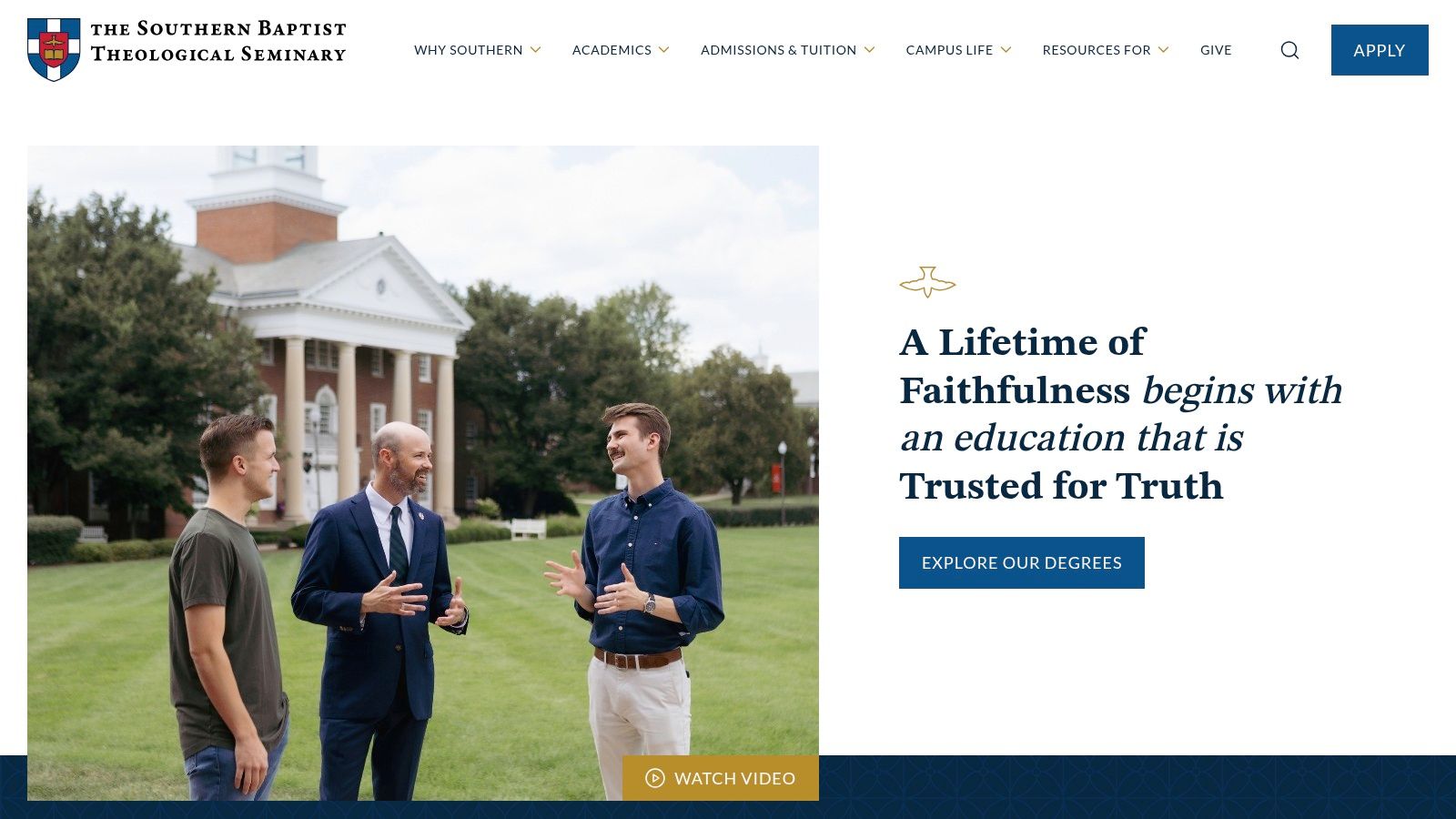
Southern Seminary in Louisville offers its MDiv through campus, online, and hybrid-modular study. The Global Campus serves students who want theological education without relocating; residential students can take part in campus life and faculty-led mentoring. Residential MDiv students may qualify for a nine-credit-hour tuition cap, subject to conditions. Review the Southern Seminary program pages to understand how those conditions affect your costs.
What pastors say about the return
In a 2008 LifeWay Research survey, researchers surveyed 1,004 randomly selected Protestant pastors by telephone. Among respondents, 85% had taken seminary classes; 96% of those pastors said they would repeat the experience, and 83% strongly agreed their training was worth the time and money.
Read those findings as a historical benchmark. The survey is about 18 years old, so it can indicate how pastors viewed seminary education at the time, not provide current figures.
Southern's Baptist commitments shape its curriculum. That focus suits students preparing for ministry in that tradition, while candidates from other traditions should examine the doctrinal fit before applying. Hybrid-modular study may require in-person attendance, so confirm which courses match your schedule and location. Check eligibility for the residential tuition cap in writing.
How the Seven Schools Compare on Location, Credit Load, and Delivery Format
The right comparison starts with your constraints: where you can study, how many credits the degree requires, and which formats the school offers. The table separates those practical choices from each program's likely fit.
School | Location | MDiv Credit Hours | Delivery Formats | Best Fit For |
|---|---|---|---|---|
The Bible Seminary | Katy, Texas | 84 credit hours | On-campus and Distance Education | Students seeking Bible-centered training and flexible study options |
Denver Seminary | Denver, Colorado | 79 hours | On-campus, online, hybrid | Students seeking ministry concentrations and flexible study formats |
Asbury Theological Seminary | Wilmore, Kentucky, with extension sites | 96 credit hours | Residential, hybrid, some fully online classes | Students seeking hybrid study with in-person sessions |
SMU Perkins School of Theology | Dallas, Texas | 75 credit hours | Hybrid/online, full-time, part-time | Students preparing for congregational ministry with supervised internship experience |
Fuller Theological Seminary | Pasadena, California; Texas cohort available | Not specified | Fully online, on-campus, hybrid cohorts | Students seeking varied formats or Spanish-language study |
Southwestern Baptist Theological Seminary | Fort Worth, Texas | Not specified | On-campus, online, hybrid-modular | Students seeking Baptist ministry preparation with multiple study formats |
The Southern Baptist Theological Seminary | Louisville, Kentucky | Not specified | On-campus, online, hybrid-modular | Students seeking Southern Baptist theological education and campus or remote study |
Use the table to narrow your options, not to make the final choice. Credit loads and delivery formats show the shape of each commitment; the school's theological commitments and the degree's practical requirements determine whether that commitment fits your ministry.
From Comparison to Application
Choose the one or two schools that meet your requirements for accreditation, format, and doctrinal fit. Then ask each admissions office the same questions in writing: total credit hours, supervised ministry requirements, residency intensives, transfer credit, start dates, and how the school serves students from other traditions. Written answers make it easier to compare specific commitments side by side. Ask for details, not general assurances.
Tuition, course rotations, and cohort schedules can change. Confirm current figures on each school's program page before you apply or budget. Treat numbers in a roundup as a starting point, not a quote.
If The Bible Seminary is on your shortlist, ask admissions how its programs fit your ministry goals. Its Master of Divinity studies all 66 books of Scripture across 84 credit hours. The Certificate of Theological Studies offers 27 credit hours of graduate-level education for people serving in vocational or volunteer leadership. TBS offers on-campus and Distance Education programs. It is an accredited member of the Transnational Association of Christian Colleges and Schools, whose approval of a 10-year renewal of the seminary's accredited status came in April 2025. Contact the seminary at info@thebibleseminary.edu or 281-646-1109.
A doctoral degree is a later decision for candidates who complete a master's and choose to continue. Practical details, including ThD graduation gown options, can wait until that stage.
Keep the purpose in view: the school is a means to prepare for service. Your future congregation will need a pastor ready to open Scripture, teach clearly, and care for people through ordinary and difficult days.