
Nicene Creed Prayer: Meaning, Origins and How to Pray It

The Nicene Creed is a formal creed, a profession of faith that churches recite and sing in worship, and it can also be prayed. Its first form came from the Council of Nicaea in 325, and the version most congregations use today was completed at the Council of Constantinople in 381.
Ask a room of churchgoers what they did after the sermon and most will say they "said the creed." Ask what it would mean to pray that same text, and the room goes quiet. The words are familiar. The move from reciting to worshiping isn't. This guide walks the creed clause by clause, keeps the fourth-century history separate from the later doctrinal vocabulary, and shows where recitation becomes prayer without collapsing into either rote repetition or a private rewrite.
Table of Contents
How the Creed Took Shape at Nicaea and Constantinople - Three labels that are not the same
What the Creed Teaches About Christ and the Spirit - Why the creed builds a fence around two words
Scripture Behind the Creed's Wording - A three-step check any study leader can run
How to Pray the Creed Line by Line - A five-step routine for one clause
Is the Nicene Creed a Prayer or a Creed
A creed declares what the church believes. A prayer speaks to God. The Nicene Creed is the first, which is why service books label it a profession of faith or an affirmation of faith rather than a prayer. That's a difference in grammar, posture and audience, not a ban on devotion.
The distinction has held for a long time. The Diocese of Lincoln notes that the creed has been recited at Mass every Sunday for 1,700 years (Diocese of Lincoln, 2024). A text recited that steadily is doing real work in the life of a church, even when individual worshipers couldn't explain a single clause.
Creed compared with prayer
Feature | Creed (profession of faith) | Prayer (address to God) |
|---|---|---|
Primary purpose | Declares what the church believes | Speaks to God in praise, request, thanksgiving or confession |
Speaker | The whole congregation together | An individual or group addressing God |
Form | Fixed wording that changes little | Set or free words, often spontaneous |
Typical setting | Sunday worship, baptism, councils | Private devotion, worship, intercession at any time |
Usual language | We believe | We thank, we ask, we confess |
The table comes clear with two family pictures. A statement of what the family stands for is read aloud at a reunion and everyone signs it. That's the creed. One family member speaking to another they love, with no document in hand, is the prayer. Same family, same convictions, opposite direction of speech.
Look down the "usual language" column and the difference is sharpest. "We believe" reports. "We thank, we ask, we confess" addresses.
The rule that keeps both: never let the creed become speech about God that never turns into speech to God, and never let private prayer drift so far that it loses the Trinitarian shape the creed was written to protect.
That tension is the whole assignment. Reciting declares truth. Praying means the declaration also turns toward the One it describes, and the rest of this guide is about doing that on purpose rather than by accident.
The Nicene Creed Text in Full
Before any history, here's the text itself, arranged in five blocks so it can be read aloud in a group. The wording below is the ecumenical English version (ICET, 1975), the form printed in the Episcopal Book of Common Prayer Rite II. Check your own service book before printing it in a bulletin, since local versions differ in small ways. This is the standard creed form used across traditions, not a liturgy written for this article.
1. The Father
We believe in one God, the Father, the Almighty, maker of heaven and earth, of all that is, seen and unseen.
2. The Son
We believe in one Lord, Jesus Christ, the only Son of God, eternally begotten of the Father, God from God, Light from Light, true God from true God, begotten, not made, of one Being with the Father; through him all things were made.
3. The incarnation and the cross
For us and for our salvation he came down from heaven, was incarnate of the Holy Spirit and the Virgin Mary and became human. For our sake he was crucified under Pontius Pilate; he suffered death and was buried. On the third day he rose again in accordance with the Scriptures; he ascended into heaven and is seated at the right hand of the Father. He will come again in glory to judge the living and the dead, and his kingdom will have no end.
4. The Holy Spirit
We believe in the Holy Spirit, the Lord, the giver of life, who proceeds from the Father, who with the Father and the Son is worshiped and glorified, who has spoken through the prophets.
Textual variant: Western Latin versions read "who proceeds from the Father and the Son." The added phrase is the Filioque, and it is not part of the 381 Greek wording. The history behind it comes later.
5. The church and the life to come
We believe in one holy catholic and apostolic Church. We acknowledge one baptism for the forgiveness of sins. We look for the resurrection of the dead, and the life of the world to come. Amen.
Read block 4 out loud once more. It's the block most congregations rush, and it's the block with the most history packed inside it.
How the Creed Took Shape at Nicaea and Constantinople
Every version of the creed you've said on Sunday carries a date stamp, and it's later than commonly assumed. These are the milestones worth memorizing.
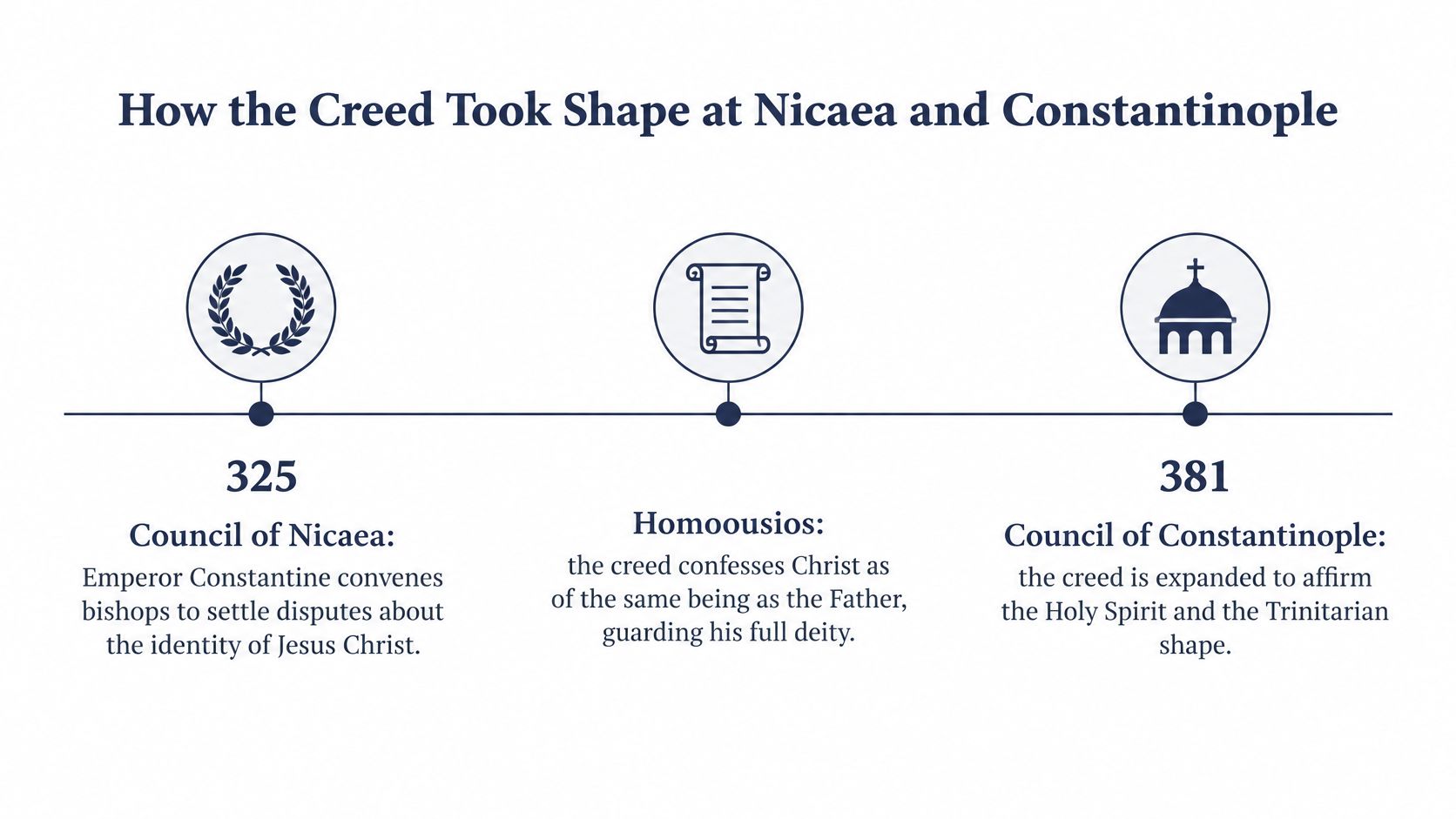
The setting was a dispute, not a liturgy committee. Emperor Constantine convened the First Council of Nicaea in 325 to address disputes about Christian teaching concerning the identity of Jesus Christ, and the council produced a doctrinal formula built around the Greek word homoousios, commonly translated "of the same substance" or "of one being" (Ecumenical Review). The term affirms that the Son shares the same divine nature as the Father.
The word answers a plain question. A wooden chair and a wooden table are the same substance. A wooden chair and a plastic one are not. Homoousios places the Son on the Father's side of that line: not a similar being, not a noble creature, but one who shares the divine nature rather than resembling it from a distance.
325, Nicaea. The council issues a formula containing homoousios and settles the vocabulary the church will argue over for the next half century.
Roughly 56 years of continued debate. Nicaea didn't end the argument. It gave the argument its terms.
381, Constantinople. The council reaffirms and expands the creed, especially its teaching about the Holy Spirit.
451, Chalcedon. The council formally recognizes the 381 formulation as the faith associated with the "150 fathers" of Constantinople.
Three labels that are not the same
"Nicaea" is a shorthand that hides a sequence. The Nicene Creed, the Niceno-Constantinopolitan Creed and "the faith of the 150 fathers" overlap but aren't identical labels, and the standard worship form is more precisely the Niceno-Constantinopolitan Creed. Tracking that sequence is the work of historical theology rather than systematic theology: one asks what happened in a room in the fourth century, the other asks what the whole Bible teaches about the Son.
Scholars still debate how far earlier baptismal formulations shaped the final text, and the documentary history is complex rather than merely obscure (Schaff's encyclopedia entry). What no one disputes is the outcome. The creed you recite is a product of fourth-century conciliar development, not a prayer composed in a single afternoon at one council.
What the Creed Teaches About Christ and the Spirit
The creed's oddest-sounding phrases are load-bearing. They exist to hold a claim in place that ordinary religious language kept letting slip.
Start with the purpose. Every technical phrase in the creed defends the full deity of Jesus Christ against readings that made him a lesser, created being. The creed calls him "begotten, not made" and "of one substance with the Father," and those two phrases work as a pair: together they distinguish eternal divine sonship from creation itself (Ad Fontes review of a creed commentary).
Why the creed builds a fence around two words
Think of the vocabulary as a fence around a field. The fence doesn't add scenery to the field. It stops one particular animal from getting in.
"Begotten, not made" is that kind of fence. It says the Son's origin is eternal generation, not manufacture. "Of one substance" says the Son isn't a superior angel or a first draft of humanity. The New Testament supplies the field the fence protects. John writes, "In the beginning was the Word, and the Word was with God, and the Word was God... All things were made through him" (John 1:1-3, ESV). Paul writes that "by him all things were created, in heaven and on earth, visible and invisible" (Colossians 1:16, ESV).
Now the plain statement that keeps people honest: "one substance" is not a Bible phrase. It's a theological formulation built to protect a biblical claim. We hold the Bible to be the fully true Word of God, which is exactly why the church's non-biblical vocabulary has to be tested against Scripture rather than treated as a verse.
The Spirit clause does similar work. The Constantinopolitan expansion affirmed the Spirit's divine status and his place within the Trinity, so that the third person isn't a force or an atmosphere but the Lord and giver of life, worshiped and glorified with the Father and the Son. Trinitarian traditions share this vocabulary even where they argue about its details.
Scripture Behind the Creed's Wording
The creed isn't a Bible passage. It's a post-biblical confession assembled largely from biblical language, which means almost every line has a home text you can open (Christian Pure overview). Seeing the echoes turns the creed from a memorized paragraph into a map.
Creed clause | Biblical echo | Reference |
|---|---|---|
One God, the Father; one Lord Jesus Christ | Opening structure follows | 1 Corinthians 8:6 |
By whom all things were made | Echoes | John 1:3 |
His kingdom has no end | Echoes | Luke 1:33 |
One baptism | Echoes | Ephesians 4:5 |
According to the Scriptures | Echoes | 1 Corinthians 15:3-4 |
Paul's sentence is the clearest source: "yet for us there is one God, the Father, from whom are all things and for whom we exist, and one Lord, Jesus Christ, through whom are all things and through whom we exist" (1 Corinthians 8:6, ESV). The creed takes that two-part shape and expands it. Luke supplies the kingdom line: "he will reign over the house of Jacob forever, and of his kingdom there will be no end" (Luke 1:33, ESV). And "according to the Scriptures" comes straight out of the earliest resurrection formula Paul says he received (1 Corinthians 15:3-4, ESV).
A three-step check any study leader can run
Find the clause. Write it on a whiteboard exactly as your congregation says it.
Open the echo text. Read the verse yourself before the group meeting, in a translation you can name out loud.
Read two verses before and two after. Context is where most creed-and-Bible confusion starts, because a phrase lifted from a paragraph can mean something slightly different on its own.
The principle underneath the check: the creed summarizes and interprets Scripture, so Scripture stays the standard. Some clauses have no single proof text. "He descended into hell" belongs to the Apostles' Creed rather than this one, and even inside the Nicene text, phrases like "God from God, Light from Light" gather several passages instead of quoting one. Say so plainly when you teach it. A confession that admits where it's synthesizing is more trustworthy, not less.
How to Pray the Creed Line by Line
Two failures are common, and they sit at opposite ends. The first is rote repetition, where the mouth moves and nothing else does. The second is an informal personal prayer that feels warm but has lost the public, Trinitarian shape the creed exists to guard.
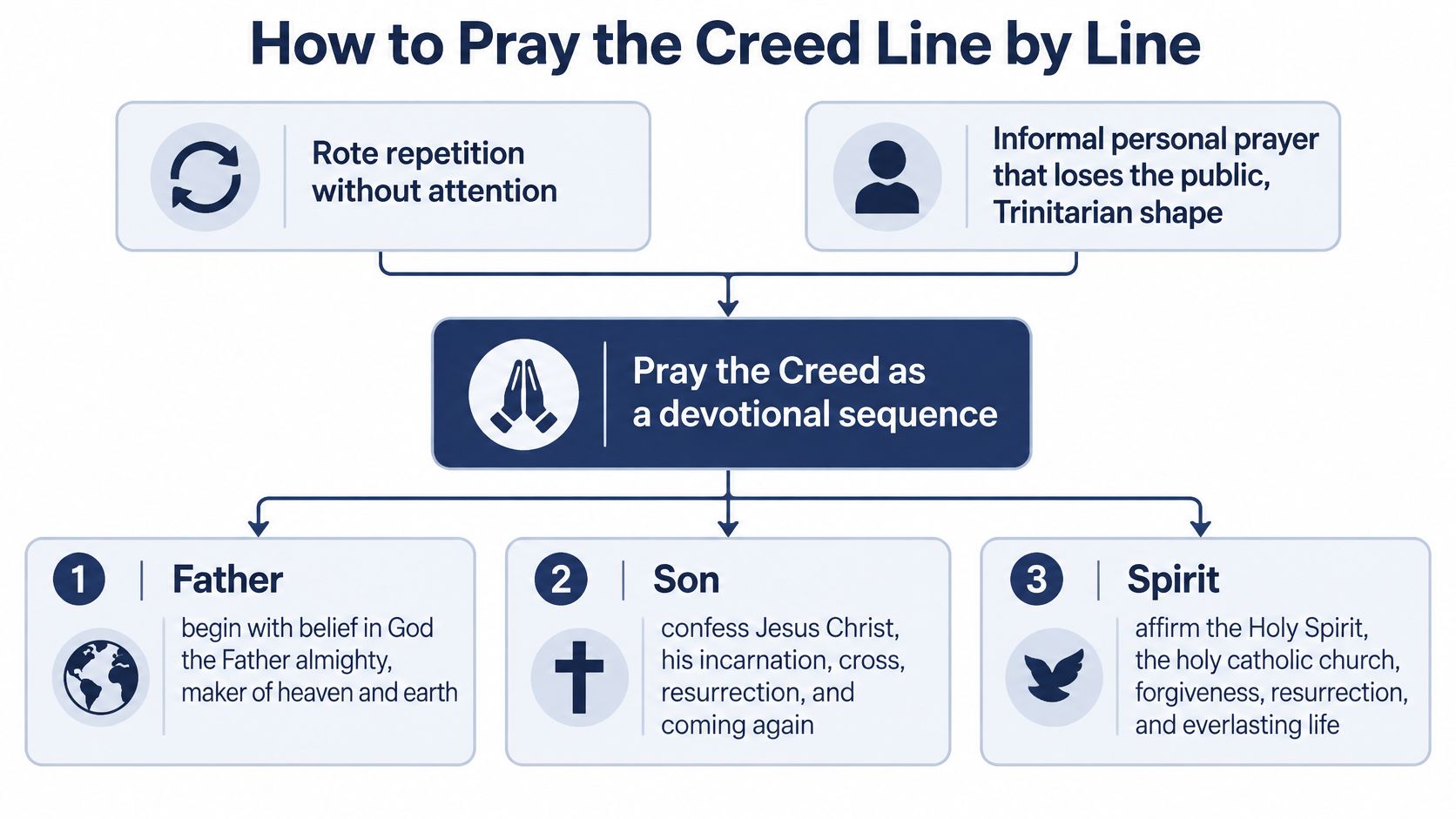
The route between them is slower and more deliberate than either. It treats the Nicene Creed prayer as a sequence: read, name, look up, respond, move on.
Creed block | What it affirms | Prayer response |
|---|---|---|
The Father | Creation and providence | Thank God for his care over ordinary days |
The Son | Eternal divine sonship; incarnation and saving work | Worship Christ and confess dependence on his saving work |
The Holy Spirit | Lord and giver of life; sanctification | Ask for the Spirit's work in holiness and daily obedience |
The church and resurrection | The church, the resurrection and the life to come | Intercede for the church and rest in Christian hope |
A five-step routine for one clause
Week one, take only the first line: "We believe in one God, the Father, the Almighty, maker of heaven and earth."
Read it aloud, slowly. Speed is the enemy here. Say it twice if the first pass was automatic.
Name the truth. God made everything, and he made it before he asked anything of you.
Turn to a supporting verse. Colossians 1:16 or Psalm 24:1 will do.
Respond in one sentence. Thanks for a specific provision, confession of a specific worry, a request for trust, or a commitment to a concrete action.
Stop there. One clause prayed well beats five clauses skimmed.
The Spirit block shows how far a single clause can travel. "The Lord, the giver of life" invites worship, then repentance over the habits that quench his work, then a request for holiness in one named area, say guarding the first twenty minutes of the morning for Scripture instead of the phone. Worship, repentance and discipleship inside one line.
Treat this framework as a teaching method, not an official liturgy or a doctrinal statement. The creed's 1,700th anniversary fell in 2025, according to ONE Magazine, which dates the creed to the Council of Nicaea in AD 325. Anniversaries make good excuses to start.
Where Churches Differ in Wording and Use
Two congregations can recite the Nicene Creed on the same Sunday and still not share one sentence about the Holy Spirit. The gap is small on the page. It is large in church history. Know which printed line is in the room before you lead anyone through it.
The Greek text says the Spirit proceeds "from the Father." The Western Latin form adds Filioque, "and from the Son" (Vatican International Theological Commission document). That phrase was not part of the original Constantinopolitan text. It entered Latin liturgical use gradually between the eighth and eleventh centuries and was inserted into the Roman Creed in 1014. Those dates are historical. Whether a church receives the phrase is doctrinal. Praying the line is a third act: you address God with the wording your own church has put in your mouth.
Tradition | Spirit clause | Notes on use |
|---|---|---|
Greek (Eastern) text | The Spirit proceeds from the Father | Reflects the original Constantinopolitan wording |
Western Latin usage | The Spirit proceeds from the Father and the Son (Filioque) | Added gradually between the eighth and eleventh centuries; inserted into the Roman Creed in 1014 |
Church of England | The Nicene wording printed for the authorized service | Authorizes the Nicene Creed alongside the Apostles' Creed, the Athanasian Creed or an authorized affirmation in specified Communion settings (Church of England liturgy) |
Reformed congregations | The clause printed in the text that congregation has adopted, with or without the Filioque | Frequency of use in worship is a local practice, separate from the creed's historical standing |
A hymnbook works the same way. One edition keeps the older stanza. Another prints an extra line in the margin. You do not treat the margin line as if it stood in the 381 Greek wording. You also leave the choice of edition to the church body, not to a hurried explanation.
Name the textual tradition before the first clause. Explain the Filioque as a Western development after Constantinople and as a theological claim your church has either affirmed or declined. Then pray the Spirit clause that is in fact on the page, one slow sentence, until "proceeds from the Father" (and, where your text has it, "and the Son") is worship rather than a stumble over fine print.
Using the Nicene Creed in Your Church or Study
A creed you only recite works like a map you never unfold. You can name the destination and still miss every turn. In a church or a study, use the Nicene Creed by settling the wording first, then praying it slowly enough that worship, repentance, and discipleship each get a turn.
Confirm the wording before anyone reads aloud. Ask which text the congregation uses, "we believe" or "I believe," and whether the Spirit clause carries the Filioque. The table on where churches differ in wording and use is the checklist for those two questions. Write the answer inside the front cover of the study binder so the group is not renegotiating it every week.
Take one clause a week. Five blocks, the Father, the Son, the incarnation and the cross, the Holy Spirit, and the church and the life to come, hold roughly twenty clauses. A year of Tuesday mornings is enough if you go slowly. Slow is the point. Give the clause one job only: praise, confession, or one concrete step of discipleship. A leader can name which of the three it is, so historical wording, doctrinal teaching, and devotional practice do not blur together.
Match the pace to the setting. Personal devotion moves at your speed. Group study needs a leader's prompts and a named translation. Sunday worship runs at the congregation's speed, which is why the creed is best prayed there with attention rather than commentary.
The Bible is the fully true Word of God, and prayer is a core value of Christian study, not an accessory to it. That is why a creed worth reciting is also a creed worth praying. No degree or certificate is required for any of it. The only prerequisite is a willingness to mean what you say out loud.
The Bible Seminary teaches all 66 books of Scripture alongside the historical, theological, and practical disciplines that make a fourth-century text like the Nicene Creed legible. The Bible Seminary offers graduate courses, certificates, and on-demand seminars you can explore at your own pace. Start with a single course on the creed or on church history and see where it leads.