
Historical Theology vs Systematic Theology: A Guide

You've served faithfully in your church, taught Bible studies, and perhaps preached or led ministry teams for years. Now, as you consider seminary training, the course catalog presents two familiar but easily confused subjects: historical theology and systematic theology. You know both involve the study of Christian doctrine, yet you may wonder why they're separate disciplines and which one best fits your calling.
The simplest answer is that historical theology asks how the church has understood Christian truth through time, while systematic theology asks what Christians should believe and do about that truth today. These disciplines aren't rivals. They're complementary ways of loving God with our minds and serving Christ's church with wisdom.
Why Both Disciplines Matter for Ministry Leaders
A prospective student might begin with a practical question: “If I already believe the Bible is authoritative, why do I need both kinds of theology?” The question is understandable. Ministry leaders face sermons to prepare, people to counsel, conflicts to work through, and doctrines to explain. It can seem that every available hour should go directly toward Bible study and ministry practice.
Yet faithful ministry requires more than collecting isolated biblical answers. Historical theology helps you recognize how Christians before you interpreted Scripture, responded to error, and articulated the faith under pressure. Systematic theology helps you bring the Bible's teaching together so that your preaching and leadership remain coherent.
Consider a pastor preparing to teach about Christ's identity. Historical theology can introduce the major debates and creeds that helped the church clarify what it means to confess Jesus as fully divine and fully human. Systematic theology then helps the pastor connect Christology with the Trinity, salvation, worship, discipleship, and Christian hope.
Ministry insight: A leader who knows only the present may mistake a familiar idea for a biblical one. A leader who knows only the past may struggle to explain the faith clearly to today's congregation.
Scripture itself presents Christian leadership as a work of careful teaching and faithful transmission. Paul tells Timothy to guard the good deposit entrusted to him and to equip faithful people who can teach others (2 Timothy 1:14; 2:2, ESV). That work involves receiving the church's confession responsibly and communicating biblical truth faithfully.
At The Bible Seminary, students pursue an education that unites scholarship, spiritual formation, and hands-on ministry. The aim isn't academic achievement for its own sake. It's training hearts and minds for kingdom service, equipping leaders to impact the world for Christ with humility, conviction, and pastoral care.
What Is Historical Theology
Historical theology is the disciplined study of Christian doctrine as it developed through time and within particular cultural settings. It examines how Christians, theologians, councils, confessions, and churches understood teachings such as the Trinity, salvation, Scripture, and the person of Christ.
The discipline is commonly organized into five broad periods: Patristic theology from the 1st to 7th centuries, Medieval theology from the 8th to 15th centuries, Reformation and Post-Reformation theology from the 16th to the mid-17th centuries, Enlightenment theology from the mid-17th to 18th centuries, and Modern theology from the 19th to 21st centuries. This framework covers roughly two millennia of Christian doctrinal development and gives students a chronological structure for tracing major changes. These periods are summarized in an overview of Christian theology.
Dates, however, aren't the heart of the discipline. Historical theology asks why a particular question became urgent in a particular setting. What controversy prompted a council to clarify its language? What assumptions shaped a theologian's reading of Scripture? How did a confession respond to the church's pastoral and cultural needs?
Historical theology as careful listening
Students work with methods such as manuscript study, textual analysis, contextualization, and comparison. They learn to distinguish what an earlier Christian writer argued from what later readers assume that writer meant.
This discipline also helps the church avoid repeatedly reopening questions that earlier believers examined carefully. It encourages gratitude for the church's inheritance while leaving room for responsible evaluation. Earlier teachers aren't Scripture, and historical consensus isn't automatically infallible. Still, their work can expose blind spots and sharpen our understanding.
For a ministry leader, historical theology turns church history into a resource for wise service. It helps you see how believers confessed Christ across centuries while remaining anchored in the authority of Scripture.
What Is Systematic Theology
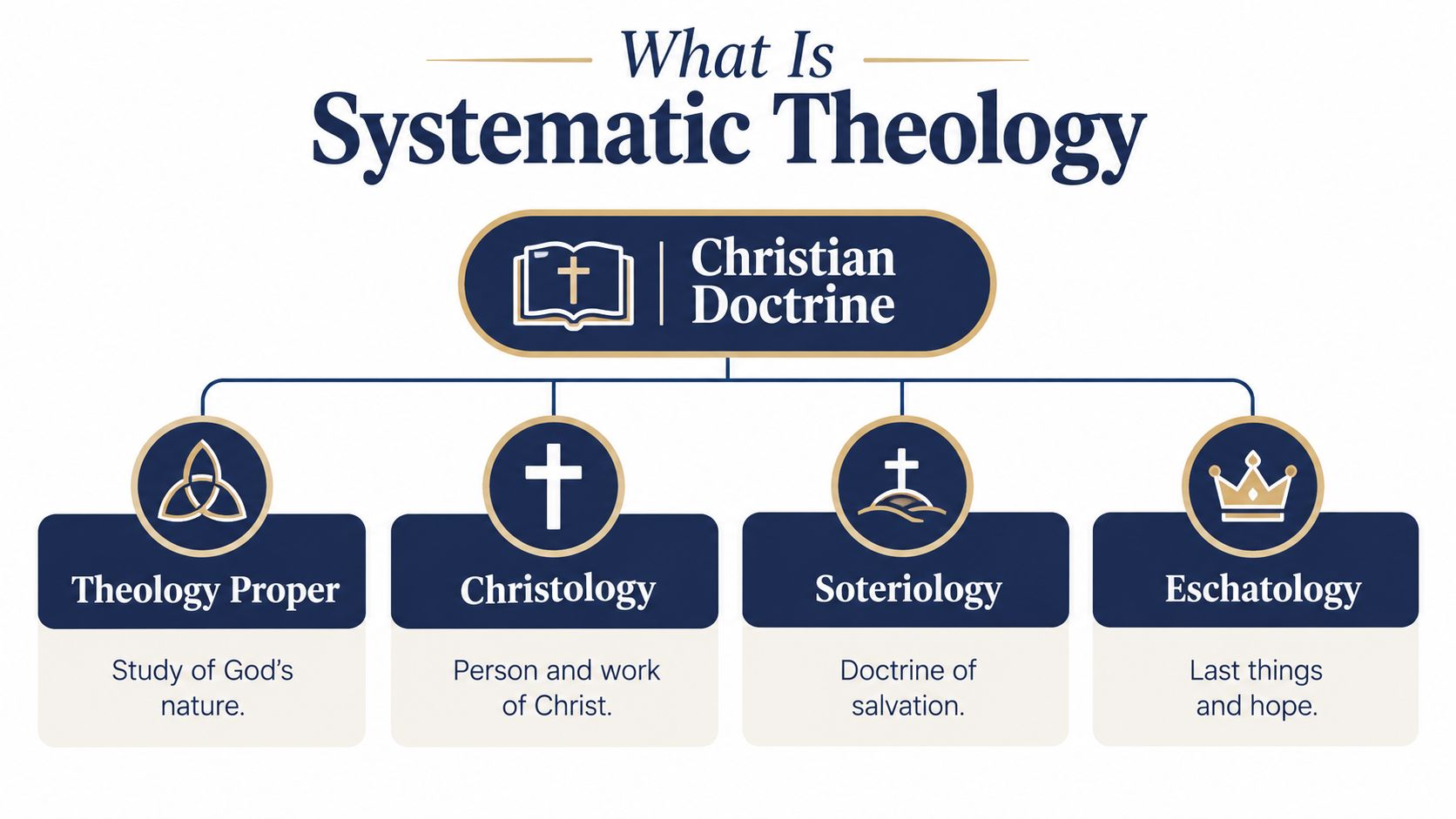
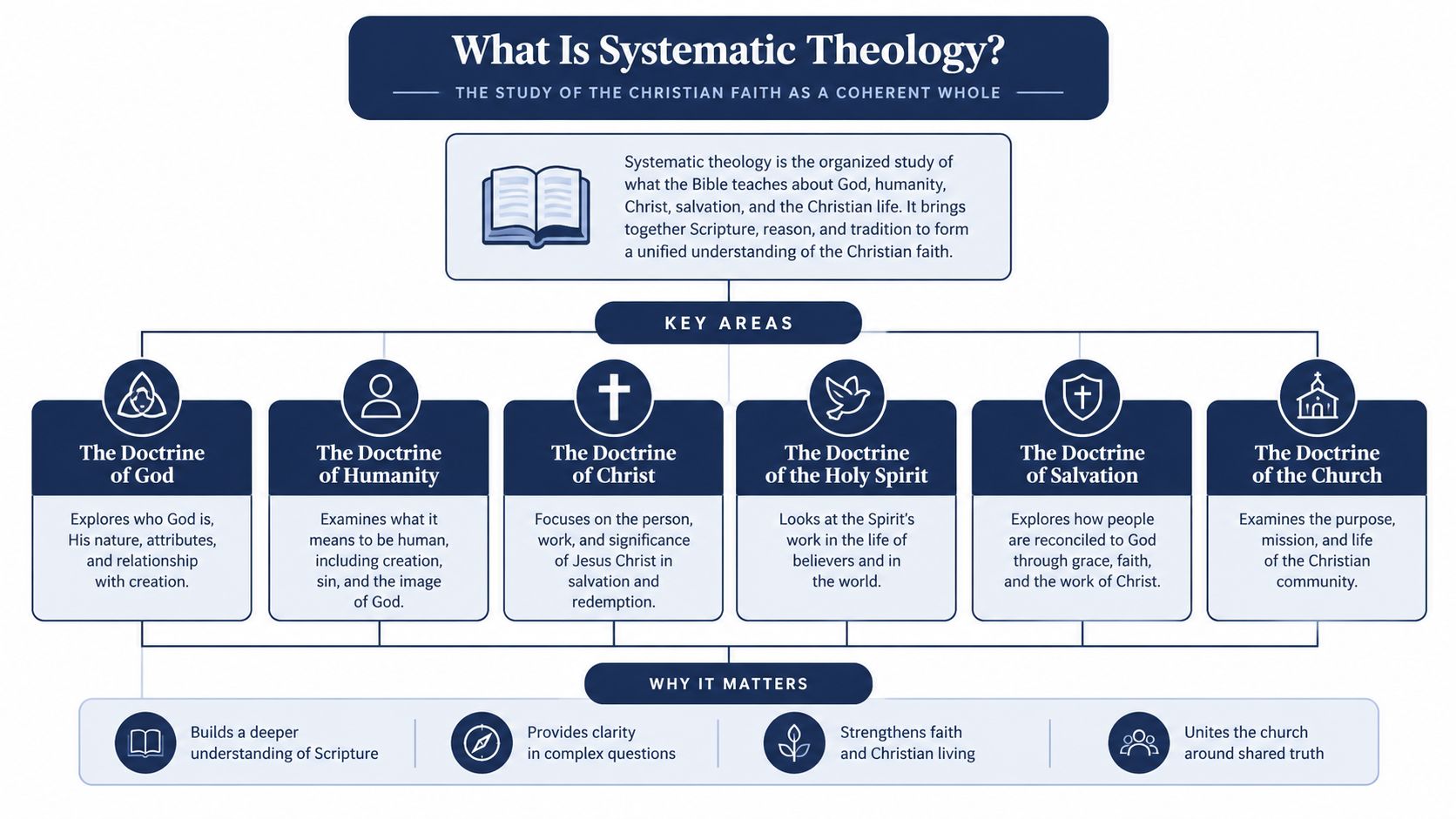
Systematic theology organizes Christian doctrine by topic rather than by historical sequence. It asks how the whole Bible speaks to a particular question and how those biblical teachings fit together into a faithful account of Christian belief and practice.
Common categories include:
Theology proper, the study of God's nature and works.
Anthropology, the study of humanity in relation to God.
Christology, the person and work of Jesus Christ.
Soteriology, the doctrine of salvation.
Ecclesiology, the doctrine of the church.
Eschatology, the study of last things and Christian hope.
A systematic theologian might ask, “What should the church believe about salvation?” The answer won't come from a single verse considered in isolation. It requires attention to creation, sin, covenant, Christ's atoning work, faith, grace, the Holy Spirit, the church, and the promised renewal of all things.
The recognizable post-Reformation form of systematic theology is usually dated to the late 16th and early 17th centuries, when Keckermann, who lived from 1571 to 1608, was identified as the first to use the term theologia systematica. This milestone reflects the growing practice of arranging doctrine in a logical order for teaching, debate, and application, as described in the history of systematic theology.
A long development
Systematic theology's academic identity became clearer during that later period, but its roots reach much further back. John of Damascus, Peter Lombard, Thomas Aquinas, Duns Scotus, Philip Melanchthon, and John Calvin are among the figures commonly associated with its development.
Systematic theology serves the preacher, teacher, counselor, and church planter by asking what the church should believe and do now. It doesn't replace careful exegesis. Instead, it gathers the teaching of Scripture into a framework that helps Christians speak consistently about God, salvation, holiness, the church, and hope.
When systematic theology is practiced humbly, it leads to worship and faithful action. Christian doctrine should shape the way we preach Christ, care for people, resist false teaching, and live as the people of God.
Methods and Key Thinkers Side by Side
Historical and systematic theology often study many of the same subjects, but they approach those subjects differently. Historical theology follows doctrine through time. Systematic theology arranges doctrine by subject and correlates the Bible's teaching.
Historical theologians may examine a manuscript, compare translations, study the setting of a controversy, and trace how a term was used across generations. Systematic theologians may gather biblical passages, test the consistency of a doctrinal proposal, and ask how that doctrine connects with the rest of Christian belief.
A student reading Augustine, Aquinas, or Calvin therefore asks historical questions such as, “What problem was this writer addressing?” and “How did this argument fit the church's context?” The same student may later ask systematic questions such as, “How should this teaching about grace relate to sin, faith, Christ's work, and Christian obedience?”
Aspect | Historical Theology | Systematic Theology |
|---|---|---|
Primary question | How has Christian teaching developed through time? | What should the church believe and do about this topic today? |
Main structure | Chronological and contextual | Topical and logical |
Typical methods | Manuscript study, textual analysis, contextualization, and comparison | Biblical correlation, doctrinal synthesis, and logical arrangement |
Primary materials | Writings, councils, creeds, confessions, and historical settings | The whole Bible interpreted in relation to a doctrinal question |
Ministry outcome | Informed judgment about inherited Christian teaching | Clear teaching and consistent application for the church |
Reading about the early church fathers can illustrate this relationship. Historical study places their writings in context, while systematic reflection evaluates how their theological insights relate to Scripture and to the church's confession today.
Practical rule: Historical theology tells you where a doctrine has traveled. Systematic theology helps you explain where the church should stand.
The disciplines also correct each other. Historical awareness can challenge a system that has forgotten the church's long conversation. Systematic clarity can help historical research serve the church rather than becoming an exercise in disconnected information.
How TBS Courses Bring Both Together
Students often ask whether they'll have to choose between church history and doctrinal theology. In an integrated seminary education, the answer is no. Courses in church history can show how Christian teaching developed, while courses in theology can help students express biblically grounded convictions for ministry today.
A practical benchmark distinguishes the disciplines by their output target. Historical theology seeks to explain the course of Christian teaching through time and how earlier theologians and councils understood doctrine. Systematic theology seeks to answer what the church should believe and do about a topic today by correlating the whole Bible into categories such as theology proper, anthropology, Christology, soteriology, ecclesiology, and eschatology. This distinction is also outlined in a discussion of theological method.
A connected learning process
A student might move through the learning process in a pattern like this:
Read Scripture carefully. Identify what a biblical passage says in its literary and canonical context.
Study the church's interpretation. Examine how earlier Christians received, debated, and confessed the teaching.
Construct a coherent doctrine. Relate the biblical teaching to other doctrines without flattening important distinctions.
Apply the doctrine pastorally. Ask how it should shape preaching, worship, discipleship, counseling, and mission.
That process reflects a Bible-based, Christ-centered, Spirit-led approach to theological education. It also protects students from treating theology as an abstract contest. The doctrines we study concern the living God, the finished work of Christ, the ministry of the Holy Spirit, and the church's calling in the world.
At the seminary, graduate majors connect biblical study with historical, theological, and practical disciplines. Students can also explore flexible pathways such as degree study, certificates, course auditing, and focused seminars. Faculty mentoring and community life give theological study a relational setting, where knowledge can mature into wisdom and service.
Which Focus Suits Your Ministry Goals
Your ministry calling may naturally draw you toward one discipline, but neither field belongs to only one kind of Christian leader. A pastor needs historical perspective when explaining a creed or addressing a doctrinal controversy. A church historian needs systematic clarity when describing what a movement believed and why those beliefs mattered.
Systematic theology may become especially important when your ministry requires clear doctrinal organization. Pastoral leadership, church planting, teaching ministry, and discipleship all require you to explain how Christian beliefs fit together. A church planter, for example, must help a new congregation understand the relationship between the gospel, the church, baptism, the Lord's Supper, worship, and mission.
Historical theology may become especially important when your ministry requires contextual judgment. Academic research, denominational leadership, Christian education, and doctrinal study all benefit from tracing how interpretations emerged. Historical theology can help you identify which questions are genuinely new and which have appeared in different forms before.
Ask yourself:
What kind of questions energize you? Do you want to trace how Christians understood Scripture across time, or formulate a coherent account of Christian belief for present ministry?
Where are you serving now? A congregation facing doctrinal confusion may need your systematic skills, while a teaching ministry shaped by historical misunderstanding may need deeper historical work.
What gaps do you need to address? Your strongest area may not be your most urgent area for growth.
How will your study serve people? Choose courses with the people, churches, and communities entrusted to you in mind.
A healthy ministry doesn't treat one discipline as superior. Historical theology gives depth and memory. Systematic theology gives structure and direction. Together, they help leaders teach with conviction while remaining teachable.
Making Your Decision with Confidence
You don't need to force yourself into a permanent identity as either a historical theologian or a systematic theologian. Most ministry leaders will use both approaches, even if one becomes a particular area of concentration.
If you're often asking | You may be leaning toward |
|---|---|
How did the church arrive at this confession? | Historical theology |
What did this council or theologian mean in context? | Historical theology |
How does the Bible address this doctrine as a whole? | Systematic theology |
How should this belief shape the church today? | Systematic theology |
How can inherited Christian wisdom serve present discipleship? | An integrated approach |
Use the framework as a starting point, not a label. Your interests may change as you encounter new texts, ministry challenges, and conversations with faculty and fellow students.
Three wise next moves
Review the curriculum. Look for courses that develop biblical interpretation, church history, doctrinal theology, and practical ministry together.
Name a ministry problem. Ask whether your current challenge requires historical context, systematic clarity, or both.
Seek personal counsel. Talk with a pastor, mentor, professor, or admissions counselor who can listen to your calling and recommend a fitting path.
The distinction between historical theology and systematic theology becomes clearer when you connect it to real ministry decisions. You may begin with a historical question, move to a systematic synthesis, return to Scripture, and then apply the result in a sermon or counseling conversation.
The purpose isn't to collect impressive terminology. It's to become the kind of leader who can explain Christian truth accurately, respond to people graciously, and point the church to Jesus Christ.
Next Steps for Your Theological Journey
Theological education begins with curiosity, but it grows through disciplined study and faithful practice. You might start by reading a confession alongside the biblical passages it summarizes. You might compare a historical theologian's treatment of grace with your own understanding, then discuss the differences with a ministry mentor.
You can also explore how theology connects with archaeology and Scripture. At the seminary's museum, biblical history is presented through nearly 200 artifacts, with over 90% described as authentic, according to the institution's provided overview. That kind of learning can remind students that biblical faith engages real places, people, texts, and histories. Where the Bible comes alive, archaeology and Scripture can be studied together with care and appropriate humility.
Frequently asked questions
Is historical theology the same as church history?
Not exactly. Church history examines the development of the Christian church and its life across time. Historical theology focuses more specifically on the development of Christian teaching within those historical settings. The subjects overlap, but historical theology gives special attention to doctrinal interpretation, debates, councils, confessions, and theological writings.
Is systematic theology more biblical than historical theology?
No. The disciplines have different tasks. Historical theology studies how Christians interpreted and expressed doctrine through time, while systematic theology correlates the whole Bible to articulate Christian belief and practice. Both should honor Scripture as authoritative, and neither should be used as a substitute for careful biblical interpretation.
Which discipline should I study first?
There isn't one answer for every student. If you're unfamiliar with the church's doctrinal heritage, historical theology may provide useful orientation. If you need a framework for preaching and teaching, systematic theology may offer immediate structure. A strong program will help you grow in both.
Can theology strengthen spiritual formation?
Yes, when theology leads to worship, repentance, hope, obedience, and love of neighbor. Christian doctrine isn't merely information about God. It shapes how we trust Christ, follow the Spirit, serve the church, and proclaim the gospel.
The Bible Seminary in Katy, Texas, offers graduate majors, certificates, faculty guidance, and ministry-focused learning for students who want theological study to serve the church. Whether your interest is historical theology, systematic theology, archaeology, or practical ministry, the next faithful step may be a conversation about how your gifts and calling can grow through study.
Explore graduate degrees, certificates, and ministry-focused theological training at The Bible Seminary. Study historical and systematic theology in a setting that unites scholarship, spiritual formation, and hands-on ministry, equipping leaders to impact the world for Christ.