
What Can You Do with an MDiv? Jobs & Pay for 2026

What if the most useful question about seminary isn't which church will hire you, but which combination of ministry, work, and service you're preparing to carry?
When you ask, what can you do with an MDiv, the answer reaches beyond becoming a senior pastor. A Master of Divinity can support congregational leadership, chaplaincy, Christian education, missions, community service, and further theological study. It can also prepare you for a blended vocation, where paid employment and church ministry belong to the same faithful calling.
At The Bible Seminary, we approach that decision as training hearts and minds for kingdom service. That means considering the work you hope to do, the requirements beyond the degree, and the financial commitments before you enroll.
Ministry Roles an MDiv Prepares You For
An MDiv prepares people for service beyond the pulpit, but it doesn't automatically qualify them for every helping profession. The degree develops theological understanding and ministry judgment. Employers, denominations, licensing boards, and sending agencies decide what else a candidate needs.
The U.S. Bureau of Labor Statistics community and social-service occupational profile groups clergy alongside counselors, social workers, health educators, probation officers, and religious-activity directors; in 2025, prior experience was required for 62.1% of jobs across that broader group. That's a reason to connect graduate study with supervised service, not to assume those occupations share interchangeable qualifications.
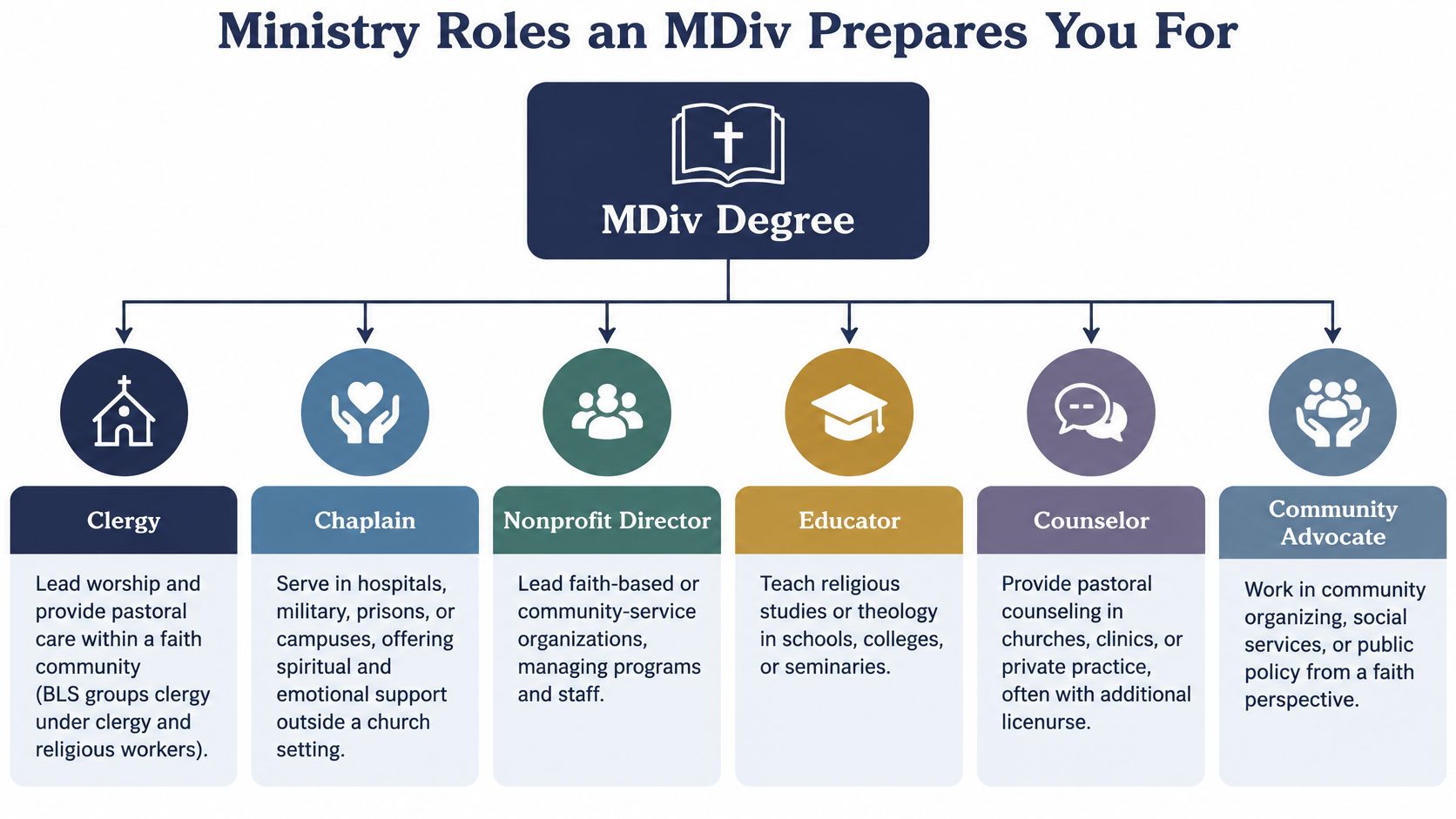
MDiv pathways, typical roles and added requirements
Pathway | Typical role | Why an MDiv fits | Common added requirement |
|---|---|---|---|
Pastoral and congregational leadership | Senior, associate or teaching pastor | Core preparation in preaching, theology and pastoral care | Denominational ordination and a church calling |
Chaplaincy | Hospital, military, campus or institutional chaplain | Pastoral care and ethics formed in supervised settings | Endorsement and supervised training appropriate to the setting |
Christian education and teaching | Ministry instructor, curriculum writer or Bible study leader | Biblical interpretation and clear communication | May meet theological preparation expectations for church or school posts; many college posts require a doctorate |
Nonprofit and community ministry | Program director or community-service coordinator | Organizational leadership and pastoral care | Demonstrated program or service experience |
Missions and discipleship | Missions mobilizer, discipleship director or cross-cultural ministry leader | Biblical training and cross-cultural teaching | Sending-agency approval and field training |
Further study | Doctoral or research track | Advanced theological research | Academic posts often call for a ThM, STM or PhD |
Count the requirements beyond graduation
For pastoral ministry, ask about ordination costs, travel for interviews, and time spent in candidacy. For chaplaincy, investigate supervised-training costs and whether placements are paid. A pastoral-care concentration isn't, by itself, a clinical counseling license.
Christian-school teaching may require credentials beyond theological education. Nonprofit employers may want experience managing volunteers, reporting program results, or administering budgets. Those skills take practice, and an unpaid placement can carry a real cost in lost working hours.
Missionary preparation can involve language study, field orientation, relocation, and support raising. An academic pathway may require additional degrees, applications, research time, and a longer period before stable employment.
BLS classifies clergy as typically requiring a bachelor's degree for entry, so an MDiv isn't universally mandatory. Its value lies in advanced preparation, denominational recognition, and readiness for demanding leadership responsibilities.
Calling-to-career test: Choose the pathway that best describes your intended service, then verify the added requirement before committing to the degree.
Pay and Job Benchmarks for Ministry Roles
National ministry salaries provide a starting point, not a promised return on tuition. In its May 2023 clergy estimates, BLS reported approximately 56,640 positions, a $63,720 mean annual wage, and a $58,920 median annual wage.
Keep the year and employment setting attached to every comparison. A national occupational estimate isn't the same thing as a local church's compensation package, and figures from different surveys shouldn't be treated as a single current salary scale.
Ministry pay benchmarks from U.S. Bureau of Labor Statistics data
Role or setting | Statistic | Value | Survey year |
|---|---|---|---|
All clergy, U.S. | Mean annual wage | $63,720 | May 2023 |
All clergy, U.S. | Median annual wage | $58,920 | May 2023 |
Clergy in religious organizations | Mean annual wage | $65,280 | May 2023 |
Clergy in colleges and universities | Mean annual wage | $70,450 | May 2022 |
Clergy in colleges and universities | Employment | 1,360 | May 2022 |
Religious workers, all other | Median annual wage | $39,370 | May 2022 |
Religious workers, all other | Mean annual wage | $45,420 | May 2022 |
Religious workers, all other | Middle 50 percent | $30,790 to $54,200 | May 2022 |
Religious workers, all other | Employment | 10,720 | May 2022 |
Clergy in religious organizations | Employment | 27,300 | May 2024 |
Directors of religious activities and education | Employment | 16,690 | May 2024 |
Other religious workers in religious organizations | Employment | 10,270 | May 2024 |
Clergy in religious, grantmaking, civic, professional, and similar organizations | Median annual wage | $58,660 | 2025 |
All clergy, U.S. | Median annual wage | $60,810 | 2025, Assessment.com compilation |
All clergy, U.S. | Jobs | Approximately 57,200 | 2025, Assessment.com compilation |
Religious workers, all other | Full-time wage-and-salary workers | Approximately 66,000 | 2025 |
For the education-setting rows, BLS's May 2022 clergy estimates identify 1,360 clergy workers in colleges, universities, and professional schools at a $70,450 mean annual wage. These are clergy positions within an industry, not a faculty salary estimate or evidence that an MDiv alone qualifies someone to teach.
For Religious Workers, All Other, BLS's May 2022 occupational estimates report 10,720 positions, a $39,370 median, a $45,420 mean, and a middle-half wage range of $30,790 to $54,200. Within religious organizations specifically, the BLS May 2024 industry chart reports 27,300 clergy, 16,690 directors of religious activities and education, and 10,270 other religious workers.
The narrower industry grouping in the BLS industry profile reports a 2025 clergy median of $58,660, while Assessment.com's compilation of BLS figures reports a broader 2025 median of $60,810 across approximately 57,200 jobs. The Federal Reserve Bank of St. Louis FRED series separately reports approximately 66,000 full-time wage-and-salary religious workers classified as all other in 2025.
Don't add those employment totals together. The FRED series, occupational estimates, and industry counts define their populations differently.
Read the number before using it
The median is the midpoint. The mean is the arithmetic average and can be pulled upward by high earners. The middle-half range describes the central portion of reported wages, not a guaranteed starting salary.
Compensation differs by region, denomination, church size, responsibilities, and benefits. Match your intended role to a local church budget or agency salary scale, then compare take-home pay, benefits, and study costs. None of these benchmarks guarantees employment or establishes an MDiv requirement.
Ordination, Licensure and the Supervised Practicum
A degree, ordination, endorsement, and professional licensure are different credentials. Denominations and employers control ordination or endorsement requirements. Clinical licensing authorities control authorization to practice regulated counseling professions.
The Association of Theological Schools accreditation standards set an MDiv minimum of 72 semester credits or equivalent and require supervised practical experience related to the student's vocational calling. That standard connects theological knowledge with observable ministry performance.
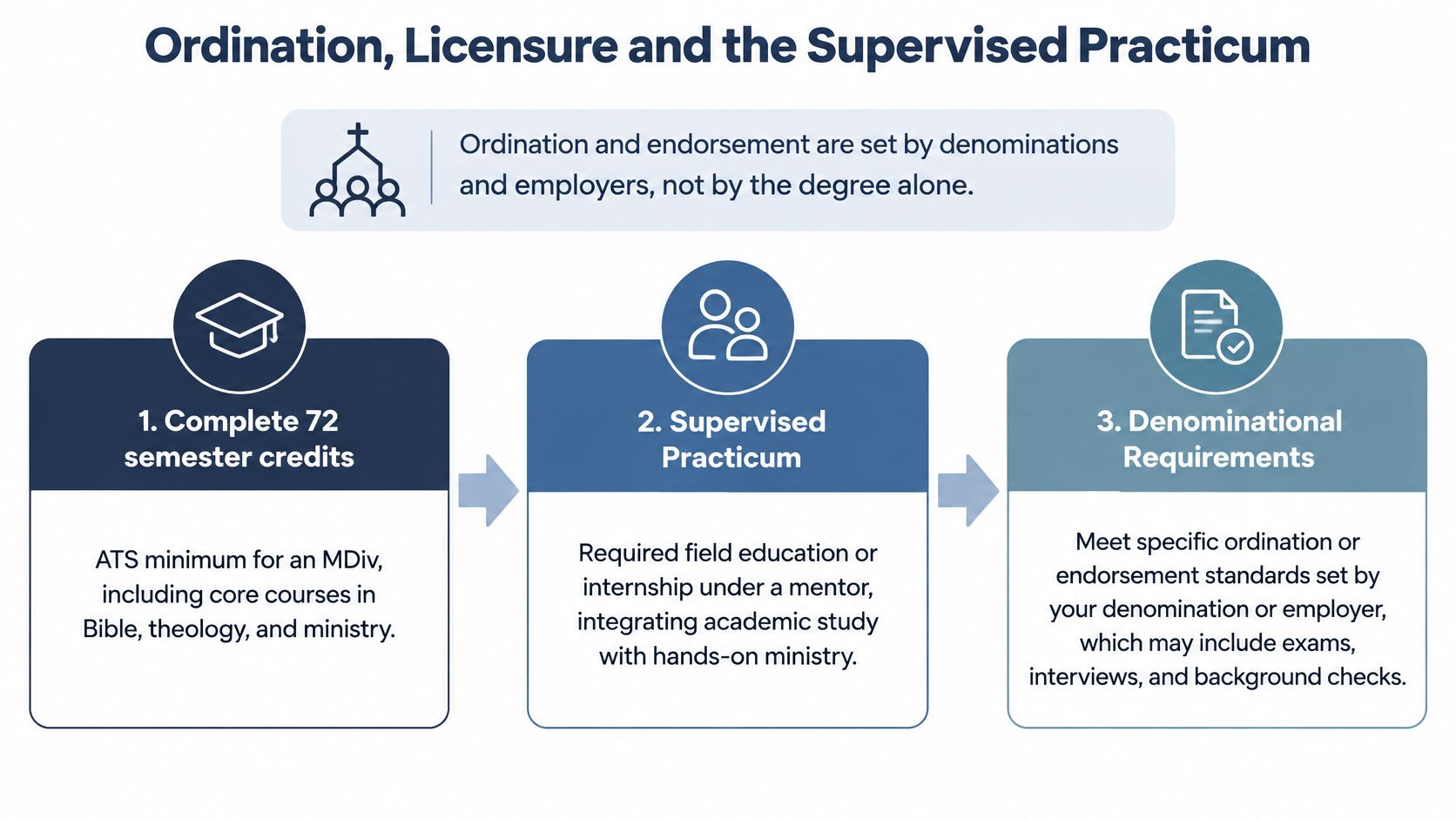
Build an approval path before enrolling
Clarify your calling with church leaders. Describe the people you hope to serve and the responsibilities you expect to carry. The common mistake is choosing a degree title before discerning the actual work.
Obtain requirements in writing. Ask your denomination or endorsing agency about experience, examinations, references, doctrinal statements, interviews, and fees. Don't assume another pastor's preparation route still applies to your circumstances.
Evaluate the practicum's design. Look for stated outcomes, qualified supervisors, an appropriate duration, and formal evaluation. A placement that merely records attendance won't show whether you're developing sound pastoral judgment.
Practice under accountable supervision. Seek assignments in preaching, pastoral care, worship leadership, administration, or community engagement that match your intended role. The mistake is treating field education as optional work you can squeeze around everything else.
Keep a ministry evidence file. Save sermon recordings, written reflections, project plans, and supervisor evaluations while protecting confidential information. Waiting until an application deadline makes it harder to document growth accurately.
Apply through the responsible church or agency. Complete its approval process, then pursue placement with clear references and verified qualifications. Graduation doesn't automatically trigger ordination, endorsement, or employment.
Evaluate formation and safeguarding together
At The Bible Seminary, experiential education occurs through classroom instruction, study tours, hands-on ministry training, and community-based training with ministry professionals. Graduate students also receive mentored learning, including local mentoring and training opportunities.
Use those experiences to ask concrete questions about feedback and accountability. Our ministry requirements resource can help frame a conversation about preparation, while your denomination or employer remains the authority on its own approval process.
Serving vulnerable people also requires appropriate safeguards. When evaluating a church placement, VolunteerBadge's discussion of a church volunteer background check policy offers a practical starting point for questions about screening procedures. Screening should accompany supervision, clear boundaries, and a documented reporting process.
Budget for application fees, travel, screening, and possible unpaid placement hours. A ready candidate has a written approval path, a documented supervised ministry record, and a church or agency reference who can speak about character and competence.
Transferable Skills Employers and Churches Value
An MDiv develops skills in interpretation, communication, ethical reasoning, pastoral care, and organization. Those capabilities can transfer beyond congregational employment, but employers need to see what you can do.
The ATS assessment case studies describe learning outcomes such as interpreting Scripture, understanding Christianity's historical and global contexts, theological reflection, worship assessment, faithful preaching, and spiritual formation. The practical connection is straightforward: students move from careful study to responsible action.
MDiv skills, where they transfer and the evidence to keep
MDiv capability | Where it transfers | Evidence to keep |
|---|---|---|
Scripture interpretation in historical and cultural context | Research, content development, curriculum design | Exegetical paper |
Public communication through preaching and teaching | Training, public speaking, advocacy | Sermon manuscript and recording |
Pastoral care | Chaplaincy, care teams, family services | Pastoral-care reflection |
Organizational leadership and ministry strategy | Nonprofit management, church administration | Supervised ministry evaluation |
Ethical reasoning | Policy, compliance and case analysis | Case-study analysis |
Worship planning and assessment | Event planning, volunteer coordination | Worship plan with assessment notes |
Transferable doesn't mean automatically qualified. A pastoral-care reflection can demonstrate listening and thoughtful referral, but it doesn't establish clinical licensure. An ethics paper can demonstrate careful reasoning, but it doesn't replace specialized compliance training.
Turn coursework into credible applications
Say a student develops a church teaching series and analyzes a dispute over eligibility for a community-care program. For a nonprofit program coordinator application, the student might describe developing audience-appropriate instructional materials and comparing service policies for fairness, consistency, and mission alignment.
Those descriptions work only if the underlying assignments support them. Keep the materials, explain your own contribution, and distinguish classroom analysis from paid professional responsibility.
For help translating ministry language into employer-facing descriptions, StoryCV on career change skills provides a useful framework. Write about the task, the audience, and the evidence rather than relying on labels such as leadership or strategic thinking.
Potential targets include nonprofit program coordinator, curriculum or Christian-education writer, community-services coordinator, and college or seminary staff support. For each, read the job description for added requirements in budgeting, software, safeguarding, educational credentials, or program administration.
Academic staff work isn't the same as a faculty appointment. Many college and seminary teaching posts require a ThM, STM, or PhD, and the clergy employment figures in educational institutions describe a work setting, not a qualification to teach.
Portfolio principle: Claim the skill you can demonstrate, not the job title you hope the degree will imply.
Before buying another credential, identify which skills you already have evidence for. Then budget for the specific gap, whether that means supervised experience, technical training, or further study.
Bi-Vocational Careers in Practice
The assumption that a meaningful seminary outcome must be a full-time pastorate leaves out many legitimate patterns of service. Bi-vocational ministry combines ministry responsibilities with another source of paid employment; a portfolio vocation may include several related roles.
An Association of Theological Schools study found that 32% of 2015–2016 graduates planning ministerial work expected to serve bi-vocationally, rising to 58% among Black, non-Hispanic graduates. These are graduates' expectations, not a measurement of their eventual employment.

Test a portfolio against your actual week
Consider these hypothetical patterns:
Part-time pastor and hospital chaplain. A pastor serves a congregation while working hospital shifts on selected weekdays. Preaching, grief care, and ethical judgment connect the roles, but hospital training and endorsement remain separate requirements. Ask whether both employers expect emergency availability and whether the chaplaincy income includes dependable hours.
Christian-school Bible teacher and discipleship leader. A teacher leads church small groups and volunteers on a nonprofit board. Curriculum design and volunteer development fit naturally, but school preparation, church meetings, and board duties can consume evenings. Confirm teaching credentials and ask whether the school salary alone can support essential household expenses.
Community-services coordinator and food-ministry leader. A coordinator manages referrals at work and organizes a church food ministry. Program planning and compassionate communication transfer well, but confidentiality and referral boundaries must remain clear. Determine who pays for mileage, required training, and other service-related expenses.
Protect both calling and capacity
Dual roles can create burnout risk when each organization assumes it has first claim on your time. Put church expectations in writing, including working hours, emergency coverage, sermon preparation, leave, and responsibilities outside the agreement.
Ask prospective programs practical questions:
Scheduling: Can required courses fit around your employment?
Placement: Can contextual ministry happen near home or within an approved existing role?
Income: Which responsibilities provide wages, benefits, or reimbursements?
Capacity: What will you stop doing when coursework or ministry intensifies?
At The Bible Seminary, we offer on-campus and Distance Education options. Ask how the available format and local mentoring opportunities would fit your proposed weekly schedule rather than assuming flexibility means an unlimited workload.
A blended vocation isn't necessarily a temporary compromise. It can be a deliberate way to serve Christ through a congregation, a workplace, and a community while maintaining financial stability.
Money, Debt and Whether the Degree Pays Off
A Duke report on theological students and debt describes surveyed theology alumni working in congregational ministry (56%), chaplaincy, counseling or parachurch work (14%), nonprofits (10%), teaching (10%), and for-profit roles (5%), with 3% unemployed; it also reports that 26% of surveyed students said student loans had interfered with living out their calling.
The employment findings suggest vocational breadth, not guaranteed outcomes for every MDiv graduate. The debt finding identifies a different question: can you pursue the work you feel called to do while meeting your financial obligations?
Work settings of surveyed theology alumni
Work setting | Share of surveyed alumni |
|---|---|
Congregational ministry | 56% |
Chaplaincy, counseling or parachurch work | 14% |
Nonprofits | 10% |
Teaching | 10% |
For-profit roles | 5% |
Unemployed | 3% |
These reported categories aren't a complete accounting of every possible work situation. They should inform your questions, not serve as personal employment probabilities.
Build a sustainable financial plan
Calculate total attendance costs. Include tuition, fees, books, technology, travel, living expenses, and reduced working hours throughout the program. Add any expenses attached to endorsement, placement, or further professional training.
Identify support before borrowing. Ask about scholarships, denominational assistance, church sponsorship, and employer contributions. Record eligibility, renewal conditions, and whether support covers tuition alone or other expenses.
Project your early-career income. Build a year-by-year household budget for your first five years using local salary information and the occupational benchmarks. Include benefits, taxes, relocation, and the possibility of part-time employment.
Stress-test repayment conservatively. Use a lower plausible wage rather than the most encouraging national average. Check whether the budget still works if placement takes longer than expected or a household expense increases.
Name a backup income route. Identify a role you could realistically obtain with your existing experience and documented skills. A backup plan should name an employer type, required qualifications, and a workable schedule.
At The Bible Seminary, we commit to graduating alumni with zero ($0) seminary debt. That commitment concerns seminary debt specifically, not every household expense or preexisting obligation. Confirm the current terms with admissions and financial aid.
In Luke 14:28, Jesus uses a builder's cost calculation while teaching about the seriousness of discipleship. Careful financial planning isn't a promise of ease, but it can support responsible commitments.
Frequently asked questions
Is an MDiv worth it if I don't become a pastor?It can be, when its theological formation and practical training match your intended service. Compare that fit with the cost and requirements of a more specialized degree.
Does an MDiv qualify me to become a licensed counselor?Not by itself. Check the relevant licensing authority's education and supervised-practice requirements before choosing a program.
Can I work while studying?A workable arrangement requires compatible course scheduling, placement responsibilities, employment expectations, and household capacity. Plan the actual week rather than relying on motivation alone.
Start with a Clear Enrollment Step
The Master of Divinity at The Bible Seminary equips ministry leaders through a 3-year study of all 66 books of the Bible, requiring 84 credit hours. Its Bible-wide coverage is part of the program's design, so include the full credit requirement in your enrollment and financial planning.
Our Dual Degree Completion pathway pairs a Bachelor of Arts in Christian Studies with a TBS MA or MDiv. Students bringing an associate degree, life experience, or prior college credit can discuss how those backgrounds may fit a combined bachelor's and master's pathway.
Bring specific questions to admissions
Review our degree programs and academics information for requirements. Ask how supervised ministry outcomes, supervisor qualifications, placement duration, and formal evaluation apply to your intended vocation, and whether the zero-seminary-debt commitment applies to your start term.
Contact us at info@thebibleseminary.edu or 281-646-1109. If you're in Greater Houston, a campus visit in Katy, Texas can help you discuss preparation within a Bible-based, Christ-centered, Spirit-led, ministry-focused community.
We unite scholarship, spiritual formation, and hands-on ministry to equip leaders to impact the world for Christ. Our approach also brings archaeology and Scripture together, studying historical context responsibly while honoring Scripture's authority.
In 2 Timothy 2:15, Paul calls Timothy to diligence in handling the word of truth accurately. That remains a fitting aim for theological education and lifelong service.
At The Bible Seminary, we offer biblical study, mentored formation, and practical ministry preparation for service in churches and communities. Explore our degree programs and begin your journey toward deeper biblical training with a conversation about your calling, career requirements, and financial plan.