
What Is Christian Education Ministry

Christian education ministry is a structured, Spirit-led process of forming people through Scripture, doctrine, community, and service. It reaches beyond classroom teaching: a children's teacher, for example, helps learners understand the Bible, practice Christian habits, and take part in a community of faith.
You might be a volunteer trying to guide a lively Sunday class, or a new believer who's been asked to lead a Bible study and wonders what to teach beyond the lesson. In either situation, the central question isn't only whether people learned new information. It's whether they're growing in understanding, character, and readiness to serve.
Understanding Christian Education Ministry
Christian education ministry brings together biblical teaching and Christian formation. Scripture and theology provide the content; thoughtful teaching helps people understand it; and relationships, worship, and service give learners a place to practice what they're learning.
That makes Christian education different from general religious studies, which can examine Christianity without seeking to form Christian disciples. It's also different from information-only teaching. A class may cover a Bible passage accurately, yet leave learners unsure how to interpret Scripture, live out its teaching, or encourage someone else.
From knowledge to practice
Consider a small-group leader studying a Gospel story with adults. The group might first observe what the passage says, discuss what it reveals about Jesus, and then consider how its teaching should shape their choices or relationships. The leader isn't asking people to jump from a verse to a simplistic answer. They're helping learners read carefully and connect biblical understanding with faithful action.
This integrated work makes Christian education a branch of practical theology. It joins theological convictions to the formation of beliefs, character, habits, and ministry skills. One study describes the field as a formation system in which curriculum provides biblical and theological knowledge, teaching develops interpretive habits and skills, and community reinforces Christian practices and identity (research on Christian education as practical theology).
A useful test: Don't only ask, “What did the class cover?” Ask, “What can learners understand, practice, and share because they took part?”
Christian education doesn't reduce spiritual growth to a classroom outcome or assume that a teacher can produce faith by technique. It offers sustained, guided learning within a community, trusting the Holy Spirit to work through Scripture, teaching, and Christian life together. The educator's task is to teach faithfully, care for learners, and create opportunities to respond.
Historical Roots That Still Shape the Field
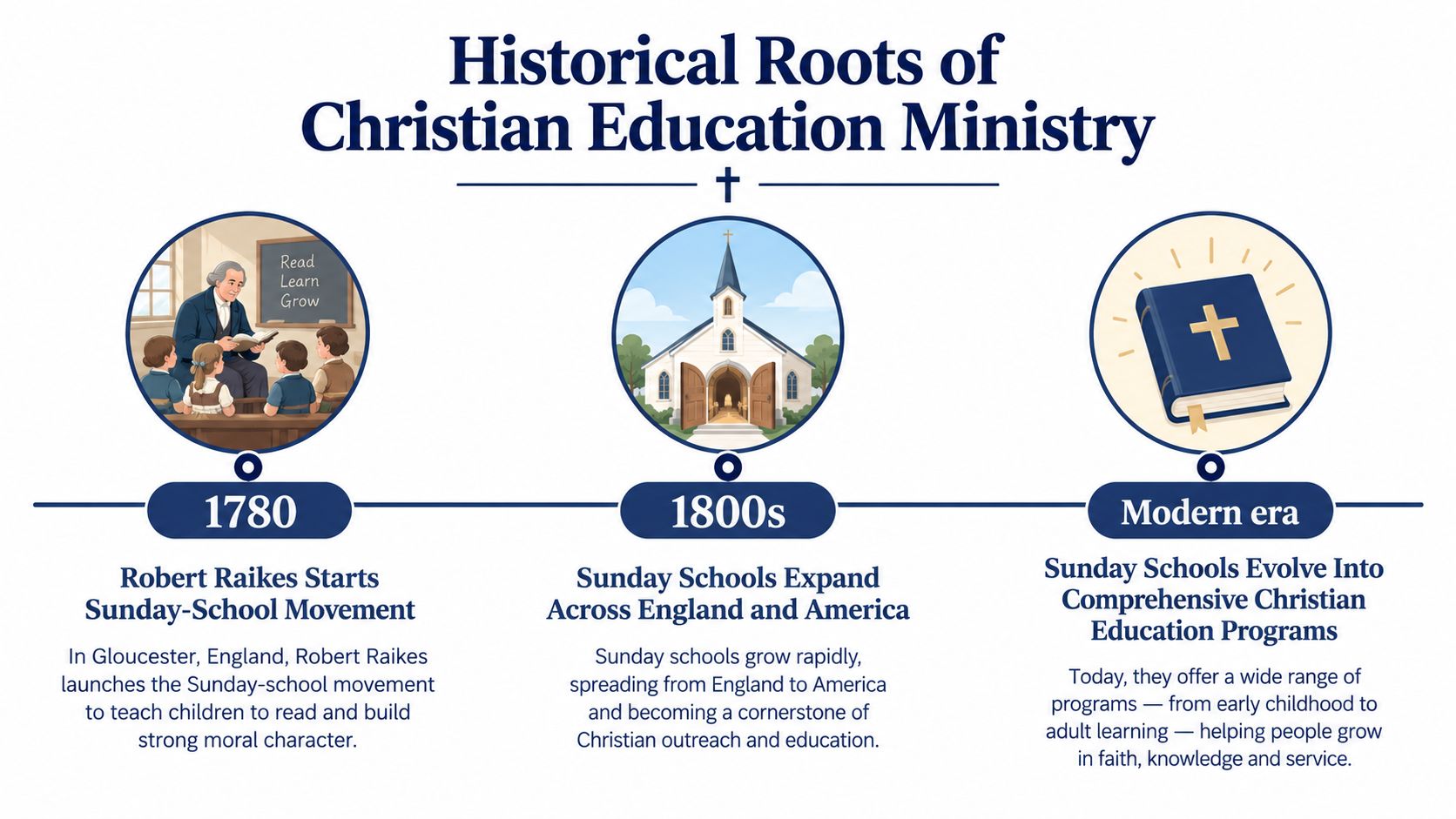
In Gloucester, England, children who worked during the week had limited opportunity for formal schooling. In July 1780, newspaper publisher Robert Raikes helped establish a Sunday school that used Sundays for reading, writing, arithmetic, and Christian instruction. The Bible served as a central text, and the effort joined practical learning with religious teaching.
As Raikes publicized the model in his newspaper, it spread. By 1800, roughly 200,000 children attended English Sunday schools; by 1830, enrollment had reached about 1,250,000, and around 1850, roughly 2 million British children attended weekly religious classes (history of Robert Raikes and Sunday schools). These numbers show that the movement grew into more than a church program. It became a significant educational and community institution for children with limited access to schooling.
A movement built for communities
The movement also crossed the Atlantic and denominational boundaries. The Philadelphia Sunday School Union, described as the first interdenominational Sunday-school association in the United States, was organized in 1791. Its formation reflected a practical insight: churches could extend their reach by coordinating educators and resources.
The movement's scale depended on more than enthusiasm. It required teachers, organized learning, and materials that supported biblical instruction. For a classroom resource connecting early American life and religious instruction, explore teaching faith in early America.
This history offers a continuing principle for Christian education: faithful teaching needs both sound biblical instruction and an accessible structure. A congregation may serve children, new believers, or adults with different levels of Bible familiarity. Thoughtful planning helps educators meet learners where they are while keeping Scripture central.
The Four Working Parts of Christian Education
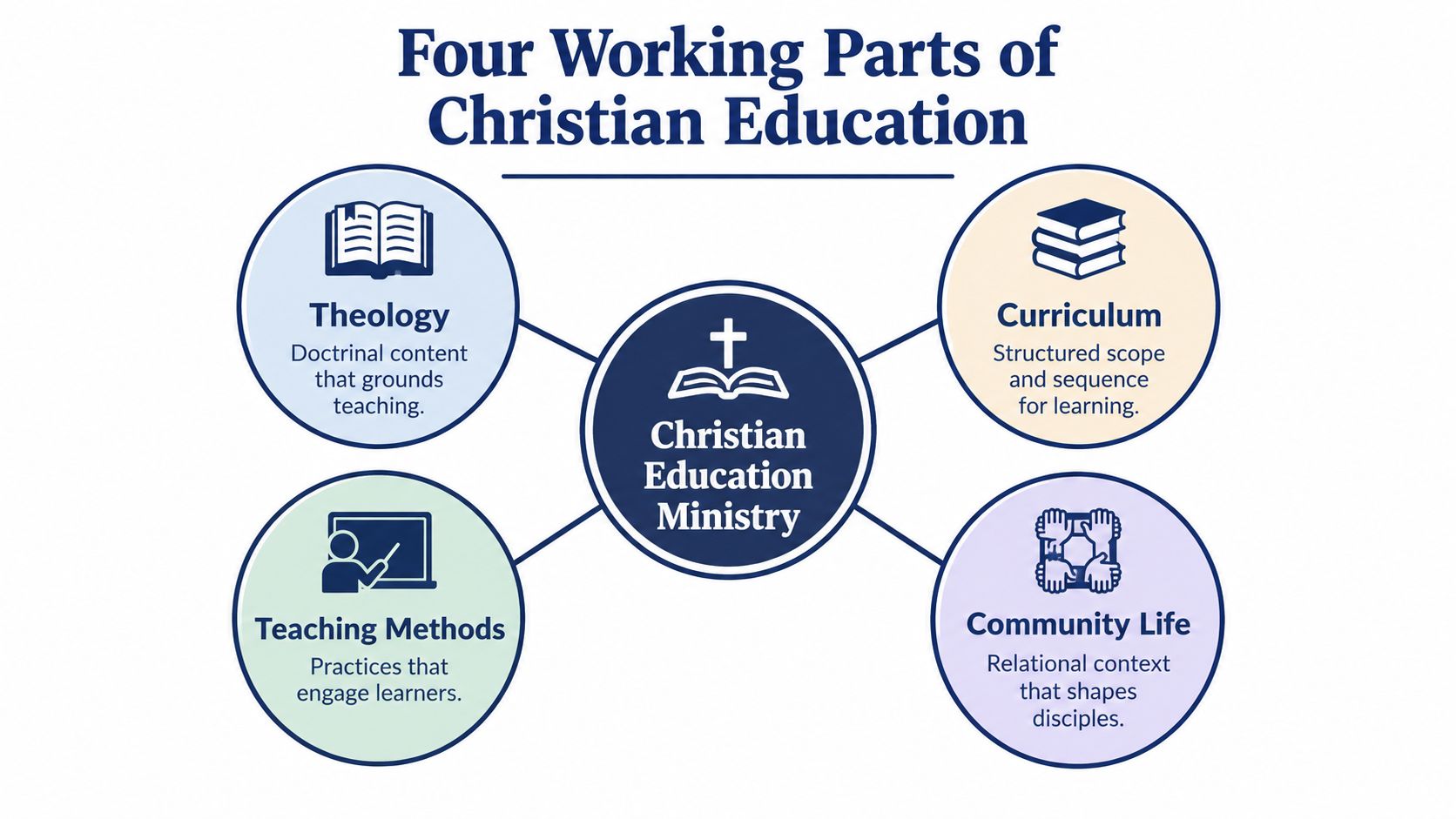
A Christian education ministry needs more than a lesson plan. Theology, curriculum, teaching methods, and community life work together. If one part is weak, even a well-prepared class may struggle to support lasting learning.
Theology gives teaching its grounding
Theology shapes what a teacher believes about God, Scripture, humanity, sin, grace, and the church. Those convictions affect the way a lesson is taught. For example, a teacher who takes grace seriously can correct a struggling learner without treating mistakes as proof that the person doesn't belong.
Curriculum gives learning a path
A curriculum sets out what learners will study and how ideas connect over time. It might help a children's ministry move from learning major stories of Scripture to seeing how those stories fit within the Bible's larger account of God's work. It also helps teachers avoid treating Bible lessons as disconnected episodes.
Teaching methods help learners engage
Pedagogy, a term for the practice and methods of teaching, includes how educators explain, ask questions, invite discussion, and check understanding. A small-group leader might ask learners to describe what a passage says before moving to what it means and how it applies. That sequence gives people room to interpret carefully instead of relying on a leader to supply every answer.
A good teaching method makes space for learners to read, think, ask, and respond, while keeping the biblical text in view.
Community makes learning lived and shared
Christian education takes place among people, not in isolation. A group offers chances to listen, practice Christian care, serve together, and learn from believers with different experiences. The historic Sunday-school movement also shows how organized teaching depends on supporting people and resources: a major Sunday-school union reported organizing 100,928 schools with 578,680 teachers and 4,070,346 scholars by 1899, alongside a substantial publishing effort (historical account of Sunday-school organization).
The four parts belong together. Theology gives curriculum substance; pedagogy helps learners work with it; and community gives them a place to live and share what they learn.
Common Ministry Contexts and Roles
Christian educators serve in more places than a Sunday-school classroom. Their work may involve children, adults, schools, small groups, or ministry teams. The role often determines which teaching and leadership skills matter most.
Research among U.S. churchgoers found that 50% of those with church duties teach or facilitate a Bible study, while 46% lead a ministry such as youth, worship, or a food pantry (Barna research on discipleship and church life). Christian education therefore overlaps with the work of many volunteers, not only people with formal teaching titles.
Roles and the work they require
Sunday school director: Recruits and equips volunteers, coordinates classes, and helps maintain consistent biblical teaching across age groups. Core competency: volunteer development and curriculum planning.
Christian school teacher: Connects academic subjects with a thoughtful Christian understanding of the world. Core competency: sound teaching practice grounded in both subject knowledge and biblical convictions.
Discipleship coordinator: Plans ways for newcomers and established believers to grow through learning, relationships, and service. Core competency: building clear, relational pathways for spiritual growth.
Children's or youth ministry leader: Guides age-appropriate learning and works with families to support young people's faith formation. Core competency: communicating Scripture clearly while earning learners' trust.
Small-group leader: Facilitates Bible discussion and helps members connect a passage with life and service. Core competency: asking useful questions and guiding conversation with care.
Ministry training director: Prepares lay leaders for responsibilities in teaching, care, and service. Core competency: matching training to real ministry tasks and offering feedback.
Some educators use creative media to introduce a Bible story, followed by reading the biblical passage and discussing its meaning. If visual storytelling would help your group, a Bible story video creation tool can be one resource to consider. Any media should support Scripture study, not replace it.
For a study example that can help a group explore biblical people and themes, see this women of the Bible study guide. Whatever the setting, the same question matters: how can a leader help learners move from hearing the lesson to understanding and living it?
Why Formation Matters More Than Information
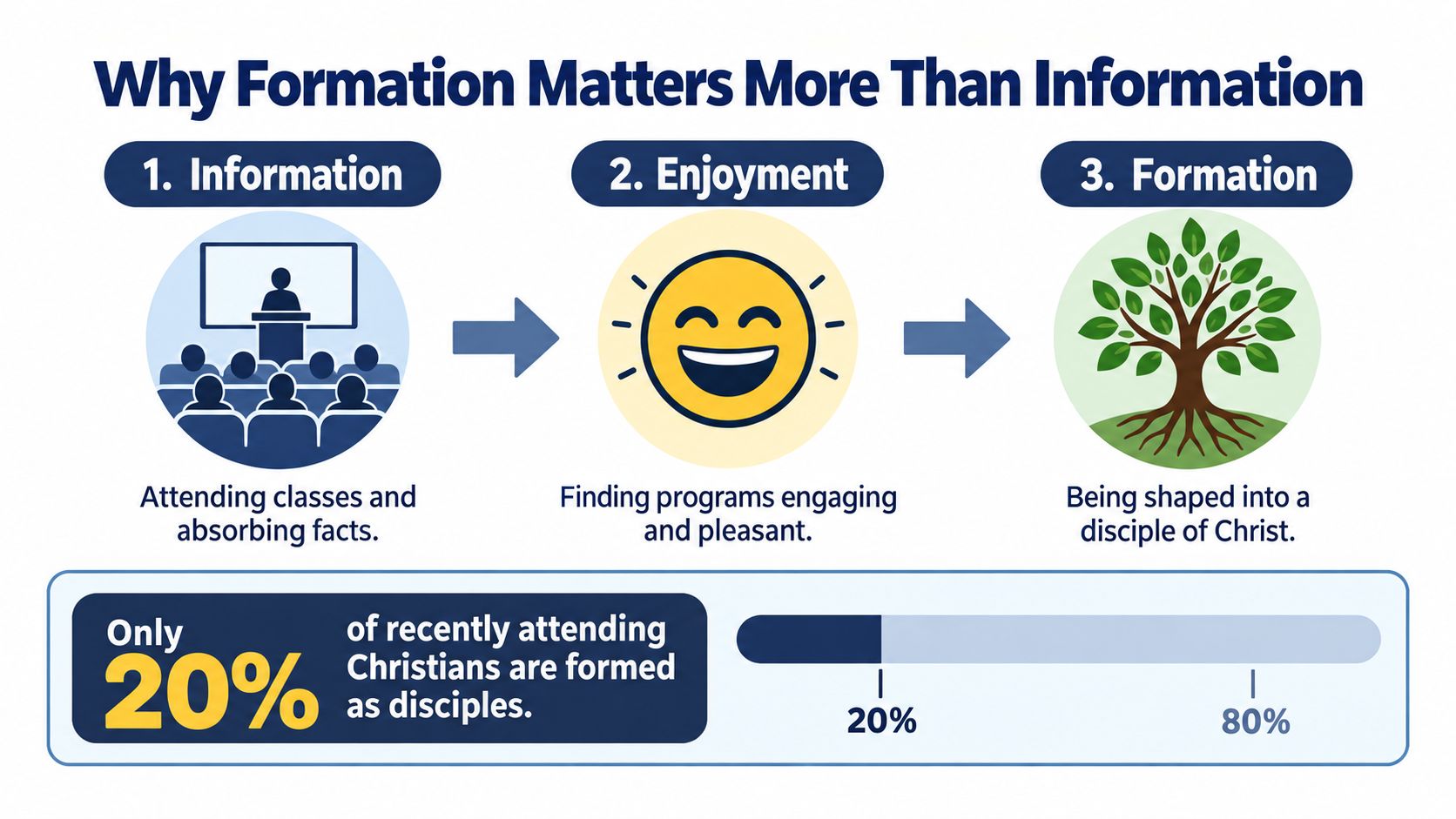
A class can be well attended and enjoyable without giving learners meaningful opportunities to practice discipleship. A 2025 study describes Christian education as teaching and learning aimed at spiritual, intellectual, and moral growth. In survey findings, only 20% of recently attending U.S. Christian adults reported participating in a discipleship activity, and 17% said they meet with a spiritual mentor (study and survey findings on Christian education and discipleship).
Those findings point to a practical challenge, not a verdict on any individual church or learner. Attendance and satisfaction tell leaders something about participation, but they don't by themselves show whether people are learning to interpret Scripture, develop Christian practices, serve others, or guide another person in faith.
A cycle that connects learning to ministry
An educator can strengthen formation by connecting three activities:
Teach: Give learners a sound biblical and theological framework. Invite them to observe a passage in context, understand its message, and consider what Christian tradition teaches about it.
Apply: Give them a concrete opportunity to use what they've learned. A student might lead part of a Bible discussion, prepare a short devotional, serve with a ministry team, or practice pastoral listening under guidance.
Reflect: Talk through what happened. A mentor can help the learner identify what was faithful, what was unclear, and what to work on before the next opportunity.
This knowledge, practice, and reflection cycle makes learning more than content delivery. The teacher offers instruction, the learner tries a ministry task, and a mentor provides feedback. Over time, that process can help identify growth in biblical interpretation, communication, ethical judgment, spiritual practices, and care for others.
For ministry leaders: Evaluate what learners are becoming able to do, not only what they have attended or completed.
Formation isn't a promise that every learner will develop at the same pace. It's a commitment to teach responsibly, build relationships, provide practice, and notice whether the ministry is helping people grow as disciples.
Degree and Certificate Pathways That Build These Competencies
Formal study can help you develop the biblical understanding, teaching ability, and practical judgment Christian education requires. A degree isn't the only way to serve, but structured theological education can bring Scripture, history, theology, and ministry practice into a coherent course of learning.
The Association of Theological Schools reported that, in fall 2023, Master of Arts enrollment reached 27,790, slightly exceeding Master of Divinity enrollment at 27,634 (ATS research on degree enrollment). The near parity illustrates that ministry preparation spans different degree formats and callings.

Match the pathway to your calling
A Master of Arts can suit students seeking focused theological preparation for a particular ministry or educational interest. A Master of Divinity offers broader preparation for pastoral and other forms of ministry. Your choice should reflect your calling, learning goals, and the kind of responsibility you hope to take on.
At The Bible Seminary, nine graduate majors combine in-depth study of all 66 books of Scripture with historical, theological, and practical disciplines. That mix supports several of the field's core needs: theology for sound teaching, broad biblical grounding for curriculum decisions, and practical preparation for ministry contexts. Study that brings Scripture together with history and archaeology can also help learners understand the world of the Bible without overstating what archaeological evidence proves.
Other options can make study more accessible or more closely suited to your situation:
Certificates offer structured theological learning without requiring you to pursue a full degree.
Auditing courses can let ministry professionals and other learners take part in a class without enrolling in a degree program.
Dual-degree completion provides a pathway for students pursuing connected qualifications.
On-demand seminars offer another way to engage biblical and ministry topics.
If you're a working pastor, volunteer educator, or homeschool parent, ask which skills you want to strengthen before choosing a pathway. You may be looking for deeper biblical interpretation, better lesson planning, or preparation to train other leaders. A conversation with a program adviser can help you compare those needs with available study options.
Career Outcomes, Real Examples, and Your Next Steps
Christian education training can prepare people for roles as pastors, ministry educators, discipleship leaders, Bible study coordinators, missionaries, and Christian school teachers. The best pathway depends on the work you feel called to do and the knowledge and skills that work requires.
Ministry Role | Core Competency | Suggested Pathway |
|---|---|---|
Bible study coordinator | Biblical interpretation and group facilitation | Focused graduate study or a certificate |
Sunday school or ministry training director | Curriculum planning and volunteer development | Degree or certificate study in a relevant area |
Pastor or ministry leader | Broad theological and practical preparation | Master of Divinity |
Christian school teacher | Integrating biblical understanding with teaching practice | Relevant graduate study and continuing education |
A simple example shows how formation might carry into ministry: a learner studies a biblical passage, practices leading a discussion with a mentor's guidance, then reflects on how well the group understood the text and felt able to contribute. That sequence gives the emerging educator a chance to strengthen both biblical understanding and teaching judgment. It's a practical model for churches as well as formal training settings.
Effortful, sustained learning also matters for biblical knowledge. In a Pew Research Center survey, Christians who regularly invested effort in learning about their faith answered an average of 9.4 out of 14 questions about the Bible and Christianity correctly, compared with 6.8 among Christians who reported making less effort (Pew Research Center findings on religious knowledge). The finding supports a steady approach to learning that includes Scripture engagement, instruction, and ongoing formation.
Frequently asked questions
How can a church tell whether its education ministry is forming disciples?Look beyond attendance and course completion. Ask whether learners can explain biblical teaching, practice Christian habits, serve others, and help someone else grow. Mentoring and reflection can help leaders see where support is needed.
How can I teach if I feel unqualified?Start with a passage you're prepared to study carefully, and ask an experienced leader to guide you. Teaching is a skill to develop, not a claim that you already know everything. Preparation, humility, and feedback can help you grow.
How can a church stay doctrinally faithful while welcoming hard questions?Keep Scripture central, explain the church's theological convictions clearly, and let learners ask honest questions without shaming them. A trained facilitator can distinguish faithful disagreement from confusion, listen with respect, and guide discussion back to biblical context.
To explore theological study, certificates, and practical preparation for ministry, visit The Bible Seminary.
The Bible Seminary offers Bible-centered graduate programs, certificates, and flexible study options that connect Scripture with theological learning and ministry practice. Explore how this training could serve your calling, or visit the Katy, Texas campus to learn about its community and resources.