
Continuing Education Credits for Ministry Leaders

A continuing education credit is a documented unit of structured learning, not a universal hour, and both the size of that unit and who accepts it are set by the issuing authority. An accounting board counts 50 minutes of participation as one credit; a denomination's clergy guidelines may count ten contact hours as one unit; a seminary counts a credit hour inside a for-credit course. Three different rulers, one phrase.
That's why a certificate reading "0.5 CEU" raises a harder question than it answers. Half of what, measured by whose clock, and recognized by whom? Answer badly in front of a credentialing committee and a summer of conferences becomes a folder of paper that doesn't count. Three things have to agree before any credit travels: the unit, the authority that accepts it, and the record you keep. When they line up, credits are useful. When they don't, you spent the hours anyway.
Table of Contents
What Continuing Education Credits Actually Measure
What does a continuing education credit prove? It records a defined amount of learning under a particular system. Like a receipt, it documents what took place, but it does not certify the learner's competence or guarantee that another authority will accept it.
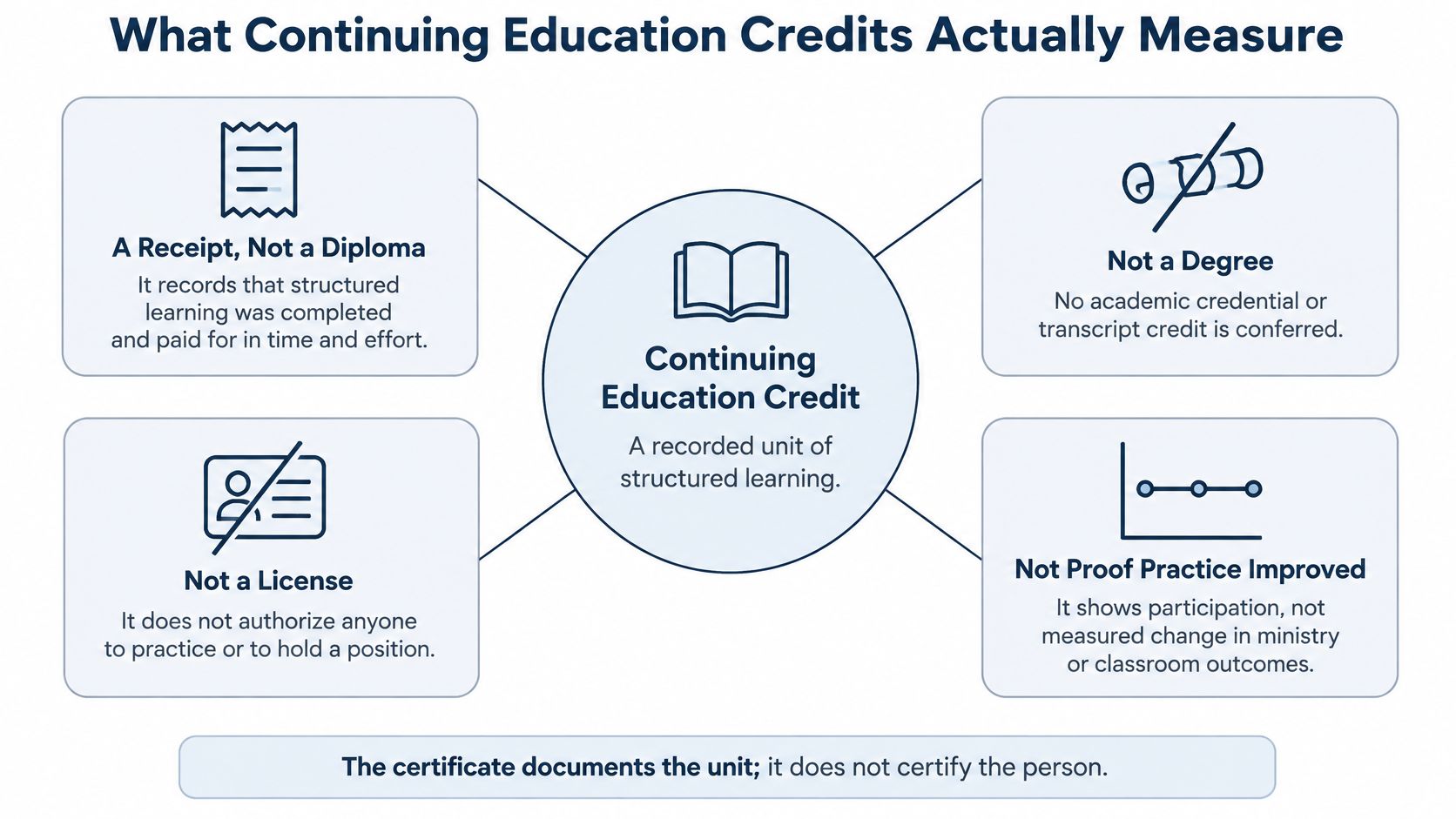
Three kinds of credit are often confused. Their units may sound similar, but they measure different things.
The professional development credit. The National Association of State Boards of Accountancy defines one continuing professional education credit as 50 minutes of participation in a learning program. The measure is instructional time, not the event's advertised length, as set out in NASBA's Statement on Standards for CPE Programs. A two-hour session therefore represents 100 minutes of instruction, not 120. The licensing authority decides whether a course qualifies. A sponsor's approval mark alone does not settle acceptance.
The clergy CEU. Denominations that use continuing education units may count contact hours rather than 50-minute periods. A clergy unit can represent a full day of instruction, depending on the denomination's rules. So a clergy CEU and an accounting CPE credit are different measures, not interchangeable labels.
The seminary credit hour. A graduate credit hour belongs to a for-credit course, with assignments, assessment, and a transcript. A workshop certificate does not become a credit hour, and a credit hour does not automatically count as a CEU. The distinction applies in other fields, too. A logged flight hour only has meaning against a stated regulatory minimum, as the 35-hour private pilot minimum explained illustrates. The school records the hour, but the applicable rule determines what it counts toward.
System | Unit | Amount and cycle | Extra rule |
|---|---|---|---|
NASBA CPE | 50 minutes of participation | Set by the licensing authority | Sponsor approval does not guarantee acceptance |
Minnesota professional development | At least 50 minutes | 24 hours in 2 years | 2 ethics hours; ethics credit cannot carry forward |
Washington CPA | CPE hour | Requirements set by the licensing authority | Check the applicable authority's ethics requirements |
ICF CCE | CCE unit | 40 units every 3 years | At least 24 units in Core Competencies |
ICF ACC renewal | Same 40-unit cycle | Completed within 3 years | Also 10 hours of Mentor Coaching |
Church of the Brethren clergy CEU | 10 contact hours | 5 CEUs, or 50 hours, in 5 years for full-time leaders | At least five focus areas; part-time service prorated |
Treat these rows as separate rulebooks, not variations of one formula. Minnesota requires 24 professional development hours in a two-year renewal period, including two ethics hours that cannot carry forward, according to its continuing education requirements. In coaching, the ICF credential renewal standard sets a 40-unit total every three years, with at least 24 units in Core Competencies. The ICF renewal requirements also require 10 hours of Mentor Coaching. A learner can meet the overall unit total and still miss a subject or activity requirement.
The rule that governs everything else: a credit is worth what the accepting body says it is worth, not what the certificate says.
Before counting hours, identify the authority for your role. For a pastor, it may be a denomination or church board. For a Christian school teacher, it may be the association the school answers to. For a counselor, it is the licensing board. Credits travel only when the unit, the accepting authority, and the learner's records agree. Even then, an hour total documents learning activity, not ministry competence.
How to Earn Credits That Can Be Documented
Earning a credit that survives review is a documentation exercise, not a seat-time exercise. Six checks stand between a good conference and a defensible record, and each one is something a reviewer could audit.
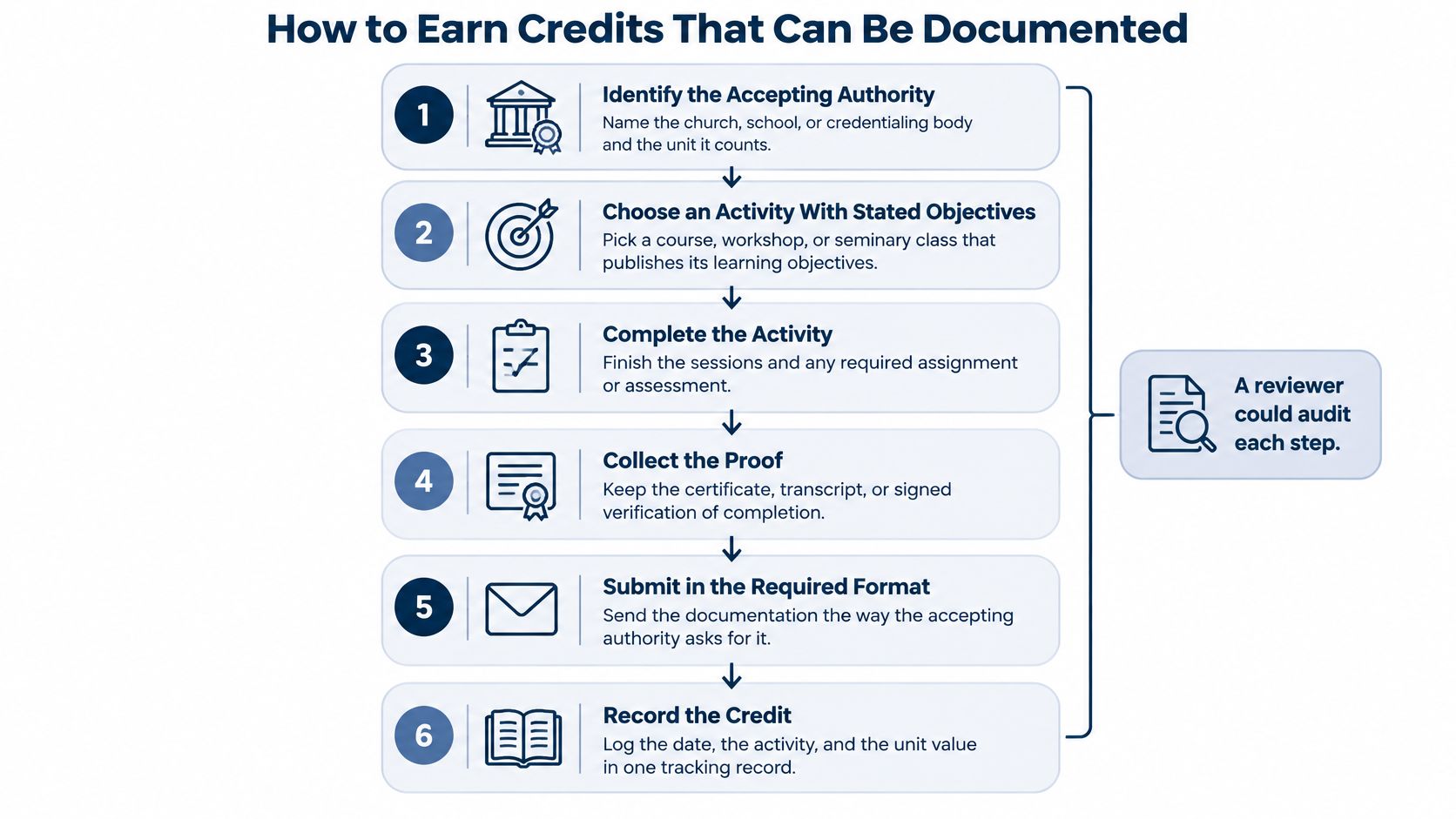
Identify the accepting authority and the unit it counts. Write down the body, the unit, the cycle, and the subject rules before you enroll. If the answer is "I'll find out later," you've already lost the option to choose a different course.
Choose an activity with stated objectives. A seminar, workshop, audited course, or for-credit class all work, provided the provider publishes what the learner should be able to do afterward. Objectives that read "grow in ministry effectiveness" won't help a reviewer.
Confirm instructional minutes, not clock time. Registration at 8:30 and dismissal at 4:00 is not seven hours of instruction. Breaks, meals, and announcements don't count, and a provider who quotes the schedule instead of the minutes is telling you something about their records.
Complete an observable task. Case analysis, a sermon or lesson plan, a ministry plan, a written reflection. Something exists afterward that didn't exist before, and a second person could evaluate it.
Collect a certificate that states the particulars. Contact time, objectives, completion date, assessment method, instructor, and any ethics or specialty label. A certificate with a name and a date but no hours is decoration.
Store the record yourself. The provider's portal is a convenience, not an archive, and it may not exist in five years.
The design logic behind those checks comes from evidence about what changes practice. A 2023 review of continuing professional development standards found that lectures, conferences, and symposia used alone generally have little effect on professional performance or health outcomes, while interactive activities using multiple methods and repeated exposure produce stronger results, according to the review of CPD standards in human resources for health. The same review found e-learning broadly as effective as face-to-face delivery when it includes interaction, application, and follow-up instead of passive video. That's encouraging for anyone taking ministry training at a distance.
It also carries a caution. The review found no evidence for one universally optimal quantity of CPD, and retention varies with task complexity and skill type. Anyone promising that a fixed credit total will improve your preaching is guessing.
A reviewer with a file folder should be able to reconstruct the learning without calling you.
Certificates matter more when the accepting body moves. A teacher who needs documentation for a language-teaching credential, for instance, will find that the paperwork is the deliverable, which is why services like ELTica let you download your TEFL certificate with the hours and dates already stated. Whether an association recognizes the hours is a separate question answered by that association. When the Association of Christian Schools International is the accepting body, provider status becomes the practical question, and we have been an approved CEU provider for ACSI since October 2015.
Pick one upcoming event on your calendar and run the six checks against it this week. Most gaps show up at step three or step five, while there's still time to ask the provider.
A Clergy Example of Credits in Practice
A clergy member's credit total is useful only when the unit matches the requirement and the accepting authority recognizes the learning. A denominational framework can show how the arithmetic works, but its rules do not automatically apply to other churches, professions, or training providers.
For example, one CEU may be defined as 10 contact or instructional hours, and a full-time ministerial leader may be expected to earn five CEUs over a five-year review period. Under that framework, the total is 50 contact hours. The unit and expectation belong to that specific framework, so confirm them with the body that will review your record.
Hours are only one part of the requirement. Leaders may also need education across at least five designated focus areas. Twenty seminars on preaching technique could meet an hour total yet fail to cover the required areas. Recorded material may have a separate reporting rule, too: a minister may need to submit a continuing-education report for each event, so viewing is documented rather than assumed.
Part-time expectations can differ. A framework may prorate them according to the pastoral-congregational agreement. A bivocational pastor serving a rural congregation at half time should check the agreement rather than assume the full-time total applies unchanged.
Three learning formats, three different records
Compare a weekend conference, a recorded lecture, and a graduate course. Each creates a different kind of evidence.
The weekend conference may provide contact hours when attendance and learning objectives are documented. Keep the program and schedule, and record the sessions you attended, not every session listed in the brochure.
The recorded lecture needs evidence of participation. Watching at home does not create an attendance record, so complete any report required by the accepting body.
The graduate course offers theological study and may count toward a denominational requirement. It does not automatically convert into a set number of CEUs. A three-credit semester course represents far more than 50 contact hours of work, but academic credits and CEUs measure different things. Any conversion belongs to the authority reviewing the course.
The distinction matters when describing what you learned. Fifteen hours in Romans and fifteen hours of hospital visitation training are different learning experiences, even if both fall within the same review period. A total records time; it does not by itself demonstrate ministry competence.
Label the area, not just the hours. A preaching workshop, counseling seminar, and administration course may all count, but they do not necessarily satisfy the same focus area. Record the area alongside the activity so a reviewer can see what the learning addressed.
The framework's subject categories help make that record clearer. Preaching, teaching, counseling, administration, and community leadership each represent a different area. Labeling an activity with the area it addresses can make its relevance easier to assess.
This is one worked example, not a universal rule. Another denomination may use a different unit or review cycle. A Christian school association or counseling board may set its own requirements, including specific subject components. Credits are portable only when the unit, accepting authority, and learner's records align.
How to Track Credits You May Need Later
A course may be complete, yet its credit can be hard to use years later if the supporting records are missing. Keep the files in a location you control, not only in a provider's online account. The goal is to show what you completed, when you completed it, and which authority might accept it.
Record | Why it matters | Timing risk |
|---|---|---|
Certificate with contact time, objectives, date, and assessment | Shows what was completed | Keep it for the full renewal or audit window |
Attendance or engagement evidence | Distinguishes participation from registration | A closed provider portal may erase it |
Syllabus and instructor identity | Helps another body judge the content | A job change does not move the file automatically |
Assessment result and certificate number | Connects the result to the learner | Missing numbers can weaken a later appeal |
Carryover note | Shows whether unused credit survives | British Columbia allows only limited amounts and looks back five periods |
The final row concerns an insurance rule, not a clergy requirement. British Columbia permits limited carryover, up to 15 credits for life and accident-and-sickness licensees and up to 8 for general insurance licensees. It also requires records covering the previous five license periods. The Insurance Council of British Columbia continuing education Q and A explains these rules and warns that relying on a third-party system can leave licensees unable to retrieve records later.
These rules show why the timing belongs in your record. A course completed after a deadline may not count for the current renewal period, even if it can count in a later one. Whether unused hours carry forward depends on the authority's rules, so do not assume they will.
The same record-keeping problem appears in ministry settings. A pastor changes churches, and the new board asks for documentation the previous board never required. A teacher's school changes platforms, and completion history disappears with the old provider. A ministry leader may have a conference, webinars, an audited course, a certificate program, and a graduate class on file, yet only some of those records may match the credentialing body's requirements.
A folder of hours is not proof that each authority will recognize them. Recognition depends on the unit being claimed, the accepting authority's rules, and records that connect the learner to the completed work. Even a provider-held copy or a friendly email may not establish all three.
Save the certificate and supporting files when they arrive. Add one line to the folder naming the renewal window they may serve. That small habit keeps the record usable when a board, school, or credentialing body asks for evidence.
Where Credits Fit in Ministry Work
A pastor already carrying a full load might reasonably ask why the paperwork is worth it. The short answer: credits make learning visible to the people who make decisions about your ministry. A church board, a school, or a credentialing body can only weigh what it can see in a form it recognizes.
Four ministry responsibilities show the pattern without repeating the mechanics.
Preaching. A workshop on exposition can be documented with a sermon plan produced afterward, tying the training to the pulpit rather than to a conference badge.
Counseling and care. A seminar on grief or crisis care is documented with a case reflection, which also gives you something to review before the next hospital visit.
Christian schooling. A course counts as professional development only when the school's own association is the accepting body. The same course may mean nothing to a different association.
Graduate Bible study. A seminary course remains academic study unless a denomination has agreed to count it as a required unit. That's a conversation to have before enrolling, not after.
Short, structured learning is where most of this work happens, and the wider adult-learning picture explains why. Across participating OECD countries, about 40% of adults take part in formal or non-formal education and training in a typical year, with non-formal learning such as short courses, workshops, and job-related training averaging 37% of adults against only 8% enrolled in formal programs, per the OECD trends in adult learning report. Roughly half of adults neither participated nor wanted to during the preceding 12 months. The short course is the common shape of adult learning, and the long formal program is the smaller slice.
Two claims the evidence doesn't support are worth naming. A fixed credit total doesn't make a minister faithful or effective, and attendance by itself doesn't change practice. Credits document structure. Character and competence are formed by something else.
Scripture sets the frame for the diligence itself. Paul writes to Timothy, "Do your best to present yourself to God as one approved, a worker who has no need to be ashamed, rightly handling the word of truth" (2 Timothy 2:15, ESV). That's a quotation from the English Standard Version, and it's a call to careful handling of the word of truth, not a mandate to log hours. A paraphrase like "study hard so your credentials stay current" would flatten the verse into something Paul didn't say.
Ask of every event: which ministry task will this change, and who besides me will be able to see that it did?
Match one responsibility to one kind of learning this quarter. The pairing does more than a catalog of options.
Barriers That Hour Counts Hide
An online catalog can make learning look accessible, yet the barriers learners report are often practical: distance, cost, family duties, and time.
A continuing-professional-development study found that location or accessibility was the leading barrier, at 76.6%. Cost followed at 59.7%, family commitments at 52.5%, and busy schedules at 52.2%, according to the study of barriers to continuing professional development. The study recommends blended and decentralized delivery. Online access can help, but it does not by itself remove these obstacles.
Barrier | Share | Source group |
|---|---|---|
Location or accessibility | 76.6% | Continuing-professional-development study |
Cost | 59.7% | Continuing-professional-development study |
Family commitments | 52.5% | Continuing-professional-development study |
Busy schedules | 52.2% | Continuing-professional-development study |
The figures describe reported barriers, not a rule that applies equally to every learner. For ministry workers, the same practical pressures may take different forms. A bivocational pastor works a weekday job and preaches on Sunday. A rural leader may face a long drive to attend an event. An international learner may have limited bandwidth, currency conversion costs, or a time difference that makes a scheduled webinar difficult to join.
Asynchronous access can ease scheduling and distance constraints. It cannot erase every cost of participation.
The true cost of a credit extends beyond registration. It can include travel, childcare, unpaid time away from a congregation or job, internet and device limits, assessment work, and the time required to document eligibility afterward. A credit may fit the formal requirement while remaining difficult to earn or use.
Price the credit in money and in hours before you register, and be honest about both.
Four assumptions can lead learners astray: a webinar is not automatically credit, a free event is not automatically accepted, online delivery is not automatically accessible, and a provider's certificate is not automatically portable. Credit has practical value only when the unit is clear, the authority that accepts it recognizes it, and the learner keeps records that show what was completed. A total of hours alone does not establish ministry competence or guarantee recognition.
Participation can widen through blended or local options, downloadable materials that work offline, low-bandwidth access, and clear credit terms on registration pages. Deadlines that account for a church calendar can also make learning more workable. These choices address access, while careful records and the accepting authority determine whether earned credits can be used.
Plan Your Next Step in Biblical Study
Three paths lead out of this, and the right one depends on who is asking you for documentation.
Path one, a body requires credits. Ask that body five questions before you register anywhere: which unit it counts, how long the renewal cycle runs, whether a subject distribution applies, whether unused credits carry forward, and what documents it accepts as proof. Get the answers from the body itself, not from a provider's marketing page.
Path two, you need structured biblical study for ministry. If you serve in vocational or volunteer leadership and want a defined course of study rather than scattered events, look at our certificate programs at The Bible Seminary. The Certificate of Theological Studies is 27 credit hours of graduate-level education for anyone serving in vocational or volunteer leadership, and it's worth reading the current requirements on the live page rather than relying on a summary. Treat that study as a strong option until the accepting authority confirms it counts as CEUs or another required unit.
Path three, you need flexibility while serving. We offer both on-campus programs and Distance Education programs, and the seminary is a member of NC-SARA and approved to offer Distance Education. Check delivery format, dates, and admissions details against the current site before you plan a term around them.
Keep one distinction fixed in your mind. A multi-year ministry degree and a continuing-education package are not the same unit, and degree credit doesn't convert into a workshop certificate by wishful arithmetic. They serve different purposes and different authorities.
Whatever path you take, the order is the same. Confirm the authority, confirm the unit, confirm the record, and only then enroll. Program names, tuition, credit hours, and delivery formats change, so verify any detail that matters against the official source before you commit.
The Bible Seminary exists to equip ministry leaders through rigorous, Bible-centered study, and that includes learners who need documented, structured education rather than one more conference. Whether you're exploring our Certificate of Theological Studies, considering an audited course, or comparing on-campus and Distance Education formats, we're glad to help you sort the unit from the credential before you invest a semester. Start at The Bible Seminary and take the next step with your accepting authority's requirements in hand.