
Women of the Bible Study Guide for Small Groups

A small-group leader sits at a kitchen table with three study books open, a phone displaying a devotional, and a list of women from Scripture that keeps growing. One resource offers inspiring character sketches. Another raises difficult questions about authority and leadership. A third supplies historical background but leaves the leader wondering how to turn research into a faithful, welcoming discussion.
A sound women of the Bible study guide can bring those pieces together. It helps a group read the biblical text directly, ask honest questions, understand historical setting, and respond to God with humility. The purpose isn't to make every woman in Scripture fit one modern template. It's to listen carefully to the whole counsel of God and see how each story participates in His redemptive work fulfilled in Jesus Christ.
Why a Women of the Bible Study Still Matters Today
A women's Bible study may begin with a simple request. Someone wants to understand Ruth's loyalty, Esther's courage, Mary's faith, or Priscilla's ministry partnership. Yet the group soon discovers that biblical women aren't merely inspirational portraits. Their stories address family, power, suffering, worship, hospitality, courage, injustice, witness, and the purposes of God.
Consider a leader preparing a study on Deborah. A character-only approach might celebrate her courage and move on. A stronger approach asks how Judges presents her role, what the narrative says about Israel's condition, how Barak responds, and what the passage does and doesn't establish about women's leadership in every setting. That distinction protects the group from both minimizing the text and making claims the text doesn't make.
Every named woman deserves careful attention
Women are a minority in the Bible's named-character record, which makes each named woman textually significant. One widely cited analysis identifies about 1,700 distinct personal names in the Bible, including 137 women, while another estimate for the Hebrew Bible identifies 1,426 names, including 111 women. These figures place women at roughly 5.5% to 8% of named biblical figures. A separate conservative estimate includes 188 to 205 named women compared with 1,181 named men when the Apocrypha is included. These estimates are summarized in the reference overview of women in the Bible.
The numbers don't tell us how valuable women are to God. They describe the narrative record and its male-dominant naming patterns. They also remind us that many women remain unnamed, so the biblical witness includes more female figures than the named list alone suggests.
Women's direct speech is also limited in the canon. One research project counted 93 women who speak, including 49 named women, and estimated that women's recorded words total a little over 14,000 out of about 1.1 million Bible words, or around 1.2%. Another summary estimates approximately 10,000 words spoken by women in the King James Bible, again around 1.2%. These figures appear in Religion News' discussion of women's speech in the Bible.
A small textual footprint can carry major theological weight.
Study for formation, not novelty
A careful study forms more than biblical knowledge. It teaches participants to notice God's faithfulness, grieve sin, resist shallow comparisons, and recognize the dignity of people whom communities overlook. Leah's story, for example, shouldn't be reduced to a lesson about feeling unattractive or unwanted. Genesis presents family deception, unequal affection, childbirth, longing, and God's attentive care within the covenant story.
A Christ-centered group asks how Scripture directs us toward the Lord's character and the gospel. Mary Magdalene's witness in the resurrection accounts, the courage of Esther, and Lydia's hospitality all invite thoughtful application, but none should be detached from the larger biblical story. At The Bible Seminary, we approach this work by uniting scholarship, spiritual formation, and hands-on ministry, training hearts and minds for kingdom service.
How to Study Each Woman Without Misreading the Text
A small-group leader begins with a familiar story, then notices that the passage resists an easy lesson. Ruth is not merely a model of loyalty, and Mary Magdalene is not an example of courage. Each woman stands within a literary, historical, and theological setting. Careful study lets the text shape the discussion rather than forcing the woman into a modern slogan.
A reliable method keeps the passage in charge. Move through observation, interpretation, and application, then examine authorship, audience, genre, and historical setting. Baylor's study guidance, cited here as the Women in the Bible study guides, also encourages direct engagement with assigned passages, shared study materials, prayer, and worship.
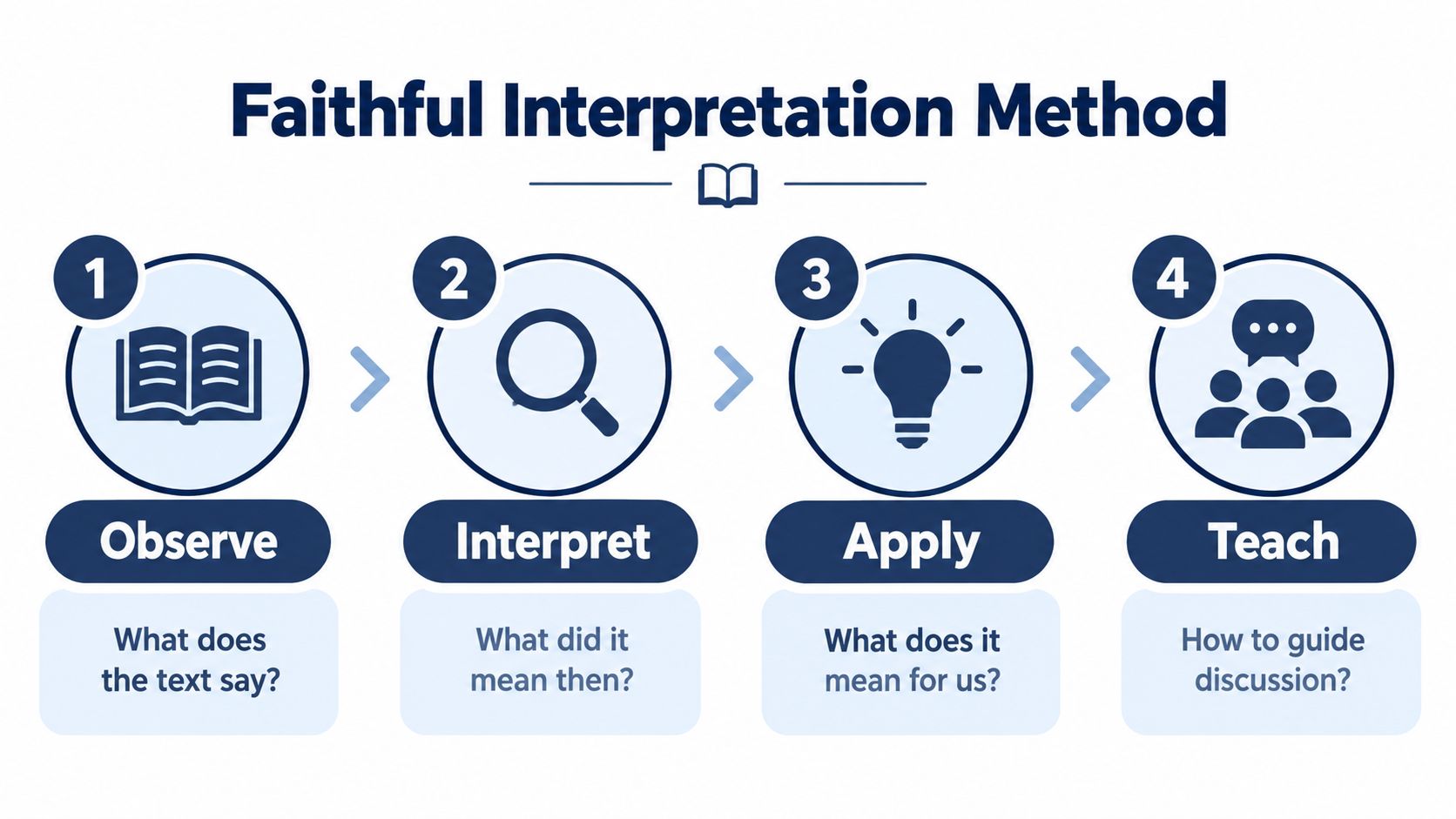
Observe before you explain
Read the passage aloud twice. The four-step women's Bible study workflow begins with observations, delays interpretation, records 2–3 unresolved questions, and ends with one concrete response or act of obedience.
Ask what the passage presents:
Notice the scene: Where does the encounter occur, and who is present?
Track the words: What does the woman say, and what do others say about her?
Watch the movement: What changes from the opening to the conclusion?
Mark the silence: What does the narrator leave unstated, and which conclusions would be speculative?
With Ruth, observation includes her decision to remain with Naomi, her covenant language, Boaz's actions, and the story's movement toward redemption. Interpretation then considers loyalty, covenant faithfulness, land, kinship, and providence within Ruth's historical and literary setting.
Interpret within the whole passage
Context protects a group from turning one verse into a rule. Ask who wrote the book, its intended audience, its purpose, and its genre. Narrative tells what happened, but description alone does not establish a command. A letter addresses real churches, so a difficult instruction belongs within that letter's argument, social setting, and theological claims.
Leaders also need to distinguish explicit teaching from responsible inference. If Scripture presents a woman as a judge, witness, host, prophet, or coworker, state what the text establishes. Then name the questions on which Christians have reached different conclusions, especially questions about authority, teaching, and leadership. Historical context can clarify the passage without deciding every theological dispute for the group.
Observation asks, “What does the text say?” Interpretation asks, “What did it mean in its setting?” Application asks, “How should we respond faithfully?”
Apply with humility and specificity
Application should arise from the passage, not from the leader's preferred theme. It may call for repentance, prayer, reconciliation, courage, generosity, or changed treatment of people whose voices communities often ignore. Give participants room to respond faithfully in different ways.
End with one concrete practice. A group studying Mary Magdalene might commit to speak truthfully about the resurrection and encourage a believer who feels disqualified from bearing witness. A group studying Lydia might welcome someone new into the church community. Leaders at The Bible Seminary likewise connect scholarship, spiritual formation, and hands-on ministry, helping study leaders carry biblical understanding into faithful service.
Planning Your Multi Week Session and Reading Schedule
A good schedule gives people enough Scripture to read without turning preparation into a burden. The following six-week plan works for a Sunday school class, home group, campus cohort, or ministry team. Leaders can expand individual sessions when a group needs more historical or theological background.
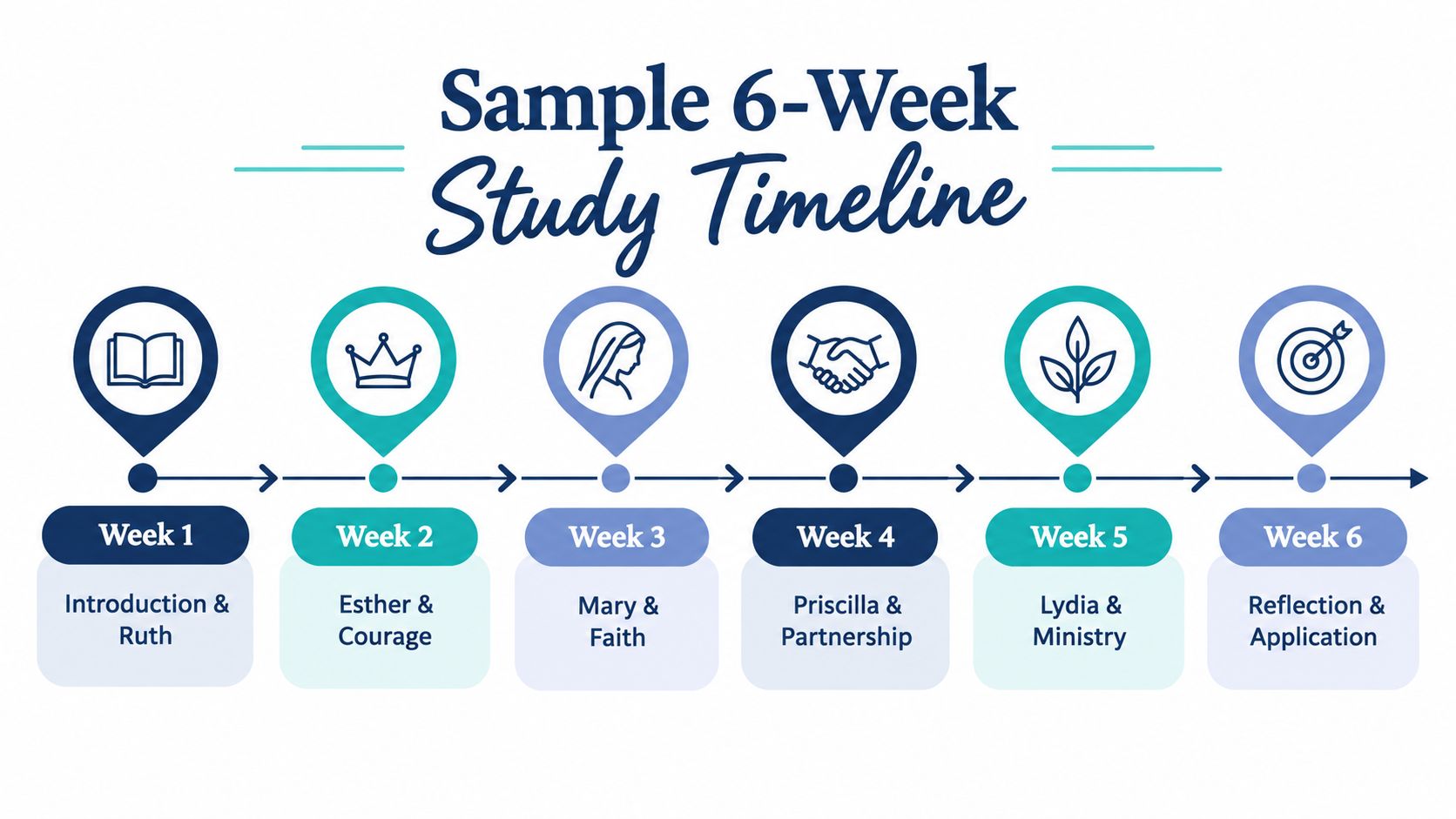
A flexible six-week plan
Week | Primary reading | Central emphasis | Leader preparation |
|---|---|---|---|
1 | Ruth 1 to 4 | Loyalty, providence, and redemption | Read the book as one story and identify repeated words |
2 | Esther 1 to 10 | Courage, wisdom, and responsibility | Note the political setting and the book's emphasis on hidden providence |
3 | Luke 1 to 2; John 2 | Mary, faith, obedience, and discipleship | Compare Mary's words across the passages |
4 | Acts 18:18-28; Romans 16:3-5 | Priscilla, teaching, and partnership | Observe how Luke and Paul describe her ministry context |
5 | Acts 16:11-15, 40 | Lydia, hospitality, and household ministry | Trace the relationship between conversion, welcome, and mission |
6 | Selected review passages | Christ-centered reflection and response | Gather observations, unanswered questions, and prayer needs |
Use the direct Bible passages as the central assignment. A study guide can support the conversation, but it shouldn't replace Scripture. Baylor's guide recommends distributing the materials, assigning the passages, and incorporating prayer and worship rather than treating study as an academic exercise alone.
A repeatable meeting rhythm
A 60-minute session might include prayer and worship, a brief review of the reading, observation, interpretation, application, and closing prayer. If your group has less time, shorten the opening and protect the discussion of the passage. If conversation runs long, record the remaining questions and assign them for the next meeting rather than rushing the final application.
Prepare leader notes under three headings:
Textual notes: Repeated words, important transitions, characters, places, and literary contrasts.
Context notes: Authorship, audience, genre, historical setting, and relevant cultural practices.
Pastoral notes: Questions that may touch grief, infertility, marriage, abuse, authority, or exclusion.
For a quiet group, give participants time to write before asking for responses. For a talkative group, invite each person to identify the verse that shaped their observation. Keep disagreement anchored to the passage, and never make a participant disclose personal pain to prove spiritual maturity.
Theological Background for Key Women You Will Teach
A leader may face a question before the group has finished reading: “Was Ruth's story mainly about finding a husband?” or “How could Deborah serve as a judge?” Prepare for those questions by beginning with the biblical passage, then adding historical and theological context. Background should function like a map. It helps the group see where a detail belongs without replacing the road itself, which is Scripture.
Ruth and Naomi
Ruth enters the story as a Moabite widow who remains with Naomi and travels to Bethlehem during the period of the judges. Her loyalty is personal, familial, and shaped by covenant commitment. The narrative also brings land, kinship responsibility, vulnerability, and community law into view. Boaz's actions make better sense when the group considers the legal and social framework surrounding his response.
Guide participants away from treating Ruth as a formula for obtaining a particular romantic outcome. The resolution highlights God's providence and the preservation of a family line. Its genealogy places the story within the history leading to David, and Christian readers see that history moving toward Christ. Ask what the text emphasizes before asking what the story might suggest about relationships today.
Deborah and Jael
Judges 4 and 5 present Deborah as a prophet and judge in Israel. She summons Barak, communicates the Lord's command, and participates in Israel's deliverance from oppression. Jael then becomes central to Sisera's defeat, while Judges 5 offers poetic reflection on the event.
A participant may ask, “How could Deborah be a judge if women were not allowed to hold that position?” That question deserves a careful answer rather than dismissal or a sweeping conclusion detached from Judges. Examine the narrative's description of Deborah, the way Israel's leaders respond to her, and the passage's place in the book's repeated pattern of deliverance and failure. BibleWise addresses the kind of doctrinal question readers bring to Deborah's role, but the biblical text remains the primary assignment.
Mary Magdalene and the resurrection witness
The Gospels identify Mary Magdalene among Jesus' followers and place her at the center of the resurrection testimony. Read the relevant accounts together. Note their differences in scene and emphasis without assuming that variation creates contradiction. The resurrection stands at the center of Christian proclamation, and the Gospel writers present women as significant participants in announcing the risen Christ.
The eyewitnesses of Jesus resource from The Bible Seminary can serve as a companion while the group studies Mary Magdalene, Joanna, and the other Mary. Use it to support observation and comparison, not to shift attention away from the Gospel testimony. Mary should not become merely a symbol in a modern debate. The group should first ask what each account says about her actions, her message, and the risen Jesus.
Priscilla, Lydia, and difficult letters
Acts 18 names Priscilla alongside Aquila and describes their role in helping Apollos understand the way of God more accurately. The passage opens discussion about teaching, partnership, hospitality, and the relationship between private instruction and public ministry. In Acts 16, Lydia is described as a worshiper of God who responds to Paul's message, receives baptism with her household, and offers hospitality to the emerging church.
The letters addressed to Timothy and Titus raise difficult questions about authority, teaching, household order, and church leadership. Ask leaders to read those passages in their literary setting, compare them with the wider New Testament witness, and identify which conclusions arise from the text and which come from modern assumptions. Baylor's guide includes women's roles in the letters to Timothy and Titus, along with Mary Magdalene and Deborah's daughters. These subjects require direct engagement with Scripture, historical awareness, and patient discussion.
Hard questions deserve patient exegesis, not quick slogans.
Adapting the Guide for Different Groups and Practical Tips
The same passage can serve a new believer, a seminary student, a homeschool family, or an experienced pastor, but the leader must adjust the questions. Depth doesn't require using every available detail. It requires choosing the detail that helps this particular group see the text clearly.
For beginners, define terms such as exegesis, meaning drawing meaning from the text, and eisegesis, meaning reading our own ideas into the text. Give them a short passage and ask them to circle repeated words before asking what the passage means. Seasoned students can compare translations, consult commentaries, and evaluate competing interpretations.
Match the method to the setting
An intergenerational group benefits from paired discussion, where older and younger participants answer the same observation question before sharing together. A workplace group may need a shorter reading and careful boundaries around personal disclosure. A larger church class can collect questions on cards so quieter participants have a voice.
Homeschool families can turn the study into a reading, geography, vocabulary, and prayer experience. Christian educators can ask students to distinguish narrator comment, character speech, and application. In Katy, Texas, and beyond, local churches can use the same material in a women's group, leadership cohort, or mixed adult class.
Use tools that preserve textual precision
Verse mapping gives participants a concrete way to investigate a passage. The method includes selecting a verse, writing it in different translations, researching key Hebrew or Greek words, documenting the people, places, and context, and recording what was learned. LifeWay's verse mapping guide outlines these mechanics.
A verse-linked database also helps leaders avoid overgeneralizing from summaries. Women in the Bible organizes biblical women by the specific verses where they appear, which supports returning to the text whenever a group makes a broad claim.
For further facilitation practice, use this guide to teaching the Bible effectively. It can help leaders connect preparation, explanation, discussion, and ministry response without losing warmth.
The best adaptation changes the pace and vocabulary, not the authority of Scripture.
Next Steps to Lead with Confidence and Keep Growing
A fruitful study doesn't depend on having every answer before the first meeting. It depends on a leader who reads carefully, welcomes honest questions, identifies uncertainty, and keeps directing the group toward God's Word and the person of Christ.
Before launching, choose the passages, create leader notes, and decide what participants will read between meetings. During the series, track unanswered questions rather than hiding them. After the final session, ask what helped the group observe the text, where discussion became unclear, and which practices should continue.
Further training can deepen this work. Explore The Bible Seminary's academics and degree programs for structured Bible and ministry education, or consider certificates and flexible study options for continuing formation. Leaders interested in the relationship between material history and Scripture can also consult TBS archaeology resources, while churches and supporters can learn about ministry partnership through the giving page.
Women's stories deserve more than quick character sketches. They call us to read with reverence, interpret with discipline, serve with courage, and trust the Lord who sees His people fully. This is how we equip leaders to impact the world for Christ, uniting scholarship, spiritual formation, and hands-on ministry for kingdom service.
Explore biblical studies, ministry training, certificates, and archaeology resources at The Bible Seminary. Bring your women's Bible study leadership questions to a community committed to training hearts and minds for kingdom service, where the Bible comes alive through archaeology, Scripture, and faithful ministry preparation.