
What Degree Do You Need to Be a Pastor in 2026?

What good is a pastoral degree if the church you hope to serve doesn't recognize it? Choosing the right education means asking not only what you'll study, but who will recognize that preparation and what ministry responsibilities you'll be authorized to carry out.
For prospective theology students, that distinction can prevent an expensive detour. Your next step should connect biblical learning, practical preparation, and the written requirements of the church where you want to serve.
Table of Contents
What Scripture Says About Pastoral Qualifications - What the text requires - How churches apply those qualifications
Three Standards That Decide Your Path - Employment and church policy - Ordination and credentialing
Why the Master of Divinity Is the Ordination Benchmark - How the curriculum serves pastoral formation
Education Levels Across Denominations and Church Types - Use the pattern, then verify the rule
M.A., Certificates and Bi-Vocational Ministry - Test recognition before choosing convenience
Confirm Your Denomination's Requirement Before You Enroll - Compare education with recognized authority
The Short Answer on Pastor Degree Requirements
What degree do you need to become a pastor? There is no single required degree across U.S. churches. A church or denomination sets its own academic requirements, and those requirements can differ from the education typically associated with clergy work.
The CareerOneStop occupational profile, which draws on Bureau of Labor Statistics data, lists a bachelor's degree as the typical entry-level education for clergy. That describes an occupation, not a universal rule for ordination or permission to lead a congregation.
Role or Context | Typical Degree Expectation | Where the Rule Comes From |
|---|---|---|
Entry-level clergy occupation | Bachelor's degree | CareerOneStop occupational profile |
Ordained pastor in many denominations | Master of Divinity or equivalent | Denominational ordination rules |
Pastor in a congregation without ordination | Local training or ministry experience; sometimes no formal degree | Local church policy |
These rows describe different kinds of authority. An occupational profile gives a general picture of education for work in a field. A denomination's ordination rules determine what preparation it requires for recognized ministry, while a local congregation may set its own standards for pastoral service.
CareerOneStop also describes clergy as generally having graduate education in theology, divinity, or a related field, along with several years of experience. Its bachelor's-degree entry-level classification and this broader description refer to different stages of preparation.
If your immediate question is how to enter undergraduate study without A-levels, Access Courses Online entry routes addresses that admissions issue. It is separate from whether a church or denomination will recognize your degree for a particular ministry role.
Bottom line: A bachelor's degree may fit the general entry-level profile for clergy, while many ordained roles require graduate theological study. The authority that sets the requirement determines what the degree qualifies you to do.
What Scripture Says About Pastoral Qualifications
What does Scripture ask of a church leader, and what does it leave to churches to decide? In 1 Timothy 3:1–7 and Titus 1:5–9, Paul describes the character and teaching responsibilities of overseers without naming an academic degree.
In the English Standard Version, 1 Timothy 3:2 names qualities including “above reproach,” “sober-minded,” “self-controlled,” “hospitable,” and “able to teach.” These are excerpts from the verse. The following verses also address responsible household leadership and warn against appointing a recent convert.
What the text requires
Titus adds moral and doctrinal responsibilities. In summary, Titus 1:7–9 calls an overseer to reject arrogance, a quick temper, violence, and greed, and to practice self-control, uprightness, holiness, and discipline. The leader must hold firmly to trustworthy teaching to instruct others and correct what contradicts it.
The passages do not set a bachelor's, master's, or doctoral requirement. A degree can provide theological education, but it does not by itself demonstrate the character or teaching ability these texts describe.
How churches apply those qualifications
Churches may use formal theological study to develop biblical interpretation, teaching, and doctrinal understanding. Other congregations may place greater weight on mentoring, recognition by the community, and demonstrated readiness to serve. These are different ways of applying the scriptural qualifications, not academic thresholds stated in the passages.
Teaching tools serve a separate purpose. Someone who uses a tool to make Bible story videos with AI should check its script, quotations, and visuals against Scripture. A video can help present a lesson; it cannot establish whether a church leader meets the qualifications described in 1 Timothy and Titus.
Three Standards That Decide Your Path
Think of pastoral preparation as a road passing through three gates: employment, church policy, and ordination. Passing one doesn't automatically admit you through the others.
The diagram separates the decisions you'll need to investigate.
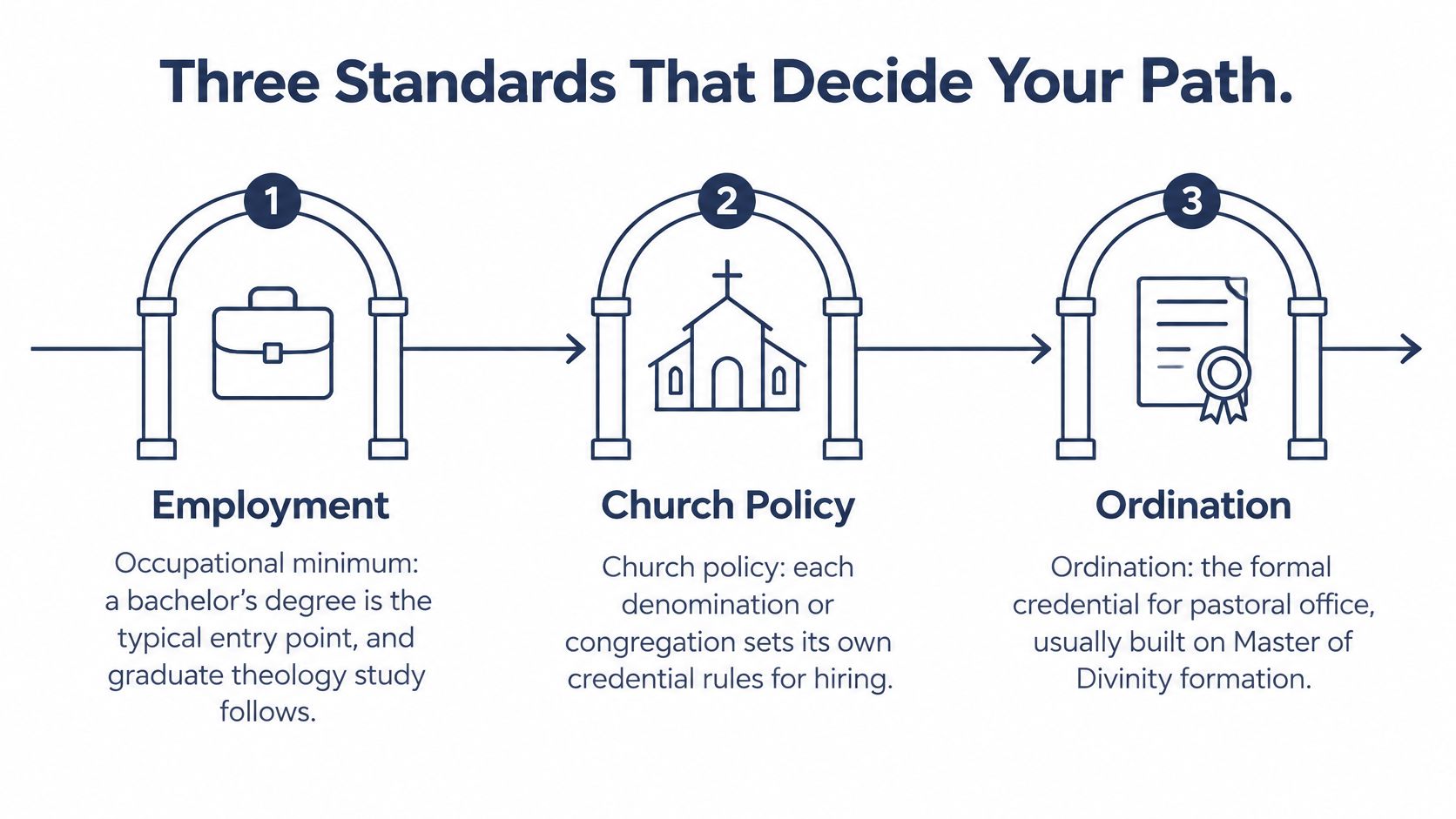
Employment and church policy
Employment concerns eligibility for a job. The CareerOneStop clergy profile cautions that its education profile describes workers' preparation rather than establishing mandatory entry requirements. A job applicant therefore needs the actual position description, not just an occupational classification.
Church policy establishes the employer's academic expectations. A presbytery might require an MDiv; a congregation might accept a bachelor's degree alongside supervised ministry. A non-denominational church might have no formal degree rule while still requiring demonstrated biblical understanding and leadership maturity.
Say a candidate holds a bachelor's degree in Bible and applies for a youth pastor position. A church that accepts that preparation could hire the candidate, yet a denomination requiring an MDiv could still decline to ordain that same person.
Ordination and credentialing
Ordination concerns recognized pastoral authority within a church's governing structure. A denomination, bishop, presbytery, credentialing council, or congregation may evaluate doctrine, supervised service, examinations, and personal readiness before recognizing a candidate.
The seminary's admissions office can explain academic eligibility, but it can't speak conclusively for every ordaining body. Likewise, a hiring pastor's approval may not settle the requirements of a denominational credentialing council.
Ask for answers that identify both the decision-maker and the document governing that decision. An informal assurance that a degree should be fine is less useful than written confirmation that the program satisfies a named requirement.
Ask the employer: What education and experience does this position require?
Ask the denomination: What must I complete before ordination or licensing?
Ask the seminary: Is this particular program recognized by both, and who can confirm that recognition?
Why the Master of Divinity Is the Ordination Benchmark
The Master of Divinity, usually abbreviated MDiv, is designed as professional formation for ministry rather than academic study alone. Its significance lies in the combination of biblical learning, theological reflection, practical instruction, and supervised service.
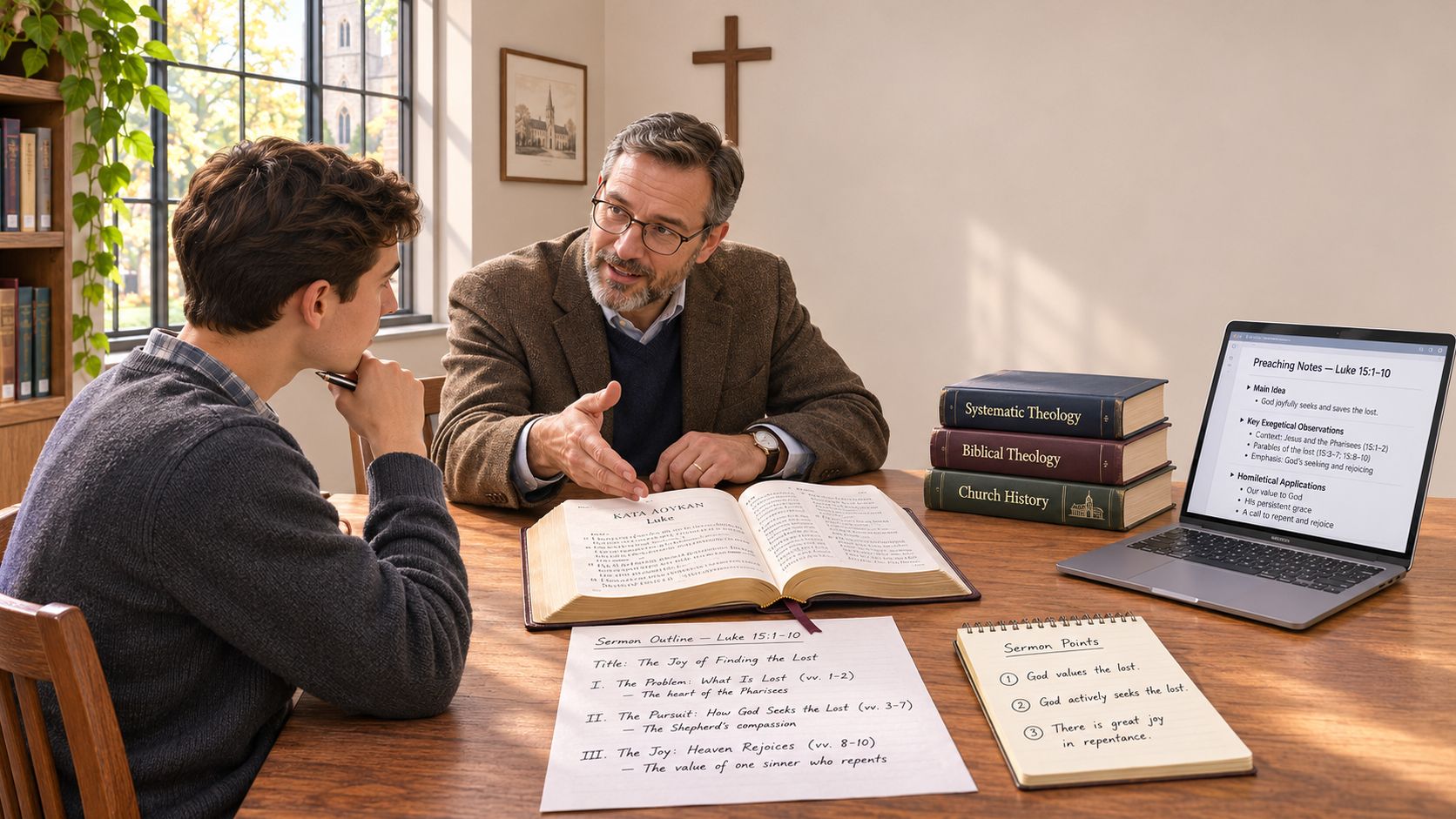
Mentored preparation helps connect study with the responsibilities of caring for a congregation.
According to Calvin Theological Seminary's ordination guidance, the MDiv is the most common educational level required for ordained pastors in most denominations, and candidates may also need ministry experience and denomination-specific courses or examinations. That guidance describes a common pathway, not TBS's curriculum or every church's rule.
How the curriculum serves pastoral formation
A typical MDiv integrates biblical languages or exegesis, theology, church history, preaching, pastoral care, leadership, and supervised ministry. Each area addresses a different responsibility: interpreting a passage carefully, explaining Christian doctrine, preparing a sermon, responding to suffering, or leading a congregation responsibly.
Supervised ministry adds something that classroom performance alone can't establish. A candidate may write a strong paper on pastoral care but still need guidance in listening, maintaining boundaries, and responding thoughtfully to a grieving family.
The degree records completed preparation. Ordination is the church's decision to recognize a candidate for pastoral responsibility.
A master's degree in theology can provide substantial academic depth without including the same preaching practice, field education, or assessed ministry formation. That doesn't make it an inferior degree. It means the degree's purpose must match the ordaining body's expectations.
The accompanying video offers another resource for considering pastoral preparation.
Before enrolling, compare the actual curriculum and recognition requirements rather than relying on the degree title alone:
Institutional accreditation: Confirm the school's status and whether the ordaining body accepts it.
Denominational recognition: Obtain confirmation for the specific program, not merely the institution.
Field education: Establish which placements, supervisors, and assessments qualify.
Examinations: Identify doctrinal interviews, polity courses, or other requirements beyond graduation.
Education Levels Across Denominations and Church Types
Pastors' education varies across church traditions, but educational patterns do not establish ordination rules. The Bureau of Labor Statistics' theology degree profile reports that 48% of theology-degree holders working as clergy held an advanced degree. That figure describes people with theology degrees who work as clergy, not pastors as a whole.
Reported education and clergy employment patterns
Group | Reported degree level | What the figure describes |
|---|---|---|
Theology-degree holders working as clergy | 48% held an advanced degree | Degree holders in clergy jobs |
Clergy workers | 49.16% needed a master's or professional degree; 18.32% needed a bachelor's degree | Education listed for clergy work in College Board's government-survey profile |
U.S. clergy workers | 230,977 had graduate degrees; 126,889 had bachelor's degrees | Degree holders counted in Data USA's 2024 clergy profile |
These figures measure different things: the degrees people hold and the education associated with clergy work. They also cover broad groups, so they cannot tell you what a particular denomination or congregation requires.
Use the pattern, then verify the rule
Start with the tradition closest to your intended ministry setting, then ask its relevant authority for the requirements that apply to your role. A broad educational pattern can help you understand what is common, but it does not determine which degree an ordaining body recognizes or what responsibilities it permits.
For Catholic ministry, consult the relevant diocesan or religious formation authority. In Protestant settings, check with the specific denomination and clarify whether its rules differ by role or congregation. A degree may show academic preparation; the church or denominational authority decides how that preparation counts toward ministry permissions.
M.A., Certificates and Bi-Vocational Ministry
Say you work full-time, want to serve a small church part-time, and may seek ordination later. An MDiv deserves consideration, but so do a Master of Arts, theological certificate, audited courses, and denomination-specific licensing education.
The practical question isn't which route is shortest. It's which route prepares you for today's responsibilities without unnecessarily restricting tomorrow's options.
According to Axios's reporting on theological education, U.S. MDiv enrollment at Association of Theological Schools institutions fell 14% between 2020 and 2024, while two-year M.A. programs and non-degree enrollment helped produce a 1.8% overall enrollment increase; approximately 30% of Michigan United Methodist clergy reportedly pursued alternative educational pathways for licensure rather than traditional ordination.
How shorter pathways compare with the MDiv
Pathway | What the evidence shows | Possible limit |
|---|---|---|
Master of Divinity | Common ordination benchmark combining biblical, theological, historical, practical, and supervised preparation | Its scope may be difficult to accommodate alongside full-time employment |
Two-year Master of Arts | M.A. programs contributed to the overall enrollment increase | May lack the field education an ordaining body expects |
Certificate, audit, or non-degree study | Non-degree enrollment also contributed to the increase | May not count toward ordination or recognition elsewhere |
Denomination-specific licensure | The Michigan example illustrates an alternative to traditional ordination preparation | Recognition may be restricted to particular roles or church structures |
Test recognition before choosing convenience
A certificate isn't a degree, and auditing a course shouldn't be assumed to earn academic credit. A licensing program may satisfy a denomination's requirements without producing a broadly transferable academic credential.
Compare total cost, schedule flexibility, theological depth, supervised practice, and denominational acceptance. A manageable schedule matters, but so does access to feedback on teaching and ministry.
Recognition: Does my denomination accept this credential for the role I want?
Ordination: Does this study count toward ordination, or would I need additional preparation?
Portability: Would another denomination recognize it, and would another school accept its credits?
Planning principle: A shorter pathway can be sufficient for a particular role and still limit later mobility or eligibility for senior service.
Confirm Your Denomination's Requirement Before You Enroll
A degree can meet one church's hiring standard and still fall short of another body's ordination requirements. Before committing to tuition or a study schedule, ask the authority responsible for the role you want to serve.
Request written requirements. Obtain the denomination's or congregation's hiring and ordination policies.
Confirm degree and accreditation rules. Ask whether an MDiv or equivalent is required and which accrediting bodies the church recognizes.
Clarify supervised preparation. Find out whether internships, supervised ministry, or clinical pastoral education count toward licensing or ordination.
Test the schedule. Check whether required classes and placements fit your church responsibilities, employment, and family commitments.
Identify ministry permissions. Ask which credentials permit preaching, communion, weddings, baptisms, and funerals. Confirm whether weddings have separate civil requirements and whether recognition continues if you move.
Use these questions to guide conversations with admissions staff and church leaders.
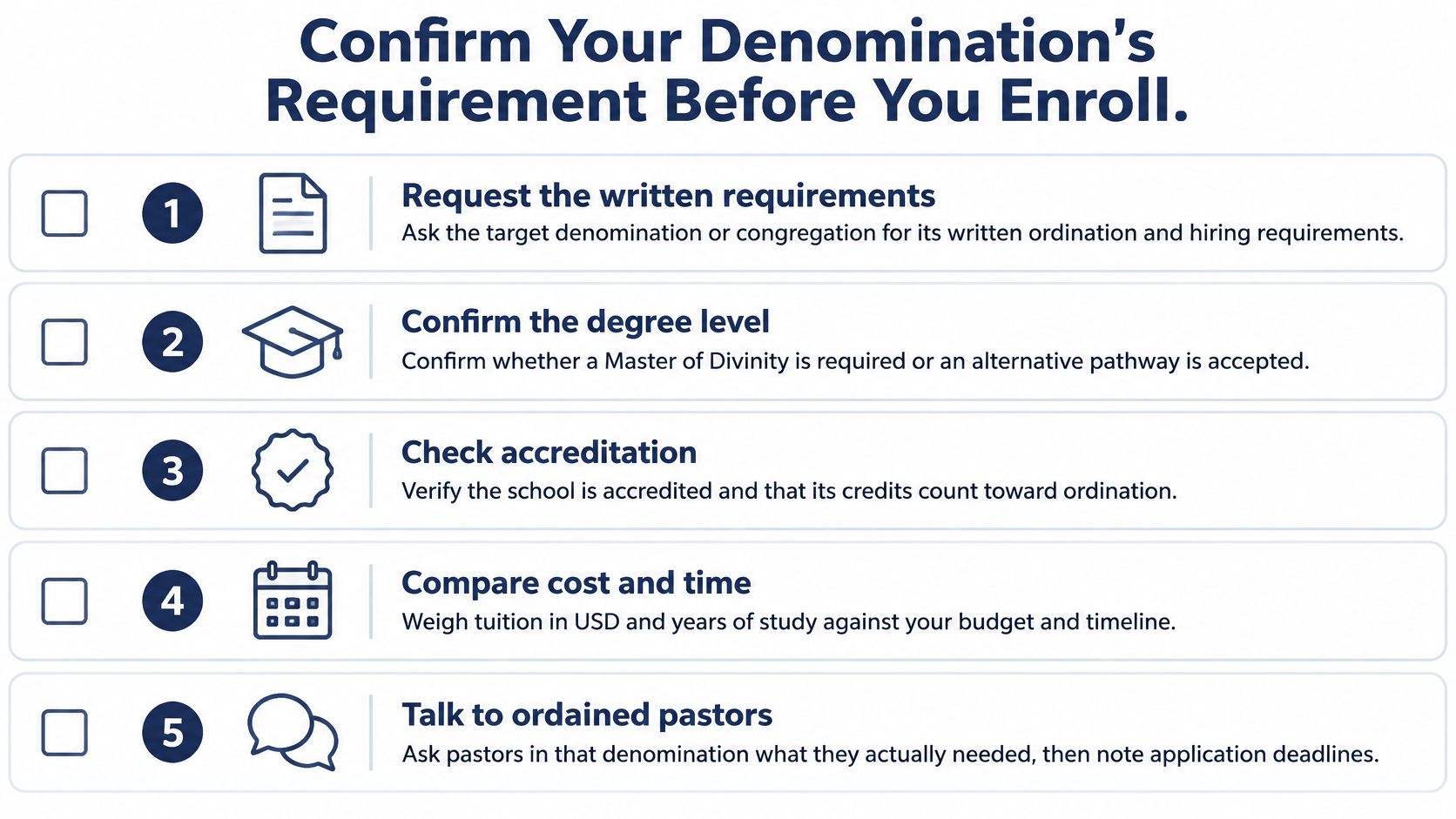
Compare education with recognized authority
A bachelor's degree in Bible might meet a church's youth pastor hiring requirement but not its MDiv requirement for ordination. Compare programs against the written rules, using our guide to schools for pastors to identify options.
At The Bible Seminary, the MDiv requires 84 credit hours and a three-year study of all 66 books of the Bible. The M.A. covers all 66 books in two years, with four majors ranging from 48 to 60 credit hours. The seminary is an accredited member of the Transnational Association of Christian Colleges and Schools (TRACS).
The seminary provides education; the denomination, bishop, presbytery, credentialing council, or congregation decides whether a credential qualifies you for recognition and ministry permissions. Confirm acceptance with the authority that will grant them.
The Bible Seminary offers Bible-centered graduate education for students preparing for ministry and leaders continuing their theological training. Visit The Bible Seminary to request program information, then compare the curriculum with your denomination's written requirements before choosing your next step.