
What Do You Learn in Seminary? a Guide to the Courses

Ask a church volunteer what you learn in seminary and you'll get a familiar list: Greek, Hebrew, theology, preaching, church history. Every item on it is true, and none of it answers the question behind the question, which is what you'll be able to do at the end that you can't do now.
That gap matters more than it used to. Graduates increasingly serve outside a pulpit, so a curriculum is only worth what it turns into: the ability to open a passage in a hospital room, hold a board meeting together, or explain a doctrine to a class without mangling it.
Every discipline on that list has a job inside the program. Naming the job is the fastest way to tell whether a school will prepare you for the work you're heading toward.
Table of Contents
Integrating Study and Practical Ministry Training - A congregation in conflict, worked through - Three questions for an admissions conversation
Bible Translations and How to Quote Scripture Accurately - Rules for quoting Scripture
Reading Scripture in Its Original Languages - Six steps from text to sermon
Church History and Doctrine Students Work Through - One council, one sentence - The method students learn
Spiritual and Personal Formation in Seminary - What to ask about formation
Choose a Study Route and Take the Next Step - Three steps to a decision
Core Subjects in a Seminary Curriculum
A seminary curriculum works like a workshop bench. The same tools sit in the same drawers at most schools, and each drawer has one job. At The Bible Seminary, each graduate major studies all 66 books of Scripture alongside historical, theological and practical disciplines, as the Christian ministry training overview describes. Scripture runs through the middle of that bench. History, theology and practice are the tools you pick up to work on it.
The individual courses are stable from school to school, and each one carries a specific learning task rather than a general topic.
Discipline | What students study | What it prepares you to do |
|---|---|---|
Old and New Testament surveys | Literary movements, historical settings, major themes and first-century context | Explain the whole Bible in its setting to a class, a small group, or a visitor |
Hermeneutics | Principles for responsible interpretation | Read a passage for a lesson or a hard conversation without proof-texting |
Hebrew and Greek exegesis | Original-language tools for close reading | Test a translation or a word study before you teach it |
Systematic theology | Doctrines of God, Christ, salvation, the church and last things | State what the church believes, and why, in plain language |
Church history | Christian teaching and movements across the centuries | Show a group how a tradition or a debate took shape |
Homiletics | Sermon preparation and delivery | Prepare a clear message for a pulpit, a classroom, or a training session |
Pastoral care | Listening, counsel, boundaries and care | Listen, set boundaries, and care for people in visits and hard conversations |
Capstone or thesis | Integrated research and communication | Pull the parts of the program into one piece of research or teaching |
The third column lists capabilities you carry into several kinds of ministry work, not a single job title. A finished student can open a passage and say what it means in its own setting, check a translation against the underlying language, and assemble a doctrine from several texts. The same student can trace where a tradition came from and then teach that material on Sunday, in a classroom, or in a staff training hour.
Order changes what those courses can do. Survey courses work like a city map: you see the whole layout before you walk any one block, which is why they come early. Exegesis slows you to a single paragraph, the way a close look at one intersection shows you details the map never named. Systematic theology asks what the whole Bible teaches once both of those are in place. Homiletics and pastoral care then ask what any of it means for the person in front of you, whether that person is a congregation, a student, or someone you are visiting. The capstone asks you to hold the parts in one piece of work.
That sequence is what turns a list of subjects into training you can use.
Integrating Study and Practical Ministry Training
A surgeon learns anatomy, technique, and bedside manner in the same years, because each one changes how the others work. Knowing every nerve in the hand does little if you cannot tell a frightened patient what happens next. Seminary uses that same arrangement. Study and practice run together so a graduate can serve a church, a classroom, a nonprofit, or a care setting.
The map below shows where academic study and hands-on training meet.
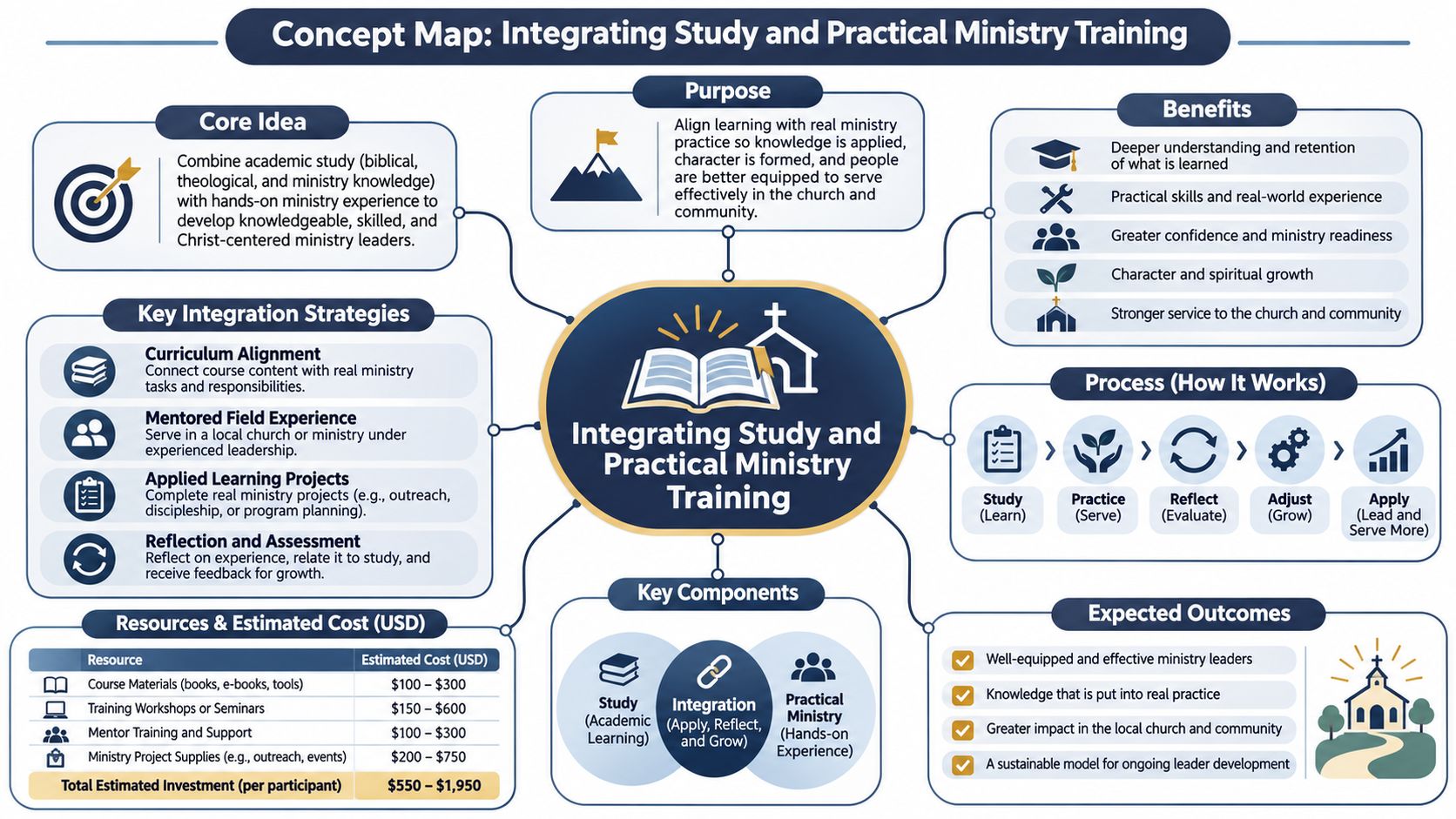
Accrediting standards expect a program to define clear learning outcomes and then test them. The Association of Theological Schools requires ongoing evaluation using quantitative and qualitative evidence, with faculty analysis feeding curricular improvement, according to its standards of accreditation with self-study ideas. A finished program should be able to show evidence that students can do the work the course described.
A congregation in conflict, worked through
Say a church splits over how a long-serving staff member's departure was handled. The student who has done the work starts by slowing down. She reads the passages that seem to apply in their original languages and historical settings, names the theological claim those passages support, works out how a leader could apply that claim without dismissing the people on either side, and then checks whether the response helped or made things worse.
That same cycle fits a shrinking congregation, and it fits roles besides the senior pastor. A children's ministry director, a nonprofit chaplain, or a church administrator can use it. Define the question. Gather information on congregational history, demographic change, spiritual practices, and organizational structure. Interpret it theologically and socially. Act. Evaluate the results. That sequence is what the standards mean by ministerial practice. It separates a leader who reacts from one who diagnoses.
The Bible Seminary describes practical ministry education as the bridge between theological understanding and service. Practical ministry training connects biblical and theological study to church and community work, as the religious studies degree program descriptions set out. Experiential education at the seminary occurs through classroom instruction, study tours, hands-on ministry training, and community-based training with ministry professionals. A study tour trains the eye the way a lab trains a surgeon's hand. Classroom work supplies the map. Time with a ministry professional tests whether the map matches the street.
Three questions for an admissions conversation
How is each learning outcome assessed? Ask for direct evidence: examinations, research papers, preached sermons, portfolios, supervised ministry evaluations. Student satisfaction surveys are indirect evidence and should not carry the argument on their own.
What supervised ministry is required, and who supervises it? A placement with a weekly supervisor and a written evaluation teaches more than a placement with a sign-in sheet.
Which courses build the role I want? Ask for course numbers rather than category names, then confirm the capstone lets you integrate the area you care about. That question matters if the role is teaching, counseling, administration, or missions rather than the senior pastor's chair.
A filter that works: count assessments. Portfolios, preached sermons, and supervised ministry evaluations show judgment. A catalog shows coverage.
Bible Translations and How to Quote Scripture Accurately
A youth leader prints a handout. A counselor quotes one verse in a care note. A writer posts a passage under a photo. Each person reached for "the Bible," yet English versions do not say the same sentence in the same way. Those differences show up exactly where a lesson, an article, or a pastoral conversation gets built.
Translation study starts with that distinction. Students at The Bible Seminary work through all 66 books of Scripture and then have to speak from those books in real ministry, including roles that never involve a senior pastor's pulpit. Choosing a translation is part of that speaking.
Translation type | Examples | How it reads | Best use |
|---|---|---|---|
Formal equivalence | NASB, ESV, KJV, NKJV | Stays close to original wording and structure | Word studies and close reading of an argument |
Optimal equivalence | CSB, NIV | Balances accuracy with natural English | Preaching, teaching, and general study |
Dynamic equivalence | NLT, GNT | Puts the author's meaning in contemporary language | Reading whole books and teaching newcomers |
Paraphrase | The Message | A retelling, not a direct translation | Devotional reading, not quotation |
A kitchen scale and a measuring cup both deal with ingredients, and they answer different questions. Formal, optimal, dynamic, and paraphrase versions work the same way. No column is the one correct Bible. The habit worth learning is naming which question you are asking before you quote.
Rules for quoting Scripture
Name the version. A sermon, article, lesson, or study guide that quotes Scripture names the translation, because listeners and readers compare.
Reproduce the wording exactly. A near-quotation presented as a quotation misleads people who trust you with the text.
Label a paraphrase as a paraphrase. A retelling helps devotional reading and a first conversation with a newcomer. It is not a quotation. Calling one the other is a small dishonesty that grows when the same line is reused on a slide, in a blog, or in a counseling note.
Say the same Hebrew word appears three times in five verses, and your point depends on that echo. A formal-equivalence translation often keeps the repetition visible in English. A dynamic-equivalence translation may use three different English words so the paragraph reads smoothly, and the echo drops out of sight. If the point rests on the repetition, compare versions before you build the talk, the handout, or the article on one wording.
Use a formal translation for word studies and close argument. Use a dynamic one when you are reading a whole book for the first time and want the sweep of the story.
A version missing from the table still has a job description. Read the translator's preface before you set it beside another Bible. Committees usually state their philosophy there in plain language, and that paragraph tells you what the version is for: pulpit work, first-time readers, or private devotion.
Reading Scripture in Its Original Languages
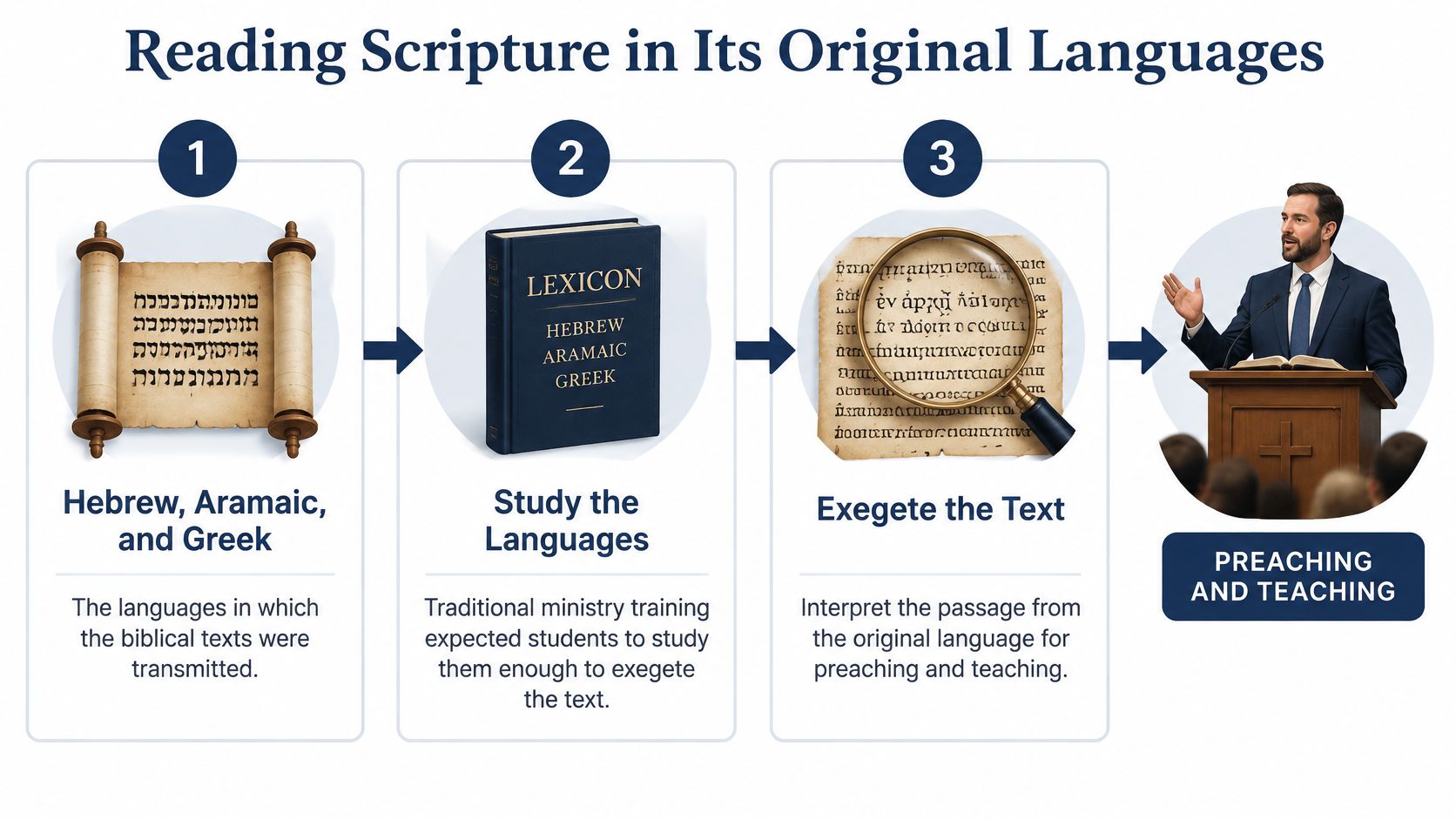
Hebrew, Aramaic and Greek are the languages in which the biblical texts were transmitted. Traditional ministerial training expected students to study Hebrew and Greek closely enough to exegete the text, which means interpreting it carefully from the original rather than from a translation. The ATS standards of accreditation identify scholarly investigation of Scripture, tradition and theology as essential across theological programs.
Programs handle this differently. Some require extensive language study. Others offer introductory or elective courses and lean on translated texts with stronger comparison tools. Either way, the purpose is the same.
The sequence below is what the language work is for.
Six steps from text to sermon
Read the passage in English and mark the key terms. You can't study a word you haven't noticed. Underline repeated words, commands and anything that feels load-bearing, then keep those marks in front of you.
Check the word and its grammar in the original. A lexicon gives you a range of meaning, not the meaning in this sentence. Verb form, preposition and word order narrow the range. This is the step that stops a preacher importing a definition the author never used.
Identify the genre. Narrative, law, poetry, prophecy, gospel, letter. Each one expects a different kind of reading. Poetry compresses and repeats. Law legislates cases. A letter argues with a specific audience in view.
Place the passage in its historical setting and in its surrounding chapters. A verse is a sentence inside a paragraph. The setting tells you what the first readers already knew and what the author had to explain.
Compare how other passages use the same terms. A word that carries one sense in one book can carry a different shade elsewhere. The comparison keeps you honest about which one is in play.
State the author's point in one sentence before you draw any doctrine or application. If you can't say it in a sentence, you haven't finished reading. Once you can, you know whether your application is attached to the text or just hanging nearby.
The example that wakes students up is a word like the Hebrew term usually translated spirit, wind or breath. In one passage it describes a gust, in another the life force inside a body, in another the Spirit of God over the waters. Build a doctrine on the single verse where your English Bible uses your favorite sense, without checking the others, and you'll preach a claim the text doesn't make.
If you learn better by watching, the session below walks through the same reading process.
Proof-texting is the name for pulling a verse out of its context to support a claim the author didn't make. It's the most common mistake in popular Bible teaching, and it's hardest to catch in yourself. Steps four and six make it visible: once you know what the paragraph is doing and can state the author's point in a sentence, a verse that doesn't fit sticks out.
Church History and Doctrine Students Work Through
Systematic theology and church history are usually taught as a pair, and for good reason. Systematic theology organizes what Scripture teaches about God, Christ, salvation, the church and last things into a coherent whole. Church history shows how those conclusions were argued out, defended, revised, and sometimes dropped.
One council, one sentence
The Nicene Creed of 325 exists because a dispute about the nature of Christ needed words precise enough to settle it. Students study the wording and the argument underneath it, because the sentence carries both. A creed you can recite but can't explain is a slogan.
The method students learn
State the doctrine in your own words. Trace its biblical basis. Check how the major traditions have answered it. Then test it against a question your congregation is asking, about grief, money, or who belongs at the table.
We're an independent, non-denominational seminary, so the disagreement question comes up constantly. Where faithful Christians differ, the work is to put three things on the table: what the biblical text says, what The Bible Seminary has published as its position where it has published one, and what other interpretations hold. Inventing an institutional position where none exists isn't teaching. It's spin.
The test of a graduate isn't whether she can recite a creed. It's whether she can explain why the church says it, what the alternatives were, and where the argument turned. That's the study of church history put to work in a real congregation, and it's what lets a leader hold conviction and charity at the same time.
Spiritual and Personal Formation in Seminary
Seminary is designed as formation, not only as information transfer. The Association of Theological Schools frames graduate theological education around four connected dimensions of student learning: religious heritage, cultural context and global engagement, personal and spiritual formation, and ministerial or vocational practice, according to its standards, policies and bylaws.
The spiritual and personal dimension has specific learning attached to it. Habits of spiritual and personal maturity: disciplined prayer, emotional resilience, empathy, discernment, healthy relationships, and the capacity to understand communities different from your own. None of those arrive automatically because you finished a systematics course.
Don't assume rigor produces them. Bethel Seminary's 2025 educational effectiveness statement measures spiritual and personal formation and intercultural competence as outcomes distinct from coursework in Bible, theology and history, rather than as results that follow from it. The same statement reports a 2025 study of first-year seminary students in which changes in religious or spiritual practices were generally positive, while some students experienced reductions or difficulties in those practices.
So the honest answer to "will seminary deepen my faith and clarify my calling" is that it can do both, and it can unsettle you along the way. Questioning, spiritual fatigue, identity change and exposure to traditions unlike your own are normal parts of the experience.
What to ask about formation
Ask how the program assesses this dimension at all: supervised reflection, mentoring relationships, ministry evaluations, formation groups. Then press on the details.
What is measured? A named outcome with evidence behind it, or a general hope?
How often is it reviewed? Once a year with a mentor, or never after orientation?
What happens when a student struggles? Ask who notices, and what the program does next.
A program that can't describe its formation process in specifics probably hasn't built one.
Careers Beyond the Senior Pastor Role
The pulpit isn't the only destination, and it hasn't been for a while. A 2025 educational effectiveness report from United Seminary found that 41% of graduates expected to work outside a congregation or parish, including administration, teaching, social services, or pastoral counseling.
The courses that get you there are already in the curriculum. What changes is which ones you lean on.
Chaplaincy runs on pastoral care, plus supervised ministry and enough theological reasoning to sit with suffering without flinching.
Christian education and curriculum work runs on hermeneutics and church history, because you have to explain a text and a tradition to people who've never heard either explained.
Nonprofit and ministry leadership runs on ethics, leadership and administration, where you learn to make a decision and defend it in a room full of people who disagree.
Writing and speaking run on homiletics, which is the discipline of saying one thing clearly and then stopping.
Missions and cross-cultural work run on the intercultural competencies built into the degree standards.
Lay leadership benefits from the whole set, because volunteers who teach and lead need the same tools at a smaller scale.
None of that makes you licensed. Theological formation is not professional licensure. Chaplaincy, counseling and ordination usually require separate certification, endorsement or denominational approval, and those requirements sit with the relevant bodies, not with the seminary.
The question worth asking every program is blunt: which courses in this catalog directly build the role I want? If the answer is vague, keep looking.
Choose a Study Route and Take the Next Step
The right route depends on your goal, and the differences that matter are credit and format.
Study route | Credential | Credit requirement | Best fit |
|---|---|---|---|
Master of Divinity | Professional graduate degree | 84 credit hours over three years | Future pastors and church leaders |
Master of Arts | Graduate degree | Set by the major you choose, confirm with admissions | Focused graduate study in a specialty area |
Certificate of Theological Studies | Graduate-level certificate | 27 credit hours | Vocational or volunteer leaders |
Dual-degree completion | Completion of a second program | The remaining credits of the second degree | Students combining two graduate tracks |
Auditing courses | No degree | No credit awarded | Learners who want the content without credit |
TBS Seminars | No degree | No credit awarded | Church groups and individuals wanting a single topic |
Degrees and certificates carry credit toward a credential. Auditing and single seminars let you study the same material without earning a degree, which is useful if you're testing a calling rather than answering one. We offer both on-campus programs and Distance Education programs, so geography doesn't have to decide this for you.
Three steps to a decision
Name your goal in one sentence. "I want to teach adult Bible study well" and "I want to plant a church" lead to different routes. Vagueness here will cost you a year.
Match that goal to a row in the table. If your goal needs a credential, take the credit route. If you need the content and not the credential, audit or take a seminar and see how the material sits with you.
Contact admissions before you enroll. Confirm credit requirements and delivery format for the specific route, and ask which courses will be running in your first term. Reach us at info@thebibleseminary.edu or 281-646-1109, Monday through Friday, 9:00am to 4:00pm.
The Bible Seminary builds its graduate programs around all 66 books of Scripture, taught alongside the historical, theological and practical disciplines that turn study into ministry. If the courses above describe the kind of training you're looking for, visit The Bible Seminary to compare the Master of Divinity, Master of Arts and certificate routes and see which one fits the role you have in mind. Admissions can walk you through credit requirements and delivery format before you apply.