
Religious Studies Degree Programs: A Complete Guide

What do you hope your religious studies degree will do for you, deepen your understanding of religion, prepare you for doctoral research, or form you for faithful ministry? Many prospective students begin with that question but struggle to distinguish an academic religious studies program from biblical studies, theology, or divinity training.
That distinction matters. A degree can shape how you read sacred texts, serve a congregation, teach others, understand cultures, and respond to the needs of your community. We'll walk through the options with honesty, including the academic opportunities, ministry pathways, practical questions, and ways a seminary education can unite scholarship, spiritual formation, and hands-on service.
What Religious Studies Degree Programs Actually Are
The most common confusion is simple: religious studies isn't the same as theology or divinity.
Religious studies usually examines religion as an academic field. Students analyze texts, rituals, institutions, communities, and beliefs across historical and cultural settings. The approach is often comparative and evidence-based. At the University of New Mexico, for example, learning outcomes include comparing traditions, applying humanities and social-science theory, and examining religion in historical, political, social, and cultural contexts (University of New Mexico learning outcomes).
Theology generally asks questions from within a particular faith tradition. It considers what a community believes about God, Scripture, humanity, salvation, the church, and faithful practice. A divinity or seminary program usually adds preparation for ministry, including preaching, pastoral care, leadership, discipleship, and spiritual formation.
Consider the Sermon on the Mount. In a religious studies classroom, you might examine its literary structure, historical setting, relationship to Jewish teaching, and influence on Christian communities. In a seminary preaching course, you might also study the passage as authoritative Scripture, interpret it within the canon, and prepare to proclaim it faithfully to a congregation.
Neither approach is automatically more serious. They answer different questions.
Choosing the right academic posture
Ask yourself:
Do you want to compare religions as a scholar? A traditional religious studies degree may provide the breadth and analytical tools you need.
Do you want deeper Christian formation? Biblical studies, theology, or divinity may better match your goals.
Do you want both? Look for programs that combine careful research with Scripture, discipleship, and ministry practice.
The U.S. field has a substantial academic footprint. In fall 2023, approximately 482 departments were awarding degrees in religion, with 138 offering graduate degrees and 73 awarding PhDs, according to the American Academy of Religion religion profile. Those programs included roughly 3,530 students in graduate degree study, showing that religious studies remains a sustained graduate discipline rather than only an undergraduate subject.
For a Christian student, the central question is not merely, “Can I study religion?” It's, “What kind of knowledge and formation will help me love God, serve people, and handle truth responsibly?” Scripture calls believers to pursue wisdom and teach faithfully, while also reminding us that knowledge must be joined to love.
“But speaking the truth in love, let us grow in every way into him who is the head, Christ.”Ephesians 4:15, CSB
Degree Levels and Specializations to Consider
Religious studies degree programs serve different learners at different stages. A certificate may suit a church volunteer, Bible study leader, or working adult who wants focused preparation without beginning a full degree. An undergraduate program can establish broad academic and biblical foundations, while graduate study usually develops advanced interpretation, research, leadership, or ministry competencies.
Here's a practical way to compare the options:
Credential | Often serves | Common direction |
|---|---|---|
Certificate | Lay leaders, ministry volunteers, exploring students | Bible literacy, ministry support, continuing education |
Associate degree | Students seeking foundational college study | Transfer preparation or entry-level service |
Bachelor's degree | Students beginning formal academic or ministry preparation | Christian education, ministry support, further graduate study |
Master of Arts | Graduates seeking focused academic or ministry training | Biblical studies, theology, counseling, education, or research |
Master of Divinity | Students preparing for substantial pastoral or professional ministry | Pastoral leadership, preaching, chaplaincy, missions, and church planting |
A student preparing for doctoral research may prioritize historical methods, languages, comparative religion, and a thesis. A future pastor may need biblical exegesis, preaching, pastoral care, church leadership, and supervised ministry. Someone pursuing nonprofit leadership may look for ethics, intercultural studies, communication, and organizational development.
Specializations that shape your direction
Common areas include Hebrew and Greek, biblical archaeology, church history, pastoral ministry, counseling, Christian education, and intercultural studies. Your intended role should guide your choice. Ordination bodies and employers may expect a particular degree, supervised ministry experience, or denominational approval, so check those expectations before enrolling.
A certificate can be a wise first step for someone testing a calling. A student who already holds an undergraduate degree may move directly into a graduate program. Some schools also offer stackable credentials, allowing a working adult to build toward a larger qualification without abandoning previous study. Never assume that every certificate course will transfer, though. Ask for the written policy before you register.
Religious studies itself has developed over time. The field expanded through early university offerings and became more institutionalized in the late twentieth century. One historical overview records a formal religious studies program beginning in 1949, an undergraduate major established in 1968, and another program tracing its origins to 1971 before receiving department status in 1980 (University of South Carolina history of religious studies).
A wise enrollment decision: Choose the credential by starting with the work you hope to do, then identify the training and recognition that work requires.
Curriculum and Sample Courses You Will Take
A strong seminary curriculum doesn't treat Bible knowledge, theology, history, and ministry as isolated subjects. Each discipline answers a different question. Biblical studies asks what the text says and means. History asks how communities and events shaped its setting. Theology asks how Christian doctrine coheres. Practical ministry asks how faithful understanding becomes faithful service.
You may encounter courses such as:
Old Testament Survey: Major themes, literary movements, historical settings, and theological claims across the Old Testament.
New Testament Survey: The Gospels, Acts, letters, and apocalyptic literature within their first-century contexts.
Hermeneutics: Principles for interpreting biblical texts carefully and applying them responsibly.
Hebrew and Greek exegesis: Work with the original languages and the tools scholars use to examine meaning.
Church History: The development of Christian teaching, worship, institutions, and movements.
Systematic Theology: Organized reflection on doctrines such as God, Christ, the Spirit, salvation, the church, and last things.
Homiletics: The preparation and delivery of sermons.
Pastoral Care: Presence, listening, counsel, boundaries, and care for people in difficult circumstances.
Capstone or thesis: A substantial project that demonstrates research, integration, and communication.
Credit structures vary by institution. Some undergraduate religious studies majors require 30 credits across 10 courses, with a minimum grade of C or 2.0 in courses applied to the major, as described by the University of Virginia religious studies major. Other programs require broader combinations of area and focus courses. Florida International University, for example, describes a 36-credit major with breadth and focus requirements, while another program requires 44 credits distributed among world religions and upper-division study (FIU undergraduate religious studies).
Why upper-level study matters
Advanced courses force students to move beyond recognition and summary. They must compare interpretations, assess evidence, write sustained arguments, and explain conclusions clearly. One program requires at least six of 10 courses at the 300 level or higher, while other programs set substantial upper-division requirements (University of Pittsburgh major requirements).
Seminary education adds formation and practice. Field education, internships, mentoring, chapel, prayer, and supervised ministry can connect classroom learning with people's actual needs. Archaeology labs, museum study, and study tours can also give students tangible ways to explore the historical world of Scripture.
The Bible Seminary describes its graduate curriculum as an in-depth study of all 66 books of the Bible, joined to historical, theological, and practical disciplines. That kind of integration matters for students who want rigorous scholarship without separating learning from service.
Career and Ministry Outcomes After Graduation
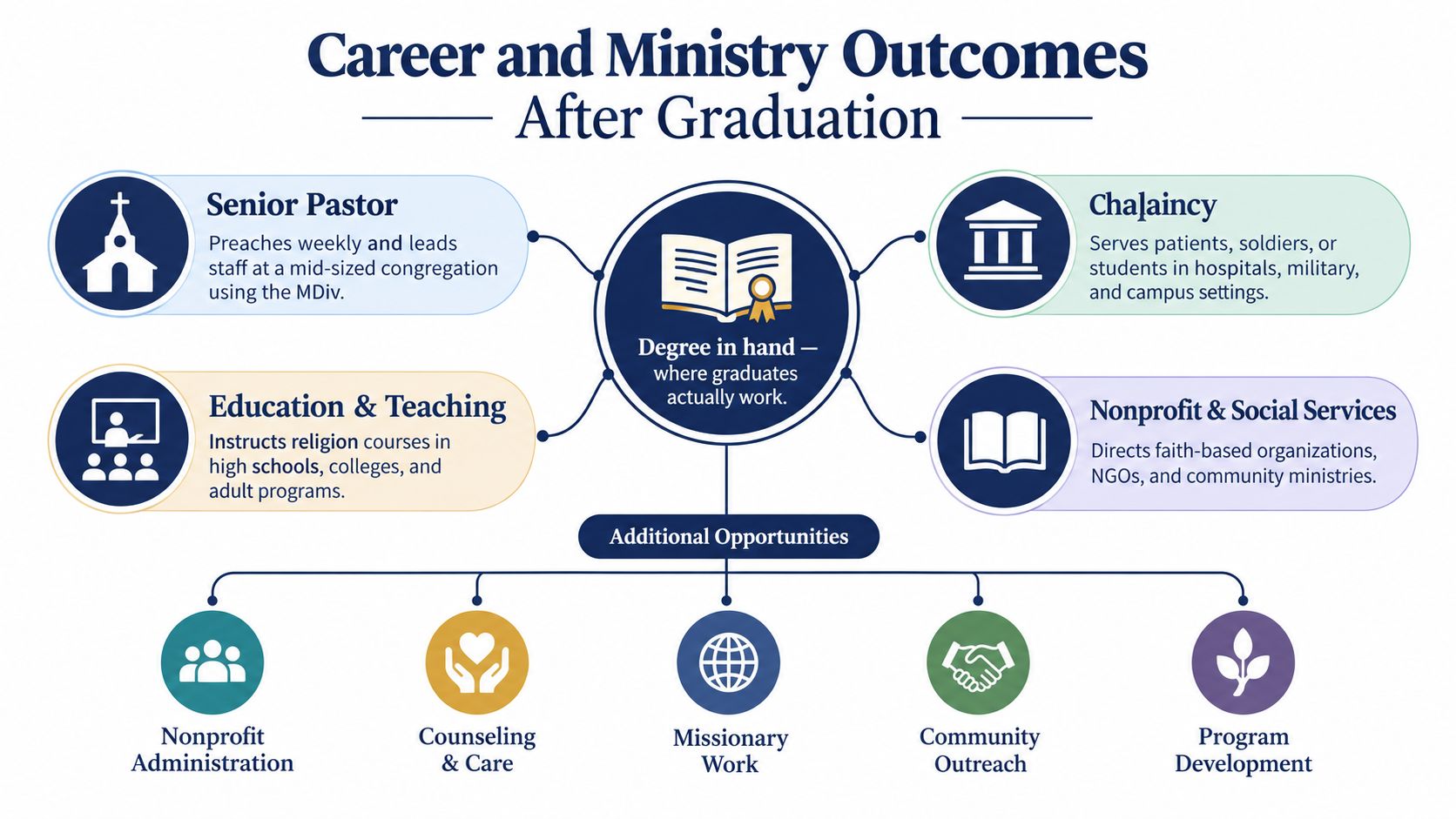
A degree becomes meaningful when it helps you serve faithfully and work competently. Consider a senior pastor preparing sermons for a mid-sized congregation. The pastor needs more than public speaking ability. Weekly ministry draws on exegesis, theological judgment, pastoral care, staff leadership, conflict navigation, and the ability to communicate Scripture to people at different stages of faith.
Another graduate may direct a nonprofit serving refugees. That person can use training in ethics, culture, public communication, organizational leadership, and human dignity without serving as a parish pastor. A college Bible teacher may combine a teaching credential with biblical knowledge, while a campus minister may use theological formation and mentoring skills to accompany students through questions about identity, vocation, and belief.
Where graduates may serve
Traditional pathways include pastoral ministry, parachurch work, chaplaincy, missions, Christian education, and congregational leadership. Academic pathways may involve doctoral study, teaching, archival research, or writing. Other possibilities include publishing, museum work, grant writing, community development, and nonprofit administration.
The labor-market picture is broader than the stereotype that religious studies leads only to ministry or a university classroom. The U.S. Bureau of Labor Statistics reports that people with philosophy and religion degrees are distributed across management, education and library work, legal occupations, and community and social service. The same profile reports a median wage of $65,000 and says 67% work in jobs requiring at least a bachelor's degree (BLS philosophy and religion field of degree data).
Data USA reports 379,743 Philosophy and Religious Studies graduates in the workforce in 2024, compared with 369,821 in 2023, and identifies clergy as the largest single occupation share at 8.76% (Data USA religious studies profile). These figures describe a mixed workforce, not a guaranteed outcome for every graduate.
Field education and capstone work can make those pathways more concrete. A student who completes a ministry placement can practice communication and pastoral care under supervision. A student who completes a research project can demonstrate the ability to locate sources, evaluate evidence, organize an argument, and present conclusions to a real audience.
Admissions Tips and Funding Your Seminary Education
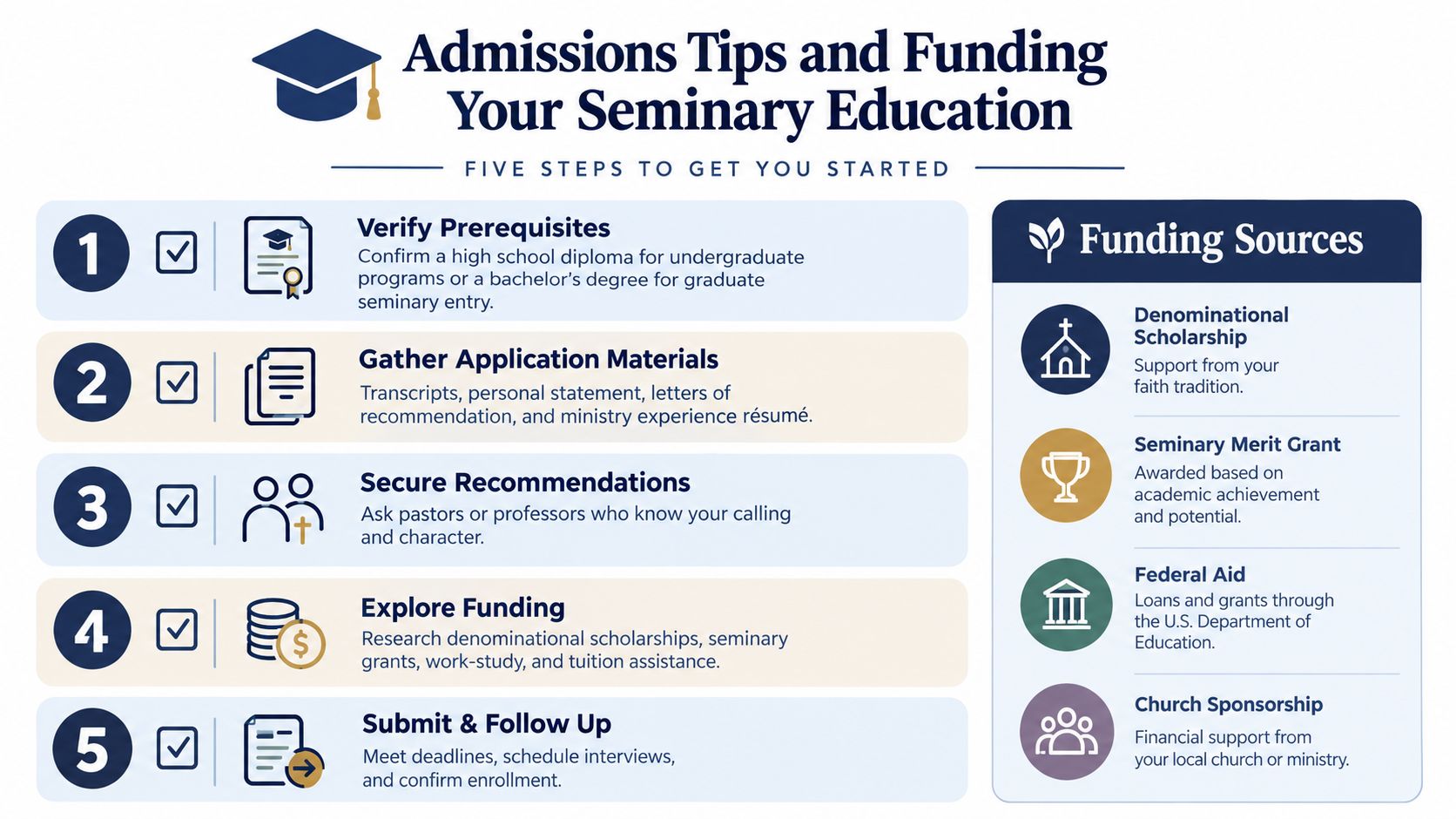
Admissions teams understand that many applicants are changing careers, returning to school, or entering ministry after years in another vocation. You may not need previous Bible coursework. Undergraduate applicants commonly begin with a high school diploma, while graduate applicants generally need a bachelor's degree, but each institution sets its own standards.
Prepare your application as a picture of calling, readiness, and character. Schools may request:
Transcripts: Provide complete academic records and explain unusual gaps when appropriate.
Personal statement: Describe your goals, faith journey, ministry experience, and reasons for choosing the program.
Recommendations: Ask pastors, professors, supervisors, or ministry leaders who know your character and work.
Writing sample: Submit a clear piece that shows organization, reading comprehension, and careful reasoning.
Statement of faith: Read the school's doctrinal position carefully and respond with sincerity.
Online applicants usually go through the same academic review as residential applicants, although interview and technology requirements vary. Ask when decisions are made, whether admissions are rolling, and how quickly you can begin after acceptance.
Building a realistic funding plan
Start with the institution's financial-aid office. Depending on accreditation and eligibility, students may explore FAFSA, school scholarships, denominational awards, church tuition partnerships, employer reimbursement, work-study, and military benefits. Funding rules change, so verify current requirements directly with each provider.
Churches sometimes support members preparing for ministry, especially when the student has a defined service role and a clear plan. Ministry nonprofits may also offer grants, and a guide to ministry grant search strategies can help you organize research without assuming that every grant fits a student's situation.
Before applying, create a simple checklist:
Confirm the entrance requirement.
Request transcripts early.
Identify recommenders who can speak specifically about you.
Compare total tuition, fees, books, and travel.
Ask which credits transfer and which aid sources can be combined.
Online vs Residential Program Formats Compared
Format affects more than your calendar. It shapes how you learn, build friendships, receive mentoring, participate in worship, and practice ministry.
A residential program may fit a younger student who wants an immersive rhythm of chapel, shared meals, library study, and cohort friendships. A fully online program may serve a bivocational pastor, working parent, or second-career student who needs asynchronous coursework. A hybrid program can serve a ministry practitioner who wants concentrated campus gatherings while completing other work remotely.
Dimension | Residential | Online | Hybrid |
|---|---|---|---|
Student life | Daily face-to-face community, chapel, meals, and library access | Flexible participation through digital classrooms and scheduled gatherings | Periodic in-person intensives combined with remote study |
Spiritual formation | Shared rhythms create frequent informal conversations and prayer | Formation requires intentional discussion groups, prayer rooms, and mentoring | Combines planned residencies with ongoing online relationships |
Scheduling | Best for students able to organize life around campus | Useful for work, family, and ministry responsibilities | Useful for students who can travel for selected intensive periods |
Main trade-off | Can interrupt established employment or family routines | Offers flexibility but reduces spontaneous embodied community | Requires careful coordination of travel, work, and coursework |
Online study isn't spiritually empty, but it does require deliberate participation. Students must speak in discussion forums, attend virtual prayer gatherings, seek faculty contact, and form relationships rather than treating the program as a collection of assignments. Residential study offers more spontaneous interaction, yet students still need humility and initiative to receive formation well.
Hybrid learning can be especially practical for pastors and ministry leaders. Before enrolling, ask how often residencies occur, whether attendance is required, how classes are recorded, and how field education works for students who live far from campus.
For a focused look at one online pathway, review this guide to an online religious studies master's degree. Then compare the format with your actual responsibilities, not an idealized version of your life.
How The Bible Seminary Approaches Religious Studies
The Bible Seminary connects religious studies with Bible-based, Christ-centered, Spirit-led, ministry-focused preparation. Its academic pathways include nine undergraduate majors across pastoral, counseling, archaeological, and educational areas. That variety gives students room to pursue a defined ministry direction while remaining grounded in biblical study.
A student drawn to historical questions may benefit from biblical archaeology and the 3J Museum, where artifacts provide a hands-on setting for exploring the world connected with Scripture. Study tours through Israel and Jordan can add geographical and cultural context, helping students connect classroom material with places, settings, and material evidence. Archaeology should support careful interpretation, not replace the biblical text or exaggerate what evidence can prove.
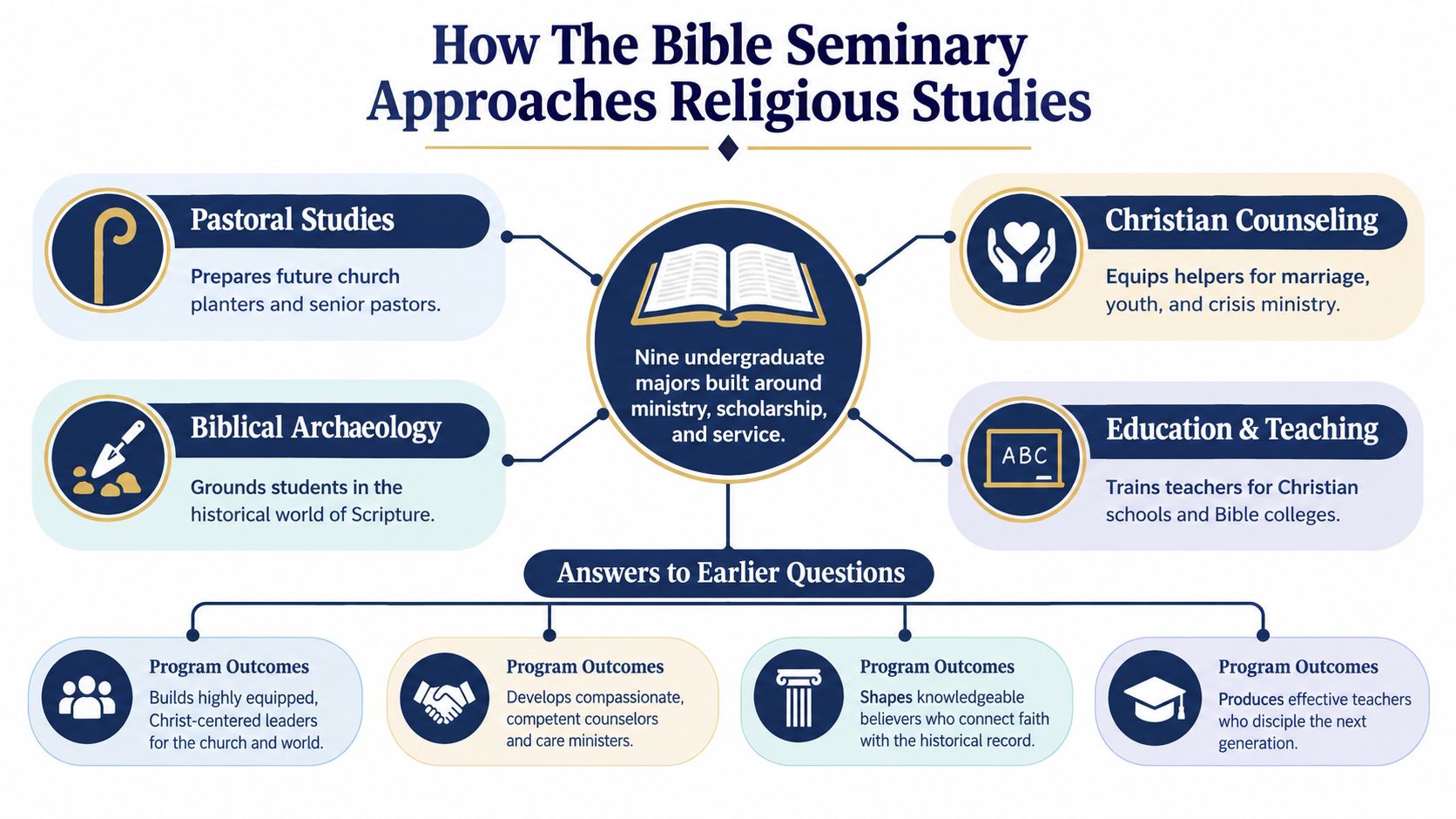
The seminary also offers residential, online, and modular scheduling. That flexibility addresses a practical concern many students carry: how can I prepare for ministry while continuing to work, care for family, or serve my church? Faculty members combine academic preparation with active ministry experience, giving students opportunities to connect interpretation with pastoral responsibility.
For discernment: The right program should help you become a more careful reader of Scripture, a more humble servant of people, and a more capable leader in the church and community.
Tuition transparency and rolling admissions can lower common barriers, although prospective students should still request current details and review every fee. Certificate options, auditing, dual-degree completion, and on-demand seminars can also give learners different entry points.
The result is an ecosystem where training hearts and minds for kingdom service doesn't compete with academic depth. Biblical literacy, archaeological context, spiritual formation, and hands-on ministry can reinforce one another. That is the heart of equipping leaders to impact the world for Christ, with scholarship placed in service to the church and its mission.
Frequently Asked Questions and Next Steps
How long does a degree take?
Completion time depends on the credential, transfer credit, course load, and delivery format. A certificate is shorter than a full degree, while a master's program requires more advanced coursework. Ask for a sample completion plan that reflects your work and family commitments rather than relying on a full-time schedule you can't sustain.
Do I need prior Bible training?
Many programs welcome students who haven't completed formal Bible study. Graduate programs generally require an undergraduate degree, but they may provide foundational courses or recommend preparation before advanced work. Ask whether language study, theological foundations, or writing courses are assumed.
Can I transfer previous credits?
Possibly. Each school evaluates transfer work according to its policies, the age and content of the courses, and the relationship between the previous institution and the new program. Request a written transfer evaluation before making financial or scheduling decisions.
Will seminary credits transfer to a doctoral program?
Transfer depends on the receiving school. Doctoral programs may examine accreditation, course level, syllabi, grades, research preparation, language requirements, and the fit between your prior work and the doctoral field. Keep your syllabi, major papers, transcripts, and faculty information so you can document your preparation.
How do accreditation and theological alignment matter?
Accreditation can affect recognition, financial-aid eligibility, transfer review, and employer confidence. If ordination is part of your plan, ask the denomination or ordaining body which degrees it recognizes, including whether it expects an ATS-recognized program. Also read the school's doctrinal statement. A program should fit your convictions about Scripture, Christ, the church, ministry, and Christian life.
Can I study while working or serving in ministry?
Yes, but sustainable planning matters. Begin with a manageable course load, reserve weekly study time, discuss expectations with your family and church, and ask whether internships can be completed in your current ministry setting. A slower path can still be faithful and fruitful.
Request a course catalog, schedule an admissions conversation, and ask how your goals fit the available programs. A thoughtful conversation can clarify whether you need broad religious studies, focused biblical studies, or ministry-centered divinity training.
The Bible Seminary offers Bible-centered degree, certificate, archaeology, and ministry training pathways designed to unite scholarship, spiritual formation, and practical service. Visit The Bible Seminary to review your options, request current program information, and take the next step toward faithful kingdom service.