
Difference Between Seminary and Divinity School

You're holding two brochures. One is from a confessional seminary, the other from a university divinity school. Both appear credible. Both seem financially possible. Yet they may be preparing you for different kinds of ministry, under different forms of accountability, with different expectations for your church life, academic work, and future credentialing.
That's the difference between seminary and divinity school. The label matters, but the deeper questions concern accreditation, governance, spiritual formation, degree structure, and the practical realities facing students in 2026. You aren't merely choosing a campus. You're choosing an environment that will help shape how you read Scripture, serve the church, lead people, and carry your calling.
Why This Question Matters for Your Calling
Daniel is thirty-two, serving as a youth minister, and beginning to sense a call toward senior pastoral ministry. He has brochures from a confessional seminary and a university divinity school on his desk. Both schools offer credible degrees. Both appear affordable on paper. But one assumes that theological education should happen within a defined church tradition, while the other offers a broader university setting with more room for academic and professional exploration.
Daniel's decision affects more than his class schedule. He needs to ask whether his denomination requires a particular degree or endorsement for ordination. He must consider who will provide spiritual oversight, whether supervised ministry is built into the program, and whether the institution's theology matches the congregation he hopes to serve. He also needs an honest plan for work, family, tuition, and the debt he can responsibly carry.
A ministry degree is never only a credential. It helps shape the minister who receives it.
The difference between seminary and divinity school is therefore a vocational decision, not a branding question. A seminary may press you toward pastoral identity, ecclesial accountability, and spiritual formation within a tradition. A divinity school may give you broader access to research, interdisciplinary study, and adjacent vocations such as chaplaincy, nonprofit leadership, or religious scholarship.
Four lenses will clarify the choice:
Accreditation: Who recognizes the institution and its degrees?
Formation: How does the school develop character, spiritual maturity, and ministry competence?
Degree structure: What coursework, field education, and academic options will you complete?
2026 realities: Can the program serve a working adult, a bi-vocational minister, or someone seeking flexible credentials?
Read this as a serious inquirer, not a shopper comparing logos. The wrong fit can cost years, money, and opportunities for faithful service. The right fit won't remove every challenge, but it will place those challenges within a community and curriculum that support your calling.
What a Seminary Actually Is
A seminary is a confessional, denominationally or interdenominationally governed graduate school whose primary purpose is to train ordained ministers, missionaries, and church leaders.
The word comes from the Latin seminarium, meaning seedbed. The term became associated with clergy education after the Council of Trent, held from 1545 to 1563, as churches developed institutions intended to cultivate and prepare future priests and ministers. The historical details differ across traditions, but the central image remains useful. A seminary seeks to nurture people for a particular kind of faithful service.
Today, seminaries may be independent schools or seminary-type institutions connected to a university. Their governing boards often remain accountable to a church tradition, whether Baptist, Reformed, Methodist, Pentecostal, Anglican, or another ecclesial body. Examples include Southwestern Baptist Theological Seminary, Reformed Theological Seminary, Asbury Theological Seminary, and Westminster Theological Seminary.
Formation belongs at the center
A seminary normally treats ministry preparation as more than information transfer. Spiritual formation, chapel, supervised ministry, mentoring, and field education often belong to the core experience rather than the margins.
That emphasis makes sense because pastoral ministry requires more than the ability to explain a doctrine or write a research paper. A pastor must interpret Scripture faithfully, pray with suffering people, preach to a congregation, work through conflict, visit the sick, disciple believers, and remain accountable to the local church. Academic competence matters, but character and embodied ministry matter too.
A seminary's confessional identity can also provide clarity. You should know what a school believes about Scripture, the church, salvation, ministry office, and Christian doctrine before enrolling. A clear theological identity doesn't eliminate every disagreement, but it tells you the framework in which your formation will occur.
“Pay careful attention to yourselves and to all the flock.” Acts 20:28, CSB
That charge captures why seminary education should join Bible-based scholarship, Christ-centered formation, Spirit-led dependence, and hands-on ministry. If your calling centers on serving a particular church tradition, a seminary may give you the ecclesial accountability and practical preparation you need.
What a Divinity School Actually Is
A divinity school is a graduate professional school, most often housed within a research university, that prepares students for ministry as well as adjacent vocations such as chaplaincy, nonprofit leadership, scholarship, and religion-related public work.
The American model took shape through university-based institutions such as Harvard Divinity School and Yale Divinity School. Harvard Divinity School dates to 1816 as the first nonsectarian theological school in the United States, a milestone that helped define the university-integrated model. Yale Divinity School became another important expression of this approach.
Divinity schools typically belong to larger universities. Their faculty work within university-wide academic structures, and students may study alongside candidates in doctoral, master's, or religion-related programs. The school may be interdenominational, ecumenical, or loosely connected to a particular tradition rather than governed directly by one denomination.
Breadth changes the student experience
The research environment is often the strongest attraction. Students may study biblical languages, theology, ethics, church history, religion and society, or comparative religious traditions with faculty whose work reaches across multiple disciplines. University libraries, research centers, professional schools, and dual-degree options can widen the path beyond congregational ministry.
That breadth can serve a student preparing for academic research, nonprofit leadership, public service, or institutional chaplaincy. It can also benefit a pastor who wants serious engagement with history, culture, ethics, and the wider intellectual world.
The trade-off is that a divinity school's institutional breadth may not provide the same level of denominational formation or direct preparation for a specific ordination process. Some programs offer field education and spiritual formation, but you must inspect the curriculum rather than assume those elements are central.
Harvard, Yale, Duke, Princeton, and Chicago help readers picture the setting. These schools are not larger seminaries with different signage. They operate within university ecosystems, and that setting influences governance, course selection, faculty culture, student identity, and professional possibilities.
Seminary vs Divinity School at a Glance
The decisive distinction is institutional DNA. A school's name may suggest a particular model, but its governance, accreditation, curriculum, and student culture tell you what you're choosing.
The Association of Theological Schools is the primary accreditor for graduate theological education in the United States and Canada, and it's recognized by the U.S. Department of Education. Among ATS-accredited schools, 43% of seminaries are affiliated with a university or college, which means a majority remain stand-alone institutions rather than university-based divinity schools. George Fox University explains the seminary model and its accreditation context.
Criteria | Seminary | Divinity School |
|---|---|---|
Institutional setting | Usually an independent theological institution, though some seminaries operate within universities | Typically a professional school embedded in a larger university |
Governance | Often governed by a board connected to a denomination, confession, or church tradition | Usually governed through university policies, faculty structures, and a broader institutional administration |
Accreditation | Frequently accredited by ATS or, in some cases, another recognized theological accreditor | Often combines university accreditation with ATS accreditation |
Primary emphasis | Pastoral preparation, spiritual formation, ministry practice, and ecclesial service | Academic theology, interdisciplinary study, professional ministry, and broader religious scholarship |
Student ecosystem | Concentrated community of ministry students, church leaders, and formation-focused peers | Students may interact with wider university programs, research centers, and professional schools |
Church relationship | Often direct and explicit, especially where denominational oversight shapes curriculum or ordination | May be ecumenical, interdenominational, or less directly tied to one church body |
Best initial question | “Will this school form me for the ministry context I'm entering?” | “Will this university environment expand the academic and professional work I'm preparing to do?” |
Hartford Institute describes a seminary as a postbaccalaureate institution for ministry training, while a divinity school generally refers to a school attached to a university. It also notes that seminaries serve multiple ministries in churches and synagogues, while divinity schools are generally university-connected. Read Hartford Institute's institutional history of seminaries and divinity schools.
The table should guide your questions, not replace them. A university divinity school may offer strong ministry formation. An independent seminary may offer strong scholarship and interdisciplinary partnerships. Investigate the actual program, not the stereotype.
Degrees, Credits, and How Each Path Trains You
Degree titles can mislead you. The Master of Divinity, or MDiv, appears in both seminaries and divinity schools, yet the experience behind the title may differ sharply.
A Master of Divinity is typically a three-year professional degree designed for ministry preparation. Harvard Divinity School's MDiv includes 24 courses and 96 units, along with three Arts of Ministry, a senior seminar, and a senior paper. Harvard describes its MDiv curriculum and requirements.
The University of Chicago describes its MDiv as a three-year curriculum combining religious studies coursework, field work in multiple settings, and cohort-based learning. Students may shape the program through dual degrees, interdisciplinary certificates, or denominational studies at neighboring schools. Chicago outlines its MDiv admissions and curriculum options.
Duke's traditional MDiv is normally completed in three years and requires 24 courses, including eight core courses, five limited electives, eleven electives, two units of field education, a spiritual formation component, and two student portfolios. Duke also requires a minimum 2.75 GPA from a regionally accredited bachelor's degree and demonstrated commitment to ordained or lay ministry. Duke lists its MDiv structure and admissions requirements.
The same degree can serve different purposes
A seminary may offer certificates, an MA, an MDiv, and a ThM in a sequence that moves students from focused Bible training into advanced ministry or theological study. Dallas Theological Seminary, Gordon-Conwell Theological Seminary, and Fuller Theological Seminary illustrate the range of program designs available in seminary education.
A divinity school may offer an MA, MTS, MDiv, and research-oriented degrees within a larger catalog. Yale says its MDiv is primarily designed to prepare students for ordination to Christian ministry and requires 72 credit hours plus a three-year residency. Yale also offers a Master of Arts in Religion alongside the MDiv. Yale explains its MDiv requirements and related degree options.
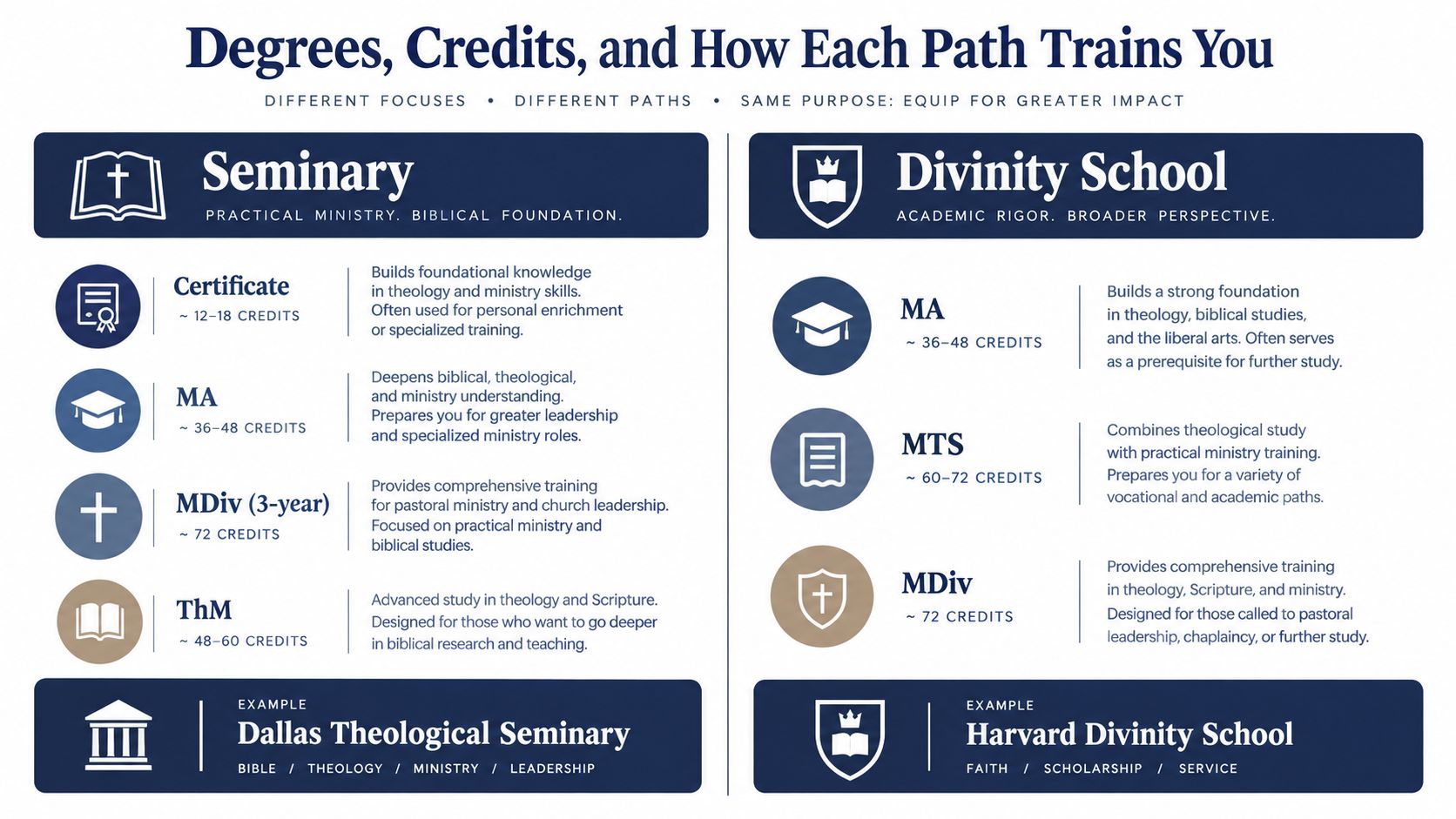
The practical question is how you learn best. Seminary programs often place supervised ministry, chapel, mentoring, and ministry assignments near the center. Divinity schools may offer more research seminars, teaching opportunities, dual-degree pathways, and access to university-wide resources.
If you're comparing a certificate with a full degree, this guide to Christian higher ed journaling tips can help you build a disciplined habit for processing lectures, Scripture, reading, and ministry application. For a focused comparison of shorter training and graduate study, review certificate programs versus degrees.
Choose seminary formation when you need your studies to press directly into preaching, pastoral care, church leadership, and denominational preparation. Choose divinity school breadth when you need research depth, academic flexibility, or a credential that supports work beyond congregational ministry.
Which Setting Fits Which Ministry Calling
Your calling should determine the setting more than prestige. A well-known institution won't compensate for a program that leaves you unprepared for the people and church tradition you'll serve.
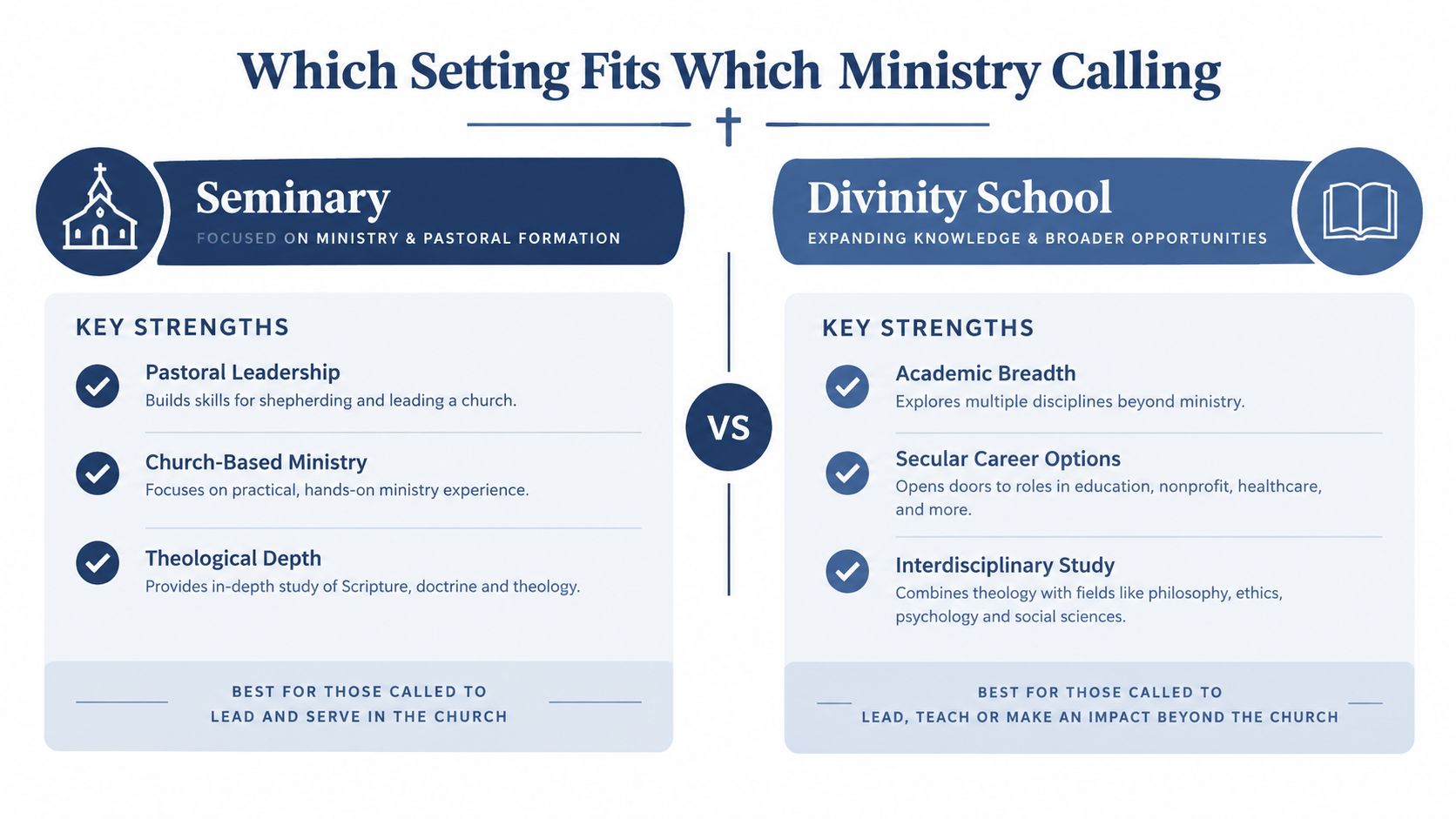
Choose seminary when formation and ecclesial alignment come first
A seminary usually fits best if you're pursuing:
Pastoral leadership: You want preaching, pastoral theology, church polity, leadership, and supervised ministry connected to congregational life.
Church-based chaplaincy: You need formation within a Christian tradition and preparation for ministry under church oversight.
Denominational endorsement: Your ordination process expects a particular theological identity, degree, or relationship with an approved school.
Church planting or missions: You need practical training, mentoring, and a peer community focused on sending and serving.
A seminary can also suit the bi-vocational minister who can't relocate. A hybrid or online MDiv may let you remain connected to your congregation, workplace, and family while receiving structured theological education. That flexibility matters because ministry formation shouldn't pull you away from the people you're learning to serve.
Choose divinity school when breadth serves the assignment
A divinity school may fit better if you're preparing for:
Academic scholarship: You're considering doctoral research, teaching, or a career in the academy.
Nonprofit leadership: You want theology and religious studies alongside organizational, social, or public-facing work.
Interfaith or public ministry: You need preparation for settings where you'll work with people from several religious and cultural backgrounds.
Hospital chaplaincy: You're pursuing clinical pastoral education and need access to a university or hospital ecosystem.
Interdisciplinary work: You want to combine theology with law, public policy, social work, education, or another professional field.
Don't confuse breadth with superiority. A wide academic catalog is valuable only if it serves the work God is placing before you. Likewise, formation is not a substitute for serious scholarship. Faithful ministry needs both a well-shaped heart and a trained mind.
Candid counsel: Calling, not campus prestige, should decide your path.
Ask where you'll be accountable, who will evaluate your ministry, and whether the program's graduates enter the kind of work you're pursuing. Then speak with the denomination, church network, or professional body that will recognize your preparation.
Admissions, Cost, and the 2026 Realities for Working Students
The practical side of enrollment deserves clear-eyed attention. You need to understand admission requirements, total program cost, delivery format, financial aid, and the amount of time your household can give to study.
Do not rely on a general internet estimate for tuition. The verified data available for this comparison does not establish a universal per-credit price for seminaries or divinity schools, so schools should be compared through current tuition schedules, fees, aid offers, and expected completion time. A lower published rate can still become expensive if the program requires relocation, unpaid ministry hours, or a pace your work and family cannot sustain.
Admissions also vary by institution. Duke, for example, publishes a minimum 2.75 GPA requirement for its MDiv, along with a demonstrated commitment to ordained or lay ministry. Other schools may request transcripts, references, writing samples, a call statement, interviews, or evidence of church involvement. Denominational endorsement may matter for ordination even when it isn't an admissions requirement.
Factor | Seminary | Divinity School |
|---|---|---|
Admissions focus | Academic readiness, Christian testimony, ministry calling, church involvement, and possible denominational alignment | Academic readiness, intellectual purpose, ministry goals, research interests, and professional direction |
Formation expectations | Chapel, mentoring, field education, supervised ministry, and local church participation are often prominent | Field education and formation may be available, but the balance may lean toward academic and interdisciplinary work |
Delivery pattern | May include residential, hybrid, online, evening, or modular formats | Often has a stronger residential orientation, though program flexibility differs by school |
Financial planning | Compare tuition, fees, travel, books, reduced work hours, and church support | Compare university tuition, housing, relocation, campus costs, and the opportunity cost of full-time study |
2026 planning question | Can you remain rooted in your ministry context while completing the degree? | Can you sustain the residential and academic demands while using the university's broader resources? |
Recent reporting indicates that theological education is becoming more hybrid and more part-time. One 2026 analysis reports that headcount and FTE have grown about 13% over the past decade, while schools have increased part-time enrollment relative to full-time study. A separate 2026 report says total enrollments are rising again after years of decline, with growth across denominational lines and program types, including modest gains in the MDiv. Review the 2026 theological education trends analysis.
These developments should change your questions. A working adult may need asynchronous courses, predictable scheduling, and a local ministry placement. A younger student seeking doctoral work may value residential seminars, faculty research, and campus access. Stackable certificates can also offer a measured starting point, but only if the credits apply to a later degree and the total cost remains transparent.
Choosing Your Path with Confidence
Begin with your ministry context, not a ranking. Ask where God has already placed you, who is affirming your gifts, and what kind of service your church or denomination expects from you.
Three diagnostic questions will usually expose the right direction:
Where is your ministry context already forming you? If your church, denomination, or mission network is central to your calling, seek a school that understands and supports that setting. If your work crosses institutions, cultures, or disciplines, a university environment may offer useful breadth.
Do you need denominational ordination or professional versatility? Confirm the requirements before applying. An MDiv from either setting may look similar on paper, but ordination bodies and employers may evaluate ecclesial alignment, supervised ministry, field education, and accreditation differently.
Can you sustain a residential commitment? If you're serving a church, raising children, or working full time, a hybrid path may be wiser than relocating. If you're ready for immersive campus study and a research-intensive environment, residential education may serve you well.
Questions serious inquirers often ask
Is a seminary degree more biblical than a divinity school degree?No. The degree title doesn't determine faithfulness to Scripture. Examine the school's doctrinal commitments, faculty, curriculum, treatment of biblical authority, and relationship to the church.
Can a divinity school prepare me for pastoral ministry?Yes, many divinity schools offer MDiv programs designed for ministry and ordination. Confirm that the program meets your denomination's expectations and includes the practical formation you need.
Should I choose online study if I'm already in ministry?Often, yes, if the format includes real faculty access, meaningful community, supervised ministry, and a credible plan for spiritual formation. Convenience alone isn't enough.
What should I ask before I enroll?Ask which accreditor recognizes the program, who oversees formation, how field education works, where graduates serve, how credits transfer, and what your church or ordaining body expects. Request a conversation with admissions and, if possible, a current student.
The Bible Seminary offers graduate degrees, certificates, dual-degree completion, audited courses, and on-demand seminars in a Bible-centered setting. Located in Katy, Texas, it brings together study of all 66 books of Scripture, historical and theological disciplines, practical ministry preparation, archaeology resources, faculty expertise, and community life. Its 3J Museum also connects biblical history with material culture through a collection of nearly 200 artifacts, over 90% authentic, from Khirbet el-Maqatir near Jerusalem. Explore The Bible Seminary's academic programs as you discern whether its approach fits your pastoral, church-planting, missions, or ministry leadership goals.
Visit The Bible Seminary to compare graduate degrees, certificates, and flexible study options for your calling. Speak with the admissions team, explore the Katy campus and 3J Museum, and take a concrete next step toward training hearts and minds for kingdom service.