
How to Develop Spiritual Gifts with Confidence

You may have noticed a recurring pattern in your life. Friends ask you to explain difficult passages, coworkers trust you with hurting people, or a church member says your encouragement helped them keep going. Yet you wonder whether you're seeing a genuine spiritual gift or drawing on personality, experience, or a skill you've practiced for years.
Learning how to develop spiritual gifts requires more than completing a questionnaire and accepting its top result. Scripture presents gifts as grace from God, distributed by the Holy Spirit and given for the common good. A faithful process joins biblical study with prayer, character formation, observable fruit, wise feedback, supervised practice, and patient reassessment.

When You Sense Something More in You
Consider Elena, a believer who keeps volunteering to lead Bible discussions. She prepares carefully, notices when people are confused, and feels genuine concern when someone misunderstands Scripture. Still, she hesitates. Is this the gift of teaching, or does she enjoy studying? Would a spiritual-gifts inventory confirm the answer, or only describe her preferences?
That uncertainty is healthy when it leads to humility rather than paralysis. Spiritual gifts aren't badges that establish spiritual importance. They're God-given capacities entrusted to believers for service, leadership, communication, discernment, and the strengthening of Christ's people. First Corinthians 12:4–11 describes different manifestations of the same Spirit, including wisdom, knowledge, faith, healing, miracles, prophecy, discernment, tongues, and interpretation. The Spirit distributes them “as he wills,” so comparison has no place in faithful discernment (1 Corinthians 12:4–11, NIV).
A gift is not a private identity project. It's a responsibility to love and serve other people well.
Development matters because discipleship becomes concrete through service. A person who senses a gift of mercy learns to sit patiently with the grieving. Someone drawn toward administration creates dependable systems that help a ministry care for people. A believer with a teaching capacity learns to communicate truth accurately, whether in a classroom, a small group, a workplace conversation, or a digital community.
The wider Christian context also calls for cultural humility. Renewalist practices such as prophecy, healing, and tongues appear across major Christian populations, but participation and interpretation vary by region. Pew research covering countries including the United States, Brazil, Chile, Guatemala, Kenya, Nigeria, South Africa, India, the Philippines, and South Korea shows why no single cultural expression should define every Spirit-filled Christian (Pew Forum research on spirit and power).
A trustworthy path therefore has several movements:
Receive Scripture: Let the Bible define the purpose and boundaries of gifts.
Discern carefully: Treat impressions and assessment results as possibilities, not verdicts.
Practice humbly: Begin where the risk is manageable and the need is real.
Invite correction: Ask mature Christians to evaluate both character and fruit.
Pursue formation: Grow in knowledge, love, wisdom, and practical ministry skill.
The Biblical Foundation You Can Build On
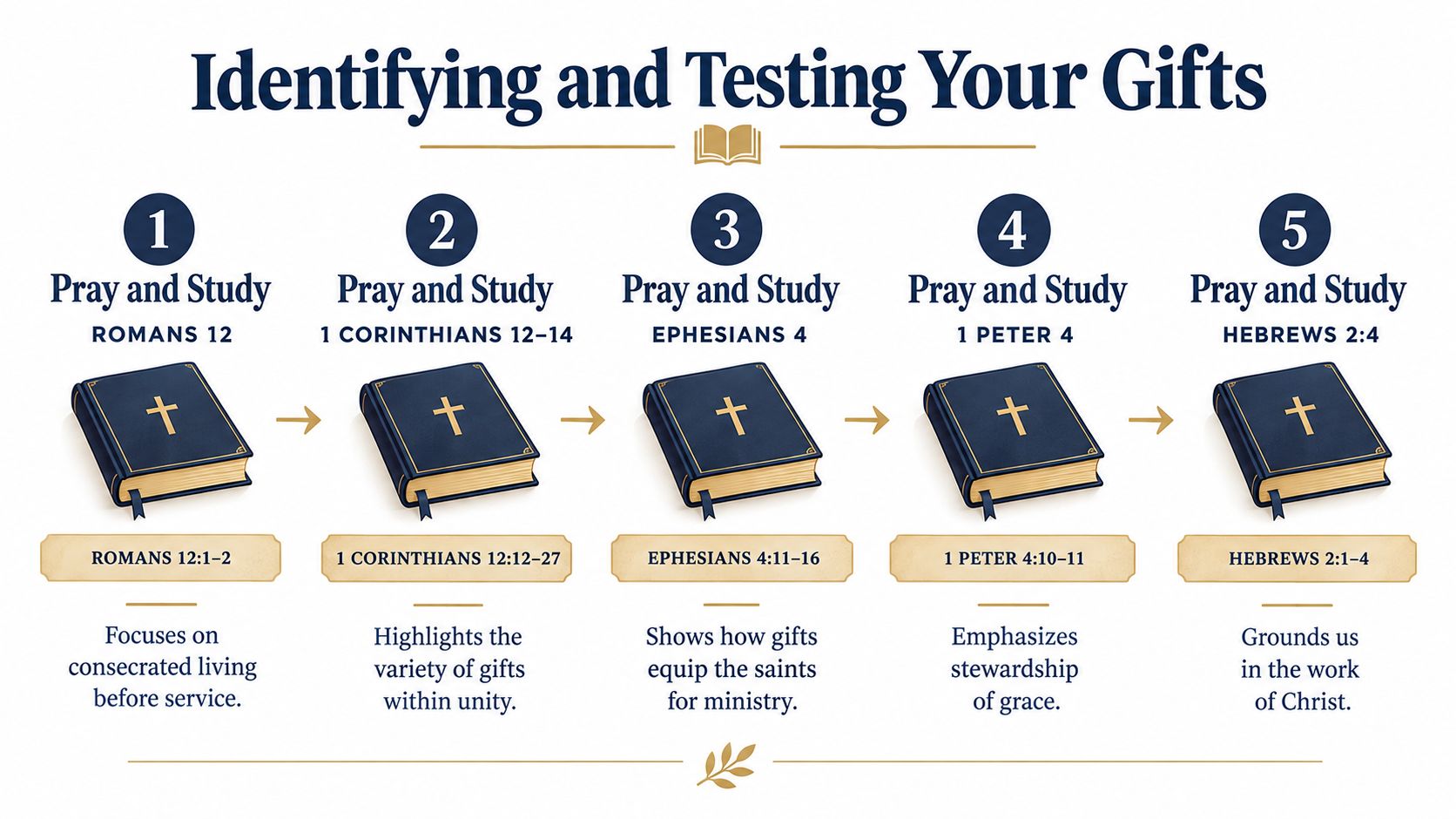
Before asking, “What is my gift?” ask, “What does God intend gifts to accomplish?” Five major New Testament passages provide a dependable framework: Romans 12:4–8, 1 Corinthians 12–14, Ephesians 4:7–16, Hebrews 2:4, and 1 Peter 4:10–11. Together, they move the conversation away from fascination and toward stewardship.
Romans connects gifts with consecrated living
Romans 12 begins with worship and renewed thinking before discussing prophecy, service, teaching, encouragement, generosity, leadership, and mercy. Paul's sequence matters. Ministry doesn't replace discipleship. A person may communicate with skill and still need deeper humility, repentance, patience, and love.
The passage also gives practical direction. Teach through teaching. Encourage through encouragement. Give generously. Lead diligently. Show mercy cheerfully. These instructions imply practice. A suspected gift becomes clearer as a believer faithfully serves in ways that match the gift and observes what helps others.
First Corinthians teaches variety within unity
First Corinthians 12–14 addresses a church tempted to rank spiritual expressions. Paul names different gifts, services, and activities while pointing to the same Spirit, Lord, and God. The purpose is “the common good,” not personal status (1 Corinthians 12:7, NIV).
The chapters also place love and order around gifted ministry. Prophecy, tongues, discernment, and other manifestations must serve the gathered church rather than create confusion or competition.
Ephesians focuses on equipping believers
Ephesians 4:7–16 names apostles, prophets, evangelists, shepherds, and teachers, then explains their purpose: “to equip the saints for the work of ministry” and build up the body of Christ. Leadership gifts are therefore measured by whether they help other believers mature and serve.
Hebrews and First Peter add two essential perspectives
Hebrews 2:4 presents God's confirming work through signs, wonders, various miracles, and gifts of the Holy Spirit according to his will. The passage keeps attention on God's initiative rather than human control.
First Peter 4:10–11 describes believers as stewards of God's varied grace. Whether someone speaks or serves, the goal is that God receives glory through Jesus Christ. This gives us a clear theological center: gifts are grace entrusted for faithful service, not achievements earned through effort.
Identifying and Testing Your Gifts
A spiritual-gifts inventory can help you name possibilities, but it can't establish divine authorization by itself. One study of 72 evangelical college students examined inventory reliability and construct validity, while another study of 32 Baptist adults found that personality factors explained approximately 50% of shared variance in spiritual-gift scores (study on spiritual-gifts inventories and discernment). Those findings don't make inventories useless. They show why you should read them as hypothesis-generating tools, not diagnostic tests.
A stronger process combines three forms of evidence:
Self-report: What kinds of service draw your attention and willingness?
Observable fruit: What happens when you serve? Do people receive clarity, comfort, practical help, or spiritual strengthening?
Community affirmation: Do mature pastors, peers, and recipients recognize the same pattern?
A formal ministry responsibility should normally wait until these indicators begin to converge. High confidence, emotional intensity, or a strong inventory score isn't enough.
Use a 90-day discernment cycle
A defined period keeps discernment from becoming either a rushed quiz or an endless question.
Days 1–30: Pray through Romans 12, First Corinthians 12–14, Ephesians 4, Hebrews 2:4, and First Peter 4. Record possible gifts, questions, and areas where your assumptions may be shaped by personality or church culture.
Days 31–60: Complete one inventory, then discuss the results with a pastor, mentor, or trained ministry leader. Choose a low-risk serving opportunity connected to one or two suspected gifts.
Days 61–90: Serve repeatedly and record the setting, your intended contribution, recipient response, and mentor observations. Reassess the pattern rather than focusing on one memorable experience.
Keep your notes concrete. “I felt powerful” is less useful than “three participants said the explanation helped them understand the passage, and my mentor identified two places where I needed greater accuracy.”
A recent study of discernment identified spiritual character traits, accumulated spiritual capital, and spiritual experiences as measurable predictors, while also reporting associations involving religious pluralism, religious monism, and mystical experience. These findings don't establish causation, but they support a balanced conclusion: discernment is an integrated capability shaped by character, learning, experience, and reflection (research on lived spirituality and discernment).
Practices That Grow What God Has Given
A gift develops when you repeatedly use it in love, under truth, and with correction. Prayer matters, but prayer isn't a substitute for preparation. A teacher studies the biblical text and learns to explain it plainly. A person serving through mercy practices attentive presence rather than rushing to solve every problem. Someone growing in discernment learns to listen carefully, distinguish evidence from assumption, and submit conclusions to wise believers.
Turn ordinary habits into ministry formation
Consider how gifts may mature in settings beyond a Sunday platform:
Teaching: Prepare a short explanation of a difficult biblical idea for a family discussion, workplace conversation, or online study group. Ask whether your explanation was faithful, clear, and useful.
Mercy: Visit, call, or practically assist someone facing suffering. Notice whether your presence communicates dignity rather than dependence.
Encouragement: Send a specific message that names God's work in someone's life without using empty praise. Follow up later to learn whether the encouragement helped.
Discernment: Before sharing a strong impression, write down the evidence, alternative explanations, and possible consequences. Ask a mature Christian to challenge your conclusion.
Faith and prayer: Keep a record of requests, actions, and outcomes. This protects you from exaggerating successes or forgetting unanswered prayers.
Practice should make you more useful, more truthful, and more loving, not merely more confident.
Community gives these habits a setting for correction. A small group, serving team, prayer gathering, or retreat can reveal strengths that solitary reflection misses. The Public Reading of Scripture, for example, can help a developing teacher practice oral clarity while remaining accountable to the biblical text.
Write down what you're learning. Track the opportunities you accept, the people affected, the feedback you receive, and the character pressures you encounter. Don't measure your progress against someone else's visibility. A quiet pattern of faithful service may reveal more than a dramatic moment.
The same principle applies in family formation. Parents and caregivers who want to cultivate wise action can benefit from a practical therapeutic action guide for parents, especially when turning good intentions into repeatable habits.
For deeper grounding, connect ministry practice with doctrinal study through Practicing Christian Doctrine. Prayer, Scripture meditation, confession, and fasting can support every gift, but they're means of communion and formation, not techniques for manufacturing spiritual power.
Mentors, Accountability, and Supervised Service
No one evaluates a gift well in complete isolation. A mentor, an accountability partner, and a supervised ministry placement each provide a different kind of help.
A mentor offers long-term perspective. This person watches your character, asks how your family and work are affected by ministry, and helps you interpret both encouragement and disappointment. A mentor is especially valuable when you're considering a major vocational step.
An accountability partner creates honest space for self-examination. This relationship may focus on motives, boundaries, consistency, and hidden temptations. For practical guidance on the role, you can review Text Lauren's partner guide, then adapt its principles to your church context and pastoral relationships.
A supervised placement tests ideas in real ministry. A teaching rotation, pastoral internship, outreach assignment, or care-team role lets leaders observe preparation, communication, follow-through, and response to correction.
Choosing the right support structure
Support Type | Primary Purpose | Best Fit For | Typical Cadence |
|---|---|---|---|
Mentor | Character formation and vocational perspective | Emerging leaders and students | Monthly or twice monthly |
Accountability partner | Honest self-examination and practical consistency | Anyone testing motives or habits | Weekly or biweekly |
Ministry placement | Observable practice and ministry feedback | Those ready for repeated service | Weekly service with regular review |
Use a feedback loop rather than a single evaluation. After each assignment, record what you intended, what happened, how recipients responded, and what your supervisor noticed. Review patterns monthly, then conduct a broader review after a season of service.
The right question isn't only, “Did I enjoy this?” Ask, “Did this help people, and did I serve in a Christlike way?”
Increase responsibility only when competence and character remain stable. A person may communicate beautifully but respond poorly to correction. Another may be inexperienced yet teachable and dependable. Supervision helps leaders distinguish temporary weakness from a persistent mismatch.
Ethical Safeguards for Higher-Risk Gifts
Prophecy and healing require special care because people may make serious decisions based on what they hear. The spiritual language surrounding a claim doesn't remove the need for testing, consent, humility, or pastoral oversight.
First Corinthians 14 requires order and evaluation in gathered worship. First Thessalonians 5:19–22 holds together two commands that Christians sometimes separate: don't despise prophetic utterances, and test everything. A responsible church neither treats every impression as unquestionable nor dismisses every spiritual claim without examination.
Test the message and protect the person
A faithful word of encouragement may say, “I believe this passage speaks hope into what you're facing. Would you be willing to consider it?” An overclaimed prophecy may announce a guaranteed outcome, demand obedience, or use spiritual authority to control a vulnerable person. The difference includes tone, certainty, accountability, and the freedom given to the listener.
For higher-risk ministry, use safeguards such as these:
Check Scripture: Reject any message that contradicts biblical teaching or the character of God.
Submit to leadership: Bring significant words and practices under local church governance.
Ask permission: Don't force physical contact, public disclosure, or private conversation.
Avoid guarantees: Pray with faith without promising a particular healing outcome.
Protect confidentiality: Never turn someone's pain into a testimony without clear consent.
Welcome correction: If your impression was wrong, acknowledge it without defensiveness.
Refer appropriately: Encourage medical, pastoral, or professional care when a person needs it.
Cultural awareness matters, too. Practices associated with prophecy, healing, and tongues are present across major Christian populations, but the meaning and reception of those practices differ. A ministry leader should learn the congregation's history and communicate in ways that edify rather than confuse.
Discernment isn't suspicion. It's a form of love that protects people, preserves trust, and honors Christ's name.
Growing Gifts Beyond the Church Platform
A church platform is only one place where spiritual gifts become visible. Teaching may appear in a workplace training session. Mercy may emerge through care for an aging relative. Administration may help a community organization serve families more reliably. Encouragement may take the form of thoughtful messages in a digital group. Discernment may help a team identify an ethical concern before it becomes a crisis.
Barna's survey of 1,006 Christian adults found that 68% had heard of spiritual gifts, while only 13% claimed one or more gifts in categories including healing, interpretation, knowledge, miracles, prophecy, or tongues. The same survey reported teaching at 9%, service at 8%, faith at 7%, encouragement at 4%, healing at 4%, knowledge at 4%, and tongues at 3%. The share who didn't know their gift reportedly rose from 8% in 2000 to 13% in the later survey (Barna's survey on spiritual gifts). These figures don't identify anyone's gift, but they show why awareness needs practical discipleship.
The same research found that 82% of self-identified U.S. Christians and 97% of practicing Christians agreed that helping people discover and develop their abilities matters. Yet only 25% of self-identified Christians said their skills were commonly noticed at church, compared with 50% of practicing Christians who understood their gifts well. Among practicing Christians interested in development, 55% were open to investing in that development at church (Barna's research on congregants' gifts). Churches therefore face an implementation challenge: many people value development, but fewer experience a clear pathway.
Everyday examples of faithful development
A caregiver may sense a gift of mercy but have little access to formal ministry. She could begin with one supervised relationship, receive guidance from a pastor, and learn to serve without neglecting her household responsibilities.
A young adult who works in technology may never teach from a pulpit, yet may lead a small online Bible discussion, create accessible study resources, or mentor a younger believer. Feedback from participants can test whether communication is both accurate and helpful.
An immigrant believer may bring cross-cultural insight to evangelism, hospitality, or church administration. A church that listens well can create meaningful roles without requiring that person to imitate the dominant culture's style of leadership.
People with disabilities may need flexible, accessible pathways such as writing, one-on-one discipleship, remote discussion leadership, prayer, or specialized encouragement. Development should not depend on physical access to a platform. Families, caregivers, young adults, and people working multiple jobs all need forms of supervised practice that respect their actual responsibilities.
Make training part of your next step
Development can include formal education without becoming a credential chase. You might audit a seminary course, join a certificate program, attend an on-demand seminar, explore a graduate major, or participate in a short workshop. The right choice depends on your season, learning goals, ministry responsibilities, and access to community feedback.
The Bible Seminary offers degree programs, certificate options, audited courses, dual-degree completion, and on-demand seminars for students and ministry professionals. Its graduate majors study all 66 books of Scripture alongside historical, theological, and practical disciplines, bringing academic learning into conversation with spiritual formation and hands-on ministry. The 3J Museum also reminds visitors that Scripture is grounded in real history through an immersive collection of nearly 200 artifacts, with more than 90% described as authentic, from Khirbet el-Maqatir near Jerusalem.

The practical question is simple: what can you do next? Sign up for a course, schedule a conversation with admissions, ask a pastor about a supervised serving role, or invite two mature Christians to help you review your 90-day notes. Training hearts and minds for kingdom service means uniting scholarship, spiritual formation, and practical obedience. It means equipping leaders to impact the world for Christ, in churches and in ordinary places where neighbors, colleagues, families, and communities need faithful service.
The Bible Seminary provides Bible-centered graduate education, certificate options, flexible courses, and ministry-focused formation for believers discerning how to serve with greater wisdom and faithfulness. Visit The Bible Seminary to explore a practical next step in training your heart and mind for kingdom service.