
God and Knowledge in a Christ-Centered World

Can you believe in God, know many facts about religion, and still misunderstand what it means to know God? A Bible study participant may confidently affirm that God knows everything, then struggle to explain how that conviction relates to prayer, suffering, or a difficult decision. The problem isn't necessarily weak faith. It may be that we're using the word knowledge for several different things.
Why the Question Matters
Consider a hypothetical conversation after church. Someone says, “I believe God has a purpose for my life.” A friend asks how they know what that purpose is, and the answer shifts between a biblical passage, a family tradition, and a strong personal impression.
Each deserves attention, but they aren't interchangeable. A passage requires interpretation. A tradition needs examination. An impression calls for discernment rather than automatic acceptance as divine instruction.
The relationship between God and knowledge matters because our reasons for believing something shape how we teach it and act on it. A pastor counseling a grieving family needs more than confidence. A teacher answering a teenager's questions needs more than religious vocabulary.
Belief and Understanding Aren't Identical
Religious knowledge can be examined separately from personal commitment. In Pew Research Center's U.S. Religious Knowledge Survey, atheists and agnostics averaged 20.9 correct answers, compared with the national average of 16.
That finding doesn't establish who knows God relationally or whose beliefs are true. It does challenge the assumption that professing faith automatically means understanding Scripture, doctrine, or other religions.
A useful conversation therefore asks:
What do you believe? Name the claim rather than relying on a broad religious label.
Why do you believe it? Identify Scripture, reasoning, testimony, or experience.
How should it shape you? Consider whether your response reflects humility, love, and responsible action.
Learning for Kingdom Service
We approach theological education as training hearts and minds for kingdom service. Intellectual care isn't a rival to devotion. It helps us avoid saying more than Scripture warrants or offering easy answers where patient listening is needed.
For prospective students, ministry leaders, and curious readers, this is an invitation rather than an entrance examination. You don't need every question resolved before beginning serious study. You need a willingness to learn, submit your assumptions to examination, and follow Christ with both conviction and humility.
Understanding the Key Concepts
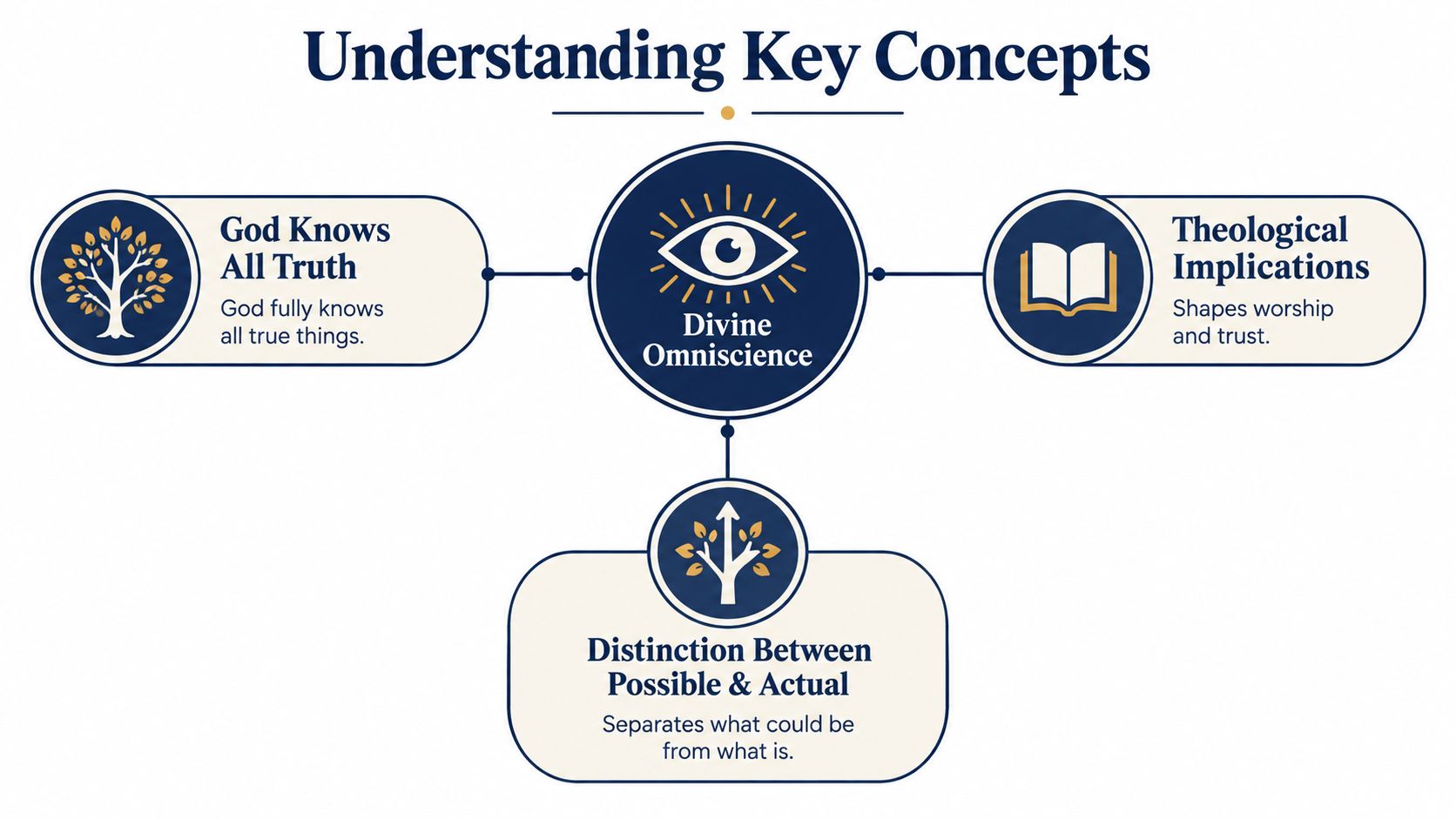
Divine omniscience means that God fully knows everything that is true. It isn't the claim that God possesses more information than we do. Within Christian theology, God's knowledge isn't subject to the ignorance and correction that characterize human learning.
The following diagram distinguishes related questions without making them identical.
God's Knowledge and God's Self-Disclosure
Theologians distinguish necessary truths, which couldn't be otherwise, from contingent truths, which concern events or circumstances that could have been different. A further distinction separates what is possible from what happens. These distinctions help clarify questions, but they don't by themselves settle debates about providence and human freedom.
Revelation concerns a different issue: how God makes himself known. Christian faith receives Scripture as authoritative divine communication and understands God's self-disclosure through the person and work of Jesus Christ.
The difference is important. God's knowing everything doesn't mean that God has told us everything. Nor does our inability to explain every divine purpose mean that God hasn't revealed anything clearly.
We can know God truly without knowing God exhaustively.
How People Receive and Evaluate Knowledge
Epistemology is the study of knowledge and its justification. In plain language, it asks what we know, how we know it, and whether our reasons are adequate.
Several terms help us answer those questions carefully:
Faith involves trust in God, not merely agreement that religious statements are correct.
Reason helps us interpret language, assess arguments, and recognize contradictions.
Tradition preserves inherited interpretations and practices for examination.
Experience includes the events, relationships, and spiritual encounters through which people understand their lives.
Spiritual intuition describes an immediate sense of meaning or direction that still requires testing.
These aren't equal authorities within Christian theology. We should assess inherited teaching, personal impressions, and arguments in submission to Scripture rather than allowing them to override it.
Think of studying a historical letter. You can identify its vocabulary yet misunderstand its purpose if you ignore the writer, audience, and circumstances. Likewise, possessing theological information doesn't automatically produce wise judgment.
A mature learner asks not only whether a claim sounds familiar, but what supports it, how it fits with other truths, and what remains uncertain. That discipline protects both confidence and humility.
Tracing Knowledge of God in Scripture
Proverbs introduces knowledge as part of a life shaped by wise instruction, not as a collection of impressive answers. An open Bible invites attentive reading before confident application.

Knowledge That Forms Character
Proverbs 1:2–7 joins learning with wisdom, discipline, understanding, righteousness, justice, integrity, and prudence. Its introductory purpose matters: readers are being prepared to receive instruction and develop sound judgment.
The passage culminates in a theological foundation:
“The fear of the LORD is the beginning of knowledge.”Proverbs 1:7, CSB
Here, reverence isn't an alternative to thinking. It establishes the learner's posture before God. We don't stand above divine instruction as its final judges; we receive it as people who need correction.
A scholarly examination of Proverbs 1:1–7 identifies its repeated vocabulary of knowing, wisdom, discipline, understanding, righteousness, judgment, and honesty. The passage deliberately connects intellectual and ethical formation.
That connection changes the questions we bring to Bible study. Alongside asking what a passage means, we should ask what kind of person its instruction calls us to become.
Remembering and Practicing What We Learn
Deuteronomy 6:6–7 describes God's commands being retained in the heart and diligently taught to children. Psalm 1 portrays sustained meditation on God's instruction. Neither picture reduces learning to hearing something once.
Historical study adds useful context without proving every detail of biblical education. Research on ancient Israelite literacy and scribal training discusses memorization, writing conventions, palaeographic evidence, orthographic patterns, and numerical notation as elements of disciplined textual formation.
We shouldn't equate scribal expertise with spiritual maturity. Still, this background reminds us that preserving and understanding authoritative texts requires effort, practice, and community.
The accompanying video provides an additional resource for reflection alongside your reading.
For a contemporary Bible study, the application is concrete: reread the passage, trace its argument, identify its moral demands, and return to it in prayer. A learner who can explain justice but won't practice fairness hasn't fulfilled the educational purpose described in Proverbs.
Biblical knowledge should cultivate reverent judgment and faithful conduct, not merely the ability to win a discussion.
Comparing the Main Theological Approaches
Christian discussions of divine knowledge often become confusing because participants are answering different questions. One asks what God knows. Another asks how creatures can speak meaningfully about God. Someone else asks how God reveals himself within human history.
These aren't necessarily competing positions. They can be complementary emphases within a larger account of Christian doctrine.
Theological Approaches to Divine and Human Knowledge
Approach | Central Question | Typical Emphasis | Pastoral Limitation |
|---|---|---|---|
Omniscience-centered | What does God know? | God's complete knowledge of all truth | Doesn't explain every particular act of providence |
Mystery-conscious | How far can human understanding reach? | Creaturely limits and reverent restraint | Can become evasive if used to avoid careful interpretation |
Revelation-centered | How does God make himself known? | God's self-disclosure received through Scripture and centered on Christ | Can confuse growth in human understanding with change in God |
Eternity-and-creation distinctions | How does divine knowledge relate to temporal events? | Philosophical distinctions concerning time, possibility, and actuality | Can burden pastoral care with conclusions beyond the evidence |
The table offers a map of questions, not a catalog of mutually exclusive denominations. A responsible teacher can affirm God's complete knowledge while acknowledging mystery and attending closely to revelation.
Progressive revelation should also be distinguished from the claim that God gradually becomes better informed. The former concerns God's unfolding communication and our reception of it, not a deficiency in divine knowledge.
Distinguishing Confession From Explanation
Some theological statements summarize clear scriptural teaching. Others propose philosophical explanations for how that teaching fits together. The distinction matters when discussing God's relationship to time or how divine knowledge relates to free decisions.
We should identify an inference as an inference rather than present it with the same authority as the biblical text. Readers who want to understand these different tasks can explore the distinction between historical theology and systematic theology.
Historical theology examines how Christians have understood and expressed doctrine. Systematic theology considers how teachings relate to one another within a coherent account of Christian faith.
Pastoral boundary: Don't turn an unresolved philosophical explanation into a condition of someone's faithfulness.
This restraint doesn't make doctrine unimportant. It keeps our teaching anchored in the confession of God as Creator, Redeemer, and Lord while allowing careful discussion of matters Christians explain differently.
When someone is grieving, begin with attentive presence and what Christians can responsibly confess about God's character. An intricate theory of eternity may belong in a later conversation, not at the bedside.
How Human Minds Form Ideas About God
A person may affirm that God knows everything yet imagine God attending to a crisis as though other events temporarily escape his attention. The stated doctrine and the mental picture don't quite match.
Cognitive research summarized by Oxford scholars distinguishes explicit theological beliefs from the implicit representations people use while processing narratives. Participants may reason with humanlike assumptions about God even when their verbal theology emphasizes divine transcendence or omniscience.
Recognizing Our Mental Habits
That distinction gives teachers a useful question: What assumptions appear in the way we interpret a story? Repeating an accurate definition doesn't guarantee that we've recognized every conflicting intuition.
The diagram names several mental activities involved in forming ideas about unseen realities.
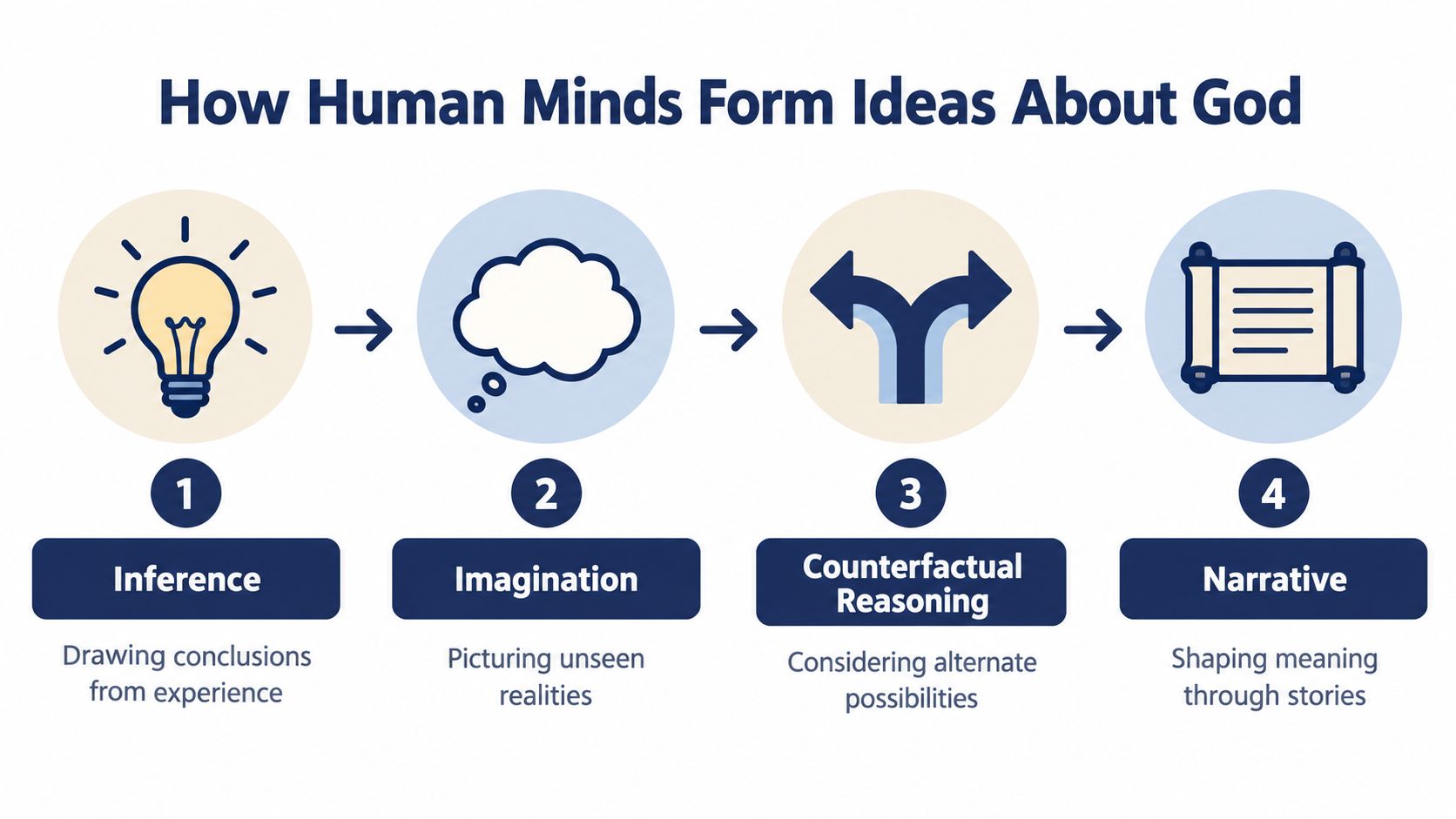
These activities shouldn't be treated as a rigid sequence that everyone follows. Cognitive-science research on reasoning about God discusses general-purpose mechanisms including inference, imagination, counterfactual reasoning, and social-cognitive modeling.
Related developmental findings describe children attributing knowledge of hidden contents to God while recognizing that ordinary human observers are limited by what they can see. Such findings concern how people represent divine knowledge. They don't establish whether God exists or whether a theological claim is true.
Naming the Source of a Claim
Consider someone who interprets an unexpected opportunity as God's guidance. A careful conversation separates the elements:
Observation: An opportunity became available.
Inference: The person believes the opportunity may serve a good purpose.
Theological judgment: They assess its consistency with Scripture and their responsibilities.
Personal response: They decide whether to proceed through prayerful discernment and counsel.
The distinction doesn't dismiss spiritual experience. It prevents an interpretation of experience from being treated as though it were an explicit biblical command.
Nor does studying cognition reduce faith to psychology. Explaining how people process a claim isn't the same as deciding its truth. For Christian educators, the value lies in helping learners notice where family expectations, cultural language, and familiar stories influence what they assume God must be like.
Teaching and Defending Knowledge of God
A student asks, “If God knows everything, why should I pray?” A hurried answer may protect a doctrinal slogan while leaving the question untouched. A better response identifies what the student means by prayer and what they think divine knowledge makes unnecessary.
Responsible teaching begins with a method that others can examine, not a conclusion they must accept.
A Method for Accountable Interpretation
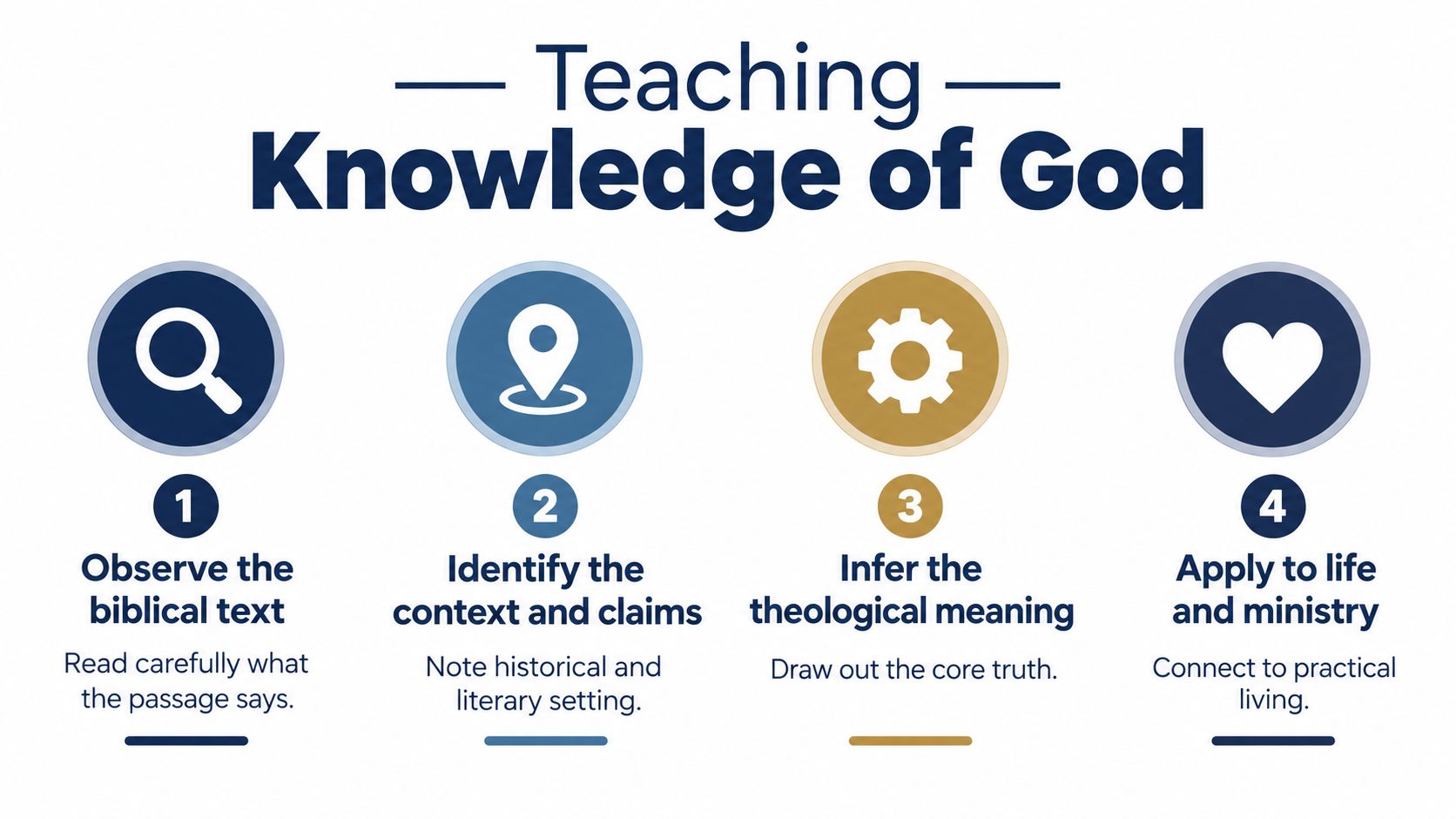
Observe the biblical text. Read the whole passage and note its actual wording. Don't begin by importing the answer you hope to find.
Identify context and claims. Ask who is speaking, to whom, and for what purpose. Distinguish a narrative description from a command or promise.
Infer theological significance. Explain how the passage supports your conclusion and acknowledge what it doesn't settle.
Verify before applying. Consult recognized scholarship and thoughtful Christian community, then connect the interpretation to life and ministry.
The visual below summarizes the movement from careful reading toward faithful application. Verification should accompany that movement rather than disappear once an interpretation feels persuasive.
Answering Questions Without Overclaiming
With suffering, distinguish what Scripture teaches about God's character from speculation about why a particular tragedy occurred. With science, identify whether the question concerns an observable process, a philosophical interpretation, or a theological claim. Don't assume that answering one automatically answers the others.
When discussing another religion, represent its teaching accurately before evaluating it. When someone describes a spiritual experience, listen carefully without either endorsing every interpretation or dismissing the person.
Explaining a text, describing a tradition, and confessing Christian trust are related but different acts. Clear language helps listeners recognize which one you're undertaking.
For learners developing a regular study rhythm, Scroll With God's guide to apps for Scripture and prayer offers a starting point for considering digital resources. Evaluate any tool by whether it supports contextual reading, attentive prayer, and accountable learning.
A useful ministry answer shows its reasons and respects the person asking.
The teacher's goal isn't to appear unanswerable. It's to help people become more faithful readers, more careful thinkers, and more loving servants.
Clarifying Common Misconceptions
Religious labels aren't reliable substitutes for conversation. Someone who doesn't belong to a religious institution may still believe in God, while another person using the same label may reject theism entirely.
Pew's research on God, spirits, and the natural world found that 92% of religiously unaffiliated respondents in Brazil believed in God, compared with 18% in Australia. Those findings make stereotyping especially unhelpful.
Rather than assuming hostility or Christian understanding, ask what the person means by God, what has shaped that understanding, and which questions remain unresolved.
Frequently Asked Questions
Does faith mean refusing evidence?
No. Trust doesn't require avoiding questions about interpretation, history, or reasoning. Christian educators should welcome honest inquiry while recognizing that different kinds of claims require different kinds of examination.
Can we know God if we can't explain everything about him?
Yes. Genuine knowledge needn't be exhaustive knowledge. The important task is distinguishing what God has revealed from what we merely assume.
Does disagreement mean every religious claim is equally true?
No. People can disagree about a claim without making incompatible conclusions equivalent. Respectful engagement requires accurate representation and careful evaluation, not indifference to truth.
Does science settle every question about God?
We should examine the particular question before answering. An account of how a process works and a claim about its ultimate meaning aren't automatically rival explanations, although specific claims may require close scrutiny.
Fluent Answers Still Need Verification
The same care applies to AI-generated theology. A confident answer may contain an invented reference, omit a passage's context, or present one tradition's interpretation as universal Christian agreement.
Before teaching from such material:
Open the sources. Check whether the cited text exists and supports the claim.
Examine the assumptions. Identify interpretive commitments and missing qualifications.
Retain responsibility. Don't delegate doctrinal judgment or pastoral discernment to a generated response.
Convenient access to information doesn't remove the need for accountable interpretation. If you can't verify an answer, don't present it as established knowledge.
Continuing the Study of God and Knowledge
Mature reflection on God and knowledge requires us to keep distinct questions in a fruitful relationship. Divine omniscience concerns God's knowledge; revelation concerns God's self-disclosure; human reasoning concerns how we understand and evaluate claims.
Tradition and experience contribute to our learning, but they require discernment. Ministry asks whether our conclusions are communicated truthfully and embodied in faithful service.
Choose a Sustainable Study Path
Begin with a biblical book rather than an endless stream of disconnected questions. Read it closely, use a reliable commentary, and keep a record of interpretive decisions you need to investigate.
Broaden your reading with purpose:
Biblical theology and wisdom literature help connect passages with their scriptural setting.
Christian doctrine and philosophical theology clarify terms and examine arguments.
Historical studies and archaeology provide context while teaching restraint about incomplete evidence.
Apologetics and cognitive approaches to religion sharpen engagement with questions and human assumptions.
Responsible historical study includes acknowledging uncertainty. Oxford Academic's discussion of education in ancient Israel recognizes evidence for educated scribes and training while noting debate over distinct wisdom schools. Evidence of scribal culture doesn't establish a standardized school network in every community.
Bring Learning Into Community
We aim to unite scholarship, spiritual formation, and hands-on ministry. Within a Bible-based, Christ-centered, Spirit-led, ministry-focused community, faculty guidance and fellow learners can help you test interpretations and practice teaching with care.
Our archaeology resources support an approach in which the Bible comes alive through archaeology and Scripture together, without asking artifacts to prove more than they can. Our academic pathways provide opportunities to connect that inquiry with theological study.
The purpose remains equipping leaders to impact the world for Christ. Whether you serve locally or across cultures, deeper learning should make you a more attentive reader, a more trustworthy teacher, and a more faithful neighbor.
Through graduate degree programs, The Bible Seminary offers Bible-centered study alongside historical, theological, and practical ministry disciplines. Visit The Bible Seminary to explore degree programs and begin deeper biblical and theological training for faithful service.