
Christian Theological Anthropology: A Complete Guide

A student sits with a Bible open after class and asks a question that reaches far beyond the classroom: “Who am I, and why do I matter?” The same question surfaces when a pastor visits someone who can no longer speak, when a teacher welcomes a child with a disability, and when a family wonders what makes a person more than a collection of abilities or achievements.
Christian theological anthropology studies what it means to be human in light of who God is and what Scripture reveals. It brings biblical teaching about creation, sin, the body, relationships, and redemption into conversation with the questions people face. For Christians, the answer begins not with what we can accomplish, but with the God who creates and calls us.
What Is Christian Theological Anthropology
Anthropology is the study of human beings. Christian theological anthropology asks what it means to be human by starting with God's revelation in Scripture and, ultimately, looking to Jesus Christ. Unlike approaches that study people without reference to God, this discipline considers human identity, purpose, and relationships in light of the Creator.
The term may sound abstract, but its questions are close to home. If a person's health, work, memory, or independence changes, what remains of their worth? How should a church treat someone who needs care rather than being able to offer help? What does it mean to live responsibly in a community and within creation?
The biblical starting point is the claim that human beings are made in God's image, or the imago Dei. Genesis 1:26–27 introduces this belief, which became a foundational framework for Christian theological anthropology (Cambridge's discussion of the imago Dei). The doctrine doesn't answer every question in isolation, but it gives Christians a starting point: people's worth comes from their created relation to God, not from a measure of talent or success.
That starting point also keeps the subject from becoming a detached exercise in definitions. To study the human person as Scripture describes them is to ask how we should care for one another, how we should understand our limits, and what kind of life Christ calls us to embody. The answers shape pastoral care, Christian education, ethics, and the daily habits through which faith is lived.
A grounding thought: Christian teaching about the human person begins with God's creative purpose, and finds its fullest expression in Christ.
The Imago Dei and Human Dignity
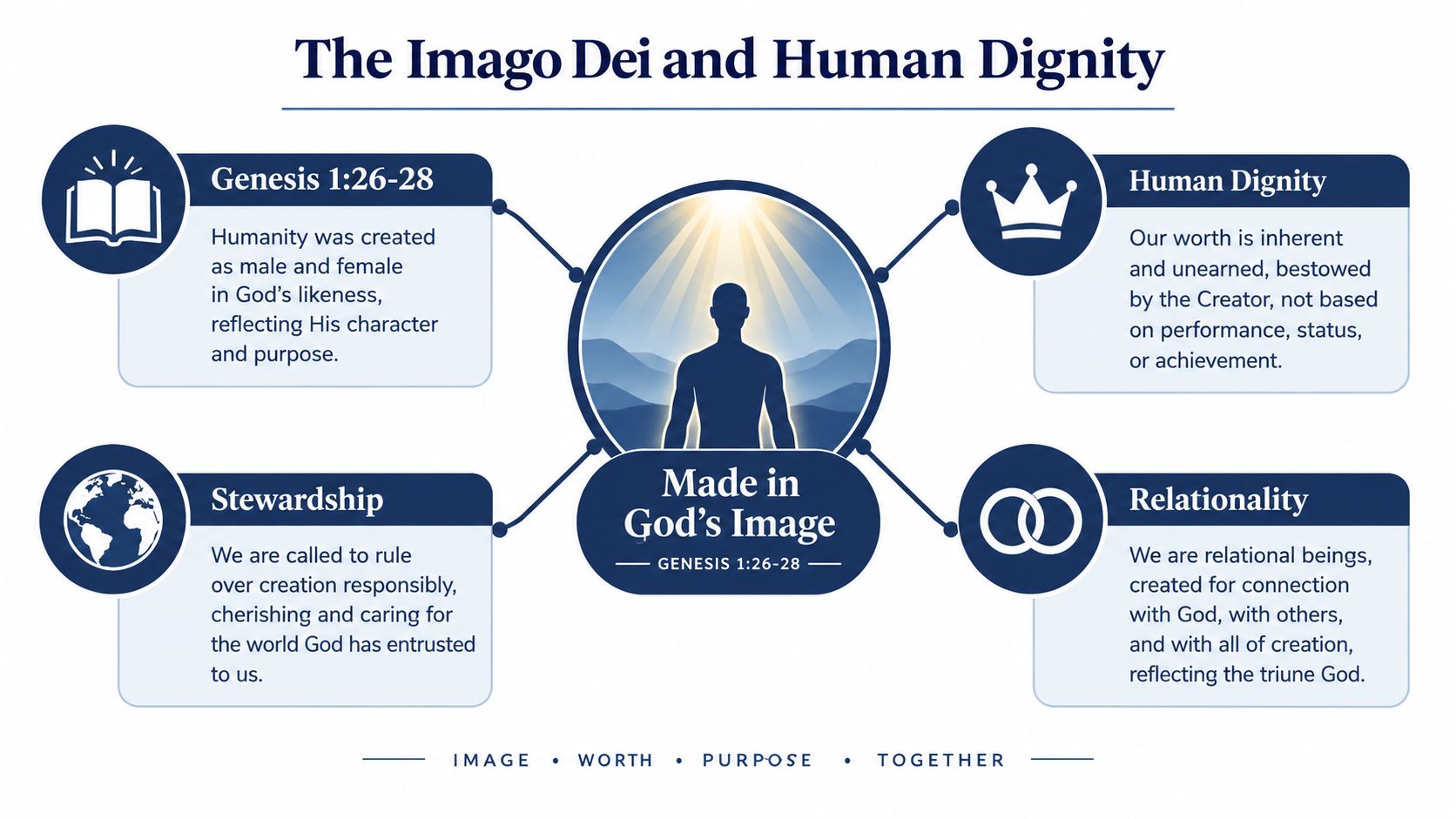
Genesis 1:26–28 pairs human identity with a task: naming, tending, and answering to God for how creation is handled. The passage blesses humanity as male and female and sends them into the world with a vocation. Worth and responsibility arrive together. People carry a God-given dignity, and their authority over creation stays accountable to the Creator.
That order matters.
Genesis never presents dominion as permission to exploit the earth or the people on it. Humanity receives a role under God, so stewardship means caring for what belongs to someone else. The household managers in Jesus' parables worked the same way: trusted with real authority, expected to give an account. When pastors teach on work, land use, or new technology, this pairing of dignity and duty gives the discussion its shape.
Early Christian thinkers read the passage through different lenses. Irenaeus of Lyons and Gregory of Nazianzus each contributed to Christian reflection on humanity before God, while Augustine of Hippo became especially influential. In Confessions and De Trinitate, he located the image of God in the human mind and its connected capacities of memory, understanding, and will. For Augustine, reason never floats free of faith and love; all three belong to the creature's orientation toward God.
Augustine also drew a careful line between human beings and Christ. In De diversis quaestionibus octoginta tribus, written approximately between 388 and 396 CE, he argued that people can rightly be called God's image while Christ remains the perfect divine image. Human likeness to God is created and received. It never becomes divinity by nature.
That distinction carries real weight for ministry. Dignity doesn't rise or fall with intelligence, age, health, independence, or social standing. A church member who needs extensive support bears the image of God no less than someone who reasons, works, and speaks with ease. Christian ethics can therefore begin with care and inclusion, and Christian authority stays a responsibility rather than a privilege without limits.
How the Doctrine Developed Through Church History
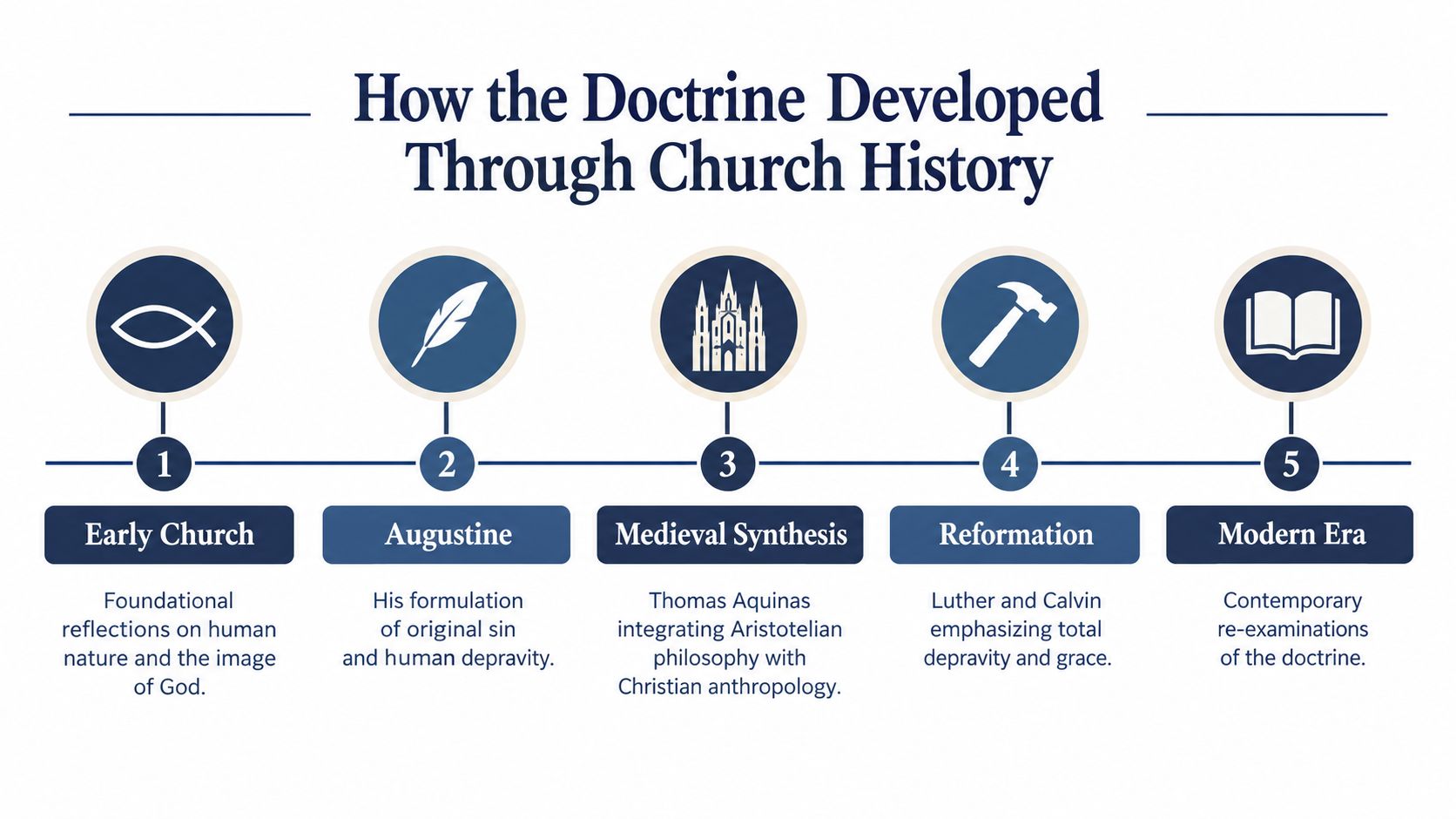
Christian teaching about human nature developed through sustained engagement with Scripture. The Bible provides the foundational witness, while Christian thinkers worked to explain how its claims fit together, particularly when questions about sin, grace, and the body demanded careful answers.
Sin, grace, and Augustine
The doctrine of original sin didn't arrive as a fully developed formula in the earliest Christian writings. Augustine made a major contribution in the late fourth and early fifth centuries. Toward the end of the fourth century, in De diversis quaestionibus ad Simplicianum, he used the expression peccatum originale, or “original sin,” and began developing a systematic account of humanity's inherited relation to Adam's sin (the Oxford Handbook's account of Augustine and original sin).
His thinking developed further during the Pelagian controversy, which began in 411 and continued through the rest of his life. Augustine argued that humanity sinned in Adam and shares in sin's punishment and guilt. The historical development matters because it helps students distinguish the biblical teaching about human fallenness from the later theological terms used to explain it. Romans 5:12–21, for example, places Adam's disobedience alongside Christ's obedience, keeping both the reach of sin and the hope of redemption in view.
The body and Christian hope
Questions about the body also shaped Christian anthropology. Some accounts emphasize the soul departing from the body after death; others focus on the future resurrection or transformation of the body. A Cambridge academic treatment notes that these ideas have historically been held together, while later theological and biblical scholarship gave greater attention to the integrated character of biblical accounts of the person (Cambridge's treatment of the soul and bodily resurrection).
Christian hope isn't escape from physical existence. In 1 Corinthians 15, Paul connects the resurrection of believers with Christ's resurrection and describes the transformed body as imperishable, glorious, and powerful. That distinction can help a pastor speak to grieving families with both honesty about death and confidence in God's promise to redeem the whole person.
Christ as the true image
The Christian account of humanity also centers on Jesus. Colossians 1:15 calls Christ “the image of the invisible God,” and Hebrews 1:3 describes him as the exact imprint of God's nature. These texts point beyond abstract definitions: in the incarnation, Christians see the true human life that is fulfilled in relation to God.
The New Testament calls believers toward Christlike humility and self-giving love, especially in Philippians 2:3–11 and Ephesians 4–5. Human dignity, sin, and the hope of bodily resurrection belong in a story of creation and redemption, with Christ at its center.
Major Theological Perspectives on the Human Person
Christian theologians have used several emphases to describe human personhood. These perspectives don't need to cancel one another out. Read with care, they can help us see the human person as created, embodied, relational, morally responsible, and dependent on God.
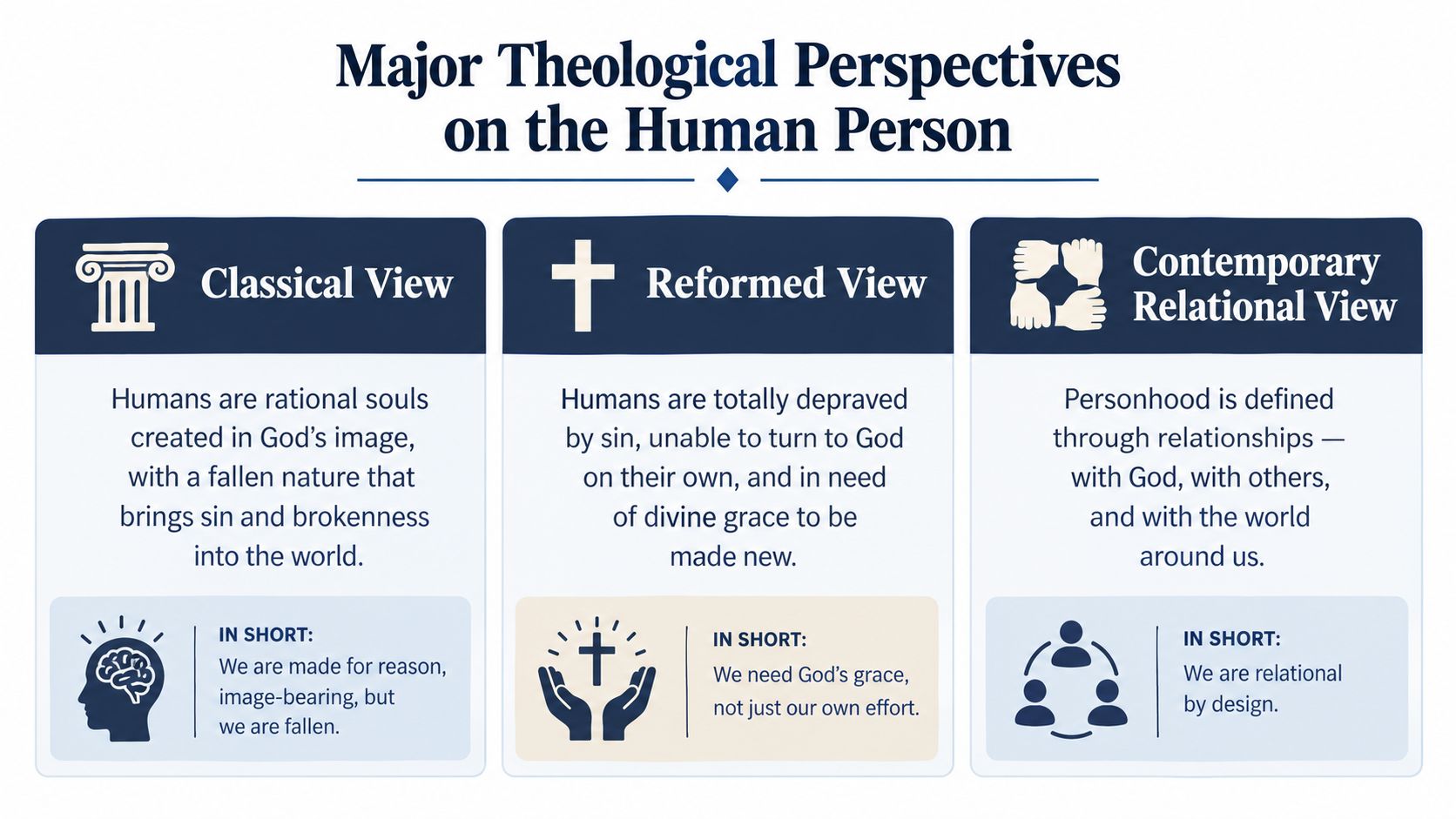
A classical emphasis often describes human beings in terms of the soul and its capacities, including reason and moral agency. This language can help explain human distinctiveness and responsibility, but it needs to be handled carefully. If worth is tied too closely to a particular ability, people who cannot demonstrate that ability may be treated as less fully human.
A central emphasis stresses that human life is not well described as a detachable mind or soul operating apart from the body. Scripture's resurrection hope points toward God's redemption of the whole person. Pastors who hold this view will take bodily life seriously when they care for people facing illness, disability, aging, or grief.
A relational and communal emphasis sees people as created for relationship with God and one another. This widens pastoral attention. Rather than asking only what an individual believes or can do, a minister also considers family ties, social support, vulnerability, and the obligations a community has toward its members.
A Christological emphasis looks to Jesus as the definitive revelation of human life. The question becomes not only “What are human beings?” but also “What does renewed humanity look like in Christ?” New Testament passages such as Philippians 2:3–11 and Romans 5:12–21 connect Christian formation with humility, obedience, love, and dependence on God.
These approaches carry practical consequences. A church that takes bodily and communal personhood seriously won't treat a hospital visit as a distraction from “real” ministry or assume that Christian formation consists only of learning information. It will ask whether its care and teaching honor the whole person and help people grow in faithful relationships.
Contemporary Debates and Global Questions
A hospital chaplain opens a message that sounds compassionate, quotes Scripture accurately, and arrives instantly. It was generated by artificial intelligence. Does the reply count as pastoral care? Christians can answer by asking what care involves: truthful words, presence, responsibility, patience, and commitment to a particular person.
This gives pastors a way to evaluate AI, neurotechnology, and human enhancement without responding with fear or fascination. A device that helps someone communicate, move, or receive treatment can serve embodied life. A project raises concern when it treats intelligence, productivity, independence, or longevity as the measure of human worth. The doctrine of the image of God helps believers distinguish a useful tool from a standard that ranks persons by performance.

The conversation also crosses cultures. Pew Research Center analyzed more than 2,700 censuses and surveys across 201 countries and territories and found that the global Christian population grew from approximately 2.1 billion in 2010 to 2.3 billion in 2020, a 6% rise (Pew's analysis of global religious change from 2010 to 2020). Those figures describe population rather than theological conviction, yet they show why doctrine must be taught with cultural attentiveness.
Ideas about family, work, migration, disability, and the body develop within particular histories. A community shaped by extended family may understand care differently from one organized around individual choice. Christians serving across cultures should avoid treating Western autonomy as the default definition of a mature person. For a related discussion of gender, Scripture, and church life, see The Bible Seminary's article on women's role in the church.
Disability makes these questions concrete. If personhood is tied to independent reasoning or productivity, a person with dementia or a significant impairment can be pushed toward the margins. Christian doctrine answers differently: human beings are dependent creatures, embodied members of a community, moral agents in varied circumstances, and recipients of God's care. That account protects people who cannot meet conventional expectations for output or autonomy.
The same framework shapes embodied ministry. Technology can transmit information quickly, while pastoral care also involves presence, appropriate touch, shared meals, advocacy, and staying with someone over time. A faithful response welcomes tools that serve vulnerable people and resists standards that turn finite human life into a performance test.
Why This Doctrine Matters for Ministry
Theology shapes ministry even when no one names it. A pastor's assumptions about personhood influence who gets listened to, how care is offered, what counts as participation, and whether a church regards vulnerability as a burden or as a call to shared responsibility.
A relational account of personhood changes pastoral assessment. If a congregant is experiencing trauma, illness, or isolation, a minister shouldn't focus only on private belief or psychological symptoms. Family relationships, community support, physical needs, and practical obligations may also matter. The right next step could be prayer and conversation, but it may also involve helping the person connect with trusted people who can offer ongoing care.
For ministry leaders: Begin by asking what this person needs to be seen, welcomed, and supported as a whole human being.
This doctrine matters in preaching, too. A sermon that teaches human dignity as God's gift gives a congregation a basis for welcoming people whose abilities, resources, or life circumstances differ from its own. In a children's ministry, that may mean adjusting an activity so a child with disabilities can participate meaningfully. In pastoral care, it may mean staying present when a suffering person has no quick answer to offer.
The practical implication is clear: human dignity isn't reducible to intelligence, autonomy, productivity, or physical ability. It's grounded in humanity's created relation to God and expressed through responsibility, communal life, and care for others (a theological study of the image of God and human dignity). This makes inclusion more than a gesture of kindness. It reflects a Christian understanding of who people are.
Christian formation should also reach beyond information retention. A class may teach students what a doctrine means, but ministry training should also ask whether they are learning to listen well, respond to vulnerability, and serve with humility. At The Bible Seminary, we value Bible-based, Christ-centered, Spirit-led, ministry-focused formation that brings scholarship into conversation with service. That approach helps prepare pastors, educators, and ministry leaders to carry theological conviction into the actual lives of the people they serve.
Practical Applications for Teaching and Daily Life
Christian theological anthropology becomes clearer when we practice seeing people as embodied, relational creatures made for life with God. These ideas can guide a classroom, a church, and everyday relationships.
Teach the doctrine through Scripture
Read Genesis 1:26–28 in context. Ask learners to notice the relationship between being made in God's image and receiving a vocation in creation. Then connect the passage with a concrete question, such as how a community should care for people who cannot contribute in familiar ways.
Make room for embodied lives
Personal identity unfolds through time and relationships, not through ideas alone. Memory contributes to continuity; the body situates thought and agency in concrete life; vulnerability reveals dependence on others; and empathy connects identity with ethical responsiveness (a study of embodiment, memory, and empathy). In teaching and pastoral care, that means making space to speak about illness, trauma, aging, and community rather than treating faith as a matter of private beliefs only.
Let dignity guide decisions
When reviewing a ministry activity, ask who can take part as it stands and who may face barriers. When discussing new technology, ask whether the decision serves people's health and relationships or makes performance a measure of worth. When caring for creation, connect stewardship with human responsibility toward neighbors and the world God made.
These practices can shape a family conversation, a Bible study, or a pastor's visit. The aim isn't to master a set of terms, but to grow in the kind of attention that treats each person as worthy of care and calls each Christian to serve faithfully.
Frequently Asked Questions About Theological Anthropology
What does it mean to be made in God's image?
It means human beings have a created likeness to God and a vocation within his creation. Human worth doesn't depend on a person's abilities, achievements, or social standing.
How should Christians understand the soul and spirit?
The Bible uses language about soul and spirit in varied contexts, and Christians have not always described their relationship in the same way. Whatever distinctions we make, Christian hope includes the resurrection of the body, not merely escape from physical life.
What is original sin?
It's a theological account of humanity's inherited relation to Adam's sin and the reach of human fallenness. Christians also confess that sin doesn't have the final word: Romans 5:12–21 sets Adam's disobedience alongside the saving work of Jesus Christ.
Does AI have the same status as a human person?
AI raises serious questions about identity and moral responsibility, but human dignity is grounded in being God's creature, not in producing intelligent-sounding responses. Christians can assess technologies carefully while protecting the dignity of people with profound cognitive disabilities and people who depend on others.
The Bible Seminary equips leaders to impact the world for Christ through Bible-centered graduate education, flexible study options, and ministry-focused formation. If you're ready to deepen your biblical understanding and prepare for kingdom service, explore what's available at The Bible Seminary.