
Requirements to Enter Seminary: A Practical Guide

You've just finished leading a Bible study, preparing a sermon, or talking with someone who needs pastoral care. You want to serve more faithfully, but your open browser tabs raise more questions than they answer. Do you need a degree, can you study while working, and will your previous education qualify?
The requirements to enter seminary make more sense when you begin with the ministry you're preparing for. Our advice is simple: identify the work, verify the credential it requires, and then build an application that demonstrates both academic readiness and a life rooted in Christ.
Starting With the Right Question
Ask what you're preparing to do before asking what you need to submit. Seminary is a means of preparation, not a destination in itself. The right pathway should strengthen your service without requiring a credential your intended role doesn't need.
A prospective pastor, Christian educator, chaplain, missionary, and lay Bible-study leader may all need deeper theological understanding. They shouldn't automatically choose the same program. Start by speaking with the church, ministry organization, or employer connected to your goal.
Name the ministry before choosing the degree
Write a plain-language description of the work you hope to undertake. Be concrete: teaching Scripture in a congregation, caring for hospital patients, preparing missionaries, or pursuing theological research.
Then bring that description to people who know your character and service.
Ask your pastor or mentor: What preparation would help me serve responsibly?
Ask the relevant organization: Which credentials do you require or recognize?
Ask yourself: Am I seeking training for an identified responsibility, or do I need space to discern my next step?
Use this calling framework to organize those conversations.
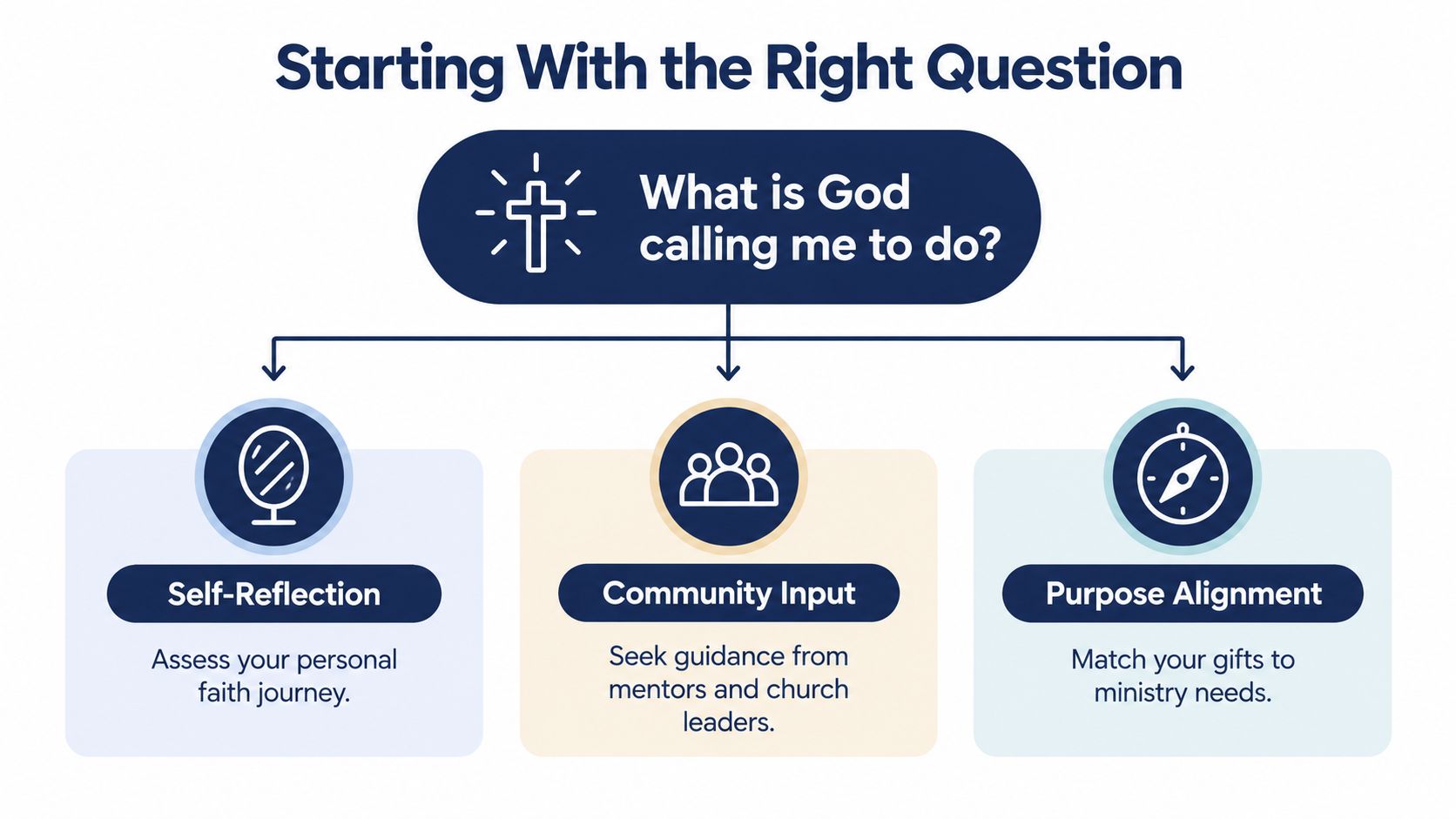
You don't need an impressive title to justify theological study. You do need an honest reason for undertaking it. We understand preparation as training hearts and minds for kingdom service, not collecting letters after a name.
In Ephesians, Paul describes ministry leadership in relation to the growth and unity of Christ's body:
“to equip the saints for the work of ministry, for building up the body of Christ”Ephesians 4:12, ESV
Understand the academic baseline
For most graduate seminary programs, the academic starting point is a completed bachelor's degree from an accredited institution or an educational equivalent. The Association of Theological Schools' 2020 accreditation standards establish that expectation for master's admission and allow exceptions when a school rigorously documents an applicant's preparation for master's-level work.
An accredited baccalaureate is an undergraduate degree whose institutional standing the receiving seminary can evaluate. Don't assume that a diploma alone establishes eligibility. Submit the official records and ask admissions to confirm how your qualification satisfies the program's standard.
For international degrees, the receiving school determines equivalency. For applicants without the usual undergraduate credential, an exception requires assessment, not merely a persuasive account of ministry experience.
The degree names also matter:
Master of Divinity or Master of Arts: Initial graduate theological study generally follows undergraduate preparation.
Master of Theology: Advanced theological study may require an MDiv or equivalent graduate theological preparation.
Doctor of Ministry and other doctorates: Expect prior graduate preparation and, depending on the program, ministry experience.
The ATS standards, policies, and bylaws distinguish the normal master's and doctoral academic thresholds. Always check the named degree, not the school's general admissions page.
A Bible or theology major can help, but don't rule yourself out because you studied another subject. Ask whether your program requires particular coursework and how you can address any gaps in reading, research, or writing.
If you're comparing undergraduate preparation in the British system, Next Level Online College's UK university entry requirements for 2026 offers a separate starting resource. Keep that inquiry distinct from graduate seminary eligibility, which the receiving institution must determine.
Transcripts, Recommendations, and the Rest of the Paperwork
Build your application around evidence, not adjectives. Saying you're committed, teachable, or academically capable is less useful than submitting records and references that demonstrate those qualities.
Start with the school's document checklist. Requirements differ, so don't assemble a generic application and assume every admissions office will accept it.
Request records through the proper channel
Ask your former registrar to send transcripts using the seminary's approved delivery method. An official transcript is an institution-issued academic record, not your own scan of a student portal. If a seal or sealed envelope is required, preserve it and follow the receiving school's instructions.
If your former school has closed, ask admissions which records custodian or successor institution it recognizes. Don't pay for substitute documentation until you know it will be accepted.
Prepare these materials as applicable:
Academic records: Official transcripts and a diploma copy.
Personal statements: A faith statement, vocational essay, or explanation of your educational goals.
Service history: A résumé or ministry CV describing responsibilities, dates, and relevant training.
Endorsements: The exact church or pastoral documentation the school requests.
For a concrete example, Asian Theological Seminary's admission requirements include an official transcript, diploma copy, three non-relative references, and a pastoral or church-board endorsement. Its reference categories include a pastor, a church official or employer, and a Christian friend.
Choose references who can answer the actual questions
A respected name isn't automatically a useful recommender. Choose someone who has observed your work closely enough to describe it accurately.
Seattle Pacific Seminary's admissions guidance requires two recommendations, separating spiritual and emotional preparedness from academic ability. It also states a 3.0 cumulative GPA maintenance requirement, which shouldn't be mistaken for a universal seminary entry cutoff.
Reference rule: Ask someone who knows your work, not merely someone who knows your name.
Give each recommender your intended program, résumé, application deadline, and the school's specific questions. Ask whether they can provide a substantive recommendation, and leave room for an honest refusal.
Your essay should connect your service, learning needs, and proposed study. Explain what you hope to become better equipped to do, rather than trying to sound like you've already completed the formation you're seeking.
What Admissions Committees Evaluate Beyond Grades
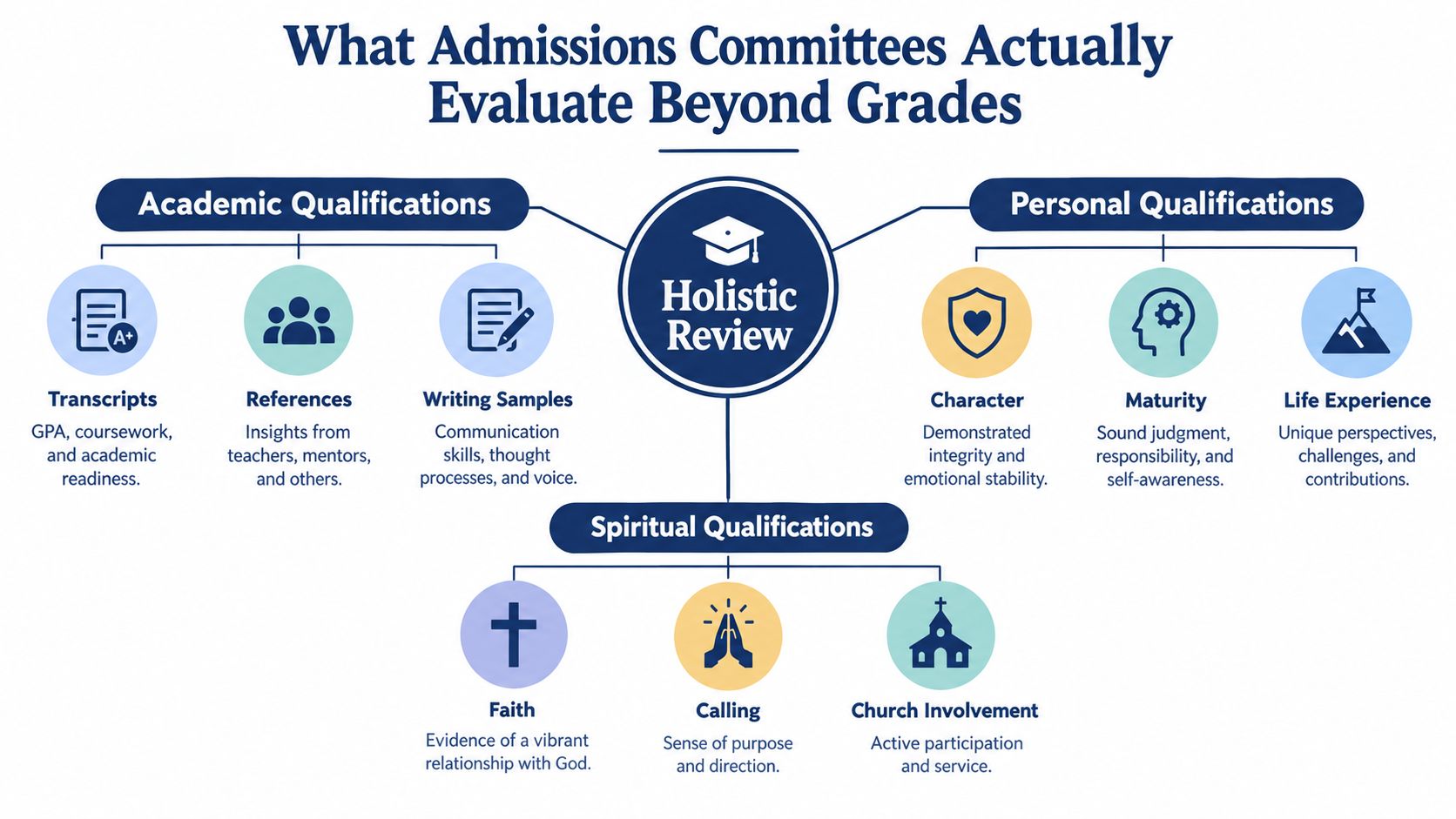
Your transcript shows how you handled coursework. It cannot show, by itself, whether you are ready for theological formation or how you will serve others. Earlier ATS standards named academic, personal, and spiritual qualifications, along with an applicant's potential contribution to church and society. The ATS admissions standards support a broader view of readiness than grades alone.
Present a coherent picture of readiness
Prepare evidence for all three dimensions at once. A gap in one is rarely offset by strength in another.
Dimension | Evidence to prepare | Question to address |
|---|---|---|
Academic | Records, academic references, requested writing | Can you undertake the program's work? |
Personal | Examples of responsibility and honest reflection | How do you respond to correction and pressure? |
Spiritual | Faith statement, church involvement, ministry references | How does your faith inform your service? |
If the school requires an interview, bring specific examples, not polished slogans. Explain a responsibility you carried, a correction you received, and a learning need you have identified. Be candid about uncertainty, while making clear that you are taking responsibility for your decisions about study and ministry.
Document experience when it is required
Some programs set ministry experience as an admissions threshold. The Graduate Theological Foundation's admissions requirements specify at least five years of ministry service, a ministry statement, and two recommendation letters for degree applicants.
That requirement applies to this institution, not to every person entering seminary. The practical lesson is to check each program's experience requirements early. When experience is required, document its duration, your responsibilities, and how it relates to your proposed study.
Describe your service accurately. Occasional participation is not sustained leadership, and overstating it can weaken your application. A clear account of faithful, ordinary service carries more weight than a grand claim you cannot support.
Approach theological education with a Bible-based, Christ-centered, Spirit-led, ministry-focused posture. Academic discipline and spiritual accountability belong together. Show evidence of both in your application; neither a strong faith story nor a strong transcript makes up for neglecting the other.
Matching Your Credential to Your Calling
Choose the minimum suitable pathway, not the smallest possible commitment or the most prestigious degree. Suitable means it meets your ministry goal, provides needed formation, and fits a workload you can sustain.
Flexible study deserves serious consideration. Religion News Service's reporting on changing seminary enrollment describes MDiv enrollment at ATS institutions falling roughly 14% from 2020, while customizable MA programs and non-degree enrollment contributed to a 1.8% overall enrollment increase since 2020.
Those figures don't determine your choice. They do challenge the assumption that entering seminary must mean immediately enrolling full-time in a residential MDiv.
Choosing the Right Seminary Pathway
The time descriptions below are planning categories, not promised completion schedules. Confirm each school's curriculum and your intended course load.
Pathway | Best Fit For | Typical Time |
|---|---|---|
Master of Divinity | Applicants whose intended pastoral preparation or credentialing calls for this degree | Extended graduate study, depending on enrollment pace |
Master of Arts | Students seeking focused theological preparation for teaching, ministry, or further study | Program-specific graduate sequence |
Certificate | Ministry leaders or Bible students seeking bounded training | Shorter course sequence, institution-dependent |
Auditing | Learners prioritizing course participation over a credential | The selected course's schedule |
Dual-degree completion | Applicants exploring an integrated route through undergraduate and graduate preparation | Depends on prior education and program structure |
On-demand seminars | Learners addressing a particular topic or continuing-education need | Determined by the seminar and learner's pace |
For an educator strengthening biblical instruction, a focused MA may deserve consideration before an MDiv. For a lay leader testing whether formal study fits, a certificate or audited course may be a more responsible beginning.
A chaplaincy applicant should first verify the credential requirements of the relevant employer and endorsing body. A research-minded student should ask how a proposed degree supports later advanced study.
Protect your options before enrolling
Use these decision questions:
Role: What responsibility am I preparing for, and who recognizes this credential?
Capacity: What study load can I sustain alongside work, family, and church service?
Progression: Will this coursework count toward a later degree, and under what written conditions?
The certificate-versus-degree comparison can help frame that choice. Don't assume a certificate, audit, or seminar automatically carries graduate credit.
For learners drawn to biblical history, consider archaeology resources alongside academic options. Archaeology should inform your understanding of historical context without replacing Scripture's authority or being treated as proof of every interpretive conclusion.
International Applicants and the English-Language Workstream
Treat language testing and credential verification as a separate project. Academic eligibility won't help if the receiving school can't validate your documents or accept your test results.
Published graduate theology benchmarks commonly include IELTS 6.5 and TOEFL iBT approximately 80–89, but institutions set their own requirements. Boston University School of Theology's application guidance lists master's benchmarks of TOEFL iBT 89 with minimum section scores of 22, IELTS 6.5, or Duolingo 115.
Follow the program's rule, not a general benchmark
Those scores are examples, not transferable promises. Verify the current standard for your exact degree, including approved tests, score validity, exemptions, and section minimums.
We recommend this sequence:
Establish exemption eligibility: Ask whether your previous English-language education qualifies and what evidence is required.
Schedule testing: Leave enough room for score delivery and a retake if needed.
Order records in parallel: Request official transcripts and approved translations while testing proceeds.
Confirm evaluation requirements: Ask whether the school requires a credential evaluation and which services it accepts.
Resolve discrepancies: Explain name changes, differing dates, and unfamiliar grading systems before review.
Verify enrollment logistics: Confirm immigration documentation, delivery-format eligibility, and deadlines with the appropriate office.
Some institutions require a NACES-member credential evaluation. Don't purchase one just because another school requires it; get the receiving seminary's instructions first.
Check the details before submission
Expired scores, unofficial translations, and overlooked section minimums can delay an otherwise qualified application. Keep copies of your correspondence and submission confirmations.
Administrative safeguard: Start credential verification while you're preparing your academic application, not after you think everything else is finished.
If something is unclear, send admissions the document title and your specific question. A precise inquiry is easier to answer than asking whether all your international paperwork looks acceptable.
A Practical Timeline and What to Do If You Do Not Meet the Prerequisites
Start with the intended enrollment date and work backward. The schedule below is a recommended planning framework, not a claim that every seminary uses the same admissions cycle.
Keep your documents, deadlines, and admissions correspondence in a dedicated workspace.

Build a schedule around the actual deadline
12 months before enrollment: Clarify your goal, compare pathways, and arrange conversations or visits.
9 months before: Request academic records and approach recommenders.
6 months before: Draft statements, address testing needs, and prepare for any interview.
3 months before: Aim to submit a complete application, unless the institution requires an earlier deadline.
1 month before: Confirm enrollment arrangements and remaining documentation. Begin immigration steps earlier whenever required.
Ask for assessment, not an automatic exception
If you lack a bachelor's degree, tell admissions directly. Ask about prior-learning assessment, bridge coursework, conditional admission, language support, or non-degree entry, and request an explanation of what each route can lead to.
These barriers matter beyond individual applicants. The World Evangelical Alliance Mission Commission's pastoral-training analysis estimates that more than 90% of pastors in Africa and similarly fast-growing Majority World regions lack structured or certified theological training, with approximately 3.7 million churches worldwide without a trained pastoral leader.
Experienced leaders deserve a serious assessment of their preparation. Church endorsements and documented ministry can support that conversation, but they don't automatically establish graduate academic equivalency.
For readers investigating earlier-stage British educational access, Access Courses Online's GCSE equivalents for university access is a separate resource. Keep undergraduate access qualifications distinct from graduate theological admission.
As you consider your next step, leave time to reflect on the preparation you need, not just the forms you must complete.
A useful admissions conversation ends with a concrete answer: what you qualify for now, what evidence remains necessary, and what preparation would make a later application realistic.
Questions Prospective Students Often Ask Next
Can I apply after a long career break?
Don't reject yourself because your formal education happened long ago. Ask the program how it evaluates returning learners and whether it has any relevant eligibility restrictions.
Show your present readiness through the evidence it requests. Explain how you'll make room for reading, writing, and deadlines, and ask what preparatory study would help if your academic skills need refreshing.
Do I need denominational endorsement?
Separate seminary admission, church endorsement, and ordination requirements. They address related but different decisions.
An admissions endorsement may attest to your Christian involvement and character. A denominational or ministry endorsement may serve a different credentialing purpose. Ask both the school and your church or endorsing body what documentation they require, who must provide it, and when.
How does conditional admission become full admission?
Request the conditions in writing before accepting the offer. Ask which courses, assessments, documents, or performance expectations must be completed, who evaluates them, and what happens if you don't meet them.
Don't assume conditional admission means prerequisites have disappeared. Treat it as a defined opportunity to demonstrate readiness, and verify whether the conditions affect course selection or later progression.
What does seminary not promise?
A degree doesn't automatically provide ordination, employment, mature character, or readiness for every ministry situation. Verify credential recognition separately, and continue pursuing formation through prayer, Scripture, Christian community, and accountable service.
Education should deepen your ability to serve people, not give you permission to stop learning from them.
We seek uniting scholarship, spiritual formation, and hands-on ministry because responsible preparation involves more than classroom achievement. That is how we understand equipping leaders to impact the world for Christ.
Choose a next step you can name and complete: confirm the required credential, request an eligibility review, or compare a degree with a non-degree starting point. You don't need to settle every future decision before making a faithful beginning.
The Bible Seminary offers Master of Arts and Master of Divinity degrees alongside certificate study, auditing, dual-degree completion, and on-demand seminars, combining biblical academics, archaeology, and ministry preparation. Visit The Bible Seminary to compare these pathways and ask which entry requirements apply to your education and intended ministry role.