
Practicing Christian Doctrine Daily Faith Into Action

You may affirm the Nicene Creed on Sunday, listen carefully to a sermon, and still find yourself impatient with your family on Monday, anxious about money on Tuesday, or silent when a neighbor needs help. That tension doesn't mean your confession is meaningless. It reveals a question every disciple must face: How does what we believe about God, Christ, salvation, Scripture, and the church become the way we live?
Practicing Christian doctrine means more than collecting theological information. It means receiving truth from Scripture, confessing it with the historic church, embodying it through worship and obedience, and returning to Christ when we fail. The Bible Seminary approaches ministry formation by uniting scholarship, spiritual formation, and hands-on ministry so that training hearts and minds leads to kingdom service.
Why Practicing Doctrine Matters More Than Knowing It
A church member named Daniel can explain justification clearly. He knows that sinners are declared righteous through faith in Christ, not through personal merit. Yet when a coworker receives the promotion Daniel wanted, resentment takes over. His doctrine is accurate, but it hasn't yet shaped his response.
A different believer, Maria, understands that the church is a people gathered under Christ's lordship. She attends worship faithfully, but she avoids every meaningful relationship in the congregation. She wants Christian teaching without Christian accountability. In both examples, the problem isn't that doctrine lacks value. The problem is that doctrine remains detached from practice.
James gives us a direct warning:
“But be doers of the word and not hearers only, deceiving yourselves.”James 1:22, CSB
Orthodoxy, right belief, and orthopraxy, faithful practice, belong together. We don't earn salvation by performing religious habits. Rather, Christ saves us, and his grace reshapes our habits, relationships, worship, decisions, and service. Christian obedience is the fruit of faith, not a replacement for faith.
Belief must travel into ordinary decisions
The doctrine of God's providence affects how you face uncertainty. The doctrine of Christ's incarnation teaches you to see embodied service, compassion, and humility as central to Christian life. The doctrine of the resurrection gives suffering a future beyond the present moment. The doctrine of the church calls you away from isolated spirituality and toward a people who worship, correct, encourage, and serve together.
Without practice, believers can confuse familiarity with maturity. They may recognize theological vocabulary but lack a pattern for prayer, Scripture meditation, confession, generosity, hospitality, or reconciliation. That gap weakens discipleship because people need more than explanations. They need help seeing how truth directs conduct.
Pastoral insight: A doctrine becomes formative when it answers not only “What is true?” but also “What should I do, love, resist, confess, or hope for today?”
This is why Christian leaders need both rigorous study and spiritual formation. Pastors, educators, parents, and small-group leaders must understand doctrine well enough to teach it accurately, then translate it into practices that ordinary Christians can repeat. A sermon on forgiveness should help people identify whom they need to forgive. A lesson on the church should lead toward participation, mutual care, and service.
The aim isn't religious performance. It is a life increasingly ordered around Jesus Christ. As we study, pray, worship, and serve, we learn to bring our whole selves under the authority of God's Word. That is how Christian doctrine moves from the page and confession into Monday morning.
What Christian Doctrine Means for Everyday Life
Christian doctrine is the church's ordered teaching about what Scripture reveals as true. It isn't a collection of private preferences or a substitute for the Bible. Historic doctrinal statements summarize and protect biblical teaching, helping the church speak faithfully about God, Jesus Christ, salvation, the Holy Spirit, the church, and the hope of resurrection.
The First Council of Nicaea formally standardized a central expression of Christian doctrine in 325 CE. Emperor Constantine gathered hundreds of bishops to address disputes such as Arianism and to produce the Nicene Creed. The creed became the first official declaration of Christian faith and remains foundational for Christians worldwide, as National Geographic's account of the Council of Nicaea explains.
The creed doesn't replace Scripture. It helps the church confess Scripture's teaching with clarity, especially when competing interpretations threaten the truth about Christ. Historic orthodoxy gives believers a trustworthy boundary. It guards us from inventing a Jesus who reflects our preferences rather than the Jesus revealed in the Bible.
Core beliefs create concrete practices
Consider how doctrine guides daily life:
God is holy and sovereign. We respond with reverence, trust, repentance, and prayer rather than treating God as a tool for personal outcomes.
Jesus Christ is fully Lord and Savior. We follow his teaching, depend on his finished work, and place our identity in him rather than in achievement.
Salvation is by grace through faith. We reject self-justification and extend grace to others while taking sin seriously.
The Holy Spirit gives life and power for obedience. We seek the Spirit's work through Scripture, prayer, fellowship, and faithful action rather than relying on willpower alone.
The church is Christ's gathered people. We join a congregation, receive instruction, practice mutual care, and contribute our gifts.
Christ will return and God will renew all things. We endure suffering with hope and serve faithfully without treating present success as our final measure.
A helpful interpretive sequence is simple. First, ask what the passage teaches. Next, identify how that teaching fits the wider biblical story. Then ask what response follows, and bring that response to God in prayer. If Scripture teaches that believers are members of one body, the application may involve seeking reconciliation, bearing another person's burden, or joining a ministry team.
For readers who want a focused biblical explanation of how salvation produces growth, this resource on justification and sanctification offers a useful place to continue.
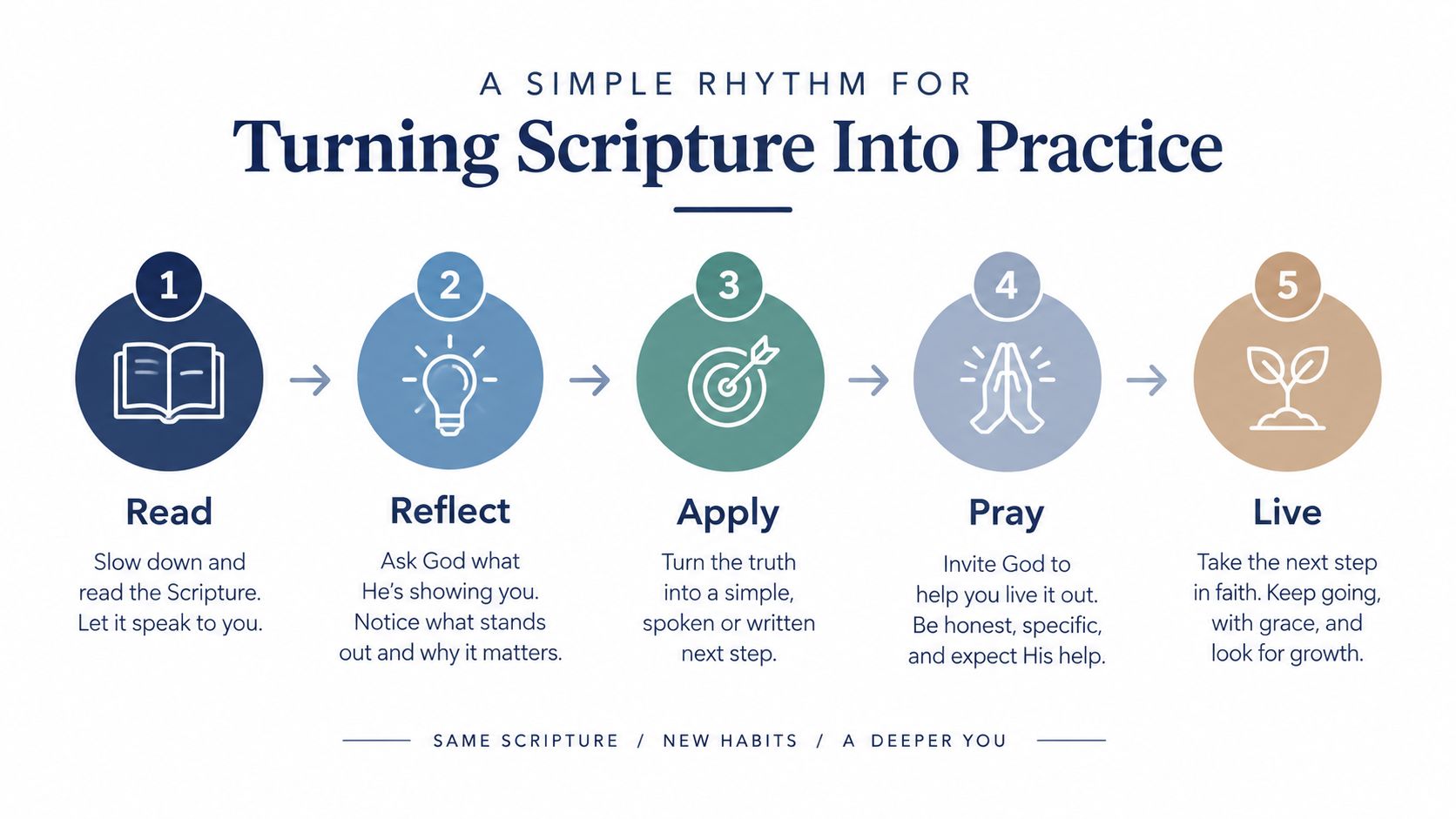
A Simple Rhythm for Turning Scripture Into Practice
Many believers want to grow but rely on occasional bursts of spiritual activity. A long reading session can encourage you, but a sustainable rhythm usually gives truth more opportunities to reach your thinking, choices, and relationships.
A practical pattern is read, interpret, apply, pray, and live.
Read and interpret carefully
Begin with a manageable passage. Read it more than once, notice repeated words, identify the speaker and audience, and ask what problem or promise the passage addresses. Don't rush to application before you understand the text.
Interpretation asks, “What did this mean in its context?” Application asks, “How should this truth shape me now?” Those questions belong together, but they aren't interchangeable. A passage about ancient Israel's covenant setting may not transfer directly into a modern decision without careful theological reflection.
Apply with a specific response
General intentions rarely produce durable change. Turn the passage into a concrete response:
If the text exposes envy, confess a particular comparison and practice gratitude.
If it commands encouragement, send a thoughtful message or speak directly to someone who needs hope.
If it reveals God's faithfulness, identify the fear you're carrying and pray through it.
If it teaches reconciliation, take a wise, truthful step toward peace.
Writing down observations, questions, prayers, and applications can help you remember what God is teaching. For readers who want a more structured tool, these journaling methods for Bible study can provide several ways to connect reading with reflection.
Distribute practice across the week
The Center for Bible Engagement reported a “four-days-per-week” threshold for Scripture engagement, describing four or more weekly touchpoints as a tipping point associated with measurable gains in spiritual growth compared with less frequent exposure. The finding is cited in ministry formation discussions through the Pew Research Center's Religious Landscape Study summary.
The practical lesson is not to turn discipleship into a scorecard. It is to distribute engagement across the week. A pastor might offer a short daily reading, a weekly small-group conversation, and a monthly mentoring meeting. A household might read a brief passage at breakfast, discuss one question after worship, and pray for one person who needs care.
Occasional participation can leave doctrine shallow. Information-only study can also make people knowledgeable without making them humble, courageous, patient, or generous. Scripture forms us through a repeated loop of understanding, response, prayer, and community.
A workable rule: Keep the passage small enough to revisit, the application clear enough to practice, and the community close enough to notice whether change is taking place.
How Worship and Sacraments Embody Doctrine Together
Private devotion matters, but Christianity isn't practiced privately alone. God gathers his people to hear the Word, confess faith, pray, sing, receive the sacraments according to their tradition, and serve one another. Corporate worship gives doctrine a shared, visible form.
Paul instructs Timothy, “Until I come, devote yourself to the public reading of Scripture, to exhortation, and to teaching” in 1 Timothy 4:13. Scholarship on early Christian worship describes public reading as a core congregational practice rather than merely a private devotion, as discussed in research on worship in the early church.
Public reading forms a congregation
Early Christian worship commonly used lectio continua, the sequential reading of Scripture rather than relying only on isolated prooftexts. That practice helps congregations hear the Bible as a coherent story and reduces the temptation to use verses merely to support a preferred topic.
A church can strengthen this pattern by reading substantial portions of Scripture publicly, explaining context, and connecting the passage to Christ's saving work. Worship leaders can choose songs and prayers that reinforce the biblical text rather than compete with it. Teachers can help children and adults see that doctrine isn't confined to a classroom.
Sacraments make truth tangible
The Westminster Shorter Catechism describes sacraments as “holy ordinances instituted by Christ” in which “sensible signs” represent, seal, and apply the benefits of the new covenant to believers. This language reminds us that Christian doctrine isn't only heard. In sacramental practice, the church receives visible signs that point to God's covenant promises.
Church traditions differ in their understanding and administration of the sacraments, so leaders should teach their congregation from Scripture and their confession with care. The central pastoral task is to prevent the Lord's Supper and baptism from becoming empty routines. They should direct believers to Christ, grace, covenant belonging, repentance, faith, and hope.
Historic Reformed teaching identifies three marks of the true church:
Pure preaching of the Word, which means Scripture governs the church's message.
Right administration of the sacraments, according to Christ's institution.
Christian discipline, through which the church addresses sin according to Scripture.
These marks connect belief with visible church life. A congregation doesn't merely claim to value holiness, truth, and grace. It teaches them, enacts them, and corrects its members when necessary.
Prayer, fasting, Bible reading, worship, fellowship, and service also belong to this formative pattern. When Sunday worship leads believers toward humility, reconciliation, mercy, and mission, the congregation helps doctrine become a lived confession throughout the week.
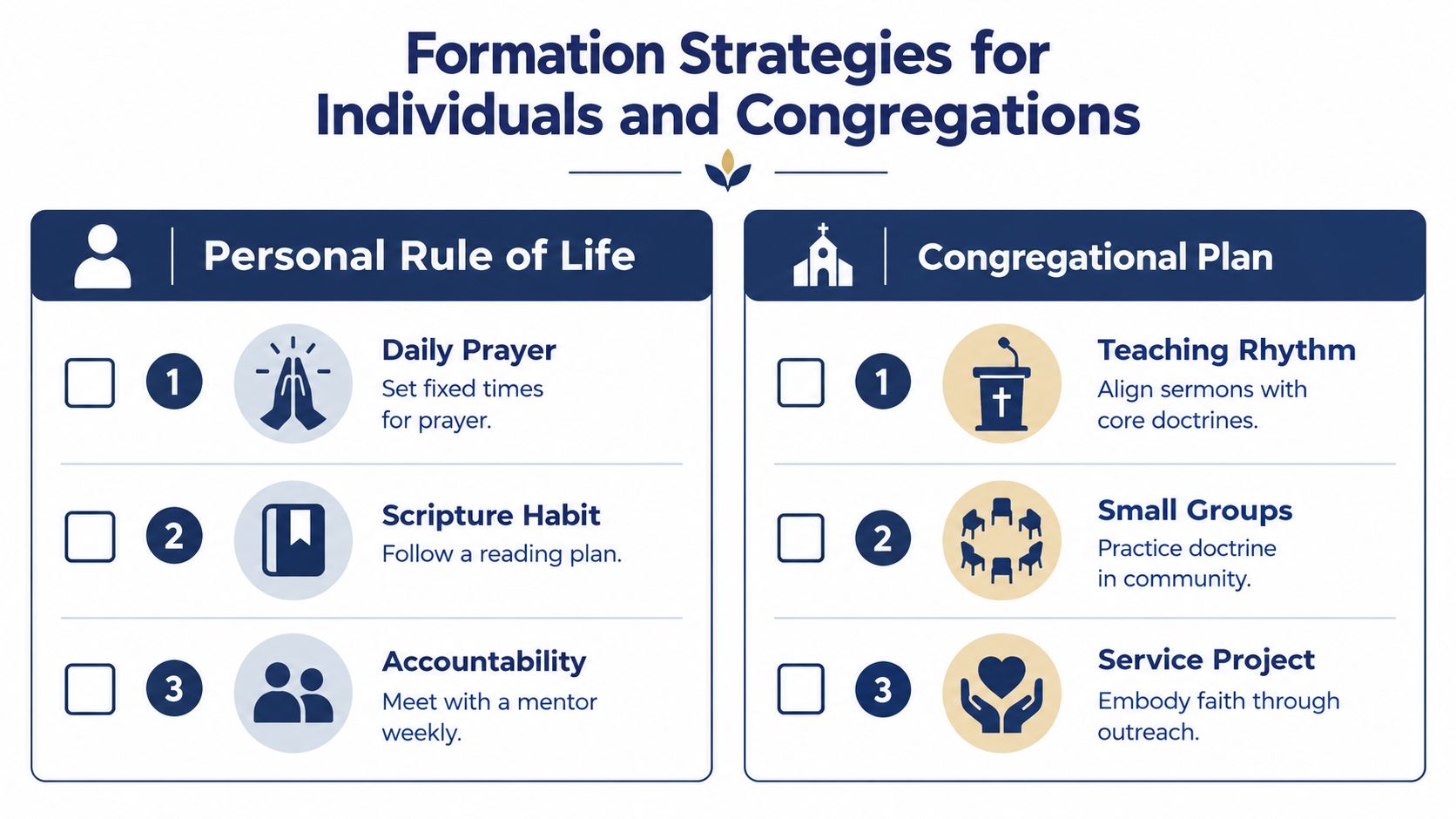
Formation Strategies for Individuals and Congregations
A formation plan should fit the people who will use it. A seminary student, a pastor, a homeschool parent, and a small rural congregation may need different schedules, but each can connect biblical truth with repeated practice.
Barna reports that 24% of U.S. adults qualify as “practicing Christians,” a decline of 22 points over 25 years, while weekly Bible reading has rebounded to 42% and strong belief in the Bible's total accuracy stands at 36%, according to Barna's analysis of faith's shrinking influence. These findings point to a pastoral challenge: renewed Bible reading doesn't automatically produce doctrinal confidence or faithful obedience.
Build a personal rule of life
A personal rule of life is a simple pattern that places ordinary time under Christian priorities. It isn't a vow of perfection. It is a practical way to decide when and how you will pursue the means of grace.
Start with a few questions:
Prayer: When will you pray, and which needs will you bring before God repeatedly?
Scripture: What reading plan will keep you engaged with the Bible's larger message?
Worship: Where will you gather with a local church?
Accountability: Who can ask honest questions about your obedience and discouragement?
Service: Which responsibility will help you love your neighbor in a concrete way?
A mentor should do more than check whether a reading was completed. Ask what the person learned about God, where resistance appeared, and what action followed. Accountability becomes pastoral when it combines truth, patience, confession, and prayer.
Create a congregational pathway
Churches can create a formation pathway that moves people from hearing to doing. Sermons can teach core doctrines in an orderly way. Small groups can discuss application rather than reviewing information only. Ministry leaders can pair newer believers with mature Christians for encouragement and guidance.
Pastors should also explain why the church teaches a doctrine and how it protects Christian hope. Difficult subjects require patient biblical instruction, not slogans or culture-war shortcuts. When leaders distinguish Scripture, historic confession, theological judgment, and personal opinion, they help congregations think faithfully and speak charitably.
Christian educators and homeschool families can use the same approach. Teach a doctrine, read the relevant biblical passages, summarize the truth in plain language, and connect it to a practice such as prayer, hospitality, service, or repentance. Children learn doctrine more effectively when they see adults embody it.
Train leaders for faithful translation
Ministry leaders need tools for expository teaching, church history, pastoral care, spiritual formation, and practical ministry. The Bible Seminary offers academic pathways that bring those areas together, including degree programs, certificates, and courses designed for theological and ministry preparation. Its approach reflects the conviction that scholarship, Spirit-led formation, and hands-on service should reinforce one another.
A healthy plan also leaves room for evaluation. Ask whether people are becoming more grounded in Scripture, more engaged in the life of the church, more willing to confess sin, and more prepared to serve. Those questions measure formation more faithfully than attendance or information retention alone.
Next Steps to Keep Growing in Doctrine and Practice
Practicing Christian doctrine grows through a settled rhythm, not a passing burst of enthusiasm. Read Scripture carefully, interpret it in context, apply it concretely, pray for the Spirit's help, and live the truth with Christ's people. Let gathered worship reinforce private devotion through public Scripture reading, preaching, prayer, sacramental practice, fellowship, discipline, and service.
Growth also requires wise guidance. Pastors and ministry leaders can strengthen their teaching through formal theological study, while lay learners can pursue certificates, audited courses, or focused seminars. Students interested in the relationship between biblical history and material evidence can explore archaeology resources, where archaeology and Scripture come together responsibly.
The Bible Seminary's faculty, community life, ministry preparation, and biblical scholarship serve learners who want to equip leaders to impact the world for Christ. Its programs include graduate study and flexible learning options for people serving churches, families, and ministries in different settings. For those near Katy, Texas, the 3J Museum also offers a setting where biblical history can be explored through artifacts and educational experiences.
Remember: Doctrine is not less than truth remembered. It is truth trusted, practiced, proclaimed, and embodied because Jesus Christ is Lord.
Growth in doctrine should make us more faithful, more teachable, more courageous in service, and more loving toward our neighbors. As we train hearts and minds for kingdom service, the church becomes better prepared to bear witness to Christ in homes, congregations, communities, and the wider world.
The Bible Seminary provides Bible-centered degree programs, certificates, and ministry training that connect theological scholarship with spiritual formation and practical service. Visit The Bible Seminary to explore your next step in practicing Christian doctrine and preparing for faithful kingdom leadership.