
Graduate Certificate vs Masters Degree for Leaders

Sunday's sermon still needs attention, your weekday job hasn't slowed down, and someone at church has asked whether you'd consider more ministry responsibility. You want deeper biblical training, but you're not sure whether a graduate certificate or a master's degree is the wiser next step.
That's a question of stewardship, not ambition. At The Bible Seminary, we want to help you choose preparation that strengthens your service to Christ without overlooking your family, congregation, finances, or capacity to study well.
Graduate Certificate vs Master's Degree at a Glance
A graduate certificate offers focused graduate study; a master's degree provides broader academic preparation. Neither choice proves that you're more committed to ministry. The right credential is the one that prepares you for the work you're called to do.
For a general benchmark, ETS's graduate credential comparison describes certificates as typically requiring 9–18 credits over about 8–12 months, compared with 30–60 credits over about two years for master's degrees. These are general ranges, not seminary promises. Theology programs can require more coursework, so compare actual catalogs rather than labels.
Graduate Certificate and Master's Degree Compared
Question | Graduate certificate | Master's degree |
|---|---|---|
Typical credits | The shorter general range described above; published examples also appear below | The broader general range described above; theological degrees may require more |
Usual time | Often completed within an academic year when the schedule permits | Commonly a multiyear commitment, especially in theological education |
Academic scope | One defined field or skill set | Broader coursework, research or supervised practice, and formation |
What you receive | A graduate certificate, a separate credential category | A master's degree |
Can credits stack? | Only when the school designates them as applicable | May be the destination for certificate credits under written rules |
Labor-market signal | Sensitive to credential length and field; not a master's substitute | Clearer broad earnings signal, with substantial field differences |
Best first fit | Focused study while you keep serving | Role qualification, senior leadership preparation, or doctoral preparation |
The main caveat is ministry fit. A shorter program won't necessarily meet a denomination's educational requirements. A longer program isn't automatically necessary if you already hold the required degree and need training in a specific area.
A shorter credential is only the better buy if it still reaches the ministry role you need.
Start With Your Actual Constraint
A bi-vocational pastor might need stronger preparation for teaching Scripture while remaining fully employed. A certificate could make sense if the immediate goal is better-informed service rather than qualification for a new position.
Someone preparing for a role with a formal graduate-degree requirement faces a different decision. Starting with the shortest credential could delay the necessary preparation if its courses won't apply toward that degree.
Choose the table row that matters most to you:
Time: What study schedule can you sustain through a demanding ministry season?
Budget: What can you afford without assuming a future salary increase?
Role: What credential does the position require?
Formation: Where do you need greater biblical understanding, practical preparation, and accountability?
The graduate certificate vs master's degree decision becomes clearer when you name the constraint before comparing programs.
What Each Credential Officially Means
Graduate-level coursework and a graduate degree aren't the same thing. Graduate certificates and master's degrees are separate credentials, each with its own name, requirements, and academic standing. Two programs can even draw on identical courses the way two buildings can use identical bricks. The materials match; the structures don't.
That distinction matters when you describe your education to a church, employer, denomination, or admissions committee. Use the exact credential name on your record rather than assuming similar coursework establishes equivalent qualifications.
A Destination, a Bridge, or Both
Schools design certificates for different purposes, and the purpose determines what the credential can do for you:
A stand-alone qualification: Focused education for someone who needs particular knowledge without pursuing a degree.
A degree pathway: Courses intentionally aligned with a named master's curriculum so the credits count toward that degree under the school's written policy.
A dual-purpose credential: A completed qualification that can also contribute to further study.
One phrase in that list does the heavy lifting: “under written policy.” Credits move from a certificate into a degree only when the institution has already decided they will. A certificate that looks like a cheaper on-ramp becomes a dead end if its courses were never mapped to a degree, so ask for the stacking rule in writing before you assume any course will count twice.
Consider the targeted add-on. Some universities offer graduate certificates in a single subject, such as history, for professionals who already hold a graduate degree and want concentrated study in one field. The educational need is a specific qualification rather than a second broad degree.
A similar question can guide ministry decisions. A Christian educator may need concentrated biblical study, while an experienced pastor may want deeper preparation in ministry leadership. The certificate's usefulness rests on two things: whether its curriculum addresses that need, and whether the church, school, or denomination you serve recognizes it.
Confirm What Will Be Recorded
Before enrolling, request clear answers about:
The award: What exact credential name appears on the completion record?
The courses: Is every course graduate level?
The transcript: Will completed credits appear on an official academic transcript?
Academic presentation can be confusing, too. If you're preparing for commencement, decoding hood colors with Graduation Attire can help explain ceremonial distinctions. Regalia, however, isn't evidence that different credentials carry the same academic standing.
A certificate can represent serious study without representing a master's degree. A master's curriculum generally makes room for greater breadth, electives, research training, and sometimes a thesis or supervised practice.
Ask admissions this direct question: Is this certificate a destination, a bridge, or both? The answer should describe the program's academic design and written credit policy, not merely its promotional language.
Credits, Time and Depth of Study
Credit totals turn an abstract credential choice into a concrete comparison. The CU Denver graduate certificate page and published university examples summarized alongside it identify 12 certificate credits at CU Denver, 18 at Texas Southern and Ashland, and 30 or 33 credits for Ashland's related master's programs, which works out to roughly 40 to 60 percent fewer credits for the shorter credentials.
A smaller total can look like a cheaper on-ramp to a master's degree. It functions that way only when written policy allows those credits to count toward the degree you want. Without that written path, the certificate stands on its own, so its value rests on whether the study itself fits your ministry.
Credit Examples From Certificates and Related Degrees
The university credit figures in this table are the published examples identified above; the TBS figure describes our own program.
Program | Certificate credits | Noted pace |
|---|---|---|
CU Denver, U.S. history | 12 | Shorter graduate certificate |
Texas Southern, history | 18 | Verify transfer rules before enrolling |
Ashland, related history tracks | 18 | Certificate alongside related master's options |
Sam Houston State, American History | 18 | Fully online, completable in one year |
The Bible Seminary, Certificate of Theological Studies | 27 | Confirm the available course sequence and completion schedule |
Ohio University's graduate-program information and the university examples informing this comparison distinguish research and applied pathways; the related Sam Houston State example is an 18-credit certificate completable fully online in one year. These examples illustrate possible structures, and each school sets its own timetable.
What Our Theological Programs Include
Our Certificate of Theological Studies provides 27 credit hours of graduate-level education for people serving in vocational or volunteer leadership. You can explore the Certificate of Theological Studies to consider how that preparation fits your responsibilities. Graduate students here receive mentored learning throughout their programs, including local mentoring and training opportunities.
Our Master of Arts covers all 66 books of the Bible in two years, with four majors ranging from 48 to 60 credit hours. Our Master of Divinity requires 84 credit hours through a three-year study of all 66 books of the Bible.
Those totals show why a generic university comparison can't substitute for a seminary catalog. A theological certificate may exceed the common certificate range, and a ministry degree may extend beyond the usual master's benchmark.
What Additional Coursework Makes Possible
When evaluating a longer curriculum, look for meaningful preparation rather than hours alone. Depending on the program, additional coursework can support biblical languages, broader study of Scripture, theology, church history, research, and supervised ministry.
A research-oriented thesis can help prepare a student for further academic work. An applied pathway may emphasize using graduate knowledge in professional practice. Either direction can serve ministry well; the better question is which kind of formation your current season calls for.
Workload rule: Estimate your course load using actual syllabus expectations, then protect time for prayer, family, rest, and the people you shepherd.
Credits and weekly hours aren't equivalent units, so don't divide one by the other. Ask for expected reading, assignments, class meetings, and deadlines, then test that workload against a normal week and a difficult one. A realistic answer about pace matters more to your ministry fit than any generic comparison of credentials.
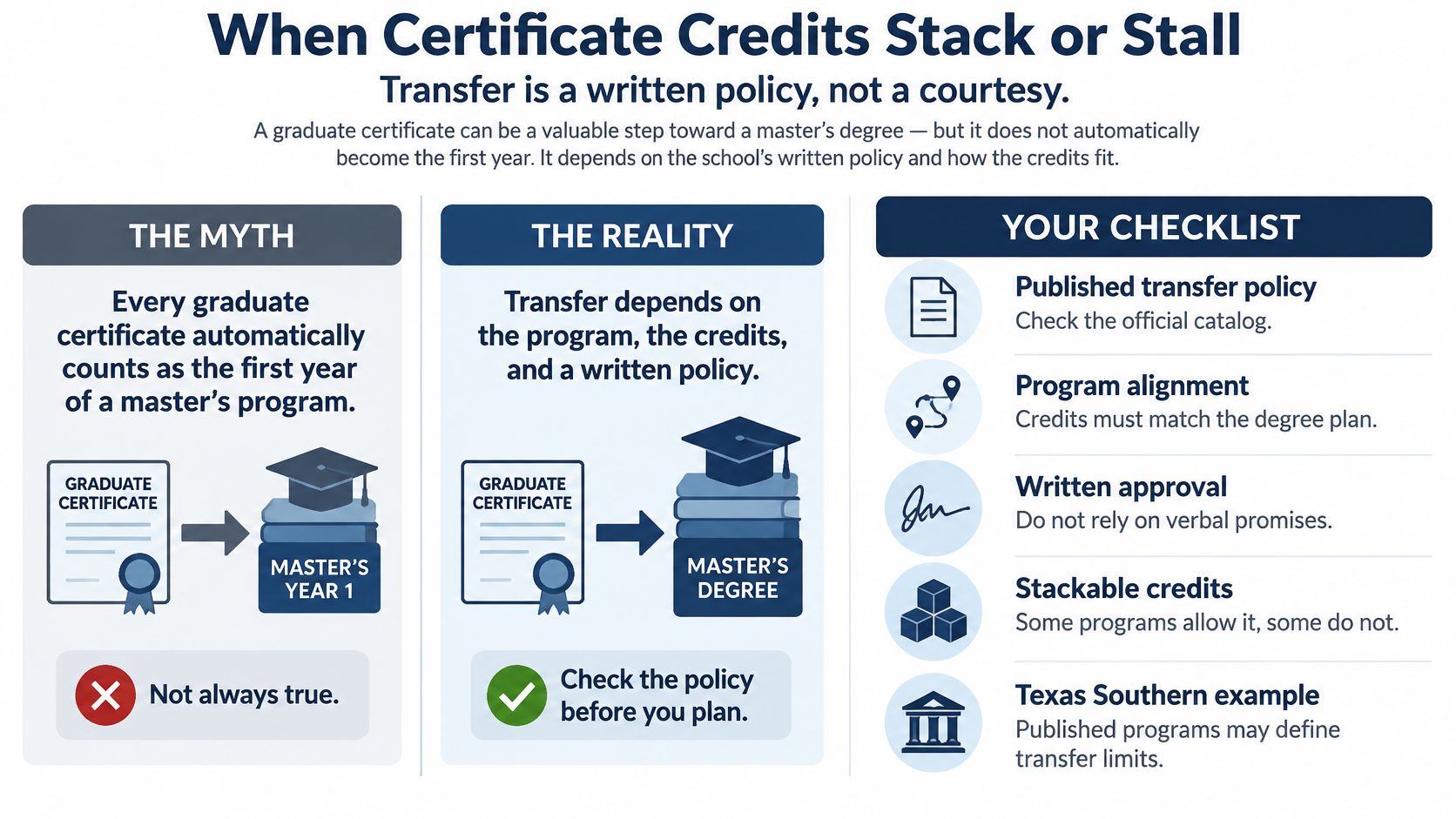
When Certificate Credits Stack or Stall
A graduate certificate does not automatically become the opening stage of a master's degree. Even courses completed at the same institution may not satisfy a particular degree plan.
Transfer is a written policy, not a courtesy.
Check the Exact Degree Path
Use this checklist before paying for a certificate you hope to apply toward an MA or MDiv:
Confirm the destination. Is the certificate explicitly stackable into the exact degree and major you may pursue? General transfer language isn't enough.
Request a course map. Ask how many credits apply, which requirements they satisfy, and which courses are excluded.
Check minimum grades. A grade sufficient for certificate completion may not meet the degree's transfer standard.
Ask about credit age. Find out whether older courses expire and when the school measures that time.
Review residency requirements. Here, residency means coursework that must be completed through the degree-granting institution, not necessarily living on campus.
Clarify admission. Determine whether certificate students must reapply, submit additional materials, and satisfy separate degree-admission requirements.
Published pathways, including examples at Texas Southern, demonstrate that certificate work can apply toward a degree. They don't establish that every certificate course will count in every program.
Count the Cost of Unusable Credits
Suppose you choose a certificate because it has the lower initial bill. Later, you discover that your intended degree won't accept the coursework. You may then pay for additional courses covering material you've already studied.
The certificate may still have helped you serve faithfully. But it wasn't necessarily the less expensive route to your eventual qualification.
A graduate-enrollment survey available through ERIC found that 30% of respondents changing careers planned non-degree study, compared with 25% overall. For someone testing a new direction, a documented bridge can be more useful than a modest upfront tuition difference.
Pastors considering future denominational recognition, teaching, chaplaincy, or doctoral admission should obtain requirements from the receiving organization as well as the school. Neither side should be asked to interpret the other's promises.
Save the written policy and your approved course map with your enrollment records. Before starting, ask: If I finish this certificate, exactly how many credits, under what conditions, will apply to the master's?
Payoff, Cost and What the Numbers Cannot Prove
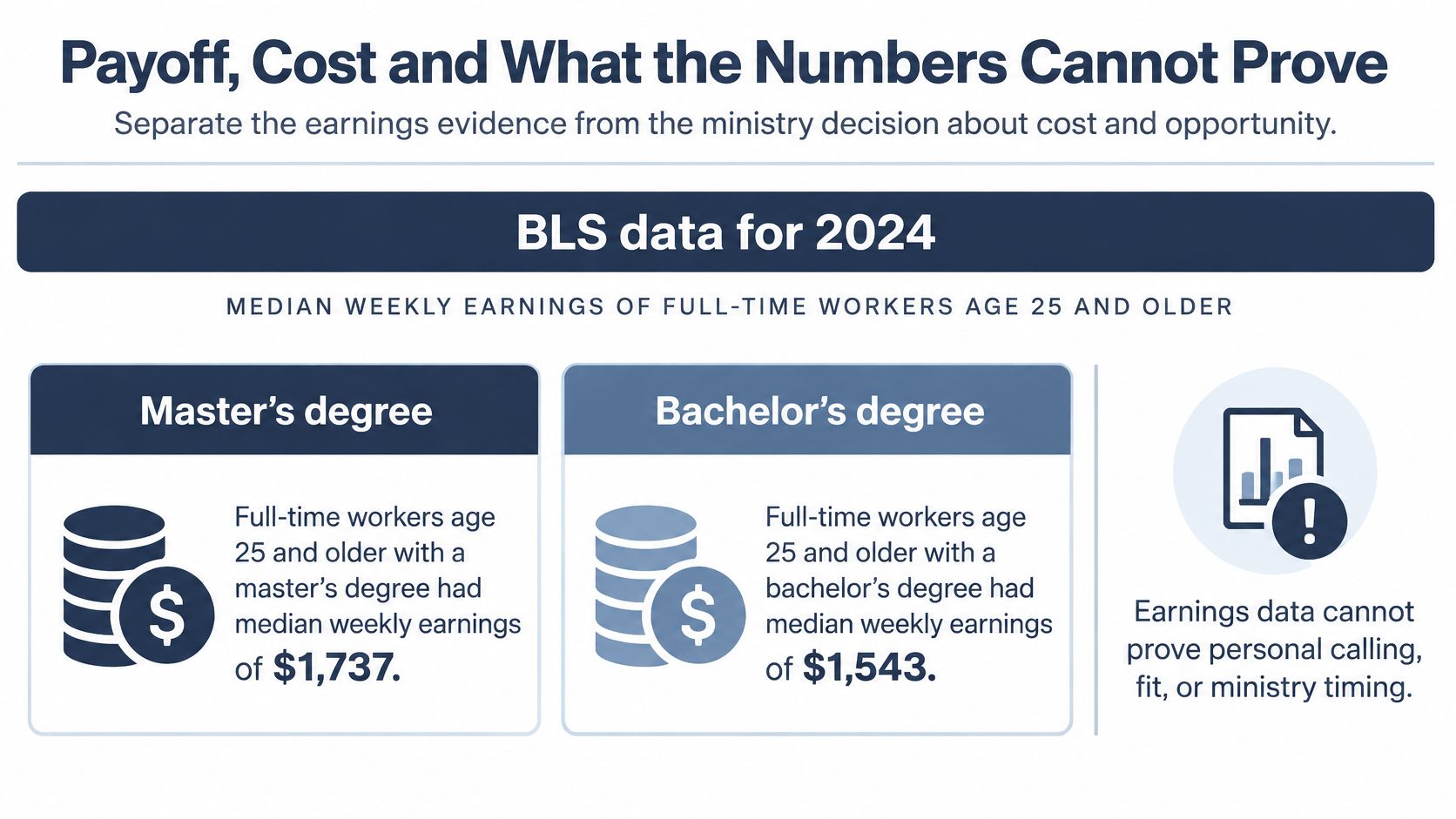
The U.S. Bureau of Labor Statistics' education-pay comparison reports that full-time workers age 25 and older with a master's degree had median weekly earnings of $1,840 and a 2.2% unemployment rate in 2024.
A national median works like an average rainfall figure for an entire country: accurate in the aggregate, yet unhelpful for deciding whether you need an umbrella on your own street. The BLS pool covers every occupation and industry, so it cannot isolate ministry roles, weigh one graduate certificate against another, or promise that a completed degree produces a raise. Your church's compensation structure and the requirements of the position you hope to fill will shape your actual return far more than a general earnings premium.
Evaluate Opportunity-Adjusted Cost
Certificates follow the same field-sensitive pattern. The American Institutes for Research report on higher-education returns indicates that certificates requiring one to two years tend to have greater labor-market value than certificates completed in under one year, particularly in technical, health, manufacturing, and construction fields.
Theological study answers to a different ledger than wage data, so weigh what you will learn, how you will serve, and whether the credential meets the requirements in front of you. A certificate with a lower sticker price can still cost more in the end if its coursework fails to move you toward your goal. Build the comparison around the full outlay:
Tuition: Include required fees, books, travel, and other program expenses.
Evenings and weekends: Identify what study will displace.
Lost work: Estimate any reduction in paid employment.
Debt: Consider repayment without assuming a promotion.
Role change: Name the position or responsibility you expect the credential to support.
Denominational requirements: Verify whether the degree itself is mandatory.
Gradshop's discussion of is grad school worth it works through similar questions from a broader angle. Keep your ministry requirements at the center of that conversation.
Consider a Smaller Initial Commitment
Auditing a TBS course costs $435 per class, and students may complete the class work for credit or take the course for personal enrichment. Clarify your enrollment status before beginning, because auditing and earning transcripted credit produce different records. An audited course feeds your soul; a credited course feeds your transcript, and only the second can count toward a credential later.
Choose a certificate for faster usefulness in a role you already hold, and a master's when it qualifies you for a position, recognition, or doctoral route the certificate cannot reach. For a ministry leader, the credential that pays is the one that fits the calling in front of you.
Which Credential Fits Your Ministry Season
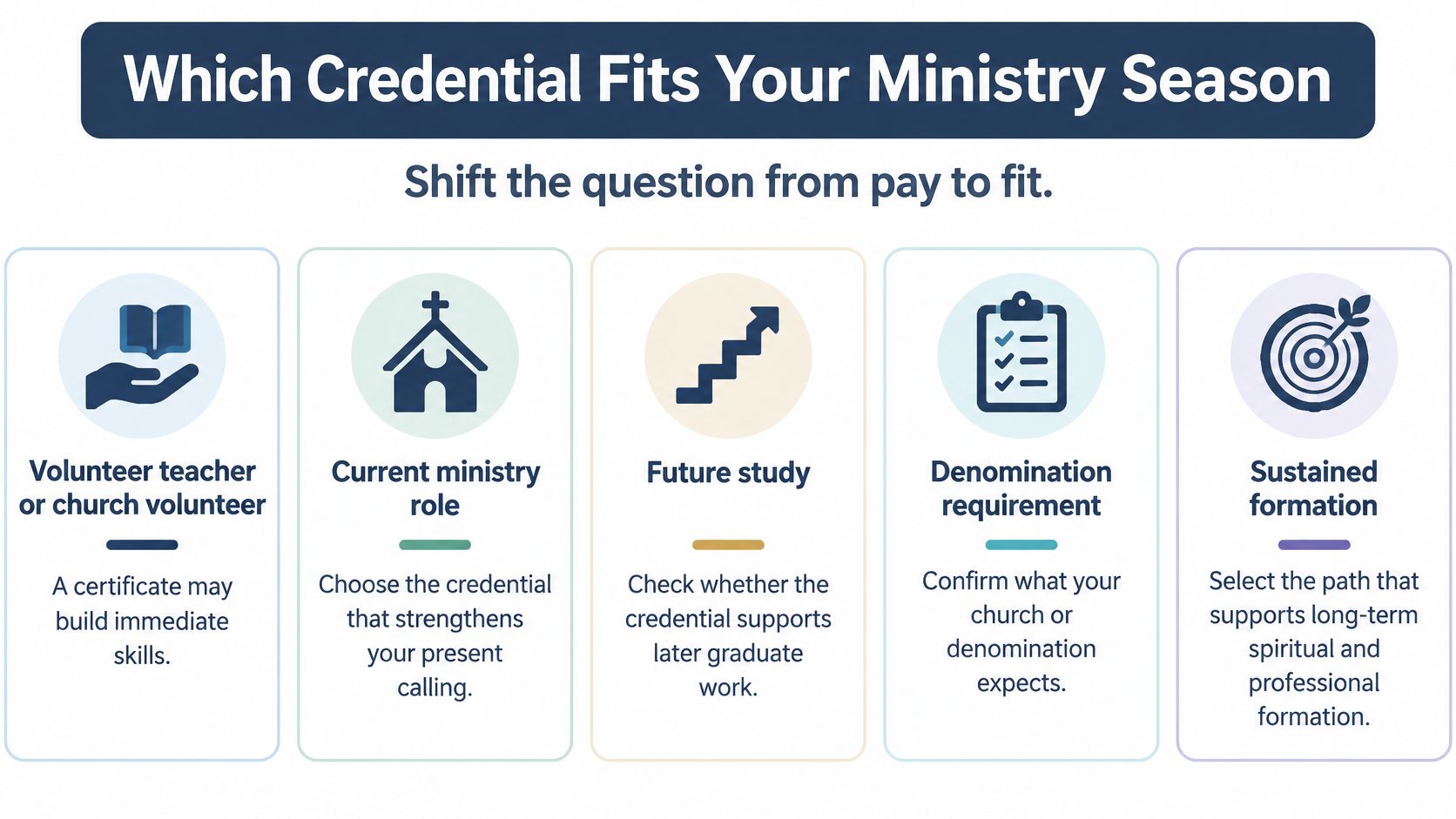
Your next credential should fit your denomination, current responsibilities, future study, and need for sustained formation. The Stevens Online comparison of certificates and master's degrees likewise distinguishes focused skill development from broader degree preparation.
For Christian leaders, the question reaches beyond qualification. In the pastoral instructions of 1 Timothy 4:13–16, attention to teaching belongs alongside attention to one's life. Academic preparation should strengthen faithful service, not become detached from it.
Match the Credential to the Situation
You teach as a volunteer and need stronger biblical foundations. You're not seeking a different position; you want to handle Scripture responsibly while keeping your job. Choose a certificate, and verify that the course schedule fits your work and church commitments.
You're a secondary educator who already holds a master's degree. Your need may resemble the targeted subject preparation offered by the American History example, rather than another broad degree. Choose a certificate, and verify your teaching institution's exact subject-credit requirements.
You're preparing for pastoral leadership, chaplaincy, teaching, or doctoral work. These paths can involve specific degree, accreditation, research, or supervised-training expectations. Plan toward an MA or MDiv, and verify the receiving organization's requirements before selecting the degree.
You're changing careers and discerning a ministry call. Graduate study can help you test your readiness, interests, and capacity without treating your first decision as your final destination. Choose a certificate, and verify the admissions pathway for later degree study.
You anticipate senior ministry responsibility but can't begin a full degree yet. A staged route may let you study now while preserving progress toward a larger qualification. Choose a certificate only with an approved stacking pathway, and verify the written course-to-degree agreement.
Formation Happens With People
Our graduate students receive mentored learning throughout their degree programs, including local mentoring and training opportunities. Faculty guidance and community life should be part of your decision, not an afterthought to the course list.
Ask how you'll connect classroom study with ministry practice and receive feedback on your growth. Bible-based, Christ-centered, Spirit-led, ministry-focused education should train hearts and minds for kingdom service, not merely help you collect credentials.
Frequently Asked Questions About Graduate Certificates and Master's Degrees
Is a Graduate Certificate the Same as a Master's Degree?
No. They are distinct credentials, even when students take some of the same graduate courses. Confirm the exact award name and describe it accurately on applications and ministry profiles.
How Many Credits Does a Graduate Certificate Usually Take?
University certificates often fall within the shorter ranges shown in the opening comparison, but theological programs can require more coursework. Read the complete curriculum rather than assuming that every certificate represents the same amount of study.
Do Certificate Credits Always Count Toward a Master's?
No. Applicability requires written institutional rules covering the destination degree, eligible courses, grades, credit age, residency, and admission. Ask for a degree-specific evaluation rather than a general assurance that credits are transferable.
Which Credential Should a Pastor Choose?
Choose focused certificate study when you need preparation for responsibilities you already hold. Choose a master's when your intended role or further-study pathway requires the degree, and confirm the particular type of master's accepted.
Can I Test Graduate Study Before Committing?
Yes. An audited course can help you assess graduate reading, classroom participation, and the effect on your weekly schedule. Before enrolling, confirm the current charge, participation expectations, and whether your chosen enrollment status earns academic credit.
A useful starting question: What do I need to learn to serve faithfully, and what qualification must document that learning?
That question keeps both formation and practical requirements in view. It also leaves room for a modest beginning without assuming that you must stop there.
Choose Your Next Step with The Bible Seminary
You don't have to choose between taking education seriously and honoring your present responsibilities. You do need a realistic plan that connects your calling with the preparation, time, and resources available to you.
Use these distinctions to frame that plan:
Choose the certificate for focused, near-term preparation.
Choose the MA for book-by-book biblical study within a structured graduate degree.
Choose the MDiv for a longer course of ministry preparation.
Choose a staged route carefully when you expect certificate work to contribute to a later degree.
Bring Your Previous Learning Into the Conversation
Our Dual Degree Completion pathway allows students with an associate's degree, life experiences, or college credit to earn a bachelor's and master's at the same time. It pairs a Bachelor of Arts in Christian Studies with a TBS MA or MDiv. Your prior preparation may therefore shape a different route than you initially expected.
Our homepage states that 100% of TBS students graduate debt free. That statement isn't an individual funding guarantee; build your own plan around available assistance, enrollment pace, employment, and household commitments.
Review our academic options alongside our degree programs. Bring your intended ministry role and previous transcripts into the admissions conversation so the discussion can focus on a workable path.
Prepare for Service, Not Just Completion
We seek to unite scholarship, spiritual formation, and hands-on ministry. Faculty, mentoring, and the Katy, Texas, community belong within that preparation, alongside opportunities to connect archaeological study with Scripture responsibly.
Our archaeology resources reflect the invitation to encounter biblical history while honoring the Bible's authority. Holy Land study and excavation opportunities complement, rather than replace, careful interpretation of Scripture.
Whether you serve locally or prepare for ministry across cultures, the aim remains the same: equipping leaders to impact the world for Christ. A campus visit or audited class can help you assess that fit before making a larger commitment.
We offer certificate, MA, MDiv, and flexible study pathways that connect biblical scholarship with spiritual formation and ministry preparation. Visit The Bible Seminary to explore your options and discuss a path that matches your call, your church's needs, and the years you can wisely give.