
Theological Studies Certificate: Guide for Ministry Leaders

A theological studies certificate is a flexible, non-degree credential that provides structured biblical training, often for ministry upskilling or as a pathway toward a Master of Divinity. Recent reporting identified 7,081 students in the United States and Canada enrolled in credit-bearing, non-degree theological education, alongside 74,283 students pursuing graduate theological degrees, showing that focused study serves a real need within theological education. Association of Theological Schools ecosystem reporting
You may be serving faithfully every week while recognizing a gap in your preparation. A pastor faces difficult questions in counseling, a worship leader wants stronger biblical foundations, or a Bible-study teacher realizes that enthusiasm alone isn't enough for interpreting a challenging passage. A full graduate degree may not fit your present responsibilities, yet informal study may leave you without the structure, feedback, and academic accountability you need.
A theological studies certificate can occupy that important middle ground. It offers focused education for people who want to grow in biblical understanding and ministry competence without immediately entering a full degree program. Used wisely, it can stand alone as continuing education or become a stackable stepping stone toward advanced theological study.
What Is a Theological Studies Certificate
A ministry leader can reach a point where faithful service has outpaced formal preparation. Sermon work raises questions about interpretation. Counseling conversations expose gaps in theology and pastoral care. Teaching opportunities call for more than sincerity. A theological studies certificate meets that moment by offering a defined course of study without requiring an immediate commitment to a full graduate degree.
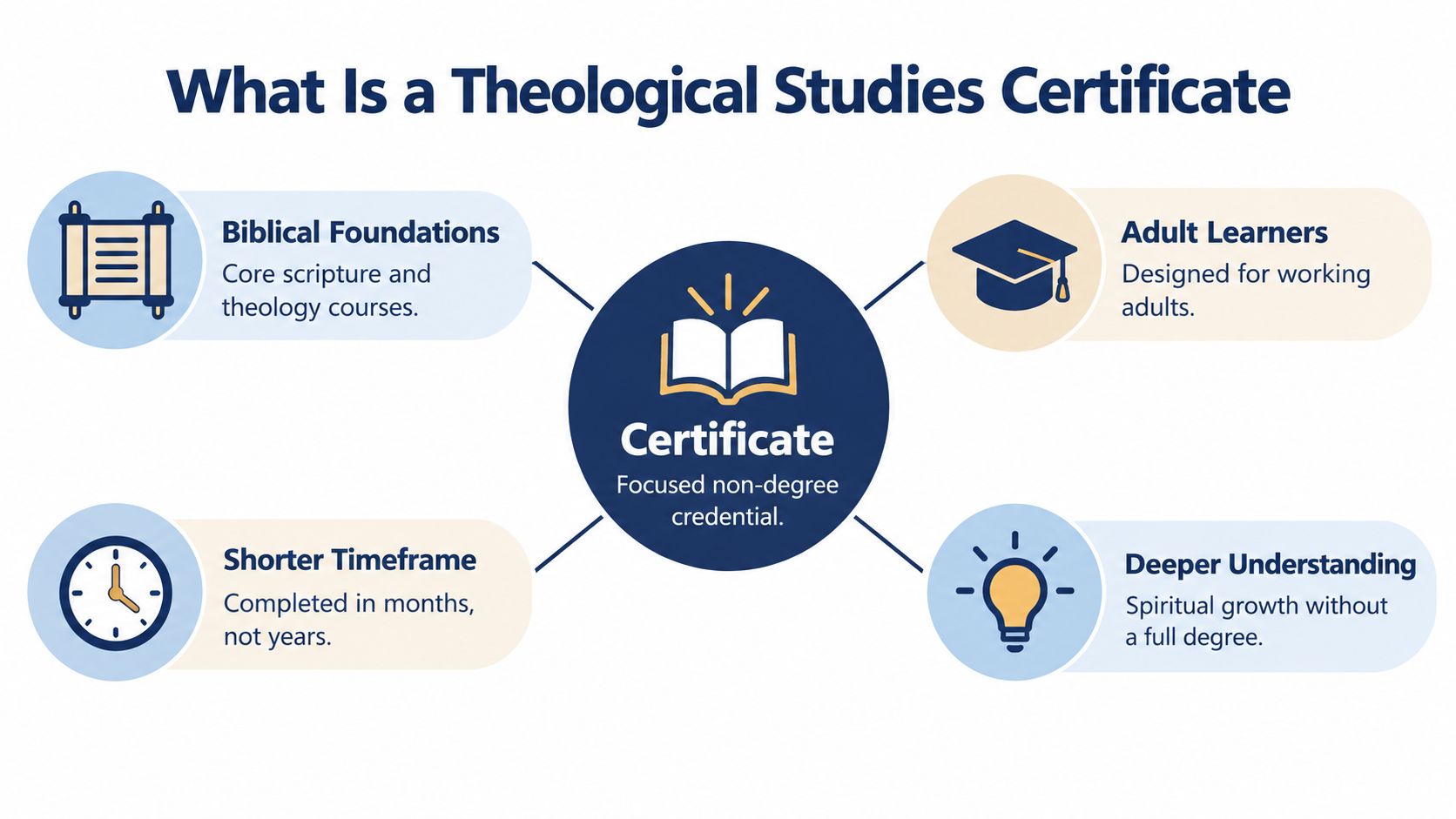
The credential is non-degree, so it does not function like a Master of Arts or Master of Divinity. Instead, it gathers a focused set of courses in biblical and theological study. Students read carefully, write assignments, receive feedback, and complete assessed work. Depending on the school, the coursework may also carry academic credit.
More than an informal Bible study
A church Bible study and a certificate can both strengthen faith, but they serve different purposes. Bible study often nourishes devotion and fellowship. A certificate adds sequence, faculty oversight, academic assessment, and a clear outcome. It helps students move from gathering helpful thoughts to building reliable habits of interpretation, theological reflection, and ministry application.
That distinction matters because a certificate often serves two roles at once. For some students, it is a standalone period of formation that sharpens preaching, discipleship, or lay ministry in the present season. For others, it is a stackable stepping stone. The coursework introduces graduate-level expectations in a manageable way, so a student can test both calling and capacity before pursuing a longer degree path.
The wider world of theological education helps clarify why that matters. The Association of Theological Schools has shaped this field for generations through accreditation and institutional data gathering. Historical studies of ATS enrollment and accreditation show that theological education has long included structured pathways of different lengths and purposes, not only full degrees. Historical ATS enrollment and accreditation context
A certificate, then, should be judged by the quality of its curriculum, the seriousness of its instruction, the care given to assessment, and the clarity of its relationship to future study.
A certificate can be a serious beginning without pretending to be a completed professional degree.
At The Bible Seminary, that beginning includes more than academic content. The aim is training hearts and minds for kingdom service. Students pursue focused biblical education while also attending to spiritual formation and the practical work of teaching, leading, discipling, and discerning whether further graduate study should come next.
Who Benefits from These Programs
A student often arrives at a certificate program with a very practical question. I am already serving, so do I need a full degree now, or do I need focused study that helps me serve more faithfully this year? That question helps identify who benefits most from these programs and whether the certificate should stand on its own or serve as a stackable stepping stone toward later graduate work.
Start with your ministry context
Pastors and ministry professionals often need targeted strengthening in preaching, pastoral care, biblical interpretation, or leadership. A certificate can meet that need in a defined course of study without requiring the immediate commitment of a longer degree. For some, that is the right stopping point for the present season. For others, it is a wise first stretch of graduate work before taking on a master's program.
Lay leaders and Bible-study teachers also benefit. Devotional reading feeds the soul, but teaching others requires more than good intentions. These students need tools for reading texts in context, answering questions with care, and guiding discussion toward Christ instead of personal opinion.
Worship leaders, educators, and missionaries may need a firmer theological vocabulary and deeper biblical understanding for work they are already doing. A worship leader, for example, serves a congregation better when songs, Scripture, and spoken transitions fit together with clear theological purpose.
Many certificate students are not at the beginning of adult life. They are people already formed by work, family, church service, and ministry responsibility. That maturity often makes certificate study a good fit, because students are not only gathering information. They are bringing real ministry questions to the classroom and testing what they learn in daily service.
Place the certificate in the wider ecosystem
The second question is academic, not just personal. Are you choosing a self-contained season of study, or are you beginning a path that may later continue into a degree?
That distinction matters because ATS accredits institutions and approves postbaccalaureate master's and doctoral programs, but it does not approve certificate programs themselves. A school can still offer a certificate within an accredited institution, and those courses may carry graduate credit under that school's policies. ATS accreditation and certificate guidance
So ask careful questions. Will the courses appear on a graduate transcript? Can the credits apply to a named master's program? What grade is required? Which accreditor recognizes the institution?
At The Bible Seminary, those questions matter because students are not only choosing classes. They are choosing a pattern of training hearts and minds for kingdom service. If your goal is present ministry formation, a certificate may be enough for now. If you may pursue advanced study later, choose a program whose structure makes that next step clear.
What You Will Study
A good certificate should feel like a course of formation, not a shelf of unrelated classes. The pieces belong together. As in a well-taught sermon, each part supports the whole, helping you grow in biblical understanding, theological judgment, historical awareness, and practical ministry skill.
Comparable U.S. graduate-certificate policies usually describe a defined curriculum of about 9 to 21 semester credits. The University of Michigan-Dearborn requires at least 9 credits, and the University of Central Arkansas describes 12 to 21 credits as a coherent graduate-level academic accomplishment. Graduate certificate policy examples
Four connected areas of study
Biblical interpretation trains you to read a passage in context. You learn to notice genre, historical setting, literary flow, and the argument the writer is making. That sounds academic, but it quickly becomes pastoral. A teacher, preacher, or ministry leader must know the difference between what a text says and what personal preference might press it to say.
Theological method then gathers those readings into a larger whole. Rather than treating verses as isolated statements, you learn how Christian doctrine arises from Scripture and how those convictions shape worship, discipleship, ethics, and pastoral care. It is here that many students begin to see that theology is not abstract. It guides how a church prays, counsels, teaches, and serves.
Church history gives perspective. It reminds students that present questions rarely appear for the first time in their generation. Earlier believers wrestled with doctrine, conflict, mission, suffering, and reform too. That history can steady a leader who feels pressure to chase novelty when wisdom is what the moment requires.
Ministry application brings the work into lived service. Learning should reach preaching, teaching, discipleship, leadership, and care for people. A theology course has done more than fill a notebook when it helps you counsel a grieving church member without shallow promises, or teach a difficult biblical theme with patience and clarity. At The Bible Seminary, that connection between study, spiritual formation, and ministry practice is part of the point.
Course titles alone do not tell you much. Look for stated outcomes that explain what a student should be able to do after finishing the certificate. Useful outcomes often include:
Interpret responsibly: Explain a biblical passage in its literary and historical context.
Think theologically: Relate biblical teaching to Christian doctrine and ministry decisions.
Teach clearly: Communicate biblical truth accurately to a congregation, class, or small group.
Serve wisely: Apply theological learning with humility, compassion, and spiritual discernment.
Scripture remains the foundation, and careful interpretation is part of faithful obedience. Paul urged Timothy to handle “the word of truth” correctly (2 Timothy 2:15, NIV). The point is disciplined stewardship.
A strong certificate changes how you read, teach, lead, and serve.
Before enrolling, ask for a written progression plan. It should show total credits, delivery format, assessment methods, transfer rules, expiration policies, and the specific master's requirements that certificate coursework may satisfy. That matters if the certificate will stand on its own for present ministry or serve later as a stackable step into advanced study. Policies differ by school, so get the details in writing.
Certificate vs Degree Pathways
The central question isn't whether a certificate is “good” or a degree is “better.” The question is what kind of preparation you need now, what your church or denomination requires, and whether you want a documented route into further study.
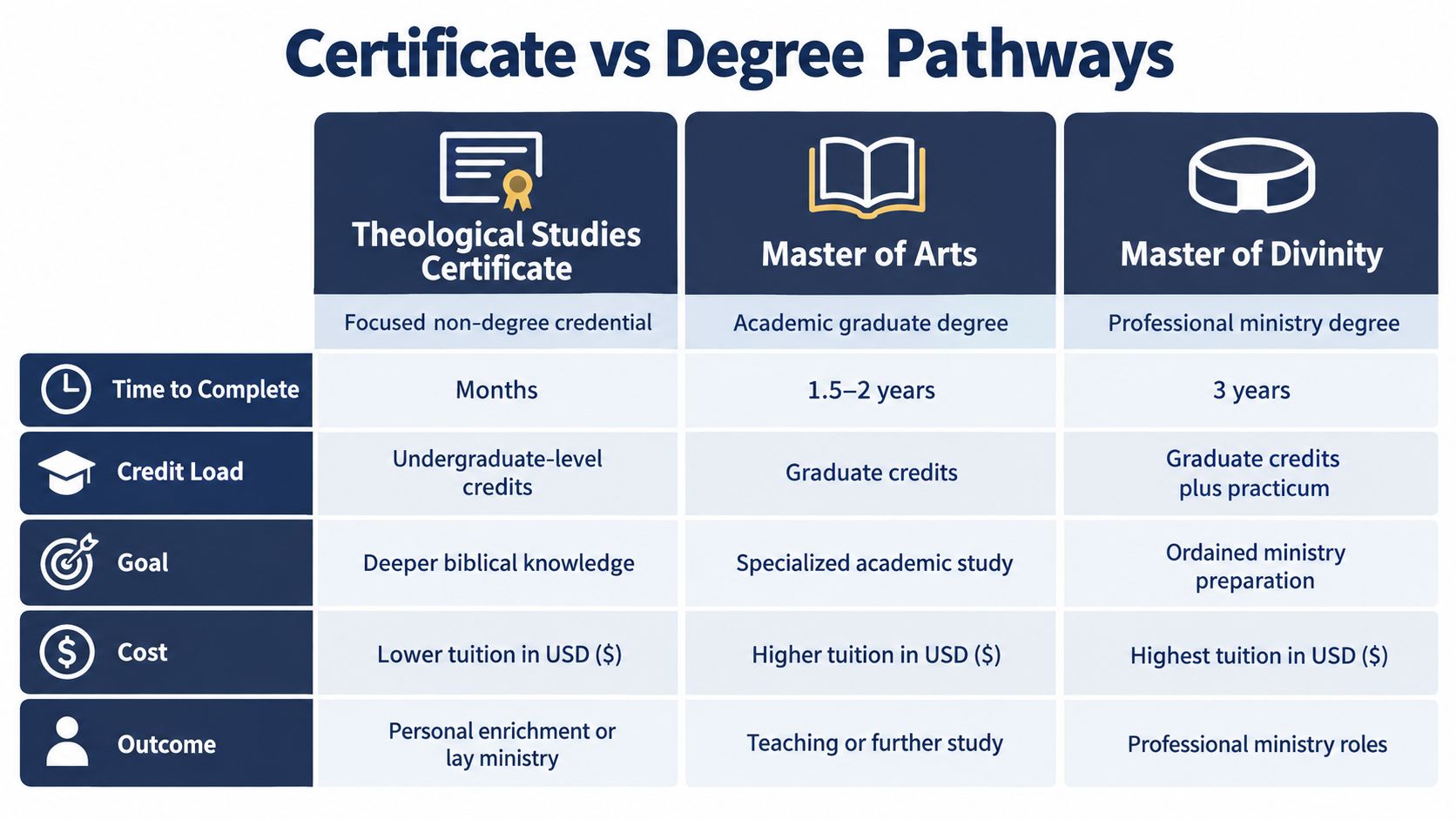
A certificate is a focused non-degree credential. A Master of Arts is an academic graduate degree, often designed for specialized study. A Master of Divinity is a professional ministry degree that commonly includes broader theological formation and practical ministry preparation. The labels alone don't tell you everything, so read the curriculum and institutional policies carefully.
Choose according to the outcome
Pathway | Best fit | What to verify |
|---|---|---|
Theological studies certificate | Focused biblical training, personal enrichment, lay ministry, or a possible entry into graduate study | Academic level, transcript status, transfer rules, and ministry recognition |
Master of Arts | Specialized academic study or preparation for further theological education | Major requirements, research expectations, and progression options |
Master of Divinity | Comprehensive preparation for professional ministry roles | Denominational standards, supervised ministry, language or field requirements, and degree outcomes |
“Stackable” means that completed certificate coursework may later count toward a degree. It does not mean that every certificate automatically transfers. The receiving program may require specific grades, recent coursework, an application, additional admissions standards, or a particular course sequence.
The difference also appears in delivery. Online study can serve working adults and geographically distant students. On-campus study offers regular face-to-face community and easier access to shared rhythms of prayer and discussion. Auditing may allow learning without the same graded-credit outcome, but it usually won't provide the same transcripted pathway. Ask what each format permits before you register.
For a fuller explanation of how these options relate, consult this certificate program versus degree comparison.
Read the boundaries honestly
A certificate may strengthen biblical literacy and ministry competence, but it isn't automatically equivalent to an M.Div. It doesn't necessarily confer clergy licensure, satisfy ordination requirements, or qualify you for a particular ministry role. Denominations, churches, employers, and countries may recognize credentials differently.
Recent graduate-education research found that 74% of graduate students cite career advancement as their primary enrollment motivation, while 90% say career-related information on program pages is essential. Graduate education motivation and information findings Those figures reinforce a practical responsibility for schools and students alike. Program pages should state outcomes plainly, and students should ask direct questions before making a commitment.
Delivery Formats and Flexibility
A student may be serving in a church all week, caring for family, and wondering whether serious theological study can fit into real life without becoming thin or detached. Delivery format matters because it shapes not only convenience, but also attention, accountability, prayer, and the kind of habits that can carry into ministry.

Match the format to your calling
Online courses often fit learners whose callings are already tied to a place. A pastor in a rural setting, a parent with an uneven schedule, or a lay leader who cannot relocate may still need graduate-level study. In that setting, a good online course works like a well-led seminar rather than a video library. Students need clear deadlines, careful feedback, real discussion, and assignments that connect doctrine to ministry practice.
On-campus courses offer a different kind of gift. You learn in the presence of others. Questions surface in the room. Interpretations are tested aloud. Faculty can often notice confusion, growth, or hesitation more quickly when they are walking with students face to face.
Audited courses can help a learner seeking growth without graded credit. Yet auditing usually serves a different purpose from a transcripted certificate. If you hope the certificate may later function as a stackable step toward advanced study, ask exactly what counts for credit and what does not. That distinction can save disappointment later.
As noted earlier, many theological students are balancing study with work, ministry, and long-standing responsibilities. Flexibility matters for them, but flexibility should still support disciplined learning and spiritual formation. A certificate is small enough to be accessible. It can also be structured carefully enough to prepare a student for further graduate work.
Technology plays a part here. Schools comparing online systems often weigh scheduling tools, discussion features, accessibility, and administrative support in different ways. A platform comparison for UK institutions offers one example of the questions schools ask when evaluating delivery systems.
Community still matters. Prayer, faculty conversation, peer feedback, and guided reflection help theological study shape both understanding and character. That is especially important in a certificate program that may stand alone for immediate ministry use or prepare the way for a later degree.
Why Choose The Bible Seminary
The value of a certificate depends on more than its course titles. It rests on the relationship among scholarship, spiritual formation, and hands-on ministry. Students need accurate teaching, but they also need mentors who help them ask what truth requires of their lives and leadership.
The Bible Seminary offers a Certificate of Theological Studies as a nine-course, 27-credit-hour non-degree program. Its curriculum includes areas such as hermeneutics, theology, church history, ministry leadership, preaching and teaching, spiritual formation, and biblical studies. The program includes seven required core graduate courses and two electives selected from available graduate-level options.
Learning Scripture in context
A certificate should help you handle the Bible as a unified, authoritative revelation centered on God's redemptive work in Christ. That requires attention to all of Scripture, not only familiar devotional passages. It also requires responsible use of history and archaeology.
The Bible Seminary's broader academic environment connects biblical study with archaeology and historical understanding. Its 3J Museum offers an immersive journey through biblical history with nearly 200 artifacts, more than 90% authentic, drawn from Khirbet el-Maqatir near Jerusalem. This reflects the theme, “Where the Bible comes alive, archaeology and Scripture together,” while still requiring humility about what archaeological evidence can and cannot establish.
Archaeology can illuminate settings, material culture, geography, and historical context. It cannot replace the biblical text or prove every theological conclusion. Responsible study keeps evidence, interpretation, and faith in their proper relationship.
Formation for ministry
Theological learning becomes practical when it shapes the way leaders preach, teach, counsel, organize, and serve. A student may use hermeneutical training to prepare a clearer Bible lesson, church-history study to understand a tradition more charitably, or spiritual-formation work to examine whether leadership is producing humility rather than merely activity.
This is why TBS emphasizes Bible-based, Christ-centered, Spirit-led, ministry-focused preparation. Its community includes faculty expertise, spiritual initiatives, public engagement, and global partnerships. Resources such as the Public Reading of Scripture, the Just Show Up Book Club, podcasts, Nehemiah Press publications, and museum events extend learning beyond a single classroom.
The certificate can therefore function in two ways. For one student, it may be a concentrated course of continuing education that strengthens present service. For another, it may be the first carefully considered step toward an advanced degree. In both cases, the purpose is larger than credential accumulation.
Training hearts and minds for kingdom service means pursuing knowledge that becomes faithful presence, wise leadership, and loving action.
The Bible Seminary's mission is equipping leaders to impact the world for Christ. That mission includes pastors, educators, worship leaders, lay teachers, missionaries, and ministry professionals whose influence may reach far beyond a classroom. Graduates serve churches and Christian communities in varied contexts, bringing together careful study, spiritual maturity, and practical obedience.
Before applying, compare the certificate with your intended ministry role, ask how coursework may transfer, and speak with an advisor about the difference between a standalone credential and a degree pathway. Review the seminary's academic offerings, explore its degree programs, and investigate its archaeology resources to see how biblical education can fit your calling.
The right next step may be a certificate, an audited course, or a full degree. What matters is choosing a path that forms you to read Scripture faithfully, serve people wisely, and follow Christ with a prepared mind and surrendered heart.
The Bible Seminary offers a focused Certificate of Theological Studies alongside graduate degrees, flexible course options, archaeology resources, and a community shaped by biblical scholarship and spiritual formation. Visit The Bible Seminary to explore how a certificate can strengthen your present ministry and, where appropriate, become a thoughtful step toward advanced theological study.