
Forgiveness and Reconciliation: What Scripture Teaches

Which is harder to say out loud in a church hallway: "I have forgiven him" or "I am not going back"?
Most of us learned to use forgiveness and reconciliation as if they were one word with two syllables. Forgive, reconcile, and everyone is fine again. That shorthand has done quiet damage in a lot of lives, especially among people who were harmed by someone with power over them and then told that a refusal to reopen the door proved their heart was still hard.
Scripture is more careful than our shorthand. It commands forgiveness in situations where reconciliation isn't possible, and it describes reconciliation as a mutual work that depends on truth, repentance, and safety. Seminaries train pastors to preach both, and churches stumble when they preach one as if it were the other. So let's walk through the distinction step by step: what each word means, where each appears in Scripture, how Jesus sequences the work, how the major traditions have framed it, and how to care for people when going back would be unsafe.
You don't need a theology degree to follow this. You need honesty about one question, and we'll get to it.
Forgiveness and Reconciliation Defined Side by Side
Start with the plainest definitions we can give.
Forgiveness is the decision of the wronged person, made before God, to release the debt of harm and set down resentment and the desire for revenge. Reconciliation is the restored relationship between two people, and it requires both of them to take part.
Picture a prisoner receiving a pardon. The cell door opens, the record is wiped, and the prisoner walks out into daylight. Now ask whether the governor who signed the pardon moves into the prisoner's house. He doesn't. The debt was released by one authority, and no relationship followed it. That's forgiveness without reconciliation, and Scripture treats it as a real, complete act.
Now picture a family divided over an inheritance. One sibling calls, the other answers, and they meet at a coffee shop where hard things get said and heard. Both people move toward each other, or nothing happens. That's reconciliation, and it's never one-sided.
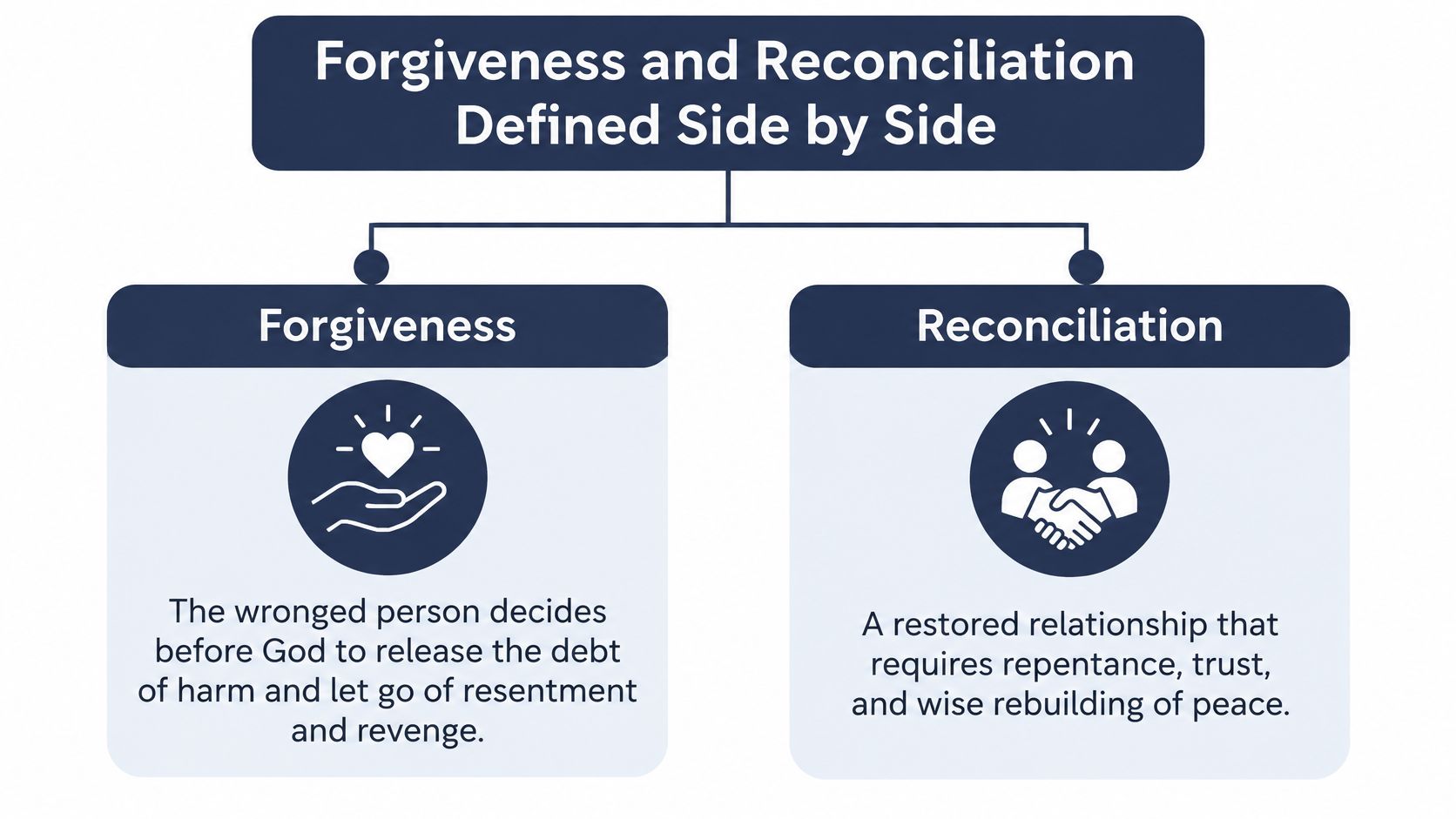
The distinction isn't a modern therapeutic invention. The American Psychological Association notes that forgiveness can be associated with improved mental health, including reduced anxiety and depression, fewer physical-health symptoms, and lower mortality risk. The same guidance is equally clear that forgiving someone doesn't require restoring the relationship or abandoning accountability. You can release vengeance and still pursue safety, truth, repentance, restitution, and lawful justice.
Aspect | Forgiveness | Reconciliation |
|---|---|---|
Who can act alone | The wronged person, by choice | Not possible alone; needs both people |
What it changes | Inner posture toward the offender | The relationship between the two people |
Needs the other person's repentance? | Not required for the inner release | Normally expected |
Requires renewed trust or contact? | No | Usually, to a degree that depends on safety |
Same as justice? | No; personal vengeance can be released while accountability remains | No; peace between people is not a court verdict |
Biblical anchor | Ephesians 4:32; Matthew 6:14-15 | Matthew 5:23-24; 2 Corinthians 5:18-20 |
Here's a test you can carry into any conversation about this. Ask one question: does this outcome depend on me alone, or on both of us? If the answer is "me alone," you're talking about forgiveness, and you can begin today, even if the other person is dead, absent, or unrepentant. If the answer is "both of us," you're talking about reconciliation, and it can't be rushed, scheduled, or demanded.
Key Passages on Forgiveness and Reconciliation
Scripture never collapses the two words into one. It does something better: it places them in the same story and gives each its own grammar.
Matthew 6:14-15 ties the two directions of forgiveness together. Jesus says that if you forgive others their trespasses, your heavenly Father will also forgive you, and if you don't, neither will your Father forgive your trespasses. Read in context, this sits inside the Sermon on the Mount, right after the Lord's Prayer, and it presses on a receiving heart rather than setting up a transaction.
Matthew 18:21-35 goes deeper. Peter asks how many times he must forgive, and Jesus answers with the parable of the servant who was released from an unpayable debt and then throttled a fellow servant over a small one. Forgiveness is rooted in mercy already received.
Colossians 3:13 and Ephesians 4:32 make it a community habit. Paul tells believers to bear with one another and forgive as the Lord forgave them, phrasing that assumes ordinary friction inside a congregation rather than only dramatic crimes.
Then the reconciliation texts shift the frame. 2 Corinthians 5:18-20 calls the gospel a ministry of reconciliation and sends reconciled people out as ambassadors. Ephesians 2:14-16 describes Christ breaking down the dividing wall between groups and making peace. Colossians 1:19-22 goes widest of all, reconciling all things through Christ.
"All this is from God, who through Christ reconciled us to himself and gave us the ministry of reconciliation." (2 Corinthians 5:18, ESV)
Paul writes that line to a church with factions, lawsuits, and a man living in scandal. He isn't describing a warm feeling. He's describing God taking initiative toward people who hadn't made the first move, which is precisely why the church's own reconciliation work has to be grounded in grace rather than in the offender's performance.
Passage | Central idea | Focus |
|---|---|---|
Ephesians 4:32 | Be kind and tenderhearted, forgiving as God forgave | Forgiveness |
Luke 17:3-4 | Rebuke, then repentance, then forgiveness | Both |
Matthew 5:23-24 | Leave the gift, go, be reconciled, then worship | Reconciliation |
Matthew 6:14-15 | Receiving mercy and extending it belong together | Forgiveness |
2 Corinthians 5:18-20 | God's initiative creates ambassadors of reconciliation | Reconciliation |
The bridge between the two categories is Luke 17:3-4. Jesus says, "If your brother sins, rebuke him, and if he repents, forgive him." Notice the order. There is a real wrong, an honest naming of it, a change of heart, and then forgiveness. Scripture pairs forgiveness and reconciliation closely, and it does not pretend they're the same thing.
How Jesus Sequences Reconciliation in Matthew 5 and 18
Jesus teaches reconciliation as a series of movements, not a mood. Matthew 5:23-24 gives the first sequence, and it starts somewhere most of us don't expect.
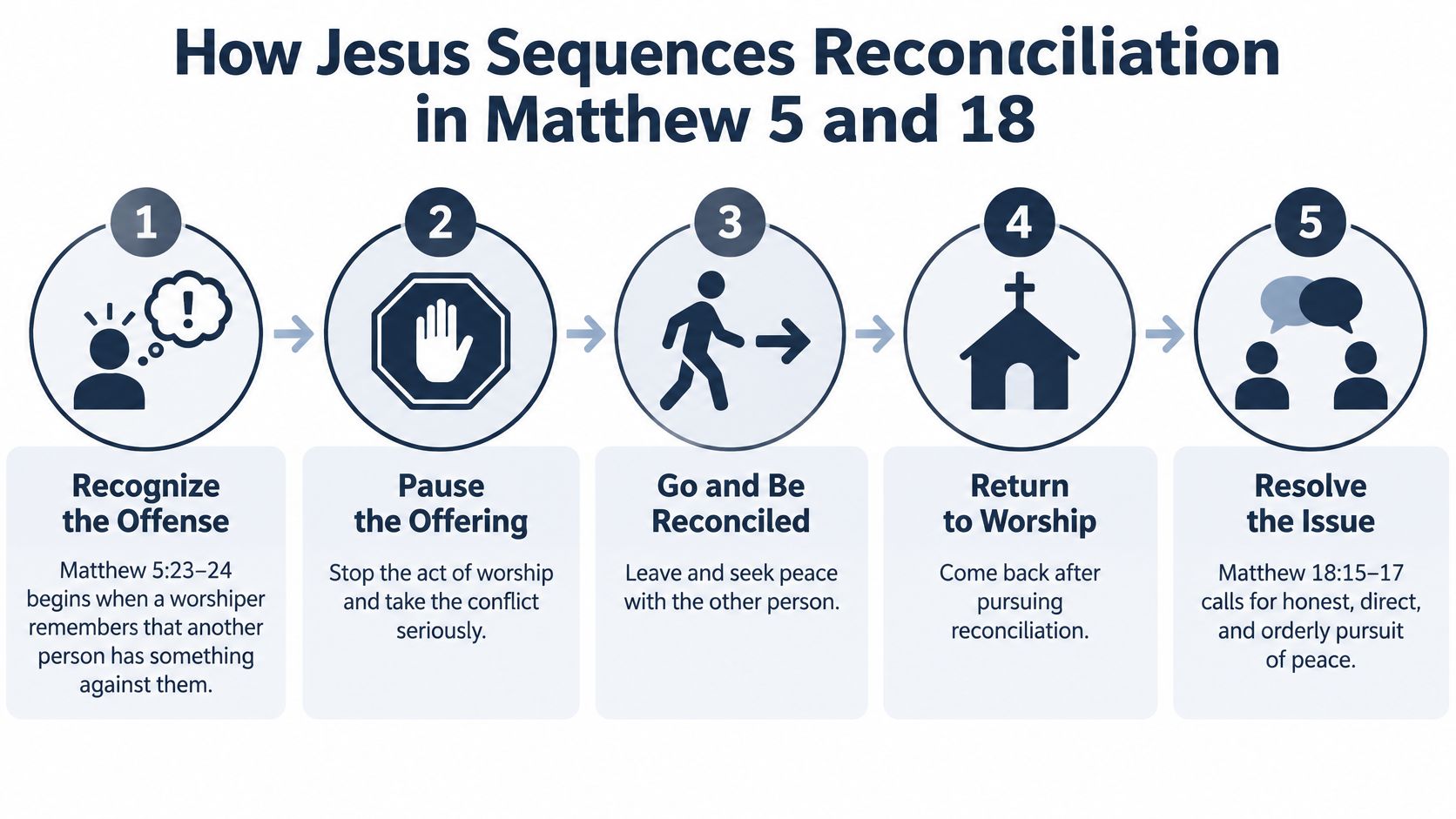
1. Recognize the offense. The passage begins when a worshiper remembers that another person has something against them. The memory itself is the signal. The common slip here is waiting for the other person to feel the same nudge, which turns a conviction into a stalemate.
2. Pause the offering. Jesus says to leave the gift at the altar. Worship isn't cancelled, but it's interrupted on purpose. The slip: using Sunday attendance, a song set, or a busy serving schedule as a substitute for repair, which is exactly what the passage in Matthew 5 forbids.
3. Go and be reconciled. This is initiative, not invitation. You make the call, you knock on the door, you own your part without rehearsing the other person's. The slip: sending a message through a third party and calling it humility.
4. Return and worship. The sequence ends where it started, with the gift back on the altar. The slip: treating the first difficult conversation as the finish line and never returning to ordinary fellowship.
Matthew 18:15-17 supplies the second sequence for when step three stalls. Go privately and name the fault between the two of you alone. Take one or two witnesses if you aren't heard. Bring the matter to the church only after those steps. The progression protects reputations, blocks gossip, and gives the offender a real chance to respond before anything becomes public.
A limit worth naming: neither passage requires a victim to meet a dangerous person alone, and neither promises a quick resolution. The outcome may depend on the other person's response.
Say two neighbors fall out over a fence line that crept two feet onto the wrong property. The Matthew 18 path looks like a private conversation at the curb, then a sit-down with a respected third party, then a mediated survey both agree on. It rarely looks like a Sunday announcement.
This week, pick one relationship where you know something is owed, and take the initiative you can take safely. If contact isn't wise, that's a subject for the next section.
How Christian Traditions Connect Forgiveness and Reconciliation
Christians have argued about the mechanics of forgiveness for centuries, and the differences are instructive rather than embarrassing. Each tradition anchors grace somewhere slightly different and then works outward toward restored relationships.
Tradition | Where forgiveness is grounded | How reconciliation is understood |
|---|---|---|
Roman Catholic | God's mercy, received through the sacrament of Penance | Restoration to the Church through confession and penance |
Eastern Orthodox | Repentance within the life of the Church | Restored communion through confession and worship |
Lutheran and Reformed | Justification by grace through faith | Human reconciliation as the fruit of grace and visible repentance |
Anabaptist and Mennonite | Forgiveness practiced within the believing community | Repair pursued through church discipline and peacemaking |
In Catholic teaching, reconciliation names something specific: the sacrament of Penance, where confession, absolution, and penance restore a person to the Church. The virtue of forgiveness lives inside that larger sacramental frame, which gives the church a defined role in the process from the start.
Orthodox practice is similarly communal but differently shaped. Repentance is understood as a lifelong turning within the Church's worship and sacramental life, so reconciliation is a return to communion rather than a legal settlement between two individuals.
Lutheran and Reformed traditions locate forgiveness in justification by grace through faith, so that no human transaction earns it. Reconciliation with another person then becomes the visible fruit of a grace already received, which is why these traditions tend to emphasize changed conduct as evidence rather than as the means.
Anabaptist and Mennonite congregations place weight on forgiveness as a practice of the believing community. Reconciliation gets pursued through church discipline and peacemaking, sometimes with remarkable patience, and sometimes with the risk of a community pressing too hard for unity.
The traditions agree that forgiveness is grace before it's anything else. They differ on structure and on how much authority the church carries in the middle of a dispute. One question tests your own church's practice well: where does the congregation sit in the process, and who is expected to start the repair? If your church's answer places the injured person at the front of the line with no protection, that's worth raising with your leaders.
Pastoral Care When Reconciliation Is Not Safe
What should a pastor say when the injured person already treats every boundary as bitterness?
A woman sits with her counselor after a sermon on forgiveness. A former partner harmed her. She can forgive him in prayer, release her anger, and still keep a no-contact boundary that protects her and her children. Those two choices answer different questions. Forgiveness is something one person can offer alone, before God. Reconciliation would give him access again, and that step needs his repentance plus her safety. A counselor who folds the second into the first is pressing a victim to prove grace with her own risk.
Popular Christian content often treats a restored relationship as the proof that forgiveness happened. That framing leaves nothing practical for the person whose contact with the offender would be unsafe, unwise, or unwanted.
A 2024 qualitative study of 12 young adults who had forgiven people who harmed them in romantic relationships or friendships found that participants experienced mental-health benefits from forgiveness even when they chose not to restore the relationship. Their peace didn't depend on renewed access.
People who have been harmed still tend to hear the two words as one requirement. Survivors of close-relationship harm often assume they must reconcile in order to forgive. A pastor who answers with a single word will tighten that knot, and the cost lands on the person least able to absorb it.
Work through a decision checklist, in this order.
What evidence of repentance exists? Look for an honest naming of what was done and a willingness to face the consequences. Remorse that appears only when someone is caught does not meet that test.
Has conduct changed over time, not only in words? Patterns are the data. Three months of new behavior weighs more than three paragraphs of apology. Promises are cheap.
Is there ongoing danger or coercion? Threats, financial control, stalking, and intimidation change the answer entirely. Goodwill from the injured person does not remove that danger.
Can boundaries stay in place? If contact is possible only by surrendering the protections that keep the person safe, reconciliation isn't on the table yet.
Who should mediate? A trained counselor, a denominational leader, or a mutually trusted third party. The offender alone should not run the conversation.
Does the injured person consent? Consent is not a formality. A survivor gets to say no without losing standing in the church.
Her counselor's job is to keep both decisions in her hands. Forgiveness works like closing a debt in your own ledger. Reconciliation works like signing a new agreement, and no one should sign that agreement while the other person is still dangerous.
Safety first, always: cases involving abuse need safety planning and professional support, and no one should be pressed to restore a relationship to prove a point about grace.
Forgiveness can proceed in prayer and in private while reconciliation waits on every answer above. Waiting can be wisdom with a spine.
Communal Reconciliation After Collective Harm
Public reconciliation is not a congregation-wide call to forgive. It's a process with records, procedures, and named harms.
South Africa's Truth and Reconciliation Commission is the most studied example. Established in 1995 to investigate gross human-rights violations committed between March 1960 and May 1994, it conducted more than 2,500 hearings, heard from approximately 21,000 victims, and saw about 2,000 people share their experiences in public sessions, according to the commission's official record. The scale of testimony warns against tidy numbers: the commission's analysis counted 46,696 violations involving 28,750 victims and noted that every 100 statements referred to about 140 victims and 160 violations, so one account often carried several people and several harms (TRC Report, Volume 3).
Amnesty was never automatic. Under the governing legislation, an applicant had to tie the act to a political objective, place it within the period beginning March 1, 1960, disclose the facts fully and truthfully, and file within the time limit. Applicants could be asked to describe their own role, including later attempts to conceal or destroy evidence, as the account of the amnesty process shows. That's confession, not a vague apology.
Group identity adds a layer individual counseling rarely touches. A 2025 study of 860 participants across Israeli-Palestinian, Kosovar-Serbian, U.S. racial, and U.K. gender conflicts found that competitive victimhood predicted lower outgroup forgiveness, with the effect shifting by dimension of group identity and by whether the conflict was direct or structural.
Three habits follow for church leaders.
Name who was harmed, specifically. General requests to "move on" transfer the cost of peace onto the injured.
Don't close the matter with a prayer. A congregational prayer can open a process; it can't finish one that still lacks repentance, restitution, or protection.
Keep the two decisions distinct. One person's choice to forgive is theirs. The community's work of repair is still owed, and it belongs in the shared life of the body, as this reflection on community among believers puts it.
Discussion Guides for Seminary Courses and Small Groups
Set ground rules before the first question. No one is required to share details of harm, what's said in the room stays in the room, and the leader says plainly that forgiveness can be one person's choice while reconciliation needs both people plus safety.
The three cases below are illustrations, not real files.
Case one: siblings estranged since a parent's death. The estate was divided badly, and one sibling hasn't spoken to the other in four years. Ask the group: What would forgiveness look like if contact stays limited to a funeral or a hospital room? What would have to change before shared holidays are wise rather than hopeful? Who could mediate without taking sides?
Case two: a church member reports a leader's misconduct. Prompts: How can this member forgive without ever being asked to meet the leader alone? What do Matthew 18's private step, the witnesses, and congregational accountability require in a case like this? What safety plan comes before any of it?
Case three: a business partner broke a promise and now wants to work together again. The injured partner can release resentment this week. Ask instead: What restitution would make a new venture fair? What changed conduct would you need to see, and for how long? Would a written agreement cover the risk, or does the partnership need to stay closed?
After each case, return to the same test. Does the outcome depend on one person or two?
Closing prompt to send home: Name one relationship. Write what forgiveness requires of you. Then write what reconciliation would still require of the other person.
Leaders should point anyone currently in danger toward professional help rather than toward a group share. A discussion guide is a teaching tool, not a crisis response.
Common Questions About Forgiveness and Reconciliation
How long does forgiveness take? It's a decision that often has to be made more than once. You may release the debt in a single afternoon and then find the resentment back three weeks later. Make the decision again. Grief and anger can return for years without undoing what you chose before God.
What if I forgave and still feel angry? Feelings lag behind decisions, and that lag isn't evidence of failure. Many people find that the anger softens gradually, and some find that a specific memory still stings decades later. Neither outcome means the forgiveness wasn't real.
Can a church require reconciliation before someone serves or belongs? No. Church discipline exists to protect the vulnerable and to call an offender to repentance, not to extract a performance from the person who was harmed. When leaders make restored contact a condition of full standing, they've handed the injured person's safety to the person who hurt them.
Forgiveness and reconciliation both belong in the church, and they're not the same gift. The Bible Seminary in Katy, Texas trains pastors, educators, and ministry leaders to teach that distinction with theological depth and pastoral care, joining scholarship, spiritual formation, and hands-on ministry in programs built around all 66 books of Scripture. We're an accredited member of the Transnational Association of Christian Colleges and Schools, and our graduates leave equipped to serve real congregations with real conflicts. Explore our degree programs at The Bible Seminary and begin your journey toward deeper biblical training.