
Community of Believers: Biblical Meaning and Practice

By 2020, sub-Saharan Africa accounted for 30.7% of the world's Christians, compared with 22.3% in Europe, according to Pew Research Center's global religious landscape report. That shift reframes how you should picture the community of believers. It's not centered in one culture or building. It's a global people gathered by Christ, and its health depends on structures you can design, practice, and review, not on a warm feeling alone.
What the Community of Believers Means
The New Testament word ekklesia means a called-out assembly. Believers aren't gathered mainly by shared interests. Christ gathers them. We use the term community of believers in two related senses.
First, there's the universal body of Christ across all times and places (Matthew 16:18; Ephesians 1:22-23). Second, there's the local congregation in a particular town (1 Corinthians 1:2). Acts 2:44 shows believers together and sharing what they had, so this community is visible fellowship, not only an idea.
"A new commandment I give to you, that you love one another: just as I have loved you, you also are to love one another. By this all people will know that you are my disciples, if you have love for one another." John 13:34-35
Community or Crowd
Three markers separate a community from a crowd of attendees:
Shared confession: You confess Christ together under Scripture's authority.
Mutual responsibility: You carry needs, correction, and encouragement together.
Ongoing presence: You keep showing up for worship, prayer, and care.
Our core values include the Lordship of Christ, the Bible as the fully true Word of God, Prayer, Unreached Peoples, The Local Church, Community, and Compassion. Say a new believer in Katy joins a Sunday class, finds a prayer partner, and takes a serving role within six months. She's no longer attending events. She's woven into shared life.
Models of Community Life from Gathering to Small Group
No single format does everything well. Healthy churches link four models so people can worship together, know a few people well, serve with a purpose, and stay connected when they can't be present.
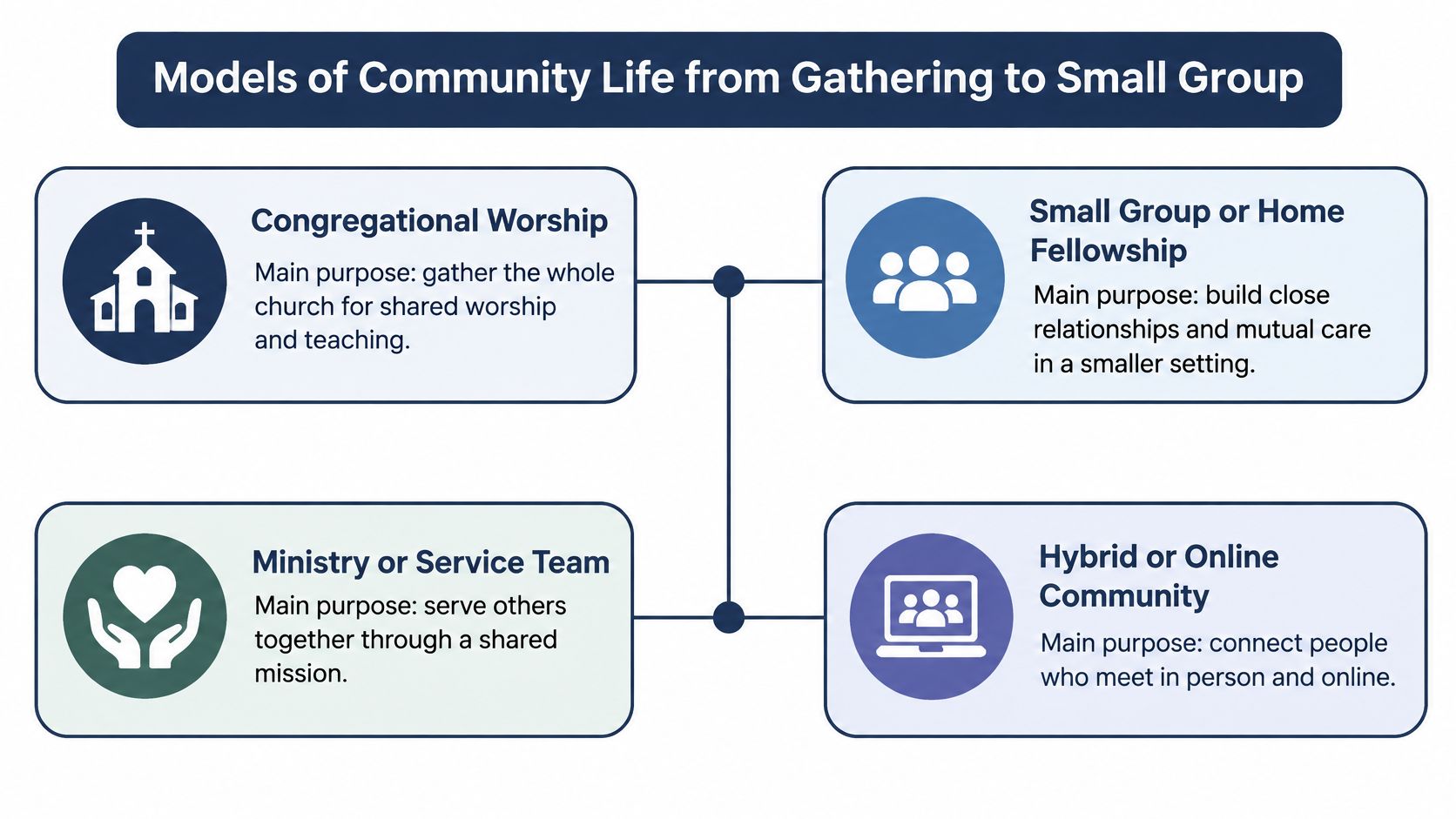
Model | Main Purpose | Typical Size | Scripture Anchor |
|---|---|---|---|
Congregational worship | Gather for teaching, worship and the sacraments | Whole congregation | Hebrews 10:24-25 |
Small group or home fellowship | Mutual care, study and accountability | 6-12 people | Acts 2:46 |
Ministry or service team | Serve needs inside and outside the church | 3-15 people | Galatians 6:2 |
Hybrid or online community | Include members who cannot attend in person | Open, organized in small online groups | 1 Corinthians 12:12-27 |
Congregational worship works best for shared confession, teaching, and reminding everyone they're part of something larger (Hebrews 10:24-25). It falls short for close friendship, because rows and schedules limit conversation.
Small groups of 6-12 people suit deep conversation, study, and accountability, like believers meeting in homes in Acts 2:46. Left alone, though, a group can become insular and serve only its own members.
Service and Hybrid Connection
Ministry teams put Galatians 6:2 into practice by bearing one another's burdens. Size them to the task, whether that's three people visiting homes or fifteen running a food distribution. Teams build bonds through shared work, but they shouldn't replace study and prayer.
Hybrid community reflects 1 Corinthians 12:12-27, where every member of the body has a role. It includes people at a distance, but it needs interaction, not just a broadcast.
Choose one model to strengthen this quarter. Name the first concrete step, such as recruiting two hosts or scheduling a team debrief, and put it on the calendar.
Four Practices from Acts Every Church Can Follow
Practice | Scripture | Modern Expression |
|---|---|---|
Apostles' teaching | Acts 2:42 | Bible study groups, sermon follow-up and discipleship classes |
Fellowship | Acts 2:42 | Hospitality, mutual care and welcome for newcomers |
Breaking of bread | Acts 2:42 | Communion and shared meals in homes or church spaces |
Prayer | Acts 2:42 | Prayer teams, prayer meetings and an intercession list |
Daily gathering and praise | Acts 2:46-47 | Regular worship, meeting in homes and public witness |
Teaching and Fellowship
Apostles' teaching meant sustained instruction, not occasional inspiration. Today, pair Sunday teaching with Bible study groups and short sermon follow-up questions. Our Acts study guide can help leaders keep discussion tied to the text.
Fellowship meant shared life. Hospitality, checking on absent members, and receiving newcomers by name make that visible. Don't assume friendly hallways equal fellowship.
Breaking Bread and Prayer
Breaking of bread joined communion with ordinary meals. A monthly table in homes or church spaces lets people linger long enough to know one another.
Prayer was corporate as well as private. Give prayer teams an intercession list, update it weekly, and report answered prayer with permission. Acts 2:46-47 also shows daily gathering in temple courts and homes, praising God publicly.
Calendar check: If a practice has no recurring time, owner, and participant list, it's a value statement, not yet a practice.
Audit your church calendar against these four practices. Identify the weakest one and strengthen it first, instead of adding another unrelated event.
Caring for Needs and Sharing Resources Well
Acts 4:32-35 says believers were "one in heart and mind," and those who owned fields or houses sold them and brought proceeds to the apostles for distribution according to need, a pattern examined in Bible Hub's discussion of Acts 4:32. Generosity wasn't vague goodwill. Resources moved through recognized leadership toward real need.
That pattern fits wider organized relief, including Acts 11:29 and care for widows in Acts 6:1-6. The limit matters too. This passage doesn't establish a universal requirement for Christians to surrender all property. It teaches that possessions serve mission and neighbor rather than blocking fellowship.
A Practical Benevolence Model
Written criteria: State which needs qualify and what documentation helps.
Two-leader approval: Require two authorized leaders for each request.
48-hour response: Acknowledge and decide urgent requests within two days.
Quarterly report: Summarize totals and categories while protecting privacy.
Say a family loses income. Deacons review the request within two days, arrange groceries and help with a bill, and connect the father with a member who mentors him in his job search. Money helps, but relationship sustains.
Ask plainly in your next leaders' meeting: where do our resources flow, and who decides?
Connecting Online and Hybrid Members
Among U.S. Christians who attended church within the previous six months, 72% primarily participated in person, 12% primarily online, and 16% used both formats about equally in early 2025, according to the American Bible Society's State of the Bible 2025 report. Online access helps when migration, disability, caregiving, persecution, distance, or work schedules make attendance hard.
The risk is a two-tier community where remote members only watch. View counts don't tell you whether anyone belongs.
Four Indicators of Belonging
Named pastoral contact: One person knows and follows up with them.
Peer relationship: They know at least one member beyond staff.
Recurring service role: They greet online, moderate prayer, or help regularly.
Way to contribute: They can lead, give input, or carry responsibility.
Use a video small group at a fixed weekly time, phone check-ins from a named member, and a shared hybrid prayer list. Say a Katy member caring for an aging parent joins online, receives a video group and prayer role, and later leads a Bible study. She's participating, not spectating.
Building Relationships Across Generations
Intergenerational contact means ages share a room. Intergenerational reciprocity means they exchange gifts. Older believers pass on experience, while younger believers contribute fresh leadership, technology skills, and cultural fluency.
A fall 2024 YouGov/CoGenerate survey of 1,500 U.S. adults examined religious communities and interaction between older and younger people, and 2025 attendance reporting found Gen Z and Millennials attending 1.9 and 1.8 weekends per month versus 1.4 for Boomers and older adults, according to Washington University's repository copy of the research discussion. More younger attendance doesn't automatically create integrated community.
Formats That Build Reciprocity
Mixed-age small groups: Study and pray without sorting everyone by life stage.
Two-way mentoring pairs: Set goals both people can teach toward.
Shared service projects: Let generations solve a real problem together.
Family-inclusive learning: Help households practice faith together.
Real decision roles: Give younger members authority, not only tasks.
Set safeguarding policies for mentoring pairs, ensure accessibility for older and disabled members, and name a simple conflict-mediation path. Say a retired teacher mentors a college student on a prayer team, while the student manages online prayer requests.
Evaluate with one question: do participants form relationships that last beyond scheduled programs?
Measuring and Sustaining Belonging Over Time
Membership counts alone mislead you. A roll can grow while participation thins, and a smaller church can show strong mutual care. Community health shows up in how people participate, not only how many names you hold.
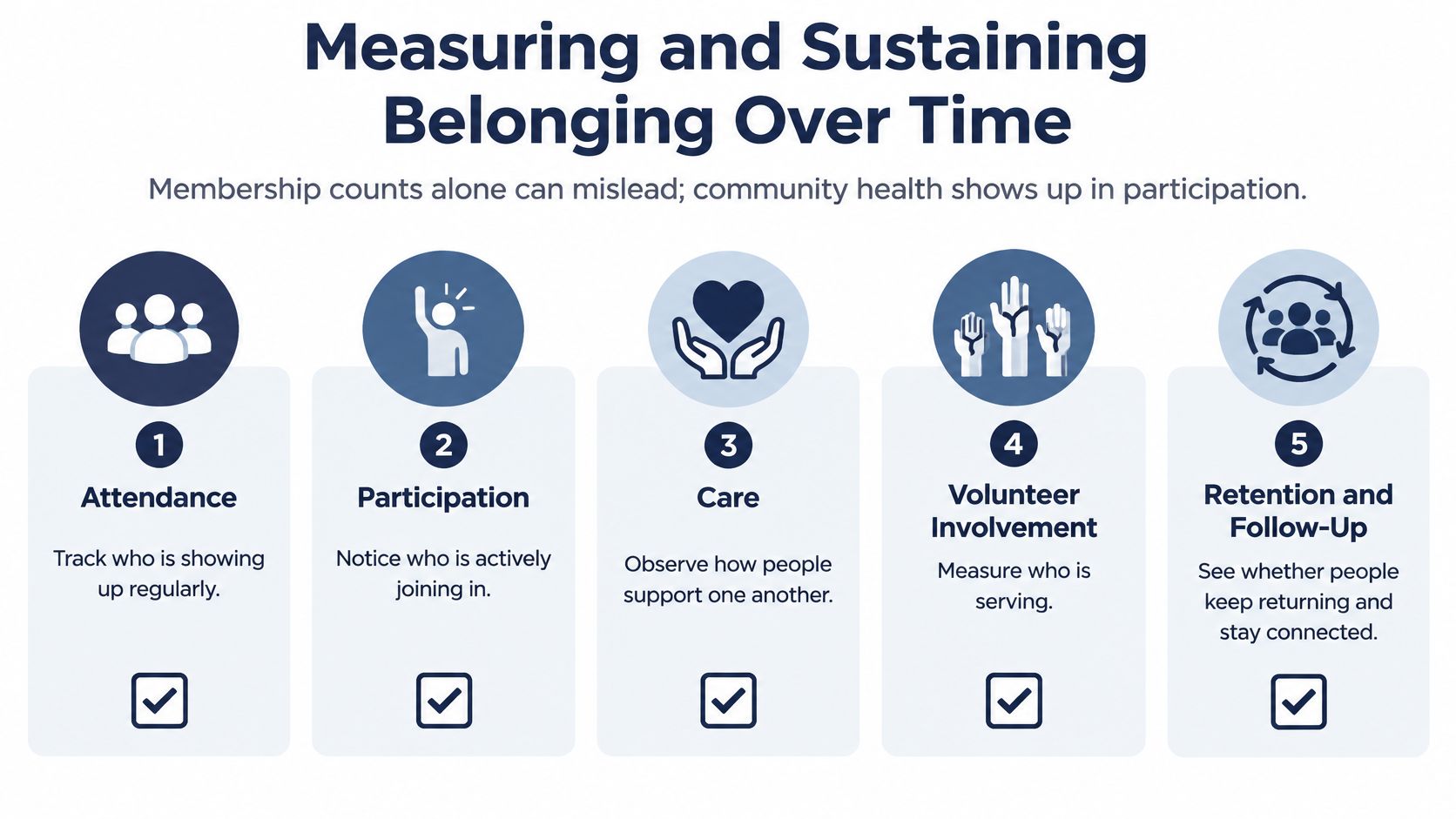
Measure | Simple Method | Review Rhythm |
|---|---|---|
Attendance frequency per person | Monthly attendance sheet | Monthly |
Members in two or more groups or teams | Group roster | Quarterly |
Volunteer hours | Volunteer log | Quarterly |
Trust and care | Anonymous annual survey with five questions | Annually |
Service beyond the congregation | Partnership and civic involvement log | Quarterly |
How to Track Each Measure
Attendance frequency: Track per person, not total headcount, so you notice drift early.
Two or more connections: Use group rosters to see who has both relational and serving ties.
Volunteer hours: Log hours by team to spot overload and gaps.
Trust and care: Ask five anonymous questions about being known, helped, and heard.
Outward service: Record partnerships and civic involvement beyond your walls.
Quality and diversity matter more than activity volume. Note whether relationships cross age, background, and income, and whether online members meet the belonging indicators used for hybrid participation rather than sitting outside every count.
Habits That Sustain It
Train and rotate small-group leaders before burnout forces rotation. Schedule pastoral follow-up for newcomers within two weeks. Review all five measures each quarter.
Set your own baseline in the first quarter instead of copying another church's numbers.
End every review by answering one question: where is belonging forming, and where is it stalling? Then assign one owner and one next step for the stalled area.
Start Building Community in Your Church or Ministry
You don't need to rebuild everything at once. Keep this work near your desk as you plan the next quarter.
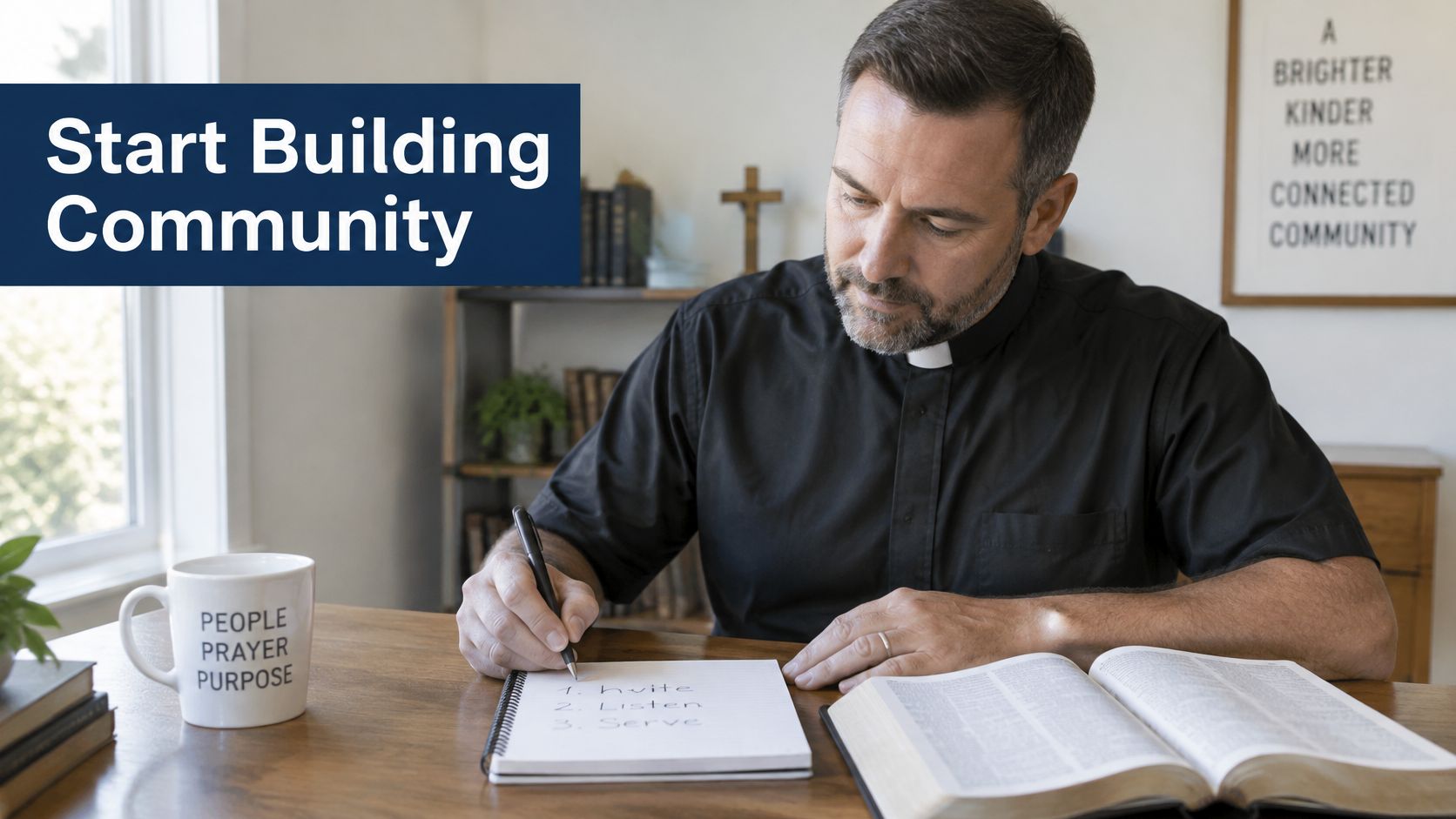
Make three moves: pick one practice from Acts, choose one model to strengthen, and set one measure to track. Christ forms this community, and Scripture, prayer, and mutual love sustain it. Your structures serve that work, consistent with Hebrews 10:24-25.
Watch this short teaching as you consider your first step:
Say a leader strengthens fellowship through small groups and tracks newcomers joining within two weeks. By quarter's end, one newcomer has a group, a prayer partner, and a serving role. That's measurable belonging.
For formal preparation, our Certificate of Theological Studies is 27 credit hours of graduate-level education for vocational or volunteer leaders, and our Master of Divinity requires 84 credit hours through a 3-year study of all 66 books. Review our degree programs, and contact us at info@thebibleseminary.edu or 281-646-1109. Explore our degree programs at The Bible Seminary and begin your journey toward deeper biblical training.
Frequently Asked Questions About the Community of Believers
What does community of believers mean in the Bible? It reflects ekklesia, the called-out assembly gathered by Christ, seen as the universal church and the local congregation (1 Corinthians 1:2).
Is it the same as a church building? No. The community is the people, marked by shared confession, mutual responsibility, and ongoing presence. A building is only where they meet.
Can online members belong to a biblical community? Yes, when they receive pastoral contact, peer relationship, service responsibility, and a way to contribute.
How large should a small group be? Leaders usually find 6-12 people works best for deep conversation and mutual care.
Do Acts 2 and Acts 4 require sharing all property? No. They describe need-based generosity with accountable leadership, not a universal requirement to surrender possessions.
Where can I study this further? Explore biblical and ministry training through our academics pages.
We're equipping leaders to impact the world for Christ by uniting scholarship, spiritual formation, and hands-on ministry in Katy, Texas. If you're ready to build a healthier community of believers with deeper biblical training, visit The Bible Seminary and take your next step with us.