
How to Footnote the Bible in Academic Writing

You're finishing a paper, the cursor is blinking in a footnote, and suddenly a simple Bible reference feels complicated. Do you abbreviate the book name? Do you add the translation? Do you need a footnote at all, or should the verse stay in the sentence?
That confusion is common in seminary, ministry training, and college religion courses. It isn't a sign that you're careless. It usually means you're working where several style systems overlap, and each one treats Scripture a little differently.
At The Bible Seminary, we care about this kind of question because good biblical writing serves the church. Clear citation helps you handle Scripture with care, write with honesty, and keep your reader focused on the text rather than distracted by formatting. When we're equipping leaders to impact the world for Christ, even footnotes become part of training hearts and minds for kingdom service.
Why Footnoting the Bible Feels Harder Than It Should
The first problem usually isn't format. It's the decision that comes before format.
Many students assume every Bible reference needs a footnote. Then they open a handbook, look at a sample paper, and discover that one professor uses in-text references, another wants Chicago notes, and another expects SBL conventions. That's where the stress begins.
The real source of confusion
Bible citations sit in an unusual place. Scripture is a sacred text, an ancient text, and a commonly referenced text in academic writing. Because of that, style guides often treat it differently from ordinary books.
A few patterns create most of the confusion:
Different classes use different guides. A theology course may lean toward Chicago or SBL, while a general education course may use APA or MLA.
Professors make local adjustments. Even within one seminary, instructors sometimes simplify or customize the house style.
Bible references are often handled in-text. That feels strange if you've been trained to footnote everything.
A good writer doesn't just memorize a template. A good writer asks what kind of reference this is and what the reader needs.
Two questions to ask first
Before you try to footnote the Bible, ask these in order:
Does this reference need a footnote at all?
If it does, what format does my assigned style guide require?
That order matters. If you skip the first question, you can spend time building a perfectly formatted note that your professor never wanted.
Why this matters theologically
For Christian writers, this isn't just a technical exercise. Scripture's authority rests on God as its author, not on outside validation, as summarized in this doctrinal teaching on the supreme authority of Scripture. We cite carefully not because the Bible needs our academic approval, but because faithful scholarship should reflect reverence, clarity, and truthfulness.
That's also why we don't want citation habits to become clutter. A page crowded with unnecessary notes can obscure rather than illuminate.
The Building Block Every Style Guide Shares
Whatever style guide you use, the basic anatomy of a Bible citation is usually the same: Book Chapter:Verse. If you need to identify the version, add the translation at the appropriate point required by your style.
So the core reference looks like this:
John 3:16
John 3:16-18
Gen 1:1-3 if your style allows abbreviations
The simplest working model
A practical way to think about it is this:
Book tells the reader where to look
Chapter and verse identify the passage
Translation tells the reader which English wording you used
If you were quoting from the New Revised Standard Version, your full reference might look like: John 3:16 (NRSV) or John 3:16, New Revised Standard Version, depending on the style.
For scholarly Bible footnotes, style guidance commonly recommends citing Scripture by book, chapter, and verse rather than page number, and naming the version in the first note if you use one translation throughout. That guidance is summarized in this SBL citation guide from Lycoming College.
When a footnote is unnecessary
This is the point many guides don't explain well enough. In a lot of academic writing, Bible references don't always belong in footnotes.
If your sentence refers to a passage, you can often place the reference directly in the sentence or in parentheses.
Jesus' conversation with Nicodemus frames new birth as a work of God's Spirit (John 3:1-8).
Paul's portrait of love in 1 Corinthians 13 remains central to Christian ethics.
If you quote a verse, many instructors still prefer the reference in the text:
“For God loved the world in this way: He gave his one and only Son” (John 3:16, CSB).
The question is not, “Can I footnote this?” The better question is, “Does a footnote help the reader here, or does it just repeat what the text already shows?”
A useful distinction
Several academic guides create confusion because they treat Scripture references as in-text citations, while using footnotes for other tasks such as identifying the translation, adding interpretation, or supplying study notes. That gap is described clearly in this Turabian Bible citation guide from AMBS.
That means a plain verse reference, a quoted verse, and a study-Bible style comment are not always handled the same way.
Chicago and SBL Side by Side
Chicago and SBL often look similar at first glance. Both care about clarity, consistency, and accurate biblical reference. But they don't always solve the problem in the same way.
Where they overlap
Both styles expect you to cite Scripture by book, chapter, and verse. Both also assume that readers may be using different editions, which is why page numbers are the wrong tool for biblical citation.
They also agree on a practical point that saves students trouble: if you use one translation consistently, identify it early, then don't keep repeating it unless you switch.
Where they differ
Chicago often appears in seminary and humanities writing because it uses notes well. SBL is built especially for biblical and theological scholarship, so it gives more specialized guidance for Scripture, ancient sources, and abbreviations.
If you want a broader refresher on note formatting, punctuation, and shortened citations, Rivul AI Chicago style resources offer a helpful overview before you adapt those patterns to biblical writing.
Chicago vs. SBL Bible Footnote Comparison
Element | Chicago (17th ed.) | SBL Handbook (2nd ed.) |
|---|---|---|
Basic Scripture reference | Book chapter:verse | Book chapter:verse |
Page numbers | Not used for Bible references | Not used for Bible references |
Translation handling | Name the version in the first relevant note or citation | Name the version in the first relevant note or citation |
Common placement | Often in text or notes, depending on assignment | Often in text or parenthetically for Scripture |
Repeating translation | Usually omitted after first use unless version changes | Usually omitted after first use unless version changes |
Focus | General humanities note system | Specialized biblical studies conventions |
A parallel example
Suppose you quote John 3:16 in a theology paper.
A Chicago-leaning professor may accept the verse in the text, with an early note identifying the translation of the Bible you're using in the paper.
An SBL-leaning professor may prefer the same verse reference directly in the sentence, since SBL commonly treats biblical references as their own special category rather than as ordinary book citations.
Keep this in mind: Chicago helps you manage notes. SBL helps you manage biblical scholarship.
If your professor says “use Chicago,” that doesn't always mean “footnote every verse.” If your professor says “use SBL,” that doesn't mean “never use notes.” It means you should match the purpose of the citation to the convention of the discipline.
How APA and MLA Handle Scripture
APA and MLA often surprise theology students because neither one treats Bible references quite like Chicago or SBL do.
APA usually keeps Scripture in the sentence
APA rarely depends on footnotes for ordinary citation. In most cases, Scripture appears in parentheses in the body of the paper, with the translation identified there.
Examples:
New birth is described as a work of the Spirit (John 3:5, New International Version).
Love is patient and kind (1 Cor. 13:4, English Standard Version).
A footnote in APA is more likely to carry a substantive comment than a basic verse reference.
The Greek term may carry a broader sense than “world” alone (cf. John 3:16, New International Version).
MLA has its own texture
MLA also tends to favor in-text handling, though some instructors still permit or require notes in religion papers. Translation disclosure usually appears on first use rather than through a separate abbreviation list.
APA vs. MLA Scripture Citations
Element | APA 7 | MLA 9 |
|---|---|---|
Default location | In-text parenthetical citation | Usually in-text citation |
Footnotes | Used sparingly, often for comments | Sometimes used, depending on assignment |
Translation disclosure | Usually given in the citation on first use | Usually given on first use |
Year in citation | APA commonly expects a year element for sources, which can create confusion in Bible assignments. Follow instructor guidance closely. | MLA does not work from APA's year-driven model |
Italics | Depends on whether you name the Bible edition as a title | Depends on whether the Bible title appears as a standalone work |
Three things students miss
APA prefers in-text references, not a page full of Scripture footnotes.
MLA handles titles differently from Chicago and SBL when the Bible as a whole is named.
In religion classes using APA or MLA, instructors sometimes borrow SBL habits for the bibliography or reference list. Ask before you assume.
That last point matters most when your course crosses departments. An English instructor and a biblical studies instructor may both say “use MLA,” but they may mean slightly different things when Scripture enters the paper.
Tricky Cases You Will Actually Run Into
Most citation trouble doesn't come from famous verses. It comes from ordinary paper situations that no quick template covers well.
Here's a visual checklist many students need once they move beyond a single quotation.
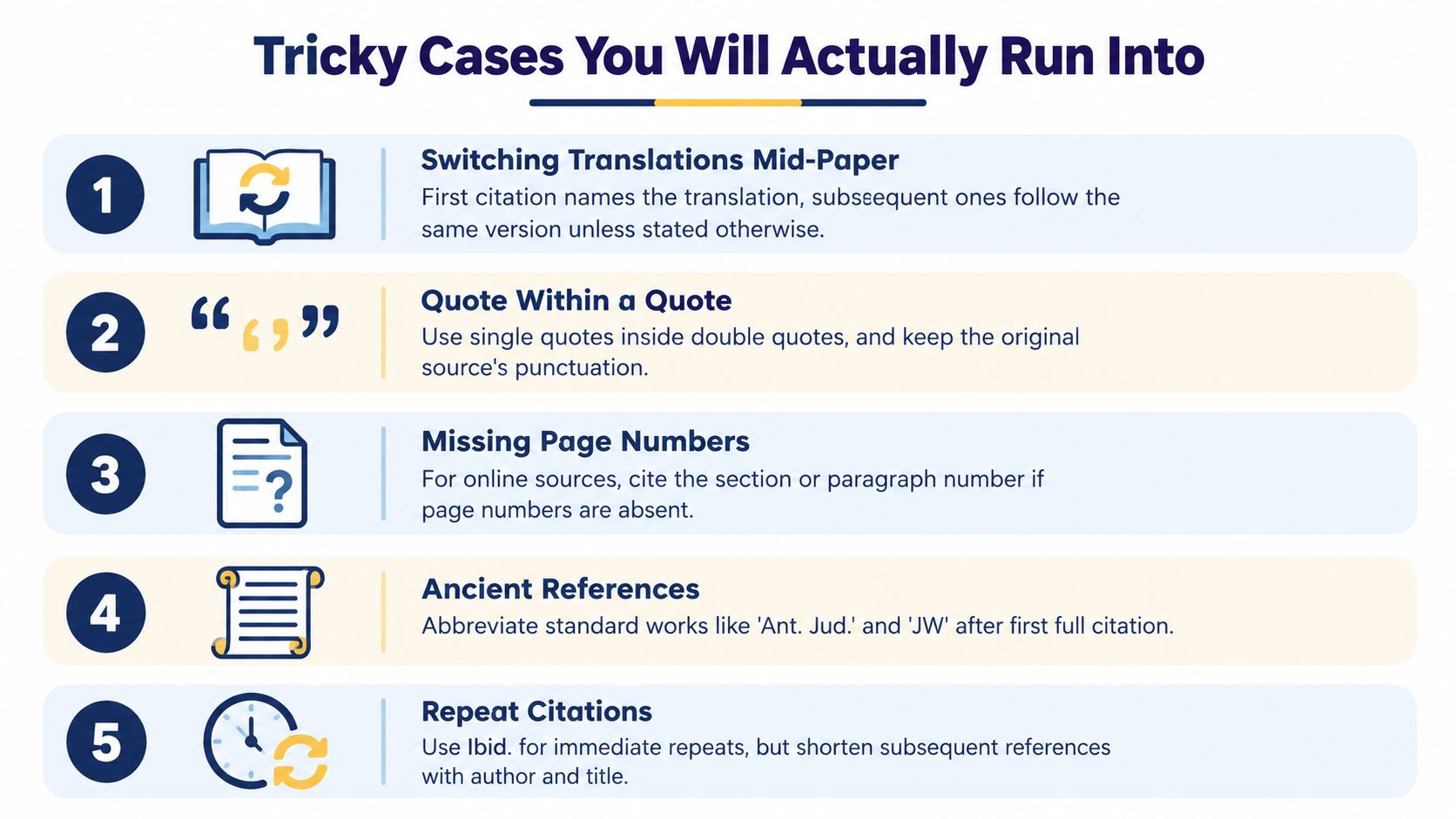
Switching translations mid-paper
If you begin with the CSB and later quote the ESV, identify the change when it happens. Don't assume your reader will notice.
Examples:
First use: John 3:16 (CSB)
Later switch: Psalm 23:1 (ESV)
A recurring issue in current citation help is version handling across multiple translations, especially when writers move between academic and ministry settings. That ongoing gap is described in this discussion of Bible footnote version handling and abbreviation rules.
Consecutive verses and repeated references
Write the full reference clearly. Don't drop the book name and leave the reader guessing.
Use:
John 3:16-18
Be careful with shorthand like “vv. 16-18” inside notes unless your professor has already established the book and your style allows it. Clarity is more important than saving a few characters.
Multiple passages in one note
When one sentence draws on several texts, list them in a clean order and separate them with semicolons.
For example:
John 3:16; Rom. 5:8; 1 John 4:9-10
Keep the references in the order they appear in your discussion or in a logical canonical order if your professor expects that.
Citing Bible study work alongside Scripture
Sometimes you're not directly citing the Bible. You're citing a scholar, pastor, or study resource who quotes the Bible. In that case, your note should cite the scholar's work, not pretend you consulted only Scripture.
This comes up often in close reading assignments and observation papers. If you're practicing interpretive habits before writing the paper, a guide like this deductive Bible study article can help you separate observation of the text from citation of secondary sources.
Practical rule: Cite the source you actually used. If a commentator quoted the passage and shaped your wording, footnote the commentator and identify the Bible version only when needed for clarity.
Seminary Paper Habits That Save You Marks
Most lost marks in citation don't come from deep ignorance. They come from hurry, inconsistency, and tiny mismatches between the body of the paper and the notes.
Five habits worth building
Choose your style guide early. Decide at the start whether you're writing in Chicago, SBL, APA, or MLA. Don't patch styles together at the end.
Choose your main translation early too. If you're using the CSB, ESV, or NIV, keep that decision visible in your notes so you don't drift.
Track every Scripture reference as you draft. A simple running list in your notes file can save a lot of cleanup later.
Proofread the footnotes separately. Students often revise the body and forget the notes. That's where punctuation errors hide.
Check repeated references for consistency. Book abbreviations, verse ranges, and translation labels should all match.
A note on Bible versions
When you mention a Bible translation by name as a whole work, handle it like a title. When you cite a biblical book, follow the style rules for Scripture reference. Those are not the same thing.
A translation overview from the Christian Standard Bible notes the NIV, ESV, and CSB among widely used modern English versions, making them appropriate choices when you need to cite a version in church or academic settings. See the CSB verse comparison overview.
Citation managers help, but only to a point
Zotero and EndNote can be useful, but Bible references often need manual checking. Citation managers are built for books and articles first. Scripture references don't always export neatly.
One practical option for students working through seminary formatting is to compare their draft notes with model papers or instructional resources. The Bible Seminary provides academic writing help through its academics pages, where students can explore program expectations and tools used in graduate-level study.
A clean paper usually reflects a clean process. The student who decides the style and translation on day one usually has fewer citation problems on submission day.
Quick Answers and Where to Go Next
A few office-hour questions come up again and again.
Does the Bible go in the bibliography
Sometimes yes, sometimes no. It depends on the style guide and the assignment. Many professors don't require a bibliography entry for Scripture if references appear clearly in the text and the version is identified. Others do want the Bible edition listed. Follow the professor's instructions first.
How do I cite a translation versus the original languages
If you're quoting an English Bible, name that translation. If you're translating directly from Hebrew or Greek, your paper should make that clear, and your professor may want a different form of citation and transliteration. Don't label a verse as CSB, ESV, or NIV if those aren't the words you used.
What if I'm citing a whole chapter or chapter only
Use the chapter reference directly, such as John 3. If your discussion concerns the chapter as a whole rather than a specific verse, don't force a verse citation that gives false precision.
Keep the framework simple. Pick the style guide. Decide whether the verse needs a footnote or only an in-text citation. Name the translation on first use. Then stay consistent.
If you want to learn how to footnote the Bible with more confidence, the deeper skill isn't formatting alone. It's learning how scholarship, spiritual formation, and careful reading work together. That's part of training hearts and minds for kingdom service, and it's one way we continue uniting scholarship, spiritual formation, and hands-on ministry in service to Christ and His church.
At The Bible Seminary, you can grow in the kind of biblical and academic clarity that strengthens both classroom writing and faithful ministry. If you want guided feedback on research, theology, Scripture handling, and graduate-level writing, we invite you to explore how our programs can help you serve the church with confidence and care.