
Deductive Bible Study: A Step-by-Step Guide

You're preparing a Bible study on forgiveness. You search for familiar verses, copy them into your notes, and begin arranging them into a lesson. Then a difficult passage raises a question that doesn't fit your outline. Do you examine it thoroughly, or set it aside?
That moment reveals both the value and the danger of deductive Bible study. This method can help pastors, teachers, and students organize Scripture around a clear theological question. Used carelessly, it can turn Bible study into a search for preselected proof texts. Used faithfully, it can help us build conclusions that are accountable to Scripture's context, language, and whole message.
What Deductive Bible Study Is and When to Use It
Deductive Bible study begins with a general premise and moves toward specific biblical conclusions. You might begin with a doctrine such as forgiveness, a theological question such as “What does Scripture teach about Christian suffering?” or a ministry concern such as “How should a church practice reconciliation?” You then gather relevant passages, examine them, and determine whether they support, refine, or challenge the premise.
This is a topic-driven, premise-first method. Descriptions of deductive study commonly contrast it with inductive study, which begins with a passage and develops understanding from the details of that text toward a broader conclusion. This overview of deductive Bible study describes the deductive approach as selecting a topic and finding passages that address it, while this comparison of inductive and deductive study emphasizes that inductive study is text-first and deductive study is premise-first.
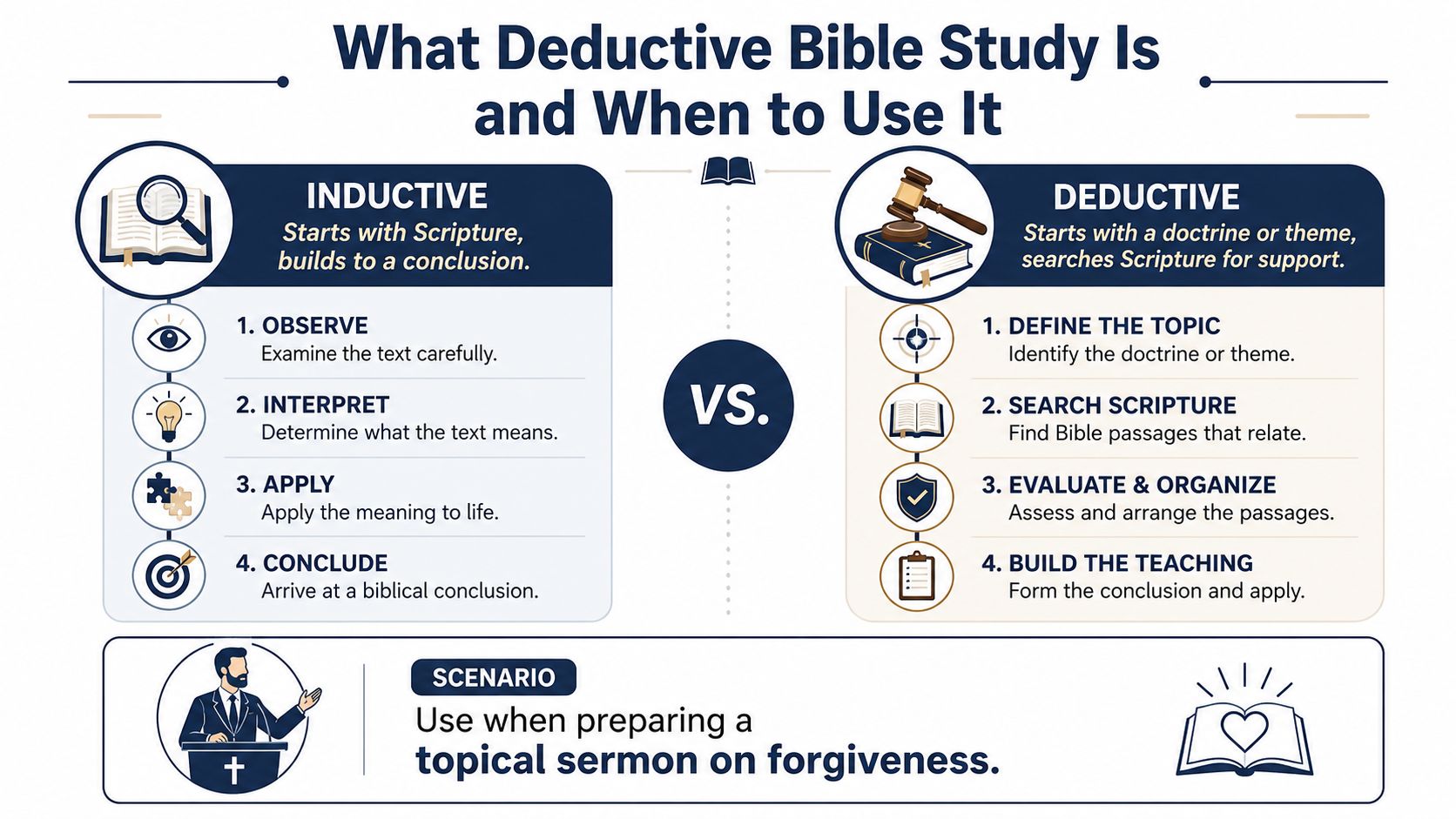
Deductive and inductive study serve different purposes
Inductive study often works well when you want to sit with one passage, follow the writer's argument, notice repeated ideas, and allow the text to establish the direction of your study. It's especially useful for devotional reading, expository preaching, and small-group discussion centered on a specific passage.
Deductive study becomes useful when you need to gather Scripture across several passages around a defined issue. It can serve you well when you're:
Forming a doctrinal statement: Collect relevant texts, examine their claims, and express a conclusion carefully.
Preparing a topical sermon: Build a biblical framework for themes such as prayer, holiness, justice, or forgiveness.
Answering a theological question: Investigate what multiple passages contribute rather than relying on a single familiar verse.
Designing curriculum: Organize a lesson around a central truth while retaining the context of each passage.
The distinction isn't a contest between a good method and a bad one. Deductive study can clarify the Bible's teaching across a theme, while inductive study can protect you from imposing a theme on a passage. Mature interpretation often uses both, with humility before the authority of Scripture.
The Historical and Academic Foundations of Deductive Study
Deductive Bible study is sometimes presented as casual verse collecting. Its more disciplined form has a deeper connection to the historical-critical and grammatico-historical approaches associated with academic interpretation. These approaches emphasize authorial intent, the original audience, the original language, historical setting, literary form, and the danger of reading modern assumptions back into an ancient text.
The historical-critical or grammatico-historical method became the dominant academic approach in Bible study from the mid-19th century until roughly one generation ago, according to the verified historical overview summarized in Cambridge's discussion of historical-critical approaches. Yale's RLST 152 lecture notes also describe the Reformation and modern history as major turning points in the rise of this approach, while observing that it wasn't the main method for most of the last 2,000 years.
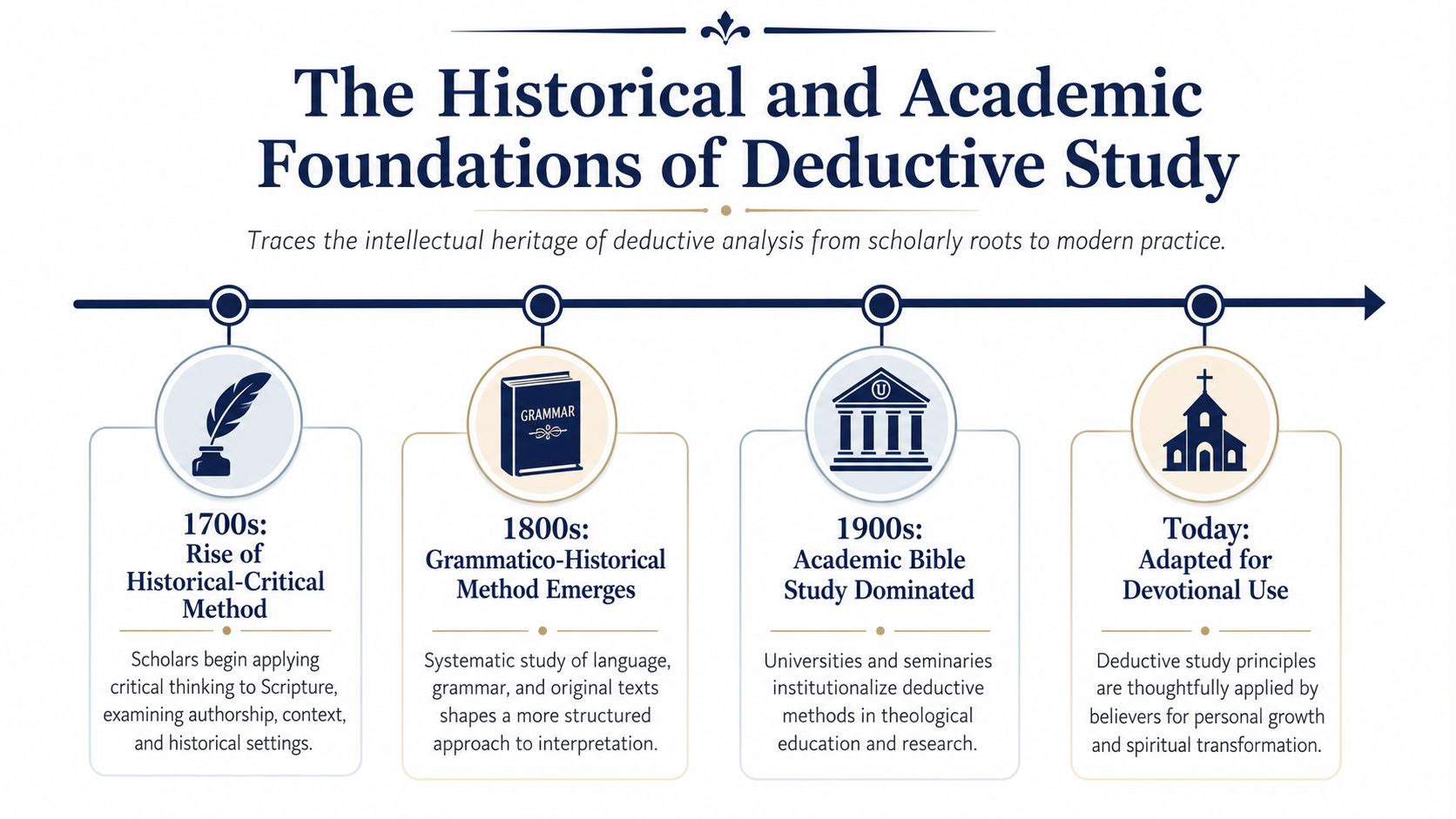
Technical disciplines make the process accountable
A careful deductive study doesn't treat every English translation or isolated sentence as self-explanatory. It asks how the text was transmitted, composed, shaped, and received.
Several technical disciplines support that work:
Textual criticism compares manuscripts, papyri, ancient translations, and patristic sources to recover the closest attainable form of the original text.
Source criticism investigates the sources or traditions that may stand behind a biblical writing.
Form criticism studies literary forms and the settings in which those forms functioned.
Redaction criticism examines how biblical authors arranged and shaped material for their theological purposes.
Tradition criticism explores how traditions developed and were transmitted before reaching their written form.
A scholarly summary of the historical-critical method describes it as indispensable for the scientific study of ancient texts while also presenting it as an approach concerned with the historical processes that produced biblical writings. The point isn't to replace faith with technical analysis. Rather, careful analysis helps us avoid claiming that Scripture says something it doesn't say.
A structured procedure also distinguishes this method from intuition-driven reflection. A classic enumeration from a 1949 Oxford ecumenical study conference identified stages involving determination of the text, identification of literary form, establishment of historical situation, recovery of meaning for the original audience, and interpretation within the total context, as summarized in this scholarly discussion of biblical interpretation.
A Complete Walkthrough of the Deductive Bible Study Process
Choose a manageable question so the method stays visible. For example, ask: What does Scripture teach about forgiveness, and what does Christian forgiveness require? Don't begin by assuming you already know the complete answer.
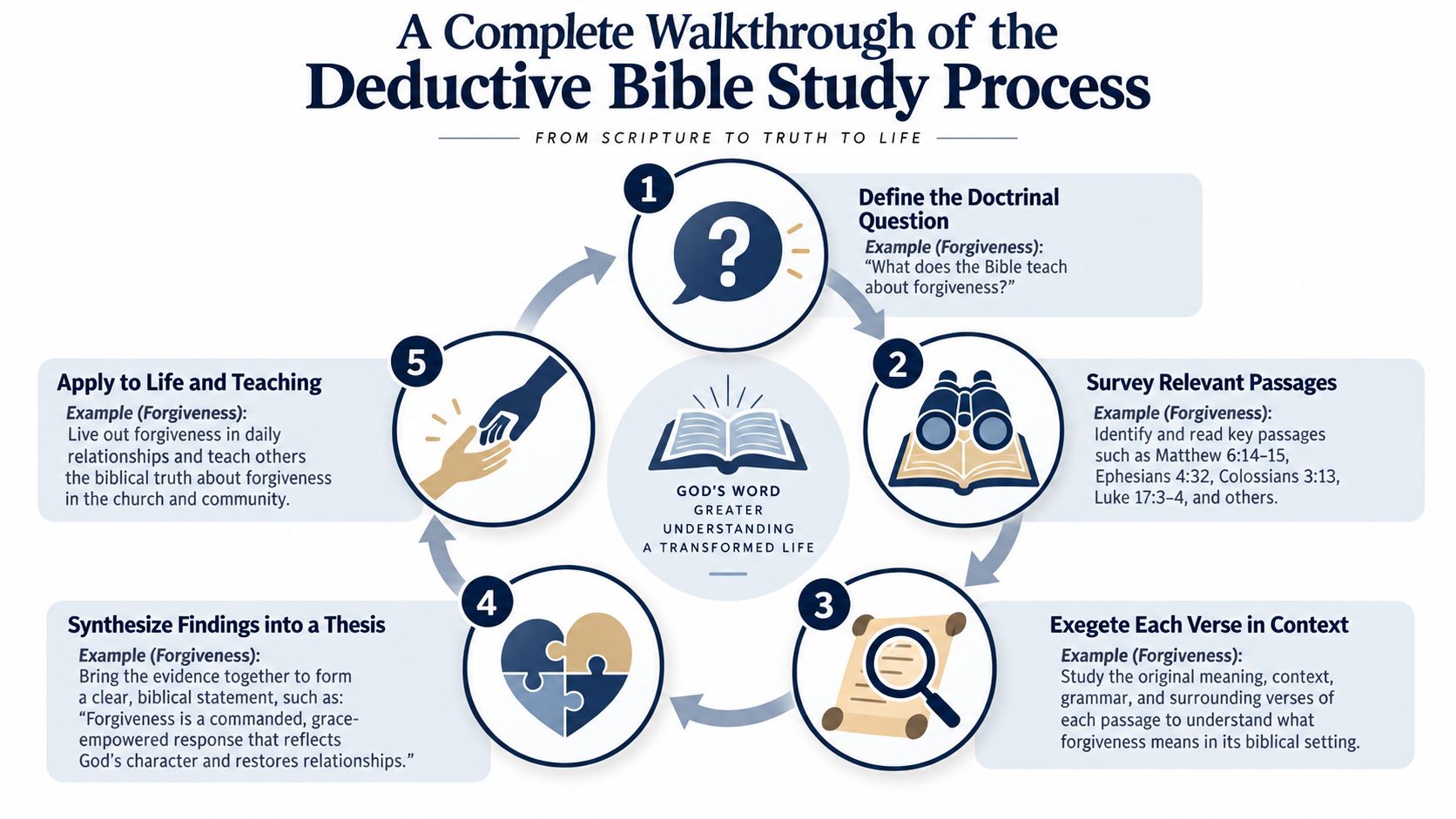
Begin with a precise question
Write the question in a form that can be tested. “Forgiveness is important” is too broad to guide serious study. “Does Scripture command believers to forgive personal wrongdoing, and what qualifications or results does the biblical context provide?” gives you something more precise.
A good question leaves room for correction. If your wording makes disagreement impossible, you've written a slogan rather than a research question.
Survey relevant passages
Use a concordance, cross-references, a Bible dictionary, or a trustworthy digital Bible tool to identify candidate passages. Search related ideas, not only one English word. For forgiveness, you might examine passages where Scripture discusses confession, reconciliation, mercy, indebtedness, repentance, and restored relationships.
At this stage, collect broadly. Don't label a passage as proof before you've read the surrounding argument. Record the reference, literary setting, speaker, audience, and apparent contribution to the question.
Exegete each passage in context
Read the whole paragraph and, when necessary, the larger unit. Identify who speaks, whom they address, what problem they're answering, and how the passage fits within the book.
Pay attention to genre. A proverb, narrative, prophetic oracle, epistle, and parable communicate differently. Original-language tools can help clarify important terms, but word studies must remain connected to grammar and context. The Bible Seminary's resource on New Testament interpretation offers a related example of the contextual care required when interpreting biblical texts.
Extract propositions before writing conclusions
Turn each passage's contribution into a carefully worded proposition. For instance, instead of writing “Jesus says forgiveness has no limits,” ask what the passage commands, whom it addresses, and what explanation accompanies the command.
Separate what the text states from what you infer. Mark tensions and qualifications rather than smoothing them away. A conclusion becomes stronger when readers can trace it from the passage's claims.
Synthesize, test, and apply
Arrange the propositions into a conclusion that reflects the evidence. Then ask:
Does each premise come from a passage read in context?
Have I included texts that complicate my preferred conclusion?
Does the conclusion fit the teaching of Scripture as a whole?
Am I moving to application only after interpretation?
The historical method's structured stages and the classic movement from observing accurately to expressing conclusions clearly both reinforce this sequence. Deductive study is efficient because it moves toward a defined answer, but the efficiency must never outrun the text.
Avoiding Confirmation Bias and Proof-Texting
The greatest danger in deductive Bible study isn't having a topic. It's treating the topic as settled before Scripture has been heard.
A leader may begin with a sincere conviction, search for supporting verses, and overlook passages that qualify the claim. The result can sound biblical because it contains many references, yet the references may not support the conclusion in their own contexts. This practical guide to deductive Bible study describes deductive study as “reductive,” meaning that it removes extraneous material until a conclusion is reached. That efficiency can help you teach clearly, but it can also produce false certainty when the premises are incomplete.
Bias alert: A verse that contains your keyword isn't automatically a verse that supports your doctrine.
Build guardrails into the method
Start by making your question falsifiable. Ask what evidence would force you to revise your initial premise. If no possible text could challenge your idea, you aren't testing a conclusion. You're defending it.
Then use a context record for every passage. Note the immediate context, the book's purpose, the audience, the literary genre, and the role of the passage in the author's argument. This simple discipline makes it harder to quote a sentence while ignoring the paragraph that explains it.
Four practices can keep your study honest:
Define terms carefully: Explain what you mean by words such as forgiveness, faith, freedom, authority, or blessing.
Seek counter-evidence: Search for difficult passages, not only familiar ones. Ask how your initial claim handles them.
Consult alternative interpretations: Read responsible commentaries that represent views different from your own, then evaluate their arguments from Scripture.
Test the whole conclusion: Compare your synthesis with the broader biblical witness rather than counting supportive references.
Frequency isn't the same as truth. Ten isolated verses don't outweigh one passage that, in context, contradicts the way you're using them. The stronger criterion is contextual fit and inferential coherence, not the size of your proof-text list, as emphasized in this training distinction between inductive and deductive study.
Recognize when Scripture corrects your premise
A difficult passage may not destroy your study. It may refine your terms, expose an overstatement, or reveal that your original question was too narrow. Write those discoveries into the conclusion.
The posture matters as much as the procedure. We come to Scripture not as judges deciding what it may say, but as servants learning to hear and obey the God who speaks through it.
Using Deductive Bible Study in Ministry and Teaching
A pastor preparing a topical sermon can begin with a question about forgiveness, gather relevant passages, and develop a coherent biblical case. The sermon should still explain each key text in context. A topical structure doesn't excuse shallow exegesis, and a verse list isn't a substitute for the argument of Scripture.
A church planter may use the method while drafting a doctrinal statement. The team can identify a doctrine, collect representative texts, study their contexts, and state the belief with enough precision to avoid saying more than Scripture says. The process also gives future leaders a trail they can review and discuss.
Small-group leaders often face direct theological questions. Someone may ask whether Christian freedom means a believer can act without moral limits, or whether forgiveness removes every consequence of wrongdoing. Deductive study helps the leader gather a range of biblical evidence, but the leader should invite participants to read the passages themselves and notice the qualifications.
Christian educators and homeschool families can adapt the same workflow:
Choose one focused question suited to the learners' maturity.
Read selected passages in full context, not only the highlighted sentence.
Ask learners to state what each passage contributes.
Compare similarities and differences among the texts.
Form a conclusion and connect it to faithful obedience.
For systematic theology, topical curriculum, and ministry counseling, deductive study offers a useful organizing structure. Its value increases when teachers pair it with passage-based observation, prayer, discussion, and willingness to revise an assumption.
The Bible Seminary's academic offerings include degree programs, certificates, auditing options, and on-demand seminars that address Bible-centered interpretation and ministry preparation. Students and ministry professionals can investigate available study pathways through the academic programs, while leaders seeking flexible preparation can review the degree program options. That kind of training connects scholarship, spiritual formation, and hands-on ministry for people serving churches and Christian communities.
Your Next Steps Toward Deeper Biblical Training
A faithful deductive Bible study can be both organized and worshipful. Begin with a question, but let Scripture have the authority to correct the question. Gather broadly, interpret carefully, state propositions faithfully, and apply the conclusion only after you've done the work of understanding.
Keep this checklist nearby:
Define the question: Write a focused, testable doctrinal or ministry question.
Gather passages: Search related biblical terms and themes without selecting only convenient verses.
Read contextually: Examine the literary unit, historical setting, genre, audience, and authorial argument.
Record propositions: Distinguish what each text says from what you infer.
Seek correction: Include difficult passages and responsible alternative interpretations.
Synthesize carefully: Build a conclusion from contextual evidence and coherent reasoning.
Apply faithfully: Connect the conclusion to worship, character, teaching, and ministry practice.
Rigorous study doesn't compete with spiritual humility. It can cultivate humility by showing us how often our first impressions need correction. At The Bible Seminary, students pursue Bible-based, Christ-centered, Spirit-led preparation while engaging Scripture alongside historical, theological, archaeological, and practical disciplines. Readers interested in the relationship between Scripture and the material world can also explore archaeology resources.
The Bible Seminary offers graduate degree programs, certificates, and flexible learning opportunities for pastors, educators, and ministry leaders who want deeper biblical training. Visit The Bible Seminary to explore how rigorous interpretation, spiritual formation, and practical ministry preparation can equip you to impact the world for Christ.