
Do Not Covet: Meaning, Context and Application

The tenth commandment forbids desiring what belongs to your neighbor, and it addresses the heart before any outward act such as theft or adultery.
If you've never taken what belongs to someone else, does that mean you've kept this command? That question invites us beyond a checklist of acceptable behavior into a more honest conversation about what we want, why we want it, and how we respond when another person has it.
At The Bible Seminary, we approach that conversation with confidence in Scripture and humility about ourselves. God calls us to more than outward respectability. Through Christ, we're invited to bring our desires into the light, receive grace, and learn to love our neighbors without needing their lives to become ours.
What the Tenth Commandment Says in Exodus and Deuteronomy
Do not covet means we must not cultivate possessive desire for what belongs to a neighbor. This final commandment closes both biblical presentations of the Ten Commandments, addressing motives that can precede visible wrongdoing.
Exodus places the command within Israel's covenant at Mount Sinai. Deuteronomy repeats it during covenant renewal, as Israel prepares for life in the land. The parallel accounts in Exodus and Deuteronomy preserve the same prohibition with meaningful differences in vocabulary and arrangement.
The NIV wording of Exodus 20:17 begins:
“You shall not covet your neighbor's house.”
Deuteronomy 5:21 begins with the neighbor's wife and then prohibits setting your desire on the neighbor's house, field, household workers, livestock, or anything belonging to the neighbor.
Exodus 20:17 and Deuteronomy 5:21 Side by Side
Feature | Exodus 20:17 | Deuteronomy 5:21 |
|---|---|---|
Verb for desire | One principal verb, ḥāmad, repeated | Two related expressions, covet and set your desire |
First object named | Neighbor's house | Neighbor's wife |
Field named | Not listed separately | Listed separately |
Setting | Wilderness, before entering Canaan | Later covenant renewal, anticipating settled life |
Catch-all phrase | Anything that belongs to your neighbor | Anything that belongs to your neighbor |
Specific categories before catch-all | Six: house, wife, male servant, female servant, ox, donkey | Seven: wife, house, field, male servant, female servant, ox, donkey |
The counted categories exclude the final catch-all phrase. That distinction matters because the command doesn't end with its examples: nothing belonging to the neighbor falls outside its concern.
Why the Differences Matter
The explicitly named field brings land and livelihood into focus. The Berean discussion of Deuteronomy 5:21 connects this detail with Israel's settled life and draws attention to the wife's placement before household assets.
We shouldn't flatten these passages into identical lists. Nor should we use their ancient household language to reduce people to possessions. The command protects relationships and livelihoods against another person's grasping intentions.
Read both passages aloud, side by side. Mark differences in order and wording, then ask how each version makes the neighbor's actual life harder to ignore.
Telling Healthy Desire From Coveting
Not every strong desire is sinful. Wanting meaningful work, a stable home, a healthy marriage, or deeper ministry training isn't automatically coveting.
The Hebrew verb ḥāmad can express desire, delight, or taking pleasure. As the Free Bible Commentary discussion of coveting explains, its meaning must be understood in context. In Exodus, the decisive issue is desire directed toward acquiring what belongs to a neighbor, not desire considered in isolation.
That helps us avoid an unhelpful conclusion: Christians don't become holy by becoming indifferent to everything good. We learn to desire faithfully, without treating another person's blessings as an injury to ourselves.
Five Desire Types and Where Each Can Lead
These distinctions are pastoral tools, not rigid definitions of every experience.
Desire | What it looks like | Where it can lead |
|---|---|---|
Admiration | Appreciating a neighbor's gifts, home, or character | Gratitude and honest encouragement |
Ambition | Wanting growth in work or ministry | Faithful effort, or resentment if it turns to rivalry |
Envy | Resentment that another person has what you lack | Comparison, bitterness, and division |
Lust | Desire that treats a person as an object | Adultery and exploitation |
Acquisitive intent | Planning to take what belongs to a neighbor | Theft, fraud, and unjust dealing |
Say a friend welcomes people generously into a beautiful home. You might appreciate the space and decide to practice hospitality in your own apartment. That's different from resenting your friend's home or believing you deserve it more.
Likewise, applying for a promotion isn't wrong in itself. Undermining a colleague because you cannot bear their advancement reveals a different posture.
Questions That Test Desire
Bring a particular desire before God and ask:
Dignity: Does this desire honor the other person as someone to love, rather than someone to use or displace?
Gratitude: Can I thank God for what I have while acknowledging what I hope for?
Direction: Does this desire motivate faithful work, or does it encourage resentment, manipulation, and entitlement?
Jesus' warning in Luke 12:15 to guard against every kind of greed comes amid a dispute about inheritance. His concern isn't merely whether someone can secure a larger share, but whether possessions have become the measure of life.
A useful distinction: Admiration can celebrate another person's good. Coveting makes that good something we must possess for ourselves.
For further reflection on wise choices and motives, our Proverbs study guide offers a companion for biblical study. Name a desire you've experienced this week and test it openly against the questions above.
How the Command Stands Apart From Ancient Law
Ancient societies prohibited theft and protected property. The distinctive question is whether their surviving laws prohibited wrongful desire itself, rather than only the actions that followed.
The TheTorah essay on coveting in the Decalogue identifies no clear direct parallel in surviving ancient Near Eastern law collections, while examining suggestive treaty comparisons. Its examples include fourteenth-century BCE Hittite material, Hammurabi's Law 25, and an Assyrian agreement protecting an Assur citizen's household and property.

Illustrative scene, not a photograph of a specific archaeological discovery.
Comparable Concerns, Different Prohibitions
Hittite treaties: The material appears to restrict improper desire for people or territory belonging to another authority. These diplomatic obligations offer a comparison, but they aren't an identical neighborhood command.
Hammurabi's fire-rescue law: The law prescribes burning for someone who steals household property while helping extinguish a fire. It punishes looting in a moment of vulnerability, not coveting as a general inward offense.
The Assyrian agreement: The text prohibits coveting and forcibly appropriating or giving away an Assur citizen's house, slave, handmaid, field, or orchard. Its setting concerns the protection of Assyrians against abuses by local authorities.
These comparisons show that concern about wrongful acquisition wasn't confined to Israel. They don't establish that the biblical command was borrowed from another text, nor do they erase the differences between a treaty provision and Israel's covenant obligations.
A Careful Historical Conclusion
The Decalogue makes a person's inward relationship to a neighbor's good morally significant. It places a boundary around motives associated with theft, adultery, exploitation, and violence.
That's a conceptual distinction, not a claim that ancient Israel had no property disputes or that this command produced a measurable reduction in crime. The presence of a command isn't evidence that everyone obeyed it.
Teachers can say comparable concerns rather than the same law. Historical context helps us read attentively, while Scripture remains our primary authority.
Read Exodus 20:17 alongside the translated Hammurabi passage in the essay. Ask whether each text focuses on wanting, taking, or both, and notice what that difference permits you to conclude.
How Desire Grows Into Sin, Step by Step
Say a colleague receives the promotion you hoped for. You congratulate her, but afterward you keep imagining yourself in her office. Eventually, you begin withholding information that would help her succeed.
That scenario shows a possible progression, not an inevitable sequence. Noticing isn't itself coveting, and temptation needn't become an outward violation. Nevertheless, tracing the movement can help us recognize where repentance is needed.
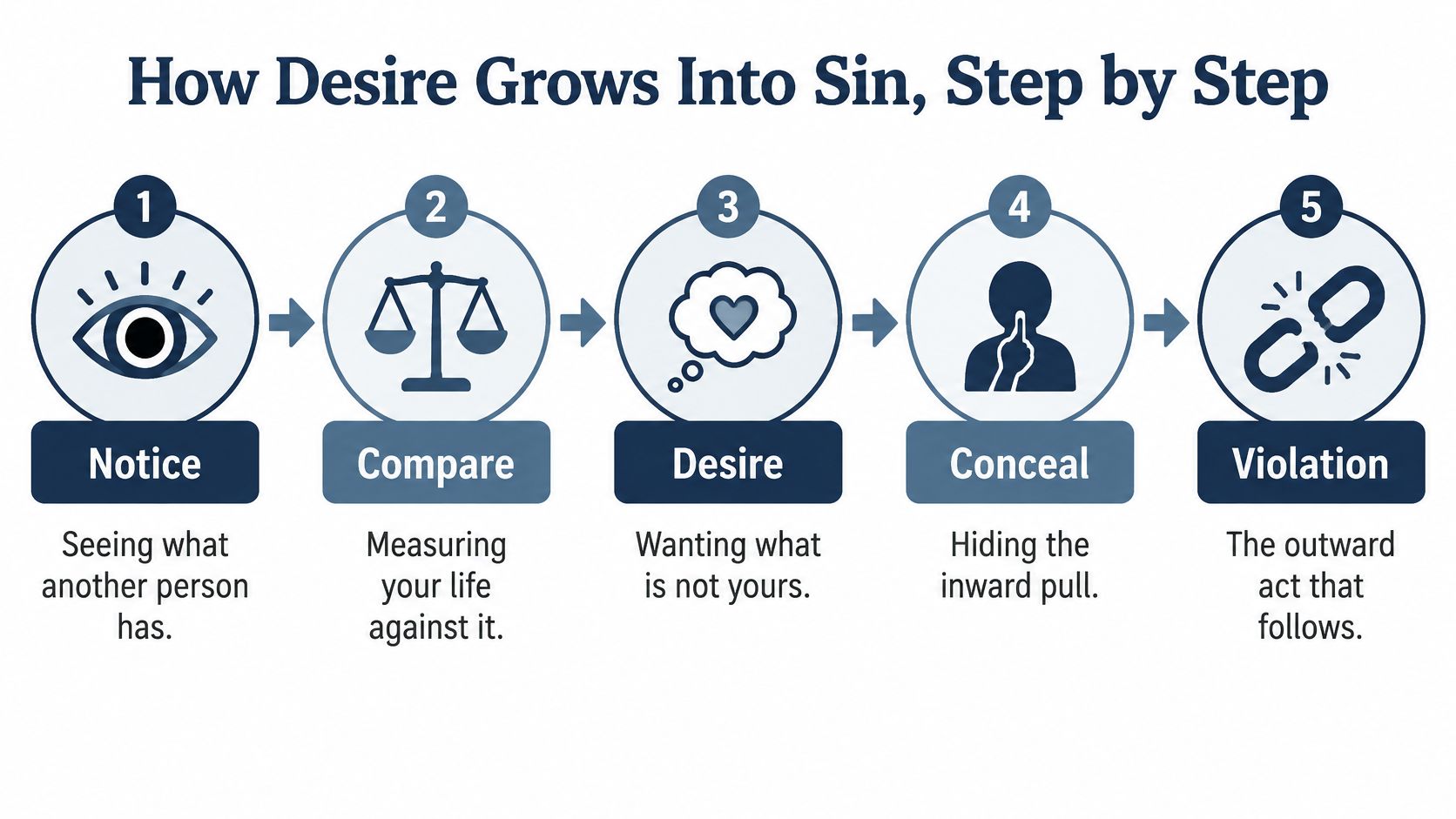
Following the Promotion Scenario
Notice. You learn about your colleague's promotion. You can acknowledge disappointment without denying her dignity or achievement.
Compare. You measure your responsibilities and recognition against hers. Instead of evaluating your own work, you begin building a case that her success diminishes you.
Desire. Imagined possession takes hold. Her position starts to feel like something that should already be yours, and you rehearse the recognition you believe you're owed.
Conceal and plan. You hide your resentment while considering how to weaken her standing. You might disguise a calculated omission as forgetfulness.
Violate. You withhold essential information or spread a misleading account of her work. The inward posture has become an action that harms your neighbor.
The same pattern could involve land, a relationship, or ministry influence. Concealment and planning may overlap, and some actions happen quickly rather than through prolonged calculation.
What Paul Helps Us See
In Romans 7:7 and its surrounding argument, Paul uses the command against coveting to explain how the law makes sin recognizable. His point isn't that God's command is sinful, but that it exposes something we might otherwise overlook.
Care with Greek helps here. Paul quotes the verbal command against coveting and then speaks of coveting or desire using the related noun epithymia. This word family concerns strong desire, with the context identifying its wrongful character.
The command therefore challenges the person who says, “I haven't done anything wrong,” while deliberately nurturing resentment. God's concern includes what we're cultivating before anyone else can see it.
Interrupt the pattern by naming the desire clearly, confessing it to God, thanking him for concrete gifts, and choosing an action that serves the other person. In the promotion scenario, that could mean sharing the information your colleague needs and requesting constructive feedback about your own development.
Trace a recent desire through this teaching model. Mark the earliest point where you could have chosen a different response, without assuming every stage occurred.
Applying the Command to Money, Media and Ministry
A purchase, a social media post, and a ministry opportunity can each reveal how desire is shaping a decision. Ask: Do I need or value this for a good reason, or am I trying to quiet the discomfort of someone else having more?
A Biblical eLearning teaching resource on the commandment connects inward desire with consumer culture and advertising. That connection invites families, congregations, and businesses to consider how their messages can encourage acquisition, not only how individuals make choices.
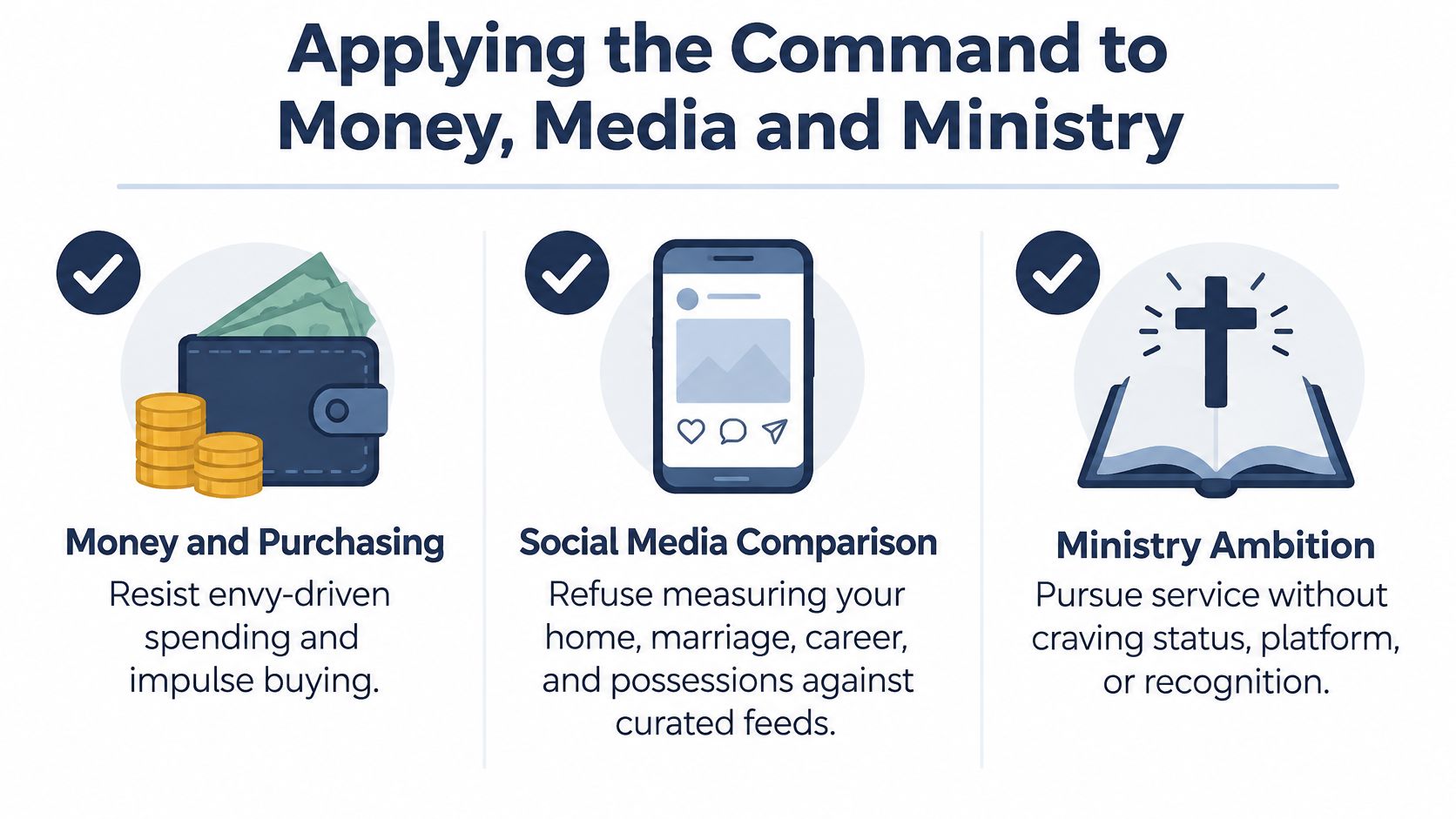
Money and Media
Suppose you were content with your car until a friend bought a newer one. Before contacting a dealer, ask whether your current car meets your needs and whether the new desire is tied to transportation or to appearing equally successful. A budget can show what you can afford; it cannot settle whether the motive is wise.
Digital feeds put homes, marriages, careers, and purchases side by side. An advertisement may then present a product as the answer to a feeling of inadequacy. You can make choices about what repeatedly occupies your attention, as well as how you respond when comparison arises.
For readers who follow digital-asset markets, crypto fear and greed readings illustrate how market sentiment and emotional language can shape financial decisions. Ask whether a decision reflects a considered need or a reaction to excitement or fear. A market sentiment indicator cannot diagnose the heart or replace financial judgment.
Try these practices:
Audit your feed: Unfollow or mute accounts that reliably draw you into resentful comparison.
Delay status-driven purchases: Set a waiting period, then reconsider the need, budget, and motive.
Name envy safely: Tell a trusted friend what you are tempted to resent, without blaming the person who has it.
Celebrate directly: Congratulate someone without belittling your own life.
Define vocation faithfully: Write down whom you are called to serve and what responsible service requires.
Ministry Without Rivalry
A pastor who measures his congregation against a larger church's attendance may start treating members as evidence of his inadequacy rather than people entrusted to his care.
He can instead ask whether he teaches Scripture faithfully, cares for people, welcomes correction, and equips others for service. Planning for growth can be appropriate; the other congregation need not become a rival.
Prosperity-oriented ministry cultures deserve scrutiny when they equate wealth or visibility with God's favor. That concern does not justify assuming that every financially successful leader has corrupt motives. Evaluate teaching and conduct fairly rather than guessing at hidden intentions.
Even simplicity can become a source of rivalry. Owning less does not settle the matter if the desire is to feel superior to those who own more.
In your small group, name a comparison trigger and choose one practice to address it this month. Let people share without disclosing private financial or relational details.
A Four-Point Sermon Outline on Coveting
Begin with an explicitly imagined scene: a farmer watches a neighbor bring in a flourishing harvest. Will he rejoice, ask for advice, or begin resenting the field across the boundary?
The illustration gives listeners a recognizable decision without pretending to report an ancient event. Keep the sermon's emphasis on how God forms people who can receive their neighbor's good without hostility.
The Command Names the Heart
Main idea: God addresses the direction of our desires, not only our public behavior.
Key text: Exodus 20:17.
Ask listeners: Where does my desire point? Encourage them to identify a particular longing rather than make a vague admission that everyone sometimes wants more.
The Command Covers the Whole Neighborhood
Main idea: Love respects the neighbor's relationships, household, and livelihood.
Key text: Deuteronomy 5:21.
Whose blessing am I tempted to resent? Give listeners space to consider an ordinary relationship: a sibling, colleague, nearby church, or friend whose circumstances seem easier.
Desire Reveals Our Need for Grace
Main idea: Recognizing covetousness should lead us toward honest repentance and dependence on Christ.
Key text: Romans 7:7.
The personal question is: What do I need God to change in me? Don't reduce the response to trying harder while leaving listeners without the hope of forgiveness and spiritual transformation.
Contentment and Love Answer Covetousness
Main idea: Trust in God's presence frees us to practice gratitude and generosity.
Key texts: Hebrews 13:5 and 1 Timothy 6:6–10.
Ask: How can I thank God for what I have this week? Explain that contentment doesn't require calling deprivation good or refusing to seek necessary help. Paul warns against the love of money, not against every possession or responsible effort to provide.
For an illustrative twenty-minute teaching plan, keep the opening and textual explanations concise and give the application the longest share. Read each passage in context using the CSB, ESV, or NIV; don't string verses together as isolated prooftexts.
Close with prayer confessing resentment, thanking God for his presence, and asking for grace to love the people we compare ourselves against. Assign a concrete practice: offer sincere encouragement to someone whose blessing has been difficult to celebrate.
Frequently Asked Questions About Coveting
Does the Command Still Apply to Christians?
Yes. Romans 13:9 includes the prohibition against coveting among the commandments summed up in love for your neighbor. Christians receive this instruction through Christ, not as a legal checklist through which we earn God's acceptance.
How Do I Help Children Who Constantly Compare?
Name the feeling without shaming the child: disappointment over a friend's new toy gives you an opportunity to discuss gratitude and fair treatment. Ask what they appreciate about their own life, while allowing them to express genuine sadness or unmet needs. Model contentment in your purchases and conversations rather than demanding a response you don't practice.
What if the Same Desire Keeps Returning?
A recurring desire isn't a reason to give up or to assume that prayer has failed. Return to confession and prayer, bring the struggle to a trusted friend or pastor, and practice a specific alternative such as thanksgiving or generosity. Hebrews 13:5 grounds contentment in God's faithful presence, not in confidence that you'll never struggle again.
Lead Your Small Group Through the Tenth Commandment
Honest conversation is more useful than polished answers. Read both Old Testament passages aloud before discussing them, and explain that participants may reflect privately rather than disclose something sensitive.
Pair each question with a passage read in its surrounding context. The aim isn't to identify the most covetous person in the room, but to become a community in which repentance and encouragement are possible.
Meaning: What does the verb in Exodus 20:17 mean, and what does it not mean?
Order: Why might Exodus name the house before people and animals?
Comparison: How do Exodus 20:17 and Deuteronomy 5:21 differ, and why do those details matter?
Discernment: Is every strong desire sinful?
Self-examination: How does Romans 7:7 change the way we read the law?
Response: Which desire needs to be brought to God this week?
Lead With Humility and Hope
For the question about order, distinguish observation from interpretation. Participants can identify what appears first without claiming certainty about every reason for that arrangement.
Don't pressure someone to describe sexual temptation, financial distress, or resentment publicly. Offer appropriate private pastoral follow-up when a discussion reveals a need for care.
At The Bible Seminary, our core values include the Lordship of Christ, the Bible as the fully true Word of God, Prayer, Unreached Peoples, The Local Church, Community, and Compassion. Those commitments connect careful interpretation with the way we treat people, serve churches, and prepare for kingdom service.
Deeper preparation joins scholarship, spiritual formation, and hands-on ministry. Our approach brings academics, archaeology, and ministry training together, helping students engage Scripture within its historical setting while learning to serve in a Christ-centered, Spirit-led community.
Readers considering further preparation can review our academics and degree programs. Ministry partners can learn about supporting ministry training, helping equip leaders for service locally and around the world.
The Bible Seminary offers Bible-centered education that connects careful study with spiritual formation and practical ministry, including the work of examining our desires before God. Visit The Bible Seminary to explore our degree programs and begin your journey toward deeper biblical training.