
Proverbs Study Guide: Reading Biblical Wisdom Well

You open Proverbs 22:6 with a hopeful heart, or read a saying about diligence and prosperity, expecting a clear outcome. Then family life remains complicated, work doesn't reward faithfulness immediately, or a wise choice still brings hardship. The disappointment can feel spiritual, but often the deeper problem is interpretive: we've treated a proverb as a guaranteed promise when it was written as a general pattern of wise living.
A faithful Proverbs study guide should do more than summarize chapters or provide application questions. It should help you read biblical wisdom in context, recognize its literary form, weigh its exceptions, and bring its instruction into present-day discipleship without flattening its meaning. Proverbs is authoritative Scripture, yet it asks us to grow in discernment rather than collect isolated slogans.
Why Proverbs Rewards Careful Study
A parent corrects a child, a colleague speaks carelessly, or a friend faces a difficult choice. In each moment, Proverbs offers language for wisdom that belongs in ordinary life. It addresses speech, money, friendship, work, discipline, sexuality, leadership, anger, justice, and worship. Parents, pastors, students, and small-group leaders can all find a vocabulary for character and faithful conduct.
Its short sayings also require patient interpretation. Proverbs 22:6 describes the formative power of a child's training, yet it should not become an accusation against faithful parents when a son or daughter wanders. Likewise, sayings about diligence and wealth describe the usual fruit of wise conduct. They leave room for suffering, injustice, and circumstances that do not follow the expected pattern.
A proverb gives wisdom for faithful living; it leaves the outcome in God's hands rather than in a formula.
This careful reading honors Scripture's purpose. The opening chapter presents Proverbs as instruction in wisdom, discipline, and understanding, while its foundational motto directs readers toward reverence for God: “The fear of the Lord is the beginning of knowledge” (Proverbs 1). The book forms judgment over time, like a teacher training the eye to recognize the difference between a straight path and a tempting shortcut.
A sound Proverbs study guide therefore does more than arrange chapter summaries or supply application questions. It teaches readers to ask what kind of saying they are reading and what work that saying is doing. Is the passage a father's extended appeal, a compact comparison, a warning about folly, or a poetic portrait of wisdom? Does it state a general principle, or do its words sound like a promise that requires careful qualification?
That skill changes both personal study and ministry. A church leader needs more than memorable phrases for a sermon. A parent needs more than a verse to win an argument. A student needs more than chapter labels. Each reader must move from literal wording to wise judgment, then from wise judgment to obedient action.
The pages ahead connect Proverbs' compiled structure and central themes with this interpretive task. They also provide close readings, a flexible plan for reading the book, and discussion questions that move beyond factual recall. The aim is careful understanding joined to spiritual humility, so biblical wisdom can shape both the mind and the heart.
Understanding How Proverbs Is Organized
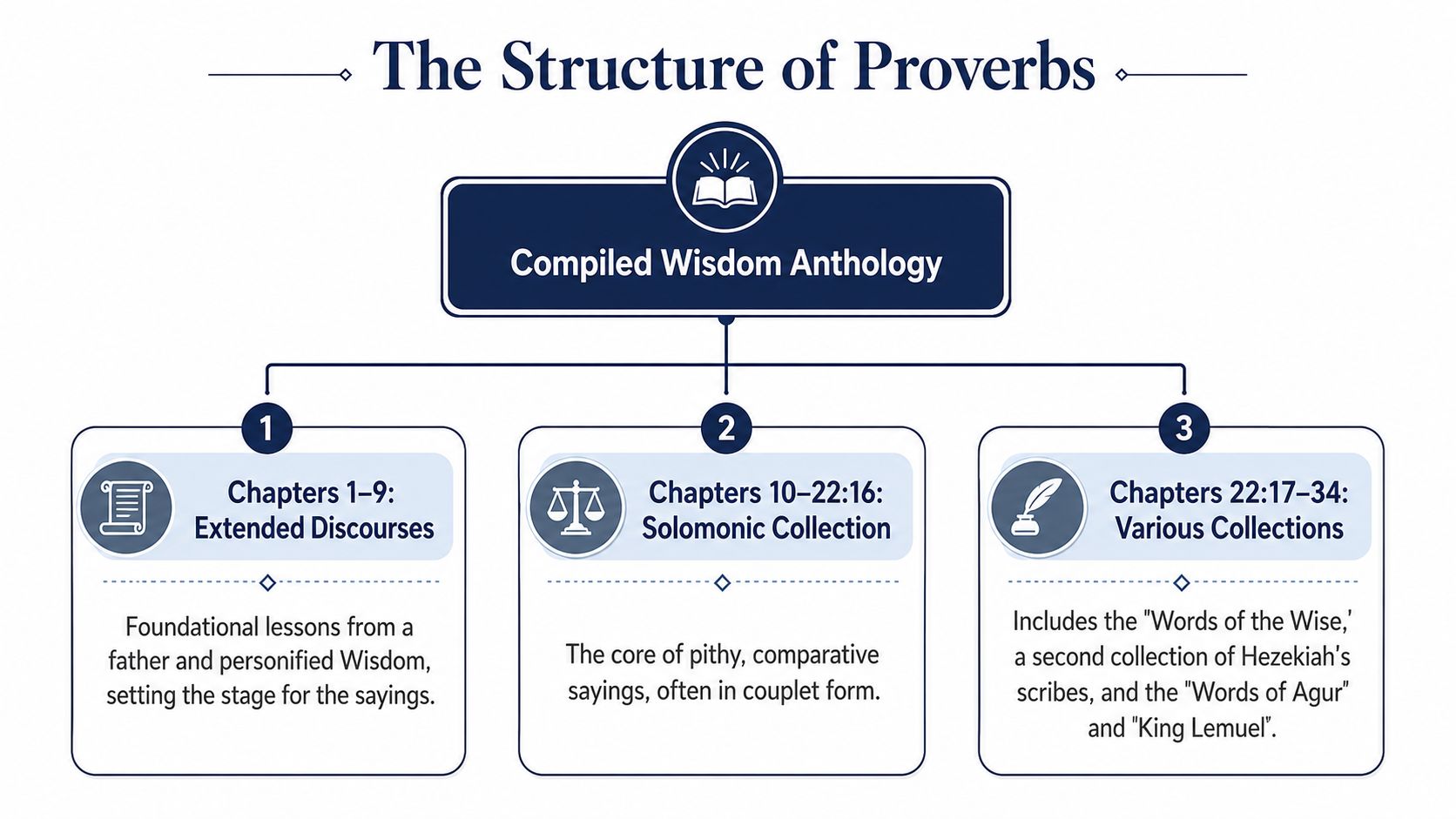
Proverbs becomes easier to interpret when you stop treating it as one flat collection. The book is a compiled wisdom anthology, gathered through multiple historical layers and voices. It's traditionally associated with Solomon's era, roughly 970–931 BC, with later editorial work connected to King Hezekiah, whose reign is dated about 715–686 BC (historical overview of Proverbs).
The book contains 31 chapters, but its chapter divisions shouldn't make every unit look alike. Several standard outlines identify these major sections:
Proverbs 1:1–9:18: Extended wisdom instruction, including appeals from a father and the personification of Wisdom.
Proverbs 10:1–22:16: A major Solomonic collection of concise sayings.
Proverbs 22:17–24:22: “The words of the wise,” a collection that shifts toward longer instructions.
Proverbs 24:23–34: Additional sayings attributed to the wise.
Proverbs 25:1–29:27: Proverbs of Solomon copied by the scribes of Hezekiah.
Proverbs 30:1–33: The words of Agur.
Proverbs 31:1–31: The words of King Lemuel and the poem describing an excellent wife.
Read each literary unit on its own terms
The opening chapters read like sustained teaching. A father urges a son to receive instruction, reject sinful companionship, pursue wisdom, and avoid the path of sexual folly. These chapters develop a theological imagination before the book presents many short sayings.
The central collections often use antithetical parallelism. One line places the righteous beside the wicked, or diligence beside laziness, so the reader can compare two paths. These sayings are memorable precisely because they compress observation into poetic form, but their brevity means you must supply careful context.
The later units broaden the book's voice. Agur's words display humility before God, and Lemuel's instruction combines royal responsibility with a portrait of wise strength and justice. The excellent-wife poem closes Proverbs by presenting wisdom as visible, embodied, and productive in household and community life.
Solomon's traditional association with large-scale proverb production also helps explain the book's diversity. 1 Kings 4:32 attributes 3,000 proverbs and 1,005 songs to Solomon, while the biblical book preserves only a portion of that output (BibleProject guide to Proverbs). The presence of Solomon, the words of the wise, Agur, Lemuel, and Hezekiah's collection shows why Proverbs shouldn't be approached as though one speaker wrote every line in one setting.
Practical rule: Before asking what a saying means, ask what kind of passage you're reading.
That question prevents a common mistake. Readers who treat a father's extended speech exactly like a standalone couplet may miss the argument. Readers who isolate a couplet from nearby sayings may miss the balanced wisdom of the collection. Structure isn't background trivia. It's an interpretive tool.
The Core Themes That Hold the Book Together
A small-group leader may begin with a question about anger, money, friendship, or work and discover that Proverbs keeps returning to the same foundation: life before God. Proverbs aims at formation first; information serves that larger goal. Its opening purpose joins wisdom with instruction, understanding, righteousness, justice, and equity. The reader learns how to recognize a life shaped by God's order and how to practice that wisdom with neighbors.
The foundation appears at the beginning:
“The fear of the Lord is the beginning of knowledge; fools despise wisdom and instruction.”(Proverbs 1)
In Proverbs, the fear of the Lord means reverent submission to God's authority. It makes teachability possible. A person may possess information, strategy, and social intelligence while remaining a fool if that person refuses correction and treats the self as the final measure of truth.
Wisdom is a way of life
Proverbs repeatedly describes four kinds of people:
The wise receive instruction and respond to correction.
The fool resists wisdom and harms others through stubbornness.
The mocker treats correction with contempt and turns truth into ridicule.
The simple lack established discernment and remain open to influence.
These categories describe moral direction rather than permanent labels. A teachable person can grow in wisdom. A confident person can drift into folly when pride closes the ear. That flexibility matters in discussion, because the text invites honest self-examination rather than easy classification of other people.
The father-son framework makes formation personal. “My son” establishes a setting of patient instruction, warning, affection, and repeated appeal. The reader receives wisdom as a gift from a trustworthy teacher, then tests it through real relationships and ordinary decisions.
Wisdom becomes visible in ordinary conduct
The book's theology reaches into daily habits. Wise speech tells the truth without inflaming conflict. Wise work rejects laziness and dishonest gain. Wise friendship recognizes influence. Wise correction seeks restoration rather than humiliation.
A saying about anger may offer no direct doctrinal statement about God, yet it still forms a person before God by exposing pride, impatience, or disregard for a neighbor. Proverbs teaches worship through conduct. For a reading plan or group discussion, ask where each saying would change a practice, not merely what definition it supplies.
For Christian readers, this formation finds its center in Christ. Jesus does not permit readers to bypass Proverbs' commands. He is the Lord who calls his people into humble, truthful, merciful, and obedient wisdom. We read these sayings as Scripture, seeking the Spirit's help to become people whose character reflects God's righteousness.
When a Proverb Is a Principle and Not a Promise
The hardest question in a Proverbs study guide is also the most pastoral: Does this saying guarantee an outcome, or does it describe a dependable pattern?
Most proverbs function as generally operable principles. They describe how life ordinarily works under God's moral order. Diligence usually produces better results than laziness. Honest speech usually builds trust more effectively than deception. Humility usually protects a person from the damage caused by pride. Yet “usually” doesn't mean “without exception.”
A theological statement may speak directly about God's character or authority. A generally operable principle describes the ordinary relationship between conduct and consequence. A pedagogical observation may use vivid overstatement or a memorable contrast to train a learner's judgment.
A useful diagnostic set asks:
What kind of statement is this? Is it theological, practical, conditional, or pedagogical?
What does the immediate context contribute? Are surrounding verses developing a sustained argument?
Does the book itself provide a balancing perspective? Proverbs 26:4 says not to answer a fool according to his folly, while Proverbs 26:5 says to answer a fool according to his folly. The tension is intentional. Wisdom requires knowing when each response fits.
What moral quality does the proverb commend? Look beneath the image for humility, diligence, justice, restraint, truthfulness, or teachability.
Reflective wisdom sections and proverbial collections can also differ in how readily they admit exceptions. A longer discourse may develop a theological vision, while a short couplet may sharpen observation through contrast. Neither should be read mechanically.
A proverb trains discernment because wise obedience depends on context, providence, and character.
This protects readers from two opposite errors. One error turns every saying into a guarantee and then blames sufferers when life doesn't follow the formula. The other error dismisses Proverbs because exceptions exist. The better response is to receive the principle seriously while submitting its outcome to God's providence.
When a righteous person suffers, Proverbs hasn't failed. The broader canon gives us categories for suffering, lament, endurance, and hope. Proverbs teaches the normal shape of wise living, not a promise that faithful people will never face trouble.
Close Readings of Representative Sayings
Close reading slows down the moment when a familiar verse becomes a slogan. Proverb comprehension develops through increasingly demanding abilities, moving from literal understanding toward analogy, desymbolization, matching, and paraphrase. Developmental research found that fourth graders performed well when context and multiple-choice support guided interpretation, with performance continuing to improve through eighth grade and correlating significantly with perceptual analogical reasoning (developmental study of proverb comprehension).
Start with the picture
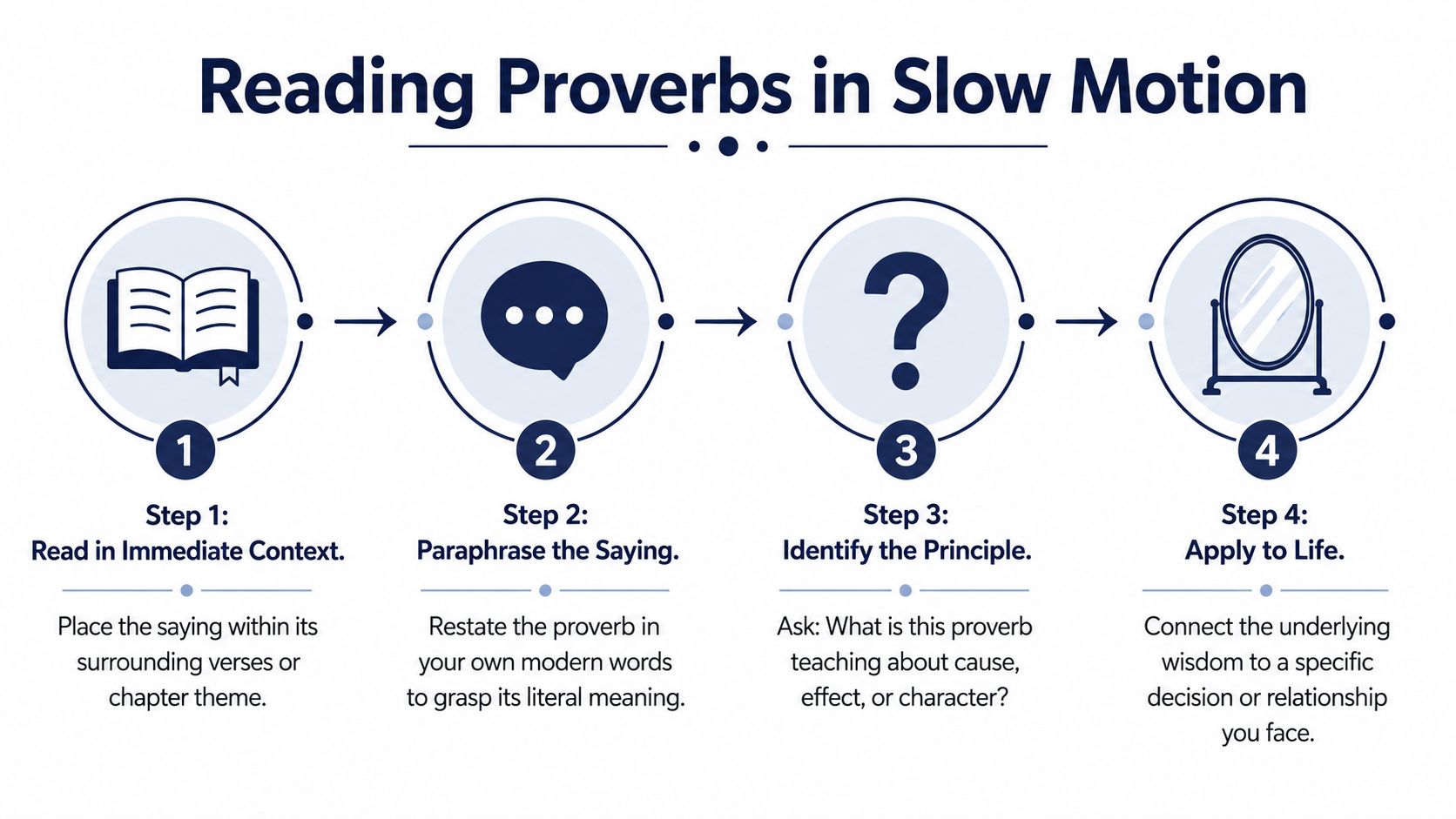
Take Proverbs 15:1, “A gentle answer turns away anger, but a harsh word stirs up wrath.” First, paraphrase the literal picture. One kind of speech reduces heat, while another adds fuel. The verse uses a contrast between verbal restraint and verbal provocation.
Next, identify the principle. The saying commends measured speech as a wise response to conflict. It doesn't promise that a gentle answer will always calm another person. A neighbor may remain angry, but the speaker has refused to intensify the quarrel.
Apply the image to a contemporary situation. A ministry leader receives an accusatory email. A harsh reply may produce another round of accusation, while a calm answer can clarify the issue and protect the relationship. The proverb addresses the leader's character and response, not the other person's guaranteed reaction.
Let context and vocabulary carry weight
Technical research shows that proverb understanding depends on context, familiarity, and lexical concreteness. Literal integration is easier than figurative integration, and differences in processing can emerge early in a proverb. Word knowledge also relates to comprehension, especially with abstract proverbs, so readers shouldn't assume they can guess every meaning from context alone (research on proverb processing).
Try Proverbs 25:11: “A word spoken at the right time is like gold apples in silver settings.” Write down the literal image, then mark unfamiliar concepts. The verse isn't describing fruit as decoration for its own sake. It uses beauty, value, fit, and timing to teach that well-chosen speech can be precious because it suits the moment.
For difficult passages, you can annotate vocabulary, compare literal and figurative readings, and, when studying public language or group responses, analyze sentiment with AI tools as a supplementary observation. Such a tool can help identify emotional patterns in a collection of responses, but it can't replace biblical interpretation, prayer, or pastoral judgment.
A Simple Reading Plan for the Book of Proverbs
A useful reading plan should respect the book's shape while remaining flexible enough for real life. Begin with Proverbs 1–9 at a slower pace. These chapters establish the theological framework, introduce the fear of the Lord, contrast wisdom and folly, and prepare you to read the shorter sayings with better judgment.
After that foundation, move through the book's 31 chapters at a chapter-a-day pace, a natural rhythm that matches Proverbs' chapter divisions. If a chapter contains too many sayings for one sitting, divide it across several days. Consistency matters more than speed.
Keep a journal with three prompts:
What kind of saying am I reading? Identify a warning, comparison, instruction, promise-like statement, observation, or poetic image.
What literal picture does it paint? Describe the scene before explaining it.
What wise response fits my life today? Name one decision, relationship, habit, or conversation where the principle could shape you.
Add a cultural translation question
Ancient imagery can feel distant. That doesn't make it irrelevant, but it may require translation. An American Bible Society study series asks readers to consider which proverbs remain timeless and which may not make good sense to modern readers in their original form (Proverbs study series).
Use that question carefully. Don't discard a proverb because its image feels unfamiliar. Instead, distinguish the enduring moral principle from the ancient picture used to express it. A saying about a gate, a marketplace, a household servant, or a royal court may require historical explanation before you can apply its wisdom responsibly.
A simple weekly journal page might include:
Text: Copy the saying in full.
Context: Note nearby verses and the chapter's dominant concern.
Image: Describe the literal scene.
Principle: State what kind of conduct or character the saying commends.
Exception: Ask whether the opposite sometimes occurs and what that teaches about providence.
Practice: Choose one action for the coming day.
Read with an open Bible, a reliable translation, and a willingness to revisit difficult sayings. Wisdom grows through repeated attention, not hurried completion.
Teaching Proverbs in Sermons and Small Groups
A small-group leader can turn Proverbs into a discussion about formation rather than a quiz. Suppose the group studies a saying about speech. Instead of asking only, “What does this verse mean?” ask, “Is this a direct command, a general principle, or a rhetorical contrast?” Then invite members to name a modern situation where applying the principle requires judgment.
A pastor might build a series from Proverbs 1–9 around the fear of the Lord, teach wisdom for work from the central collections, or focus on how speech shapes community life. Each message should keep the saying connected to its literary setting and to the wider biblical witness.
Use questions such as:
Wisdom: What does a teachable person do when correction feels unfair?
Discipline: What does this passage commend, and what harmful form of correction should we reject?
Speech: Does my proposed application pursue truth, love, and self-control?
Context: Which details belong to the ancient image, and which moral principle carries into our setting?
Exceptions: What happens when the proverb's ordinary pattern doesn't match someone's experience?
Practice: What specific conversation or habit will change this week?
Leader preparation benefits from a repeatable rhythm. Read the passage aloud, summarize its immediate context, explain the image, identify the principle, and finish with one concrete practice. Keep the discussion anchored in the text rather than allowing personal experience to become the final authority.
For additional teaching support, consult this resource on how to teach the Bible effectively. It can help leaders connect careful interpretation with clear communication and faithful application.
At The Bible Seminary, we equip leaders to impact the world for Christ through Bible-based, Christ-centered, Spirit-led preparation that unites scholarship, spiritual formation, and hands-on ministry. Explore biblical studies, ministry training, and resources that help you teach Scripture faithfully by visiting The Bible Seminary and taking the next step toward kingdom service.