
What Is Certificate Programs? a Plain Guide

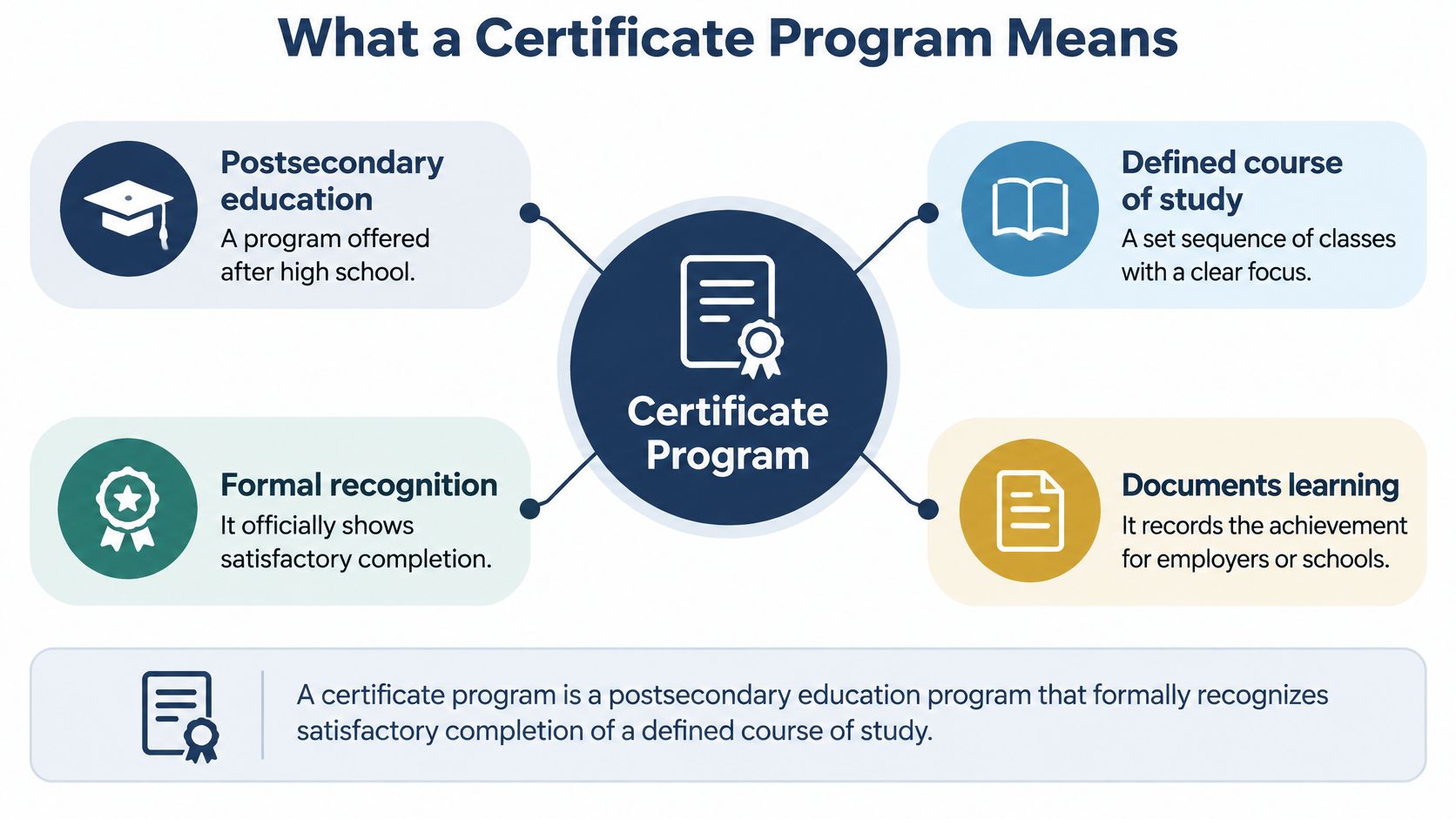
A certificate program formally recognizes completion of an organized course of study and does not confer a college degree.
But if two programs both award a certificate, do they prepare you for the same responsibilities? Not necessarily. For ministry, the important questions concern what you'll learn, who recognizes the credential, and how the study will help you serve Christ and His church.
What a Certificate Program Means
Say you teach an adult Bible class and want more structured preparation. You're ready to study biblical interpretation, theology, and ministry practice, but you aren't ready to pursue a full degree. A certificate program can give that learning a defined beginning, a coherent curriculum, and a recognized point of completion.
The National Center for Education Statistics explains that certificates may be awarded at any postsecondary level, including below the associate degree, and its reporting system doesn't require a particular program length or an exclusively career-oriented purpose (NCES definitions). That breadth matters: the word certificate identifies a kind of award, not a universal academic standard.
What certificate study can accomplish
Certificate programs commonly serve these purposes:
Preparation for a role. A learner develops knowledge needed for a particular responsibility.
Professional growth. Someone already serving strengthens an area of practice.
Academic specialization. A student concentrates on a subject within a broader discipline.
Focused theological study. A Christian pursues organized learning in Scripture, theology, or ministry.
For our volunteer teacher, the difference between a certificate and independent reading is structure. Instead of choosing books without feedback, the student follows a curriculum, completes assignments, and works toward stated learning outcomes.
An introductory explanation of what certificates are and how they work from CertSeal can help clarify the terminology. When evaluating theological education, however, move beyond the document itself to the learning it represents.
Read the program description carefully
Think of a certificate as a marked trail through a particular stretch of biblical and ministry learning. A degree usually provides a longer route through the discipline, with additional breadth, depth, and requirements.
Neither route should be judged by its name alone. A modestly titled program can demand careful reading and substantial assessed work, while another certificate may recognize attendance rather than academic achievement.
Before comparing schools, identify these essentials:
Curriculum completed. What courses and assignments must you finish?
Academic level. Is the work undergraduate, graduate, or noncredit?
Award earned. Does completion result in a certificate rather than a degree?
Those checks turn a broad label into something you can evaluate.
Certificates Beside Degrees and Other Credentials
How a certificate differs from related credentials
Credential | What it records | Typical scope | Degree title | Ministry fit |
|---|---|---|---|---|
Certificate program | Completion of an organized curriculum | School-defined coursework, often shorter than a degree | No | Focused Bible, theology, leadership, or enrichment study |
Academic degree | A full degree program | Multi-year associate, bachelor's, master's, or doctoral study | Yes | Degree-required paths, ordination preparation, or advanced scholarship |
Assessment-based certificate | Instruction plus evaluated learning outcomes | A course sequence with a proficiency standard | No | Documented competence in a defined ministry skill |
Professional certification | Meeting a recognizing body's standard | Often an exam, sometimes with coursework | No | Roles where a church, school, or denomination accepts it |
License | Legal permission to practice | Rules set by a state or professional board | No | Uncommon for most church roles; more relevant in counseling-type work |
Noncredit certificate or CEU | Participation or continuing education | Often short and not recorded as degree credit | No | Personal growth or required continuing education |
The New York State Higher Education Services Corporation distinguishes a certificate from a degree by the curriculum completed: the certificate recognizes a curriculum other than one leading to a degree. The document may be meaningful without carrying an associate, bachelor's, master's, or doctoral title.
Completion, competence, and permission
A certificate program records completion of an educational pathway. An academic degree represents completion of a degree curriculum, usually with broader requirements across a field.
An assessment-based certificate adds an important expectation: the learner must demonstrate the intended knowledge or skill. For example, a teaching-focused program might require an interpretation paper and a lesson plan evaluated against clear criteria, rather than attendance alone.
Professional certification comes from a recognizing body's standards. Even when coursework helps someone prepare, the certification itself isn't the same thing as the school's certificate.
A license concerns permission to practice under applicable rules. Churches may also use the phrase licensed minister, but that church designation shouldn't be confused with state professional licensure, especially in counseling-related work.
A noncredit certificate or continuing education unit, often shortened to CEU, documents learning outside degree credit. Such study can be valuable without becoming part of an academic degree.
Practical rule: Ask what the award authorizes, what it documents, and who agrees to recognize it. Those are different questions.
Apply the distinction to your ministry goal
A church might welcome certificate study as preparation for leading a Bible class. A school might accept particular continuing education for an educator's development. Neither decision means every church or school will recognize the same award in the same way.
Ordination, chaplaincy, teaching, and institutional hiring may involve a degree, supervised experience, denominational approval, or other requirements. If your intended role requires an M.A. or M.Div., a certificate can strengthen your preparation without replacing that requirement.
Who Benefits and When the Time Is Worth It
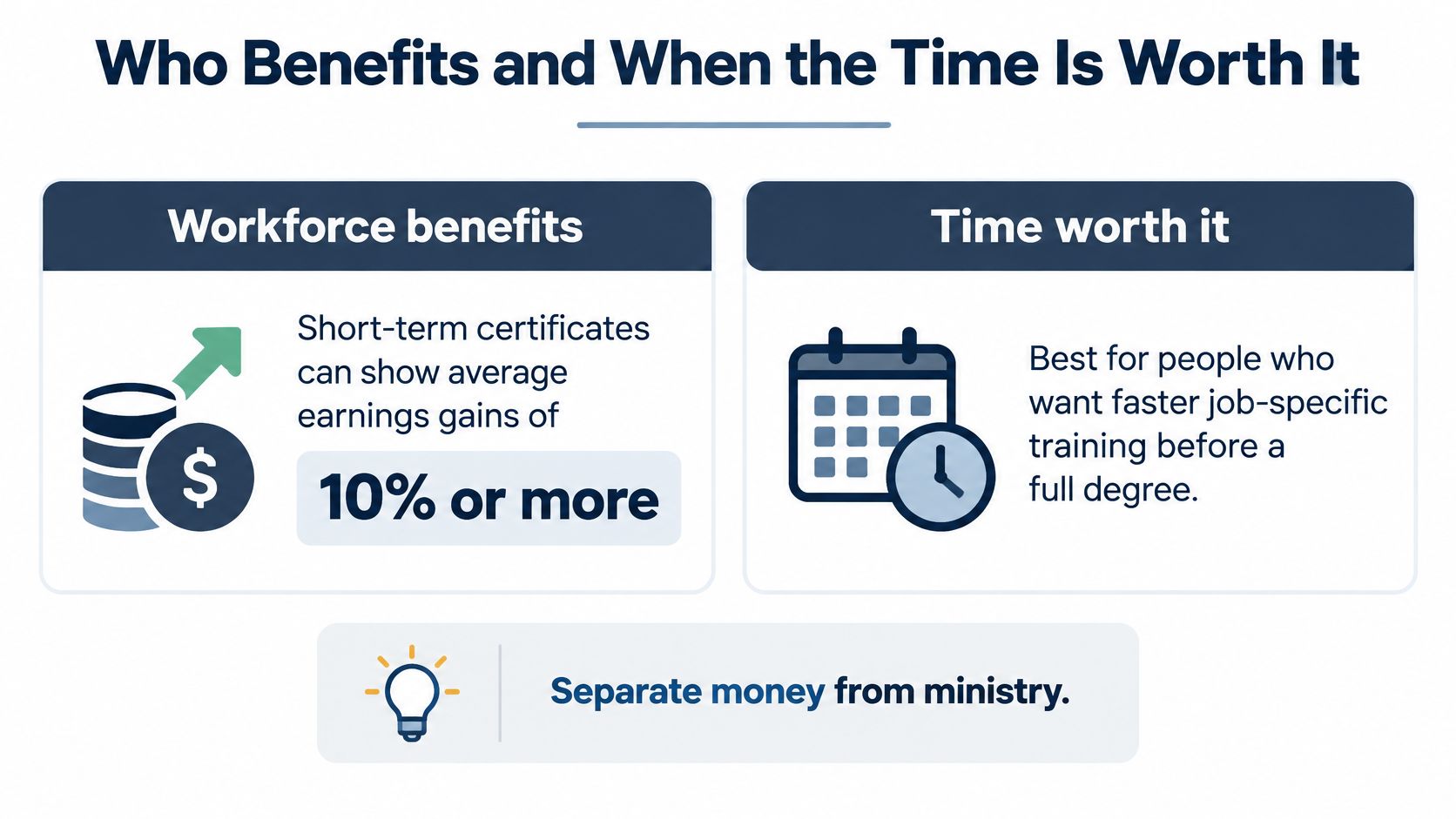
Workforce evidence provides a useful caution against treating every certificate as a financial investment with predictable returns. New America's review of labor-market outcomes summarizes evidence that short-term certificates can produce average earnings gains of roughly 10–20%, with substantial differences by occupation, gender, prior education, and local demand.
Other findings are less encouraging. RAND's discussion of short-term nondegree credentials notes that certificates taking less than a year often produce no or very small wage gains.
Separate financial return from ministry formation
Those workforce findings aren't promises about theological education or ministry salaries. For someone serving a congregation, the most important benefit may be better biblical interpretation, wiser leadership, or greater readiness to teach.
A certificate can be worthwhile when its assignments prepare you for work you need to do. A polished completion document is less useful if you leave unable to explain a passage, evaluate a teaching resource, or apply theological understanding to a ministry decision.
These learners may find a focused program particularly helpful:
Volunteer teachers who want a sound method for studying and explaining Scripture.
Bivocational pastors who want to test the demands of graduate study alongside employment.
Worship and children's ministry leaders who need structured biblical and theological preparation.
Christian educators who want continuing study connected to their teaching responsibilities.
Our guidance on continuing education certificates offers another starting point for thinking about ongoing learning in ministry.
Count the whole commitment
Tuition isn't the entire cost. Books, travel, technology needs, time away from family, and reduced availability for church responsibilities all belong in the decision.
Discuss the schedule with the people who share those responsibilities. A program that fits your academic interests but leaves no room for work, worship, rest, or relationships may be poorly timed.
A useful ministry outcome is concrete: you can teach more faithfully, lead more wisely, or serve people with better-informed judgment.
Before enrolling, name the skill you hope to gain and the assignment that will help develop it. Also consider whether future degree study matters to you and whether the proposed pathway has written academic support.
If your denomination, chaplaincy body, or employer requires a degree, begin with that requirement. Choosing a shorter route that doesn't meet the intended destination can cost more time in the end.
Length Credit Hours and Course Shape
Certificate length and credit ranges
Award length | Marker | What it means |
|---|---|---|
Less than one academic year | The NCES classification guide specifies fewer than two semesters or three quarters, or fewer than 900 contact hours for a full-time student | A short certificate that can be finished relatively quickly |
One to less than two years | NCES identifies at least one but fewer than two full-time-equivalent academic years; approximately 30 to fewer than 60 credit hours; or 900 to fewer than 1,800 contact hours | Sustained study rather than a weekend workshop |
Sample graduate certificate policy | The University of Denver graduate bulletin specifies at least 16 semester hours or 24 quarter hours for academic certificates | Schools set their own floors; there's no global credit rule |
These categories describe different kinds of educational workload. They aren't a promise that a particular student can finish while studying part time, and the federal classifications shouldn't be mistaken for a universal graduate certificate curriculum.
Translate credits into a workable calendar
Start with the academic level. Graduate coursework typically expects sustained reading, reasoned discussion, research, and written argument, not just familiarity with the topic.
Next, examine how the school distributes that work. A concentrated course schedule may look convenient on a calendar while requiring substantial preparation between meetings.
Ask for a sample syllabus. Look at the reading schedule, assignment deadlines, discussion expectations, and final project before deciding whether the pace fits your life.
A theological certificate might bring together courses in Bible, theology, and ministry practice. The exact combination should serve the program's stated purpose rather than resemble an unrelated collection of interesting classes.
Make room for learning beyond class attendance
A student preparing to teach a biblical book may need to trace its argument, study its historical setting, compare interpretations, and develop an appropriate application. That preparation happens outside the scheduled class meeting.
Shorter doesn't mean effortless. If you preach, lead volunteers, care for family members, or work outside ministry, place study time on your calendar before adding another course.
Use these questions to compare delivery formats:
Level and prerequisites. Does your previous education prepare you for the expected work?
Credit requirement. What total coursework must you complete?
Calendar fit. Can you meet deadlines during demanding ministry seasons?
Learning format. Are courses live, online, on campus, or a combination?
Whole-Bible attention also matters in theological education. Sound interpretation connects a passage with its literary setting and the larger biblical witness instead of building lessons from favorite verses alone.
At The Bible Seminary, our Bible-based, Christ-centered approach treats Scripture as foundational to theological learning. Academic planning should make room for that careful engagement, not merely for finishing assignments.
What to Verify Before You Enroll
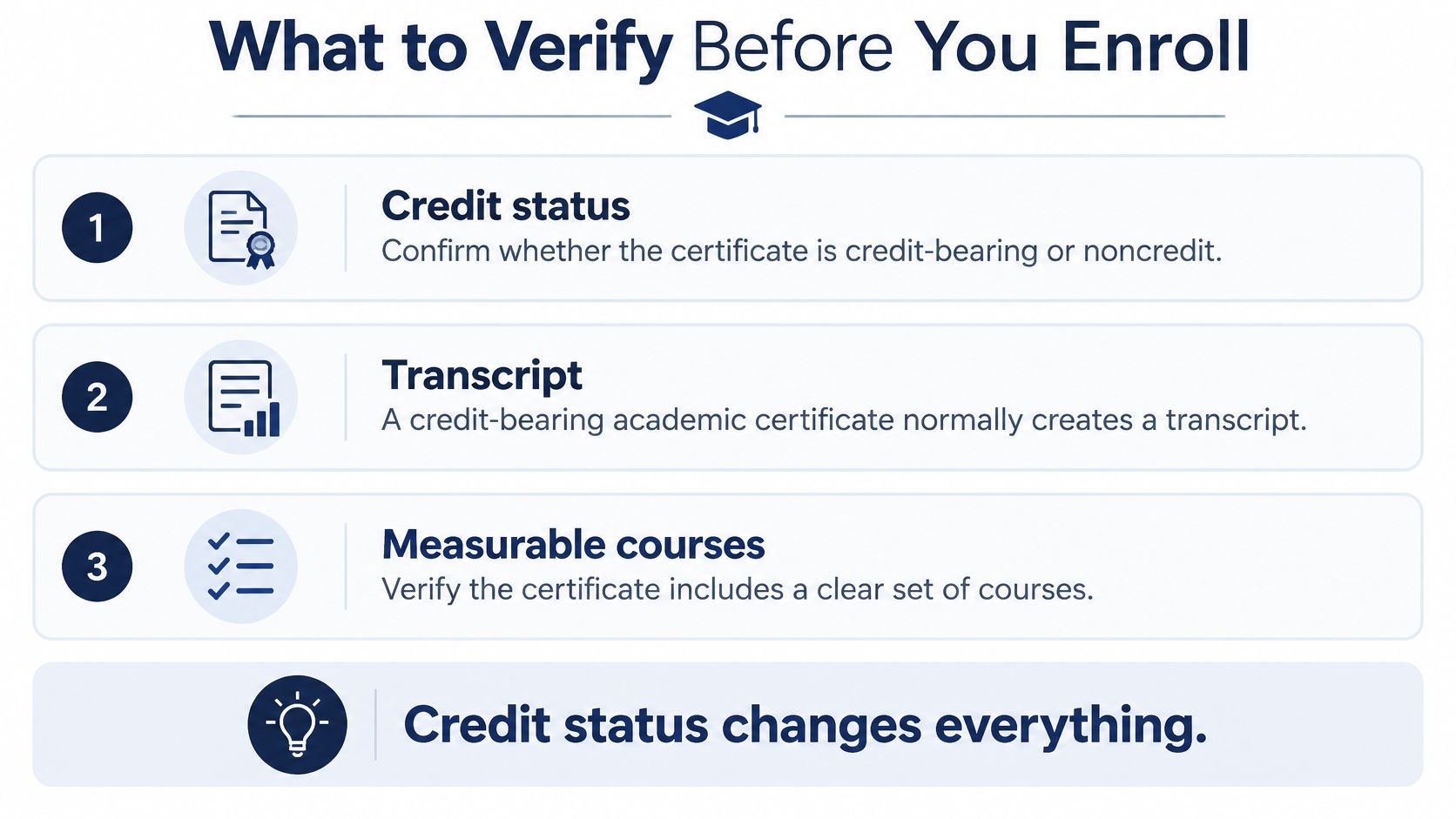
Credit status changes how your work is recorded and how it might connect to further study. The University of Denver certificate policy distinguishes academic certificates from noncredit certificates, illustrating why the award's title alone isn't enough.
A credit-bearing certificate normally produces an academic transcript and identifiable coursework. A noncredit award may recognize participation or completion without generating credits toward a degree.
Request clear answers in writing
Use this checklist when reviewing a program:
Learning outcomes. What should graduates know and be able to do?
Faculty qualifications. Who teaches, and how do their academic preparation and ministry experience fit the subject?
Assessment. How will instructors evaluate your learning?
Credit status. Is the study credit-bearing or noncredit?
Transcript notation. What will appear on your permanent academic record?
Recognition. Will your church, denomination, school, or employer accept the credential for your intended purpose?
Refund rules. What happens financially if you withdraw?
Master's pathway. Is any proposed application of certificate coursework to a degree documented?
These are practical questions, not signs of distrust. A clear answer helps you understand both the school's commitments and your own.
Keep accreditation, transfer, and aid separate
Accreditation concerns institutional standards. It doesn't automatically make every certificate transferable or sufficient for a particular ministry role, a distinction addressed in this ERIC-hosted credential guide.
We're an accredited member of the Transnational Association of Christian Colleges and Schools (TRACS), and we're a member of the Council for Higher Education Accreditation (CHEA). The Bible Seminary is also a member of the National Council for State Authorization Reciprocity Agreements (NC-SARA) and is approved to offer Distance Education.
Transfer is the receiving school's decision. Confirm whether your proposed master's program will accept the specific courses, at the appropriate academic level, under its current policies.
Federal aid has separate eligibility rules. Federal Student Aid explains that students generally must be regular students in an eligible degree or certificate program, maintain satisfactory academic progress, and meet citizenship or eligible-noncitizen requirements and other applicable conditions.
Don't assume a certificate qualifies because the institution offers other eligible programs. Confirm the particular program and your circumstances with the school before including federal assistance in your budget.
Ministry Uses of a Theological Certificate
Consider a volunteer Bible teacher in a Greater Houston church who works full time. The goal isn't another title after a name. It's the ability to prepare a teaching plan rooted in an entire biblical book, distinguish the author's meaning from personal impressions, and guide discussion responsibly.
Structured study can give that teacher a repeatable process: observe the text, examine its context, interpret carefully, and develop faithful applications. Feedback on a teaching assignment can reveal weaknesses that private study alone might leave unnoticed.
Study that informs actual service
A ministry leader considering seminary has a different question: Can I sustain this kind of learning? A bounded course of study offers a way to experience academic reading, deadlines, and theological reflection while discerning the next educational step.
The practical outcome might be a leadership decision made with clearer theological categories. Instead of asking only whether an idea will attract participation, the leader can also consider whether it reflects the church's calling and serves people faithfully.
A Christian educator or homeschool parent may want greater confidence when a student raises a difficult question. Careful study can help that educator explain a challenging passage without flattening its meaning or pretending every interpretive issue is simple.
Continuing-education recognition may also matter, but it should support the educational purpose rather than replace it. The central question remains whether the learner is becoming better prepared to teach truthfully and serve patiently.
Formation requires more than a credential
“Do your best to present yourself to God as one approved, a worker who has no need to be ashamed, rightly handling the word of truth.”2 Timothy 2:15, ESV
Paul's instruction to Timothy calls for diligent, faithful handling of the word of truth amid the dangers of quarrels and false teaching. It isn't a promise that earning a credential produces spiritual maturity.
We seek to unite scholarship, spiritual formation, and hands-on ministry: training hearts and minds for kingdom service. Prayer, church participation, teachability, and accountable service belong alongside academic work in a Spirit-led life.
Historical study can enrich that learning too. Exploring biblical archaeology resources and learning from authentic artifacts in a teaching museum can make Scripture's world more concrete without treating an object as proof of a doctrine.
The aim is faithful service in local congregations and across cultures. Strong learning communities and knowledgeable faculty help students pursue that aim with both conviction and humility.
Frequently Asked Questions About Certificate Programs
Is a certificate program the same as a degree?
No. A certificate recognizes completion of its prescribed coursework without conferring an associate, bachelor's, master's, or doctoral degree. Some academic certificate courses may later count toward a degree under the receiving institution's policies.
Can certificate credits transfer?
Only the receiving school can approve transfer. Before enrolling, obtain its written policy and ask about the specific courses you intend to complete, rather than relying on a general statement about accreditation.
Do certificate students qualify for federal financial aid?
Only students and programs that meet applicable federal eligibility rules qualify. Confirm the particular certificate's eligibility and your own status with the school; don't assume that every academic award has the same aid options.
Does a certificate lead to ordination?
Not by itself. Your denomination or sending body determines its ordination process, which may include a degree, examination, supervised ministry, or other preparation.
For a practical decision, keep the destination in view:
Educational goal. Identify what you want to learn.
Role requirement. Confirm what your church or employer requires.
Program match. Compare the curriculum with both.
Our academic information provides program details to help you make that comparison. Consider the proposed course of study alongside your current responsibilities and longer-term ministry direction.
Decide Between a Certificate and a Degree
Choose a certificate when you need focused graduate study, want to test your readiness for seminary, or serve in a role that doesn't require a full degree. Choose a master's pathway when your intended responsibilities require that qualification or when you want the broader preparation of a full degree curriculum.
Neither choice measures the sincerity of your calling. The better choice is the one that fits your preparation, responsibilities, and intended service.
Match the pathway to your purpose
The Bible Seminary credit totals
Program | Credit hours | Best fit |
|---|---|---|
Certificate of Theological Studies | 27 credit hours | Graduate-level education for anyone serving in vocational or volunteer leadership |
Master of Arts | 48 to 60 credit hours by major; two years | Study of all 66 books of the Bible with four majors |
Master of Divinity | 84 credit hours; three years | Ministry leaders preparing for pastoral and church leadership through study of all 66 books |
Our degree program information can help you compare the longer pathways. Consider not only the completion requirements but also the kind of sustained learning your future responsibilities call for.
Approved distance education can help students who can't relocate remain connected to study. Our Katy, Texas community also provides a setting for relationships, ministry engagement, and learning beyond the classroom.
Keep the purpose larger than the award
We're committed to equipping leaders to impact the world for Christ. That means treating academic rigor, spiritual formation, and practical ministry as complementary responsibilities rather than competing priorities.
For ministry partners, our giving information explains opportunities to support this work. The kingdom value of theological education reaches beyond an individual student to the churches and communities that graduates serve.
Your next educational step should help you become a more faithful steward of Scripture and a better-prepared servant of others. A carefully chosen certificate or degree can support that work without becoming a substitute for dependence on Christ.
The Bible Seminary offers graduate certificate and degree pathways that unite biblical scholarship, spiritual formation, and ministry preparation. Visit The Bible Seminary to explore these options and begin your journey toward deeper biblical training for kingdom service.