
Church Leadership Degree Options: MA, MDiv and More

Would you choose a church leadership degree by its title, or by what it prepares you to do when a congregation needs faithful teaching, wise counsel, and steady leadership? Those aren't always the same decision.
A program may offer appealing course names without showing how students practice ministry. A wiser starting point is your calling, the people you hope to serve, and the biblical understanding and practical abilities you need to develop. We believe preparation should be Bible-based, Christ-centered, Spirit-led, and ministry-focused, training hearts and minds for kingdom service.
Church Leadership Degree Options at a Glance
Church leadership degree types compared
Degree | Primary purpose | Best fit |
|---|---|---|
Master of Divinity (MDiv) | Professional preparation for pastoral and congregational ministry | Pastors and those entering church vocation |
Master of Arts (MA) | Focused biblical, theological or ministry study | Educators, chaplains, lay leaders and specialists |
Doctor of Ministry (DMin) | Advanced, practice-based leadership development | Experienced ministry leaders |
PhD or ThD | Research and scholarship | Future scholars and seminary faculty |
Graduate certificate | Targeted training in one subject or skill | Working ministers adding a specific area |
Which credential should you pursue? Church leadership isn't one educational pathway but a family of pathways. The table gives you a starting point, not a verdict about which credential makes someone a faithful leader.
What each pathway prepares you to do
The Master of Divinity is the traditional professional route into pastoral and congregational ministry. Its broad purpose makes it worth examining if you expect to preach, teach, shepherd people, and carry responsibility across several areas of church life.
A Master of Arts offers more focused biblical, theological, or ministry study. Look closely at the specialization: an MA centered on biblical interpretation may serve a different purpose from one emphasizing ministry leadership. Educators, lay leaders, and ministry specialists should compare actual learning outcomes, while prospective chaplains should also verify employer and endorsement requirements.
The Doctor of Ministry serves experienced leaders who want to examine and strengthen their ministry practice. A PhD or ThD emphasizes research and scholarship instead. These aren't interchangeable versions of an advanced credential.
A graduate certificate can provide targeted training without committing to a full degree. It may suit a working minister who needs deeper preparation in a particular subject rather than another broad qualification.
Let the purpose govern the choice
In Ephesians, Paul describes ministry gifts in relation to the growth and unity of Christ's body, not the status of individual leaders:
“to equip the saints for the work of ministry, to build up the body of Christ.”Ephesians 4:12, CSB
That purpose should shape your comparison. Ask whether a program will help you equip others, teach Scripture responsibly, and serve the church with humility.
Programs differ in length, credit requirements, prerequisites, and delivery. Confirm those details on each program's published page rather than relying on generic completion ranges. Also distinguish a graduate degree from a certificate when checking accreditation; they don't receive identical treatment.
How Church Leadership Degree Enrollment Is Shifting
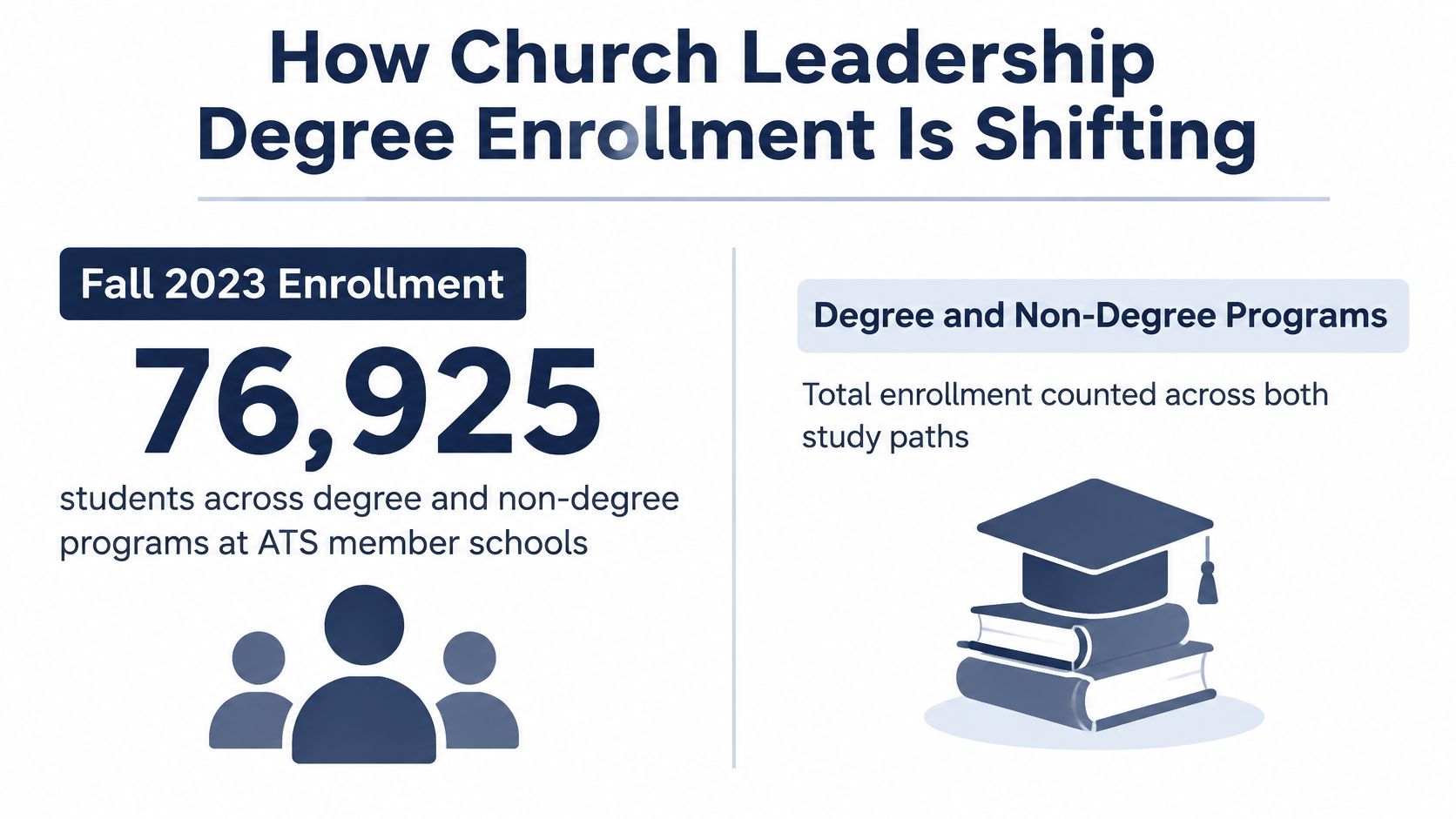
In its projected fall 2023 figures, the Association of Theological Schools enrollment snapshot reported 76,925 students across degree and non-degree programs at member schools, with 27,975 MA students outnumbering 26,266 MDiv students by 1,709.
That made the MA the largest single degree category in those projections. The comparison matters because prospective students sometimes assume that serious preparation for church leadership must follow the same degree pathway.
Enrollment by degree category, fall 2023 projections
Degree category | Fall 2023 students | Change from fall 2022 |
|---|---|---|
Master of Divinity (MDiv) | 26,266 | -5.0% |
Master of Arts (MA) | 27,975 | +0.7% |
PhD and ThD | 4,192 | +1.9% |
Advanced professional, including Doctor of Ministry | 12,015 | Not specified in the cited summary |
Non-degree | 5,182 | Not specified in the cited summary |
Total | 76,925 | -1.2% |
Figures are from the ATS projected enrollment snapshot identified above.
What the comparison means for your decision
The pattern points toward diversification, not a simple disappearance of theological education. Students are pursuing foundational pastoral preparation, focused graduate study, advanced professional development, and non-degree learning.
The MDiv remains a major route into pastoral ministry. Its declining enrollment doesn't establish that it has become unnecessary, just as MA enrollment growth doesn't establish that an MA satisfies every pastoral employer's requirements.
Read the categories carefully, too. The advanced professional category includes the Doctor of Ministry but doesn't isolate DMin enrollment. Non-degree participation shouldn't automatically be read as certificate enrollment, because that category can encompass other forms of study.
These are projections from ATS member schools, not a count of everyone preparing for Christian leadership. They describe an educational setting, not the quality of a particular program or the faithfulness of its graduates.
For your decision, the useful question isn't which credential attracts the most students. It's which program fits your ministry goal, professional context, and need for flexibility while providing substantial biblical and theological preparation.
What a Church Leadership Curriculum Covers
How can you tell whether a church leadership degree will prepare you for the ministry you hope to serve? Start with the work its curriculum asks you to do, not just the names of its courses. A leadership class might assess reading and exams, or it might ask you to analyze a ministry challenge, propose a response, and receive feedback from a supervisor.
The ATS Standards of Accreditation describe connected expectations for theological education, including curricula aligned with each degree's mission and vocational goals:
Biblical and theological understanding through disciplined study of Scripture, tradition, doctrine, and practice.
Intellectual and cultural engagement that helps students understand the communities they serve.
Personal and spiritual formation involving emotional maturity, moral integrity, personal faith, and social concern.
Vocational preparation that develops capacity to enter and grow in a defined ministry calling.
From understanding to faithful practice
Old and New Testament study should teach you to interpret passages in their literary, historical, and canonical contexts. Theology and doctrine help you explain Christian belief coherently, while church history introduces questions and decisions Christians have faced across generations.
Preaching, pastoral care, leadership, and administration connect that foundation to ministry responsibilities. For a practical introduction to the administrative side, HolyJot's resource on organizing day-to-day ministry operations can help you identify tasks to discuss with a program advisor, such as coordinating volunteers and clarifying responsibilities.
Field education adds guided practice. You might prepare a Bible lesson, teach it in a local church, then review your interpretation and communication with a mentor. Spiritual formation should accompany that work, shaping a servant whose conduct supports the message being taught.
Keep Scripture and application together
Paul connects responsible handling of God's Word with accountable service:
“Be diligent to present yourself to God as one approved, a worker who doesn't need to be ashamed, correctly teaching the word of truth.”2 Timothy 2:15, CSB
A management-focused program may teach organizational techniques without enough theological judgment. A program centered on content may offer too little supervised practice in responding to congregational conflict or cultural differences.
Look for a clear progression from knowledge to application to reflection. Curriculum maps, field-education expectations, mentoring arrangements, and assessed student work can help you see whether students practice ministry skills and receive feedback.
Skills and Ministry Outcomes Graduates Build
The Lifeway Research 2025 Pastor Attrition Study reported that 73% of pastors said their training prepared them for the people side of ministry; the reported comparison was 61% among pastors with a master's degree versus 19% among pastors without a college degree. These findings invite careful attention to preparation, but they don't prove that earning a degree causes better ministry outcomes.
The practical question is what students learn to do. Look for opportunities to practice conflict navigation, staff supervision, congregational trust-building, crisis response, self-leadership, and preaching grounded in careful interpretation.

How preparation appears in daily ministry
Consider these illustrative scenarios, not accounts of actual graduates.
A youth pastor in Katy receives a parent complaint. Rather than discussing the parent with volunteers, the pastor arranges a private conversation. Where the situation involves a personal offense, Matthew 18:15 informs a direct, restorative approach. That passage must never become an excuse to conceal abuse or bypass safeguarding responsibilities.
A bivocational pastor teaches an adult Bible class. Graduate biblical study helps the pastor distinguish what a passage says from a familiar interpretation, explain the context, and prepare questions that encourage careful reading.
A chaplain visits a hospital patient. The chaplain draws on theology to speak thoughtfully about suffering and hope, while listening without forcing a lecture into a vulnerable moment.
These examples combine knowledge with judgment. A strong student assignment might ask you to explain your decision, identify its biblical basis, receive critique, and describe what you would change.
Connect skills to roles without promising placement
Potential ministry directions include lead and associate pastoral service, youth and worship leadership, Christian education, chaplaincy, and ministry-related nonprofit work. Each role brings distinct expectations, so an appealing career list isn't sufficient evidence of preparation.
The available research doesn't establish placement rates for particular programs. Ask schools how they define graduate outcomes, which graduates they track, and whether reported roles relate to the training received.
Our emphasis is uniting scholarship, spiritual formation, and hands-on ministry to develop servants rather than merely credential holders. A degree works best alongside mentoring, supervised ministry, and local-church accountability. Paul's charge to the Ephesian elders in Acts 20:28 keeps the responsibility personal: leaders must attend both to themselves and to the flock entrusted to their care.
Online, Hybrid and Campus Study Compared
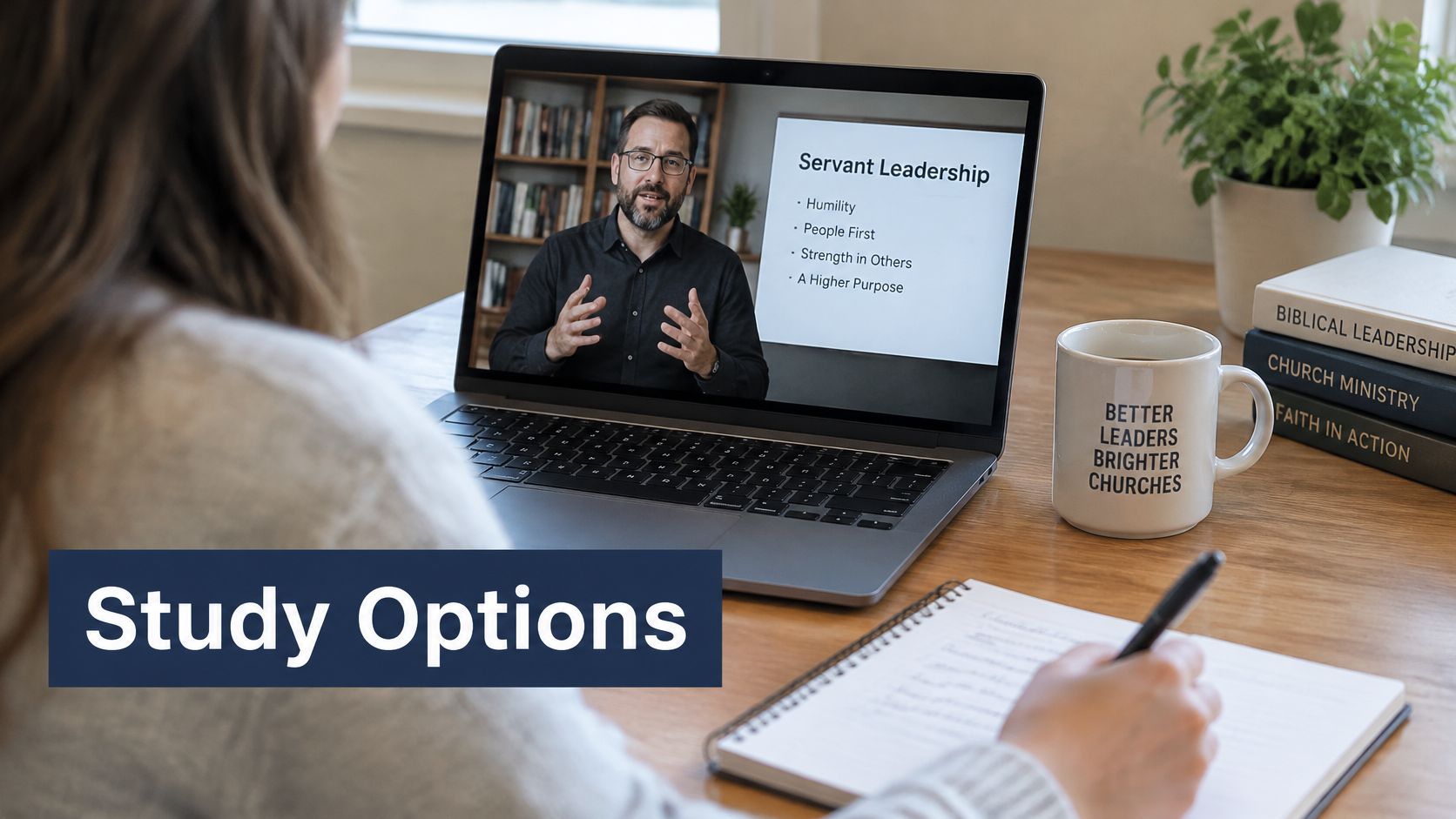
An empirical study of graduate theological education found that distance students represented about 63% of enrollment by fall 2023, nearly 48,000 of approximately 76,000 students, and that about 80% of ATS institutions offered distance education by 2023.
Preliminary 2025 data cited by In Trust also indicated fewer incoming degree-seeking students choosing fully online programs, alongside continuing interest in hybrid and geographically convenient options. The distinction matters: distance participation doesn't mean every student wants an entirely online experience.
Match the format to the formation you need
Ask which setting will help you develop preaching, pastoral presence, peer accountability, spiritual disciplines, and ministry relationships.
Working pastors may need asynchronous coursework that fits around employment and congregational care. Check assignment deadlines and live-session requirements rather than assuming online means self-paced.
Emerging leaders may value residential or campus-based community, with regular opportunities for conversation, prayer, and faculty interaction.
International students should examine time zones, language expectations, and whether assignments allow thoughtful application in their own cultural settings.
Established ministers may find that individual courses or a certificate meet a focused learning need more appropriately than a full degree.
Compare the actual weekly experience
A hybrid program might combine remote coursework with scheduled campus gatherings. That can preserve local ministry involvement while creating room for face-to-face feedback, but travel and time away still need planning.
Ask how a preaching assignment is evaluated, how faculty meet with students, and how classmates build relationships. A recorded lecture alone can't tell you whether the program offers meaningful interaction.
Online and campus aren't competing definitions of faithfulness. The emerging picture is a range of flexible, purpose-specific pathways. Review current degree programs and delivery details, including opportunities associated with our campus in Katy, Texas, before deciding what you can realistically sustain.
Matching Your Calling to a Degree Level
Your present situation | A pathway to investigate |
|---|---|
Preparing for a first pastoral role | MDiv |
Developing teaching, chaplaincy, or specialist ministry preparation | MA, subject to role-specific requirements |
Seeking advanced development from an established ministry setting | DMin |
Preparing for theological research or seminary teaching | PhD or ThD |
Adding a focused skill while continuing ministry | Certificate or individual courses |
Start with your ministry goal, not the highest credential you can imagine earning. The ATS Standards of Accreditation distinguish foundational professional preparation from advanced ministry study and emphasize theological integration, contextual competency, leadership capacity, and personal or spiritual maturity.
Those categories offer a useful test: can you explain how the program's assessed work connects to the responsibility you hope to carry?
Confirm the fit before committing
Name the role you want. Write a sentence such as, “I want to teach Scripture and shepherd a local congregation,” rather than “I want to do more ministry.”
Check external requirements. Ask your denomination, prospective employer, or endorsing body whether it requires a particular degree or additional preparation.
Set realistic boundaries. Consider tuition, fees, books, travel, employment demands, and responsibilities to your household and church.
Choose a sustainable learning format. Compare your actual weekly availability with the program's attendance and assignment expectations.
An MDiv addresses foundational professional preparation; a DMin normally builds on substantial ministry experience. If your need is narrower, a comparison of certificate programs and degrees can help you weigh the commitment without treating either option as superior.
Discernment question: What should I be able to do more faithfully for the people I serve when this program is complete?
Proverbs 11:14 commends the value of many counselors. Invite your pastor, a trusted mentor, and your church into the decision, especially if further study will change your availability or finances.
Then compare your goal sentence with the program's published outcomes and admissions requirements. A credential is one part of discernment, not a substitute for the church's recognition of character, gifts, and readiness.
Frequently Asked Questions
What can a church leadership degree teach that experience alone cannot?
A degree provides organized biblical, theological, and historical study, along with opportunities for supervised reflection. It can expose assumptions you might never encounter within a single congregation.
Local-church ministry still teaches patient listening, relational trust, and service among people who know you well. Bring classroom learning into that setting and invite correction rather than treating academic knowledge as the final word.
Can online study include meaningful supervised ministry?
Yes, when a program arranges field education with a qualified site supervisor and clear learning outcomes. Ask who approves the placement, how often supervision occurs, and what evidence demonstrates growth.
A ministry activity becomes an educational experience when someone helps you evaluate it. Logging service hours doesn't tell you whether you're learning.
How can I stay connected to my church while studying online?
Ask a pastor or denominational leader to serve as a mentor, and agree on regular conversations about your learning. Remain involved in local ministry rather than allowing coursework to replace congregational life.
Where available, use intensives or residencies to strengthen relationships with faculty and peers. Discuss scheduling with your church before committing to travel.
Is a certificate the same as an accredited degree?
No. A certificate and a graduate degree represent different educational commitments, and ATS doesn't approve certificates as it does eligible graduate degree programs.
Check the institution's published description carefully. An accredited institution's name alone doesn't establish the approval status of every offering.
Do I need a degree to lead a church?
Requirements differ by denomination, employer, and role. Speak with your church leaders and review the expectations of the body through which you hope to serve.
Formal education can support preparation, but it doesn't replace Christian character, demonstrated service, or accountability to the church.
Verify Accreditation and Take Your Next Step
Before enrolling, use a verification process that reaches beyond promotional language:
Confirm institutional accreditation. Check the accreditor's records against the institution's own published information.
Confirm approval of the specific degree. Match the exact program name and credential rather than assuming every offering has the same status.
Request curriculum maps and learning outcomes. Look for a clear connection between required courses and the ministry abilities the school promises to develop.
Examine field education and mentoring. Find out who supervises students, how placements are approved, and how feedback reaches the faculty.
Review assessment and graduate outcomes. Ask for examples of evaluated student work and a clear explanation of how the school follows graduates.
Understand what accreditation does and doesn't cover
According to the ATS accreditation FAQs, its framework applies to postbaccalaureate theological education, including eligible master's and doctoral programs, with degree requirements addressed particularly through Standards 4 and 5. ATS doesn't accredit undergraduate programs or approve certificate programs.
Its current standards contain no residency requirement for degrees other than the PhD, although individual institutions determine which delivery formats they offer. Flexible delivery therefore doesn't automatically rule out theological accreditation.
Conversely, a certificate shouldn't be described as ATS-accredited because an accredited institution offers it. Verify the institution and the specific program separately, and don't infer this seminary's status from a general explanation of ATS.
Choose preparation that serves your calling
Accreditation is an important checkpoint, not the entire decision. You also need sound biblical teaching, accessible faculty expertise, formative community, and practice that connects study with service.
Our academic information can help you examine those connections, including the place of historical study and archaeology alongside Scripture. Archaeological learning should illuminate historical context responsibly, never replace Scripture's authority or claim more than the evidence supports.
Choose the degree that fits your calling and role, not the one with the most attractive title. The purpose remains equipping leaders to impact the world for Christ, in local congregations and wherever God leads them to serve.
Explore our degree programs at The Bible Seminary and begin your journey toward deeper biblical training. We offer MA and MDiv study that brings Bible-centered academics together with spiritual formation and practical ministry preparation; visit The Bible Seminary to discuss your ministry goals and identify the program requirements to review.