
Certificate Program vs Degree: Ministry Training Guide

A pastor stands at the kitchen table after the children are asleep, comparing two possibilities. One path promises focused theological training that can fit around preaching, work, and family responsibilities. The other offers a fuller academic formation that may better support future pastoral leadership, ordination, or graduate study. The question is not just, “Which program is shorter?” It's, “What kind of servant and leader is God shaping me to become?”
That's the heart of the certificate program vs degree decision. Both can serve Christ's church, but they communicate different levels of preparation, scope, and long-term flexibility. A certificate may help you gain focused skills now. A degree may provide the broader formation and institutional signal required for the ministry you hope to pursue later.
The right choice should honor both your calling and your current season. It should also account for your denomination's expectations, your church's needs, your available time, and the kind of credibility you'll need in the years ahead.
Discerning Your Path in Ministry Education
Consider a bivocational church planter who wants stronger biblical grounding before leading a growing congregation. He may not be able to pause employment or relocate for a traditional program. A focused certificate could give him structured study in theology, Scripture, or ministry while he continues serving. For another student, however, the goal may include ordained pastoral ministry, chaplaincy, teaching, or doctoral preparation. That student may need the breadth and sustained formation of a graduate degree.
A certificate program is typically shorter and more focused than a degree. Penn State's Graduate Certificate in Applied Statistics, for example, requires 12 credits and can be completed online, while the same institution's master's pathway requires substantially more coursework. Penn State also notes that the certificate can be earned while completing the degree, illustrating how certificates may function as focused credentials or add-on studies rather than complete substitutes for a degree. Penn State's certificate program information provides a useful academic comparison.
A degree is a broader course of study. It normally develops foundational knowledge, specialized understanding, research ability, and practical competence over a longer period. In theological education, that breadth can include biblical languages, theology, church history, spiritual formation, preaching, pastoral care, ministry leadership, and engagement with the whole canon of Scripture.

More than a choice about credentials
Christian education isn't merely a transaction. Paul reminded Timothy that faithful ministry requires both character and competence: “Keep a close watch on yourself and on the teaching” (1 Timothy 4:16, ESV). Academic study cannot replace prayer, obedience, or the work of the Holy Spirit. It can, however, give a servant of Christ better tools for handling Scripture carefully and serving people wisely.
At The Bible Seminary, the vision is to unite scholarship, spiritual formation, and hands-on ministry. That combination matters because ministry leaders need more than information. They need biblical conviction, humility, discernment, and the ability to apply truth in real congregational settings.
A certificate can begin your preparation. A degree may deepen and extend it. Neither credential, by itself, replaces faithfulness to Christ.
Before comparing programs, ask what outcome you need. Are you seeking immediate skill gain for a current ministry assignment? Or are you preparing for a long vocational path that may include ordination, senior leadership, teaching, or advanced study? Your answer will shape the value of each pathway.
Comparing Curriculum Depth and Academic Structure
The clearest difference between a certificate and a degree is academic scope. A certificate concentrates learning in a defined area. A degree builds a wider foundation and usually gives you more room to integrate biblical, theological, historical, and practical disciplines.
A standard bachelor's degree is generally 120 credits and takes about four years, while an associate degree is typically 60 credits and takes about two years. Certificate programs are usually shorter, often ranging from 12 to 36 credits, with many falling between 12 and 18 credits. These general distinctions are summarized by Southern New Hampshire University's comparison of certificates and degrees.
Graduate certificate policies also show that certificates are structured academic credentials, not merely informal collections of classes. The University of Denver requires academic certificates to include at least 24 quarter hours or 16 semester hours of credit, according to its certificate policy. Kansas State University requires graduate certificates to include between 12 and 20 hours of graduate credit, with at least 12 hours at the 600 level or above, as described in its graduate certificate policy.
A side-by-side view
Feature | Certificate Program | Graduate Degree, MA / M.Div. |
|---|---|---|
Primary purpose | Focused study in a defined theological, biblical, ministry, or archaeological area | Comprehensive preparation for broader ministry leadership and advanced study |
Academic scope | Narrower and more concentrated | Wider integration of biblical, theological, historical, and practical disciplines |
Typical commitment | Often shorter and more manageable alongside work or ministry | Longer and more demanding, with sustained progression through a curriculum |
Credential type | Non-degree academic credential, depending on the institution | Formal graduate degree |
Best fit | Targeted skill development, continuing education, or exploration of a ministry field | Long-term pastoral preparation, leadership formation, teaching, chaplaincy, or further academic study |
Transfer potential | May apply toward a degree when institutional policies permit | Already represents a completed degree-level pathway |
Formation emphasis | Focused formation around a particular subject or ministry need | Broader formation across knowledge, character, ministry practice, and leadership |
A certificate can be rigorous without covering everything a degree does. Purdue describes its Graduate Certificate in Applied Statistics as a four-course program for students who already hold a bachelor's degree and aren't enrolled in its Statistics M.S. or Ph.D. program. Virginia Commonwealth University's post-baccalaureate statistics certificate requires 33 credit hours and must be completed within five years, demonstrating that certificates can vary substantially while remaining defined and credentialed. Purdue's graduate nondegree information offers that comparison.
Why curriculum breadth matters in theology
A focused certificate may help you study biblical interpretation, Christian education, archaeology, or ministry leadership with purpose. A degree gives you more opportunity to connect those subjects. Studying Scripture alongside church history, theology, pastoral practice, and spiritual formation can help you recognize how doctrines shape ministry decisions and how ministry decisions affect people.
That breadth is especially important when you're preparing to preach, counsel, lead staff, shepherd families, or teach future leaders. The Bible comes alive when careful interpretation, historical awareness, and faithful application work together. Where archaeology and Scripture meet, responsible evidence can illuminate biblical history without exaggerating what archaeology can prove.
The Hidden Tradeoff Between Speed and Ministry Signaling
Speed is valuable, especially when a church needs a leader who can serve now. But speed and signaling are not the same thing.
A certificate may tell a church that you've pursued focused study and developed competence in a defined area. A degree often signals something broader: sustained formation, exposure to multiple disciplines, institutional accountability, and readiness for responsibilities that require long-term judgment. In trust-based professions such as ministry, those signals can influence how churches, denominations, and Christian organizations assess a candidate.
A person may complete a certificate that prepares him to lead a Bible study, teach a specialized Sunday school class, or strengthen a ministry area already under his care. That focused learning can be quite useful. Yet a church considering a senior pastor, chaplain, theological educator, or long-term ministry leader may look for a degree because the role requires more than one area of competence.
Signaling is audience-dependent
The same certificate can be meaningful to one audience and insufficient for another. A local church may value the initiative and practical knowledge it represents. A denomination may have specific educational requirements for ordination. A graduate school may evaluate whether previous courses meet its admission and transfer standards.
This is why prospective theology students should separate three outcomes:
Immediate skill gain: Can you use what you learned in your present ministry?
Employer or church recognition: Will the people evaluating you understand and trust the credential?
Credit transferability: Can the completed coursework count toward a future academic program?
Those outcomes often overlap, but they aren't identical. A credential may improve your ability to serve immediately without satisfying a denomination's ordination requirements. It may be respected by your congregation without transferring into a master's program.
Recent higher-education coverage reflects a fragmented market. The National Association of Colleges and Employers discussion summarized by New Mexico State University's certificate and degree overview reports that 76% of online and continuing-education units offer non-credit certificates, while 40% offer credit-bearing certificates. Those figures describe availability, not universal recognition or ministry outcomes.
Ordination and leadership credibility
Ordination requirements belong to denominations and appointing bodies, not to a certificate or degree in the abstract. Before enrolling, ask your denomination or church network what education it expects for ordination, licensing, pastoral placement, or teaching eligibility.
Degrees remain an important hiring and leadership filter because churches often need evidence of sustained preparation. The reason isn't merely tradition. A degree can demonstrate that a student has worked through a broader curriculum, remained accountable to an institution, and developed habits of study over time.
If your future role depends on formal recognition, ask the ordaining or hiring body before you choose the program.
Skills-based hiring may be growing in some sectors, but ministry still depends heavily on trust, doctrine, character, and institutional confidence. A certificate can open a door to service. A degree may keep more doors open as your calling develops.
Evaluating Time Investment and Flexible Learning Options
Most prospective students aren't choosing between study and an empty calendar. They're balancing work, children, caregiving, church responsibilities, and financial obligations. A wise decision respects those realities without allowing convenience alone to determine your preparation.
Certificate programs often serve working professionals and can support rapid skill-building. Their narrower scope may reduce the immediate academic burden, while a degree requires a longer pattern of reading, writing, reflection, ministry practice, and community participation. The lower-cost and faster return of a certificate can be helpful, but it may not provide the long-term flexibility of a degree.
RAND's review of postsecondary credential returns found positive labor-market gains for credit-bearing certificates, but a smaller average annual earnings increase than for associate degrees. The review reports roughly $2,120 to $2,960 for certificates compared with $4,640 to $7,160 for associate degrees, or about 7% to 10% versus 18% to 26% in earnings gains. RAND's review of credential returns suggests a broader principle: certificates may provide a faster, lower-cost return, while degree pathways often provide stronger long-term wage effects.
Build a realistic plan
Start with the requirements that cannot be negotiated.
Confirm the credential you need. Ask your denomination, prospective church, or ministry organization about ordination and hiring expectations.
Map your weekly capacity. Count the time you can give consistently, not the time you hope to find during an unusually quiet season.
Ask about credit status. Determine whether courses are credit-bearing, whether they can transfer, and whether they expire under institutional policy.
Plan for the next step. If a certificate might lead to a degree, verify that pathway before enrolling.
Include formation. Look for prayer, mentoring, ministry practice, faculty access, and community life, not only course titles.
The University of Denver limits transfer credit toward certificate and master's programs to 25% of the minimum credits required for the credential. It also requires graduate-level credit for transfer into graduate certificates and degrees, and the credit must have been earned within five years before the transfer request. Those rules show why students should investigate policies early rather than assume every completed course will count. Denver's transfer-of-credit policy explains the details.
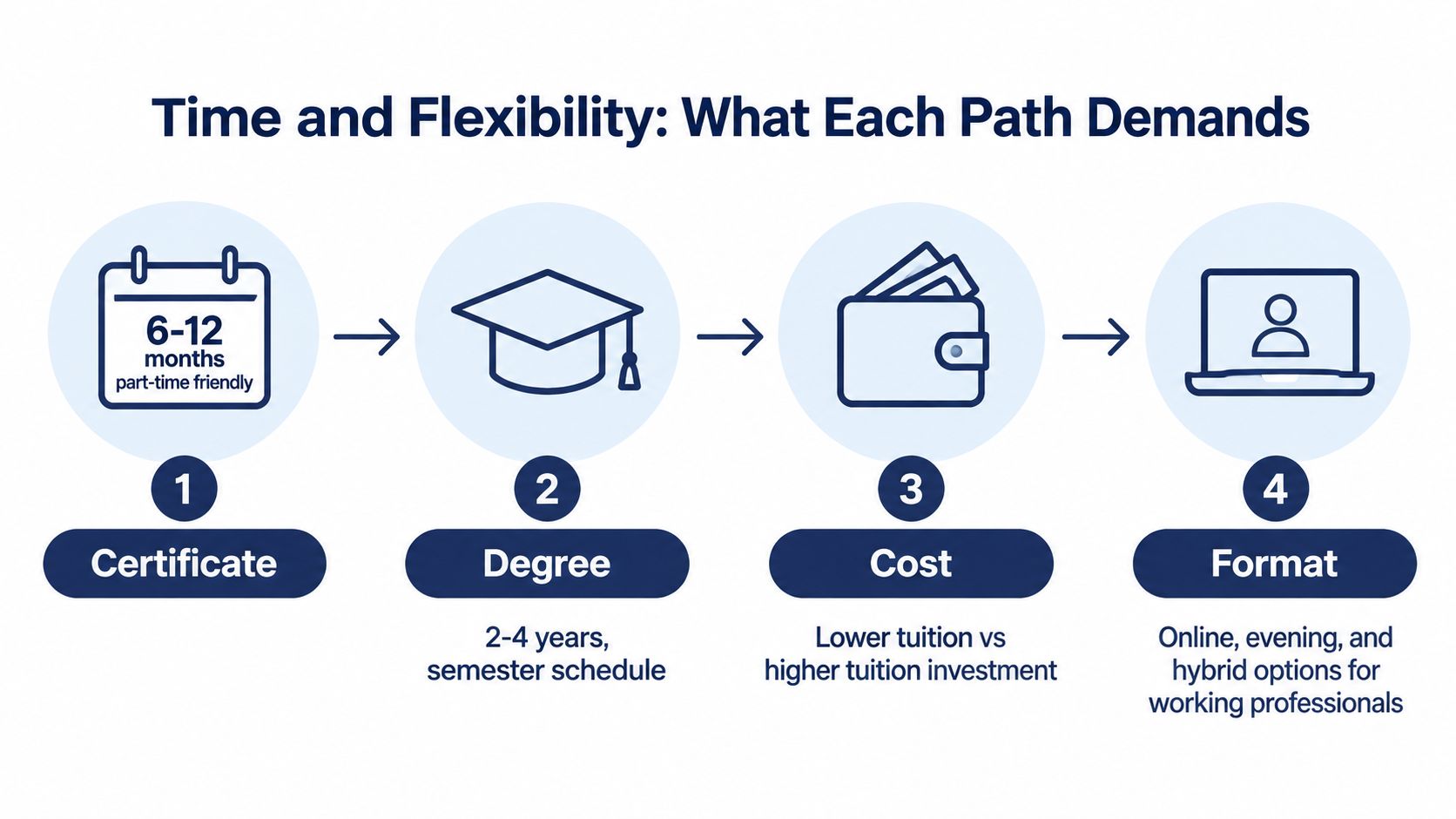
Auditing a course can provide another option for personal enrichment when a student wants learning without the pressure of grades, though audit policies vary by institution. Some schools also offer stackable credentials or dual-degree pathways. These options can help you begin with focused study and continue toward broader preparation when your season allows.
Real-World Ministry Scenarios and Career Outcomes
A bivocational church planter may need immediate grounding in biblical interpretation, discipleship, or church leadership. He may already preach regularly and need a structured next step that fits around employment. A certificate can serve that situation well if it offers relevant coursework and the planter confirms that it aligns with the church network's expectations.
A lay leader may be teaching adults every week but feel uneasy about handling difficult passages. Focused study can strengthen preparation, clarify doctrine, and cultivate humility. The goal isn't to sound more impressive. It's to serve learners faithfully and point them toward Christ.
A seasoned pastor may pursue specialized study in biblical archaeology or ancient history. That work can enrich preaching and teaching when evidence is handled responsibly. Resources connected with The Bible Seminary's archaeology offerings can help students explore the relationship between Scripture, history, and material culture without treating archaeology as a replacement for revelation.

Match the credential to the responsibility
The following examples can clarify the distinction:
Bible study leader: A certificate may provide targeted preparation for interpretation, teaching, or Christian education.
Bivocational church planter: A certificate can offer structured training while the planter continues serving and working.
Pastor pursuing senior leadership: A graduate degree may provide broader formation and stronger institutional signaling.
Chaplain or ministry professional: Requirements vary by organization, so confirm the expected degree, supervised experience, and ecclesial standing before enrolling.
Future seminary professor: A degree may be an important foundation, but teaching eligibility can also depend on further graduate study and institutional requirements.
Church leader interested in archaeology: A focused certificate or specialized coursework may deepen historical understanding without requiring a full change in vocation.
The practical question many theology students ask is whether a certificate will remain useful later for ordination, teaching eligibility, or stacking into a master's path. The answer depends on the institution and the receiving body. Some certificates carry academic credit that may apply toward a degree, while others are non-credit and function primarily as continuing education.
The Bible Seminary offers degree programs, certificates, auditing options, and ministry-focused study that connect biblical academics with practical service. Its programs also bring together Scripture, archaeology, and spiritual formation, helping students train hearts and minds for kingdom service. Explore The Bible Seminary's academic programs to compare available pathways.
Choosing the Right Path for Your Season of Life
You don't need to choose the most impressive credential. You need to choose the pathway that faithfully serves your calling, responsibilities, and likely ministry future.
A certificate may be appropriate when your present need is focused and immediate. Perhaps you're serving while working full-time, have limited capacity for extended study, or want to test a field before committing to a longer program. A certificate can be a wise act of stewardship when it gives you useful preparation without creating an unsustainable burden.
A degree may be the wiser investment when you're preparing for senior pastoral leadership, seeking thorough theological formation, or anticipating requirements that depend on a formal graduate credential. The longer path can help you develop intellectual breadth, ministry judgment, and the credibility that churches and institutions often seek for enduring leadership.
Ask these questions before enrolling
What ministry responsibility is in front of me now? Name the actual role, not only the aspiration.
What might God be preparing me to do later? Consider preaching, church planting, counseling, chaplaincy, teaching, missions, or administration.
What does my denomination require? Get written guidance about ordination, licensing, and educational expectations.
Will the credits transfer? Ask both the sending and receiving institution.
Can I complete the program faithfully? A realistic pace is better than an ambitious plan you can't sustain.
What kind of formation does the program provide? Look for biblical depth, prayer, faculty engagement, community, and ministry practice.
Your decision should also include prayer and wise counsel. Speak with your pastor, denominational leaders, trusted mentors, and admissions personnel. Ask faculty about the daily demands of study and ask current students how they balance learning with service.
The certificate and degree pathways can both contribute to Christ's mission when pursued with humility. What matters is not collecting credentials but becoming the kind of leader who handles Scripture faithfully, loves people well, and serves the church with wisdom.
Common Questions About Seminary Credentials
Can certificate credits transfer into a degree?
Sometimes. Transfer depends on the institution, the course level, the age of the credit, and the receiving program's policy. The University of Denver, for example, limits transfer credit to 25% of the minimum credential requirement and applies additional rules concerning graduate-level coursework and the age of credits, as described earlier.
Is every certificate academic credit?
No. Some certificates are credit-bearing, while others are non-credit continuing-education credentials. Credit-bearing study may have a clearer path toward a degree, but you should confirm the policy in writing before enrolling. The difference between a certificate and a certification also matters. A certificate records educational completion, while a certification typically verifies competence through a professional or organizational process.
Can a certificate lead to a master's degree?
It can, when the institution designs the program for that purpose and the receiving degree accepts the coursework. Ask whether the certificate is stackable, which courses apply, and whether admission to the master's program remains a separate process. Continuing education certificate guidance from The Bible Seminary can help you think through that transition.
Will a certificate satisfy ordination requirements?
There's no universal answer. Ordination standards belong to denominations, churches, and ministry bodies. Confirm their requirements before choosing a program, especially if you hope to pursue pastoral leadership or chaplaincy.
Is a degree always the better choice?
No. A degree offers broader preparation and may carry stronger long-term signaling, but a certificate may be the faithful and practical choice for focused ministry development in your current season. The wisest path is the one that fits your calling, responsibilities, and recognized ministry goals.
The Bible Seminary offers Bible-centered certificates, graduate degrees, flexible learning options, archaeology resources, and practical ministry formation for students serving in many seasons of life. Visit The Bible Seminary to compare certificates and degree programs, ask about transfer pathways, and begin training hearts and minds for kingdom service.