
Women's Role in the Church: A Biblical and Theological Guide

A search committee has finished interviewing candidates, but one question keeps returning: should a woman preach regularly, serve as an elder, or lead the congregation? In another church, a woman organizes the Bible study, trains volunteers, visits families in crisis, and teaches children, yet no one has asked her to help shape the ministry budget. A seminary classroom may include women preparing for ministry alongside men who hold different convictions about ordination.
These situations show why women's role in the church can't be reduced to a single question about the pulpit. Churches must also ask who belongs, who participates in governance, who receives training and compensation, and who holds final authority. Scripture gives us the foundation, Christian history gives us a complicated record, and pastoral wisdom helps us apply both with truth and charity.
Why Women's Role in the Church Matters Now
A ministry meeting often reveals the tension before anyone names it. A worship leader asks a woman to teach a Sunday class because she has deep biblical understanding. A pastor wants to invite her onto the leadership team, while another member asks whether that role carries authority reserved for elders. Everyone wants to honor Scripture, but the church still needs to decide how gifts will be recognized and how people will be equipped.
A helpful starting point is to separate three operational dimensions:
Membership, who belongs to the congregation and participates in its worship and community.
Governance, who serves on boards, committees, councils, and ministry teams with meaningful decision-making power.
Senior leadership, who holds roles such as pastor, priest, elder, bishop, or denominational executive.
These dimensions overlap, but they aren't identical. A church may welcome women as members and invite them to serve on committees while limiting preaching or ordained office. Another church may permit women to preach yet appoint few women to its highest governing positions. Careful language prevents us from calling a church fully inclusive or fully restrictive without asking, “Inclusive in which role?”
What this guide will and won't settle
Faithful Christians disagree about the meaning and application of passages concerning eldership, teaching, ordination, and authority. Complementarian and egalitarian Christians can both affirm Scripture's authority while reaching different conclusions about certain offices. Roman Catholic, Eastern Orthodox, and many Restoration Movement churches bring their own theological histories and practices to the discussion.
This guide won't declare one denominational policy correct for every congregation. It will help pastors, students, and curious readers distinguish biblical interpretation from institutional habit, formal permission from actual appointment, and essential ministry labor from public authority.
A faithful conversation asks two questions at once: What does Scripture teach, and how is our church actually stewarding the gifts God has entrusted to women?
For a seminary community, this matters because leaders will serve churches with different convictions. Training hearts and minds for kingdom service requires both confidence in biblical study and humility toward believers who interpret difficult texts differently. The purpose isn't to weaken conviction. It's to help the church practice conviction with honesty, love, and accountability.
Biblical Foundations for Women's Ministry
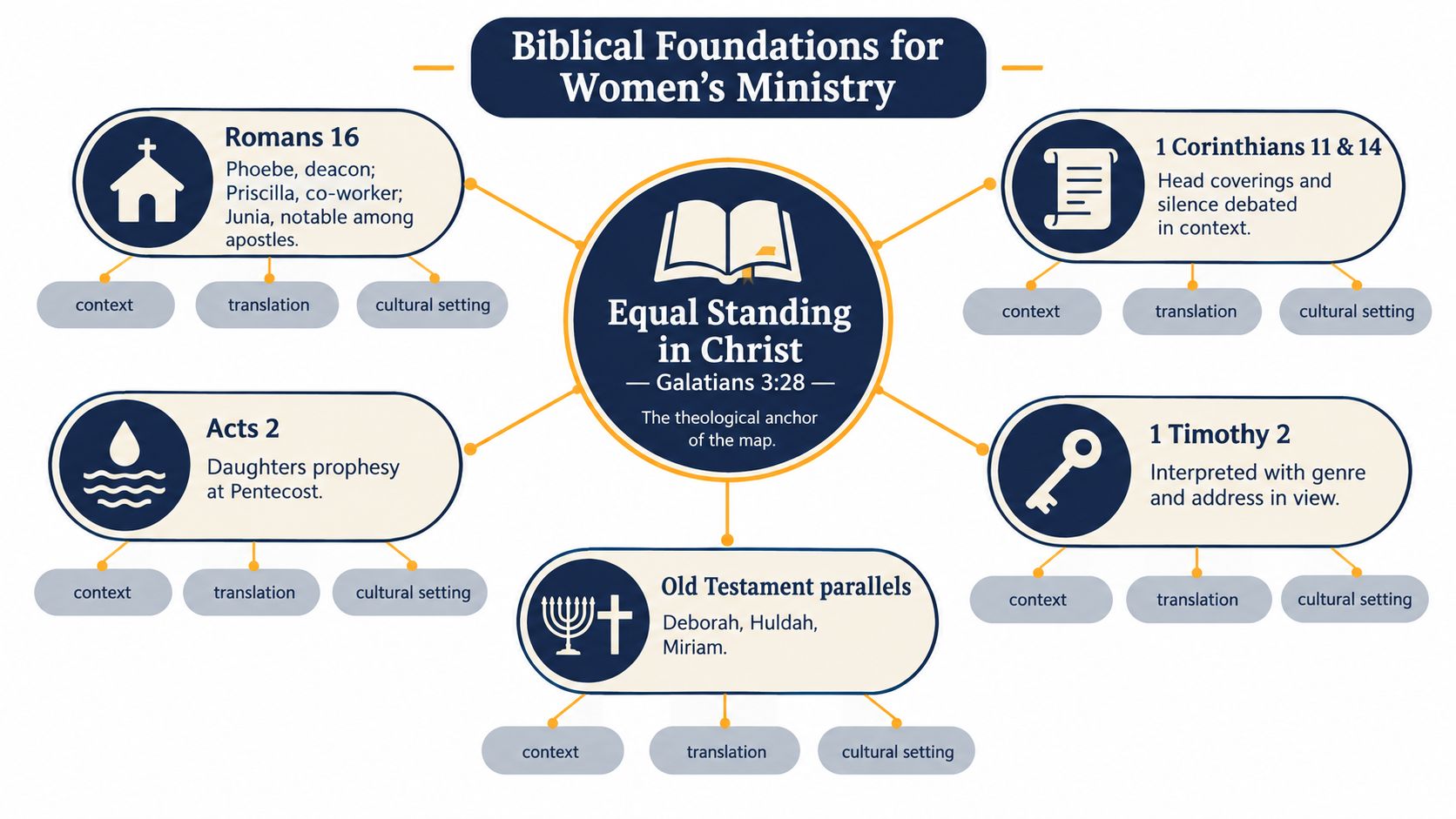
Scripture presents women as full participants in God's redemptive work, while also giving churches passages that require careful interpretation. The first theological anchor is humanity's shared standing before God. Paul writes in Galatians 3:28 that in Christ “there is no Jew or Greek, slave or free, male and female,” because all are one in Christ Jesus. In context, Paul is describing equal access to salvation and identity in Christ, not providing a complete organizational chart for every church office. Still, the passage establishes a foundation that no Christian account of ministry should ignore: women and men share equal dignity as Christ's people.
Romans 16 then gives us named examples. Paul commends Phoebe as a diakonos of the church at Cenchreae and describes her as a benefactor or patron to many, including himself. Priscilla appears with Aquila as Paul's coworker, and Acts 18 records the couple explaining the way of God more accurately to Apollos. Junia is identified among the apostles in Romans 16:7, though interpreters continue to discuss how that phrase should be understood. These passages don't answer every modern question, but they do show women recognized as significant coworkers in the early Christian mission.
Lydia and the ministry of hospitality
Acts 16 gives another important example. Lydia, a seller of purple cloth in Philippi, believed Paul's message, was baptized with her household, urged Paul and his companions to stay at her home, and opened her household to them. Scholarly analysis connects her actions with the Roman patronage system and supports understanding Lydia as a benefactress of the church at Philippi, as discussed in this study of Lydia's role in the early church.
The text doesn't assign Lydia a formal office. It does show that her economic resources, household authority, hospitality, and public commitment materially advanced the gospel. Leadership defined only by preaching can miss forms of service that Scripture itself treats as consequential.
Difficult passages require context
First Timothy 2:11–15 and 1 Corinthians 11–14 are central to the debate. Complementarian interpreters commonly read Paul's instructions about teaching, authority, prophecy, head coverings, and silence as establishing enduring limits on certain church offices. Egalitarian interpreters often argue that Paul addresses specific local problems, that the passages must be read alongside women praying and prophesying, and that translation, cultural setting, and the nature of the offices matter.
First Corinthians 11:5 explicitly refers to women praying and prophesying, while chapters 12 through 14 address order, edification, and the evaluation of prophetic speech in worship. That creates an interpretive question, not a reason to dismiss the text. Readers should examine Paul's complete argument, the situation in Corinth, the meaning of key terms, and how each proposed interpretation accounts for all the relevant passages.
A Bible-centered education doesn't make every disagreement disappear. It equips pastors to handle Scripture responsibly, teach without prooftexting, and honor Christians whose convictions differ. Where the Bible speaks clearly, we should be clear. Where interpretation remains contested, we should show patience without surrendering seriousness.
A Brief History of Women in Christian Leadership
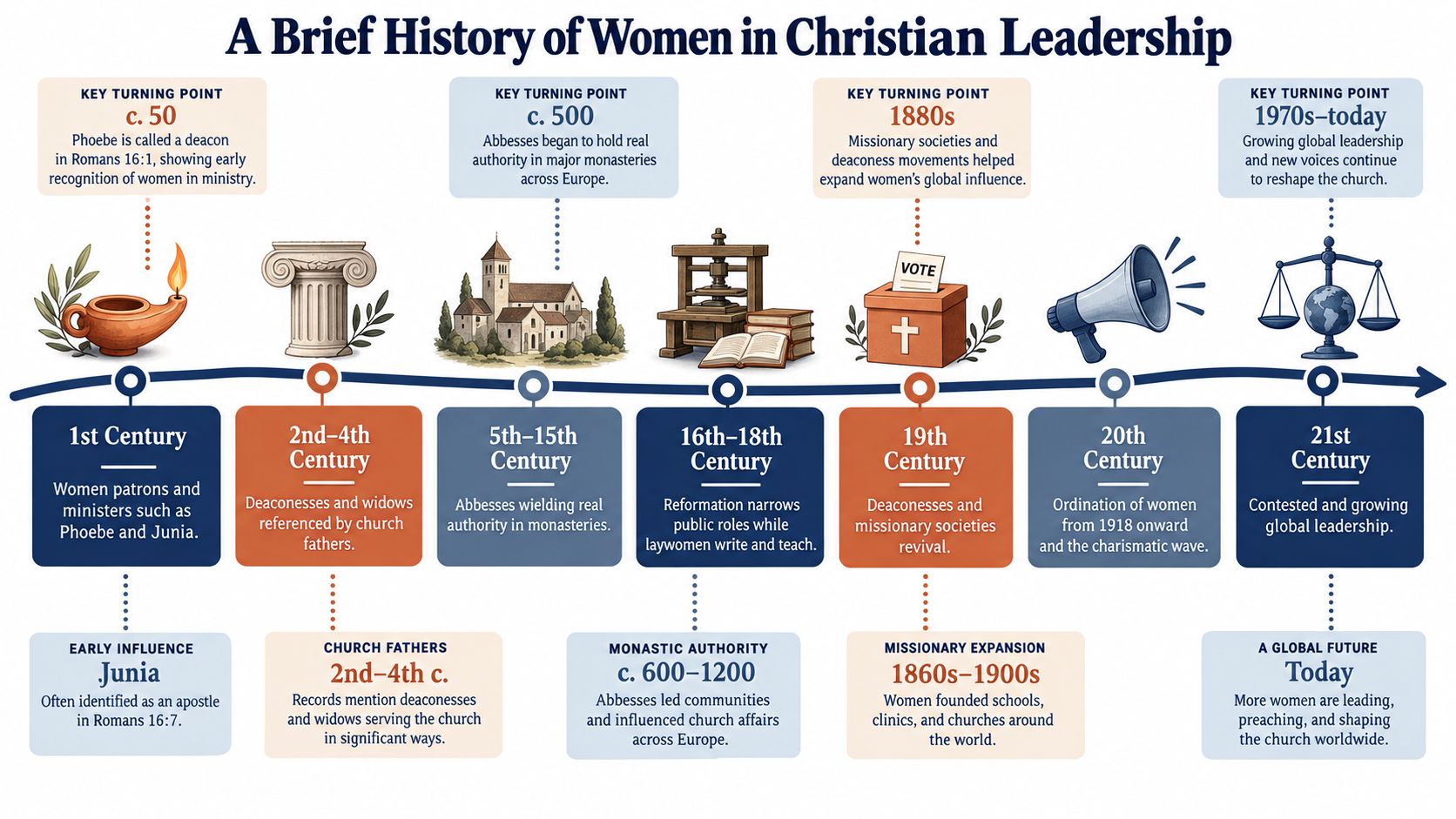
The history of women's role in the church is neither a straight march from exclusion to equality nor a simple story of uninterrupted leadership. Women served in varied ways across the first Christian centuries, while later institutions often narrowed their public authority. Regional practice, social custom, theological interpretation, and church structure all shaped the opportunities available to women.
The New Testament already presents women as patrons, coworkers, teachers, prophets, and witnesses. Phoebe likely used her resources and social standing to support the church. Priscilla participated in theological instruction. Junia's mention in Romans 16:7 has generated sustained discussion about the meaning of “apostle.” These examples don't erase the restrictions some traditions find in other passages, but they prevent the mistaken assumption that women were absent from significant ministry in the earliest churches.
Early Christian writers and inscriptions add physical evidence. An inscription from ancient Phrygia, in modern Turkey, commemorated Ammio as a presbytera. Cyprian, writing in the mid-230s, referred to a female presbyter in Cappadocia. Inscriptions from Thera and Sicily used feminine forms of the title elder for Epiktas and Kale. A fourth-century Jerusalem inscription remembered Sophia as a deacon and called her “the second Phoebe,” as described in this overview of early evidence for women church officers.
Why titles need careful reading
An inscription can directly establish a name, title, location, or memorial honor. It can't, by itself, settle what that title meant in every region or century. Presbyteros and related terms could carry different meanings depending on local practice, and a modern office shouldn't automatically be projected backward onto an ancient community.
The medieval period offers another example of complex authority. Abbesses could exercise recognized oversight within monasteries, manage property, direct communities, and sometimes hold influence beyond their houses. Their authority was real, but it operated within structures that didn't necessarily equate to parish priesthood or episcopal office.
The Reformation brought new emphasis on Scripture, preaching, and household vocation, but many Protestant communities also restricted women's public teaching. Laywomen continued to write, teach children, organize prayer, support missions, and sustain Christian communities. In the nineteenth and twentieth centuries, missionary, holiness, deaconess, and charismatic movements created new avenues for women's public ministry, including ordination in some Protestant traditions.
Historical study helps us resist two errors. We shouldn't claim that one artifact proves a universal Christian policy, and we shouldn't claim that women have always been absent from recognized ministry. Where the Bible comes alive through archaeology and history, students learn to separate evidence from inference and conviction from assumption.
Denominational Positions on Women's Role in the Church
Christians often use the terms complementarian and egalitarian as though they describe every possible position. They don't. Each term includes internal differences, and many traditions use their own vocabulary rather than these labels.
Complementarians generally affirm equal dignity before God while teaching that men and women have distinct responsibilities in the home and church. Many reserve eldership, senior pastoral authority, or certain teaching functions for qualified men. Egalitarians generally argue that Scripture's gifts and offices are open to women and men without a gender-based restriction, provided candidates meet the biblical qualifications.
Both approaches ask serious questions of the biblical text. Complementarians often emphasize creation order, Paul's instructions in First Timothy, and qualifications for elders. Egalitarians emphasize Galatians 3:28, women praying and prophesying, the named coworkers in Romans 16, and the way Jesus welcomed and commissioned women. Neither side should be represented as though it has no biblical rationale.
Denominational Positions at a Glance
Tradition | Core Conviction | Ordination Practice | Preaching in Worship |
|---|---|---|---|
Complementarian Protestant traditions | Men and women share equal dignity, with some governing or teaching offices assigned to qualified men | Ordination commonly reserves elder or senior pastor roles for men, though women may serve in other ministries | Practice varies, with some churches permitting women to teach in defined settings |
Egalitarian Protestant traditions | Spiritual gifts and church offices are open to women and men | Women may be ordained as pastors, elders, or ministers when they meet the same standards | Women may preach and teach in gathered worship |
Roman Catholic tradition | Women and men share baptismal dignity, while priestly ordination is reserved to men | The Roman Catholic Church doesn't ordain women to the priesthood | Women may serve in many teaching, pastoral, and ministry roles, but not as priests |
Eastern Orthodox traditions | Women and men share life in Christ, with ordained priesthood traditionally reserved to men | Priesthood and episcopacy are reserved to men in established practice | Women participate in teaching and ministry, while sacramental priestly preaching belongs to ordained clergy |
Restoration Movement traditions | Churches differ in how they interpret biblical authority, gifts, and office | Practice ranges from male eldership to women serving in broad ministry and leadership roles | Congregations vary according to their reading of worship and leadership texts |
These summaries are starting points, not substitutes for denominational documents or local church constitutions. A church's official policy may also differ from its everyday practice.
In seminaries, chaplaincies, mission organizations, and ecumenical partnerships, charitable conversation requires accurate vocabulary. Ask what a tradition means by “leadership,” which offices it distinguishes, and how it applies its convictions to teaching, administration, missions, pastoral care, and governance. People can disagree about ordination without denying one another's love for Christ or commitment to Scripture.
What the Data Shows About Participation and Authority
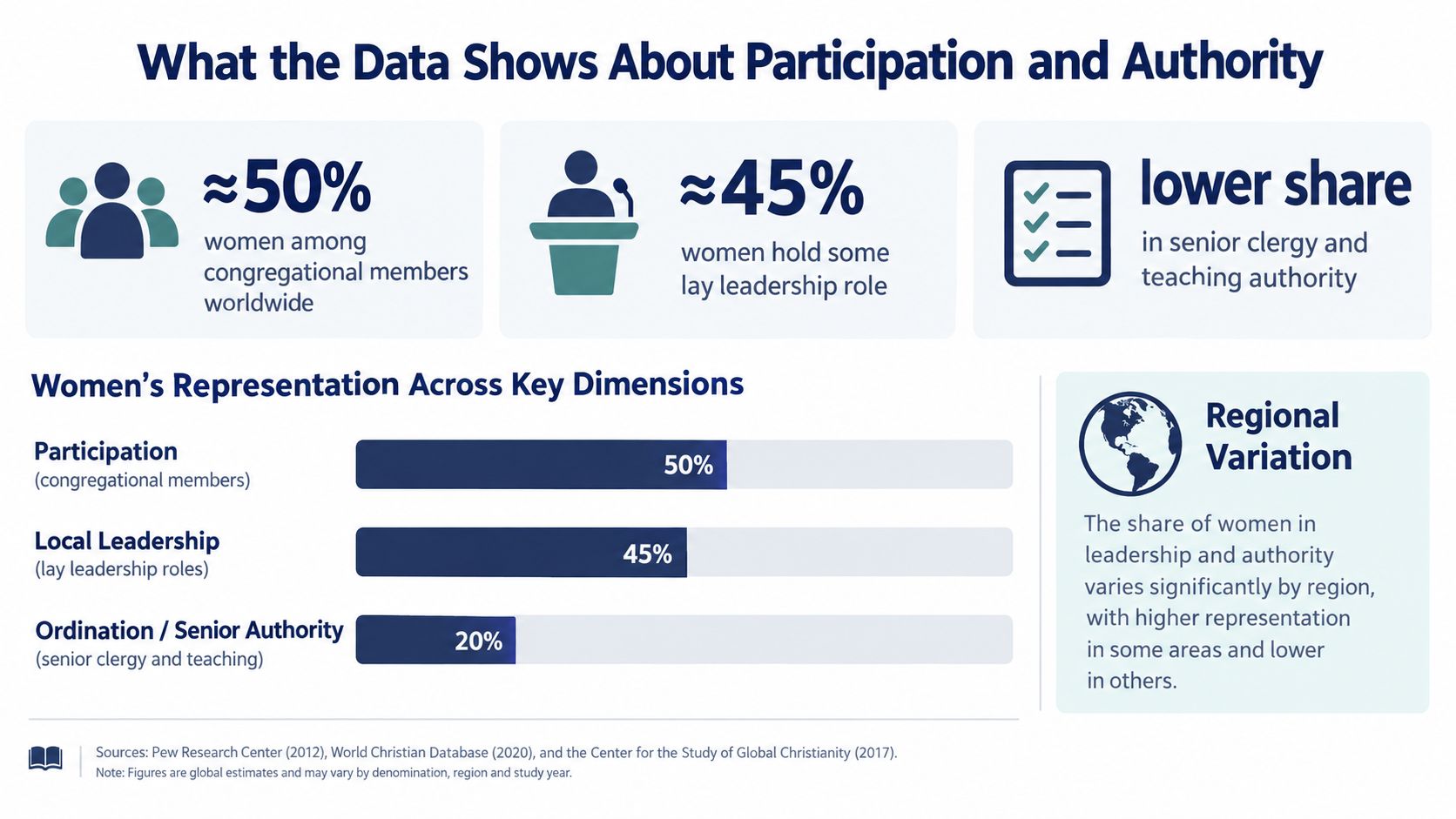
The global picture becomes clearer when we keep membership, governance, and senior leadership separate. Women are central to church life numerically and practically, but their representation in formal authority remains uneven.
A 2024 global analysis by Gina A. Zurlo found that approximately 45% of Christians worldwide worship in churches that permit women to serve as pastors, while approximately 83% belong to churches that permit women to participate in governing or decision-making bodies. The analysis, published in a peer-reviewed study of women's roles in Christianity, describes an institutional authority gradient. Churches may welcome women into boards, committees, administration, children's ministry, worship, or intercession while restricting the highest preaching or sacramental office.
The regional picture isn't uniform. The same analysis reports that 48% of Christians in the Global South are in churches allowing women pastors, compared with 35% in the Global North. These figures don't tell us which theology is correct. They show why “women's inclusion” needs more precise measurement.
Permission isn't appointment
U.S. congregational data illustrates the difference between policy and practice. A report summarizing the 2018–2019 National Congregations Study found that 71.8% of congregations allowed women to preach or lead services, while 56.4% allowed a woman to serve as head clergyperson or primary religious leader, based on research covering 5,300 religious communities. A separate analysis of the 2021 National Congregations Study found that women led 13.8% of American congregations, while 8.1% of worshippers attended a congregation with a woman as head pastor or priest, as reported in this summary of women's congregational leadership.
Historical comparison also shows why permission should not be confused with appointment. In Switzerland, congregations allowing a woman as the main clergy person rose from 47.8% to 54.0%, while congregations led by a woman rose from 12.3% to 14.7%, according to the cited comparative research summarized in this analysis of women in clergy leadership.
For church planning, the lesson is practical. Measure who belongs, who votes, who teaches, who receives ministry budgets, who is ordained, and who reaches senior office. A dashboard can reveal whether women are carrying substantial ministry responsibility without receiving agenda-setting power, compensation, mentoring, or a clear leadership pathway.
Pastoral Application for Today's Church
Pastors don't serve statistics. They serve people with gifts, wounds, convictions, and responsibilities. A church can hold a clear theological position and still examine whether its practices are honest, orderly, safe, and consistent with that position.
Begin with four questions: What do we believe? What do we practice? Whom are we developing? Whom are we protecting? Write the church's convictions in language members can understand. Then compare those convictions with committee assignments, teaching invitations, pastoral care expectations, budgets, compensation, credentialing, and succession plans.
Recognize the work already being done
Women's ministry often includes crisis caregiving, meal trains, funeral food, showers, decorating, and childcare for church gatherings. A survey of 842 women's ministry leaders found that only about one in six held a paid position, despite these substantial responsibilities, according to the State of Ministry to Women Leaders report.
Unpaid service can be freely offered and spiritually meaningful. It can also become invisible labor when churches repeatedly rely on the same women without training, rest, budget, recognition, or a route into decision-making. “Servant leadership” should never become a religious phrase for unlimited access to someone else's time.
Practical rule: If a ministry is essential enough to depend on, it's important enough to evaluate, resource, and safeguard.
An annual ministry-equity review can ask:
Workload: Who handles crisis care, hospitality, discipleship, and administration?
Formation: Who receives theological training, mentoring, and opportunities to teach?
Authority: Which committees include women with agenda-setting and final voting power?
Compensation: Which roles are paid, and are expectations clear?
Pipeline: Who is considered for ordination, senior leadership, and denominational service?
Safeguarding: Who can report abuse, coercion, harassment, or boundary violations?
The review should respect the church's theology while distinguishing spiritual gifting from gendered expectation. Leaders who want a focused biblical framework can also consult The Bible Seminary's theology of leadership resource.
Women are not only a ministry audience. They are disciples, theologians, teachers, caregivers, organizers, patrons, administrators, worshipers, and leaders. Pew Research Center's cross-national analysis found that among Christians in 54 countries, women reported daily prayer at rates averaging 10 percentage points higher than men, an association that should not be treated as proof that gender causes prayer behavior. It does suggest that churches should take seriously the ministry insight and spiritual participation of women rather than treating them as a peripheral constituency, as discussed in this global analysis of gender and religion.
Practical Next Steps and Trusted Resources
A church leader can begin this week without waiting for a new committee or a denominational convention. Gather the written policy, the recent ministry calendar, the leadership roster, and the budget. Read them together rather than assuming that one document represents the whole life of the congregation.
A church leadership self-assessment
Use these questions for prayerful review:
Policy and practice: Do our stated convictions match the roles we do assign?
Teaching: Where do women teach, and are those opportunities limited to children or women's settings?
Governance: Do women participate in decisions, or do they mainly provide support after decisions are made?
Resources: Are ministry expectations matched by training, budgets, compensation, and time off?
Development: Who receives mentoring and invitations to pursue credentials?
Safety: Can women raise concerns without risking their ministry standing or personal relationships?
Keep the answers descriptive before making them argumentative. “Women serve in many ministries” is useful, but it becomes more meaningful when leaders identify which ministries, how much authority accompanies them, and whether the work is sustainable.
Build a trustworthy reading path
Read Scripture in context, then consult resources that represent your tradition accurately. A complementarian reader should engage a careful egalitarian argument, and an egalitarian reader should understand the strongest complementarian interpretation rather than a caricature. Historical resources should distinguish inscriptions and documents from later theological conclusions.
Prospective students can compare academic programs at The Bible Seminary and review degree programs that unite biblical study with theology, history, archaeology, and practical ministry. The seminary's wider learning community also connects classroom formation with Scripture, archaeological study, and service to local churches.
The aim is not to produce leaders who win every argument. It is to equip leaders to impact the world for Christ by studying Scripture carefully, recognizing ministry gifts faithfully, and serving people with courage and compassion. Churches need pastors and ministry professionals who can unite scholarship, spiritual formation, and hands-on ministry while remaining accountable to the authority of God's Word.
The Bible Seminary offers Bible-centered graduate education, certificate options, and ministry-focused formation for students and church leaders who want to study Scripture thoroughly and serve faithfully. Visit The Bible Seminary to explore a path that trains hearts and minds for kingdom service, bringing archaeology, theology, and practical ministry together.