
Pastoral Training Program: A Guide for 2026 Ministry

What would happen if a pastor loved Christ intensely, studied Scripture faithfully, and still felt unprepared when a grieving family arrived, a conflict divided the church, or a difficult passage needed to be preached clearly? A pastoral calling deserves more than goodwill alone. It needs formation that joins biblical conviction, theological understanding, spiritual maturity, and practiced ministry.
Across the world, many pastors serve with limited access to formal theological education. That reality doesn't diminish their faithfulness. It does show why churches, seminaries, mentors, and ministry partners must build accessible pathways for leaders who want to shepherd God's people with wisdom and endurance. A strong pastoral training program helps move ministry from constant reaction toward thoughtful, Scripture-shaped service.
Why Pastoral Training Matters for Today's Church Leaders
A newly appointed pastor opens the Bible before a congregation that has prayed for faithful leadership. The pastor loves the people and has spent years serving in the church. Yet the first months bring questions that personal devotion alone can't answer. How should a sermon address a complicated text? How can a leader guide two families through conflict without taking sides? What does wise pastoral care look like when grief, addiction, marriage strain, and spiritual doubt arrive at the same time?
These questions don't suggest that the pastor lacks sincerity. They reveal the breadth of the shepherd's work. Paul told Timothy to handle the word of truth correctly, and he also emphasized character, endurance, teaching, and care for others. Pastoral ministry requires a life submitted to Christ, but it also requires habits and competencies developed through study, practice, correction, and prayer.
“Pay careful attention to your life and your teaching; persevere in these things, because by doing so you will save both yourself and your hearers.”1 Timothy 4:16, CSB
Preparation serves people
A pastoral training program shouldn't exist to make ministers appear scholarly. Its purpose is faithful service to real people in real churches. Biblical studies can help a pastor interpret a passage in context. Theology can clarify what the church confesses and why it matters. Training in counseling and leadership can help a minister respond with patience rather than impulse.
The same principle applies to practical stewardship. Churches often need help with administration, communication, volunteer coordination, and responsible resource use. Leaders exploring nonprofit tools for faith groups may find useful support for the operational side of ministry, freeing more attention for prayer, teaching, and people.
Formal preparation also gives pastors a place to receive supervision and honest feedback. A preaching student can learn that a faithful sermon may still need clearer structure. A ministry leader can discover that good intentions don't automatically produce healthy boundaries. Such lessons are gifts when they come before a crisis rather than after one.
Training doesn't replace dependence on the Holy Spirit. It helps prepare the servant who depends on Him. The result should be a pastor who can open Scripture carefully, listen humbly, lead responsibly, and keep pointing the church to Christ.
What Is a Pastoral Training Program
A pastoral training program is a structured course of formation that prepares people for the responsibilities of Christian ministry. It usually combines biblical study, theological reflection, spiritual formation, supervised practice, and ministry leadership. The exact pathway may be a degree, certificate, cohort, or continuing-education program, but the defining feature is integration.
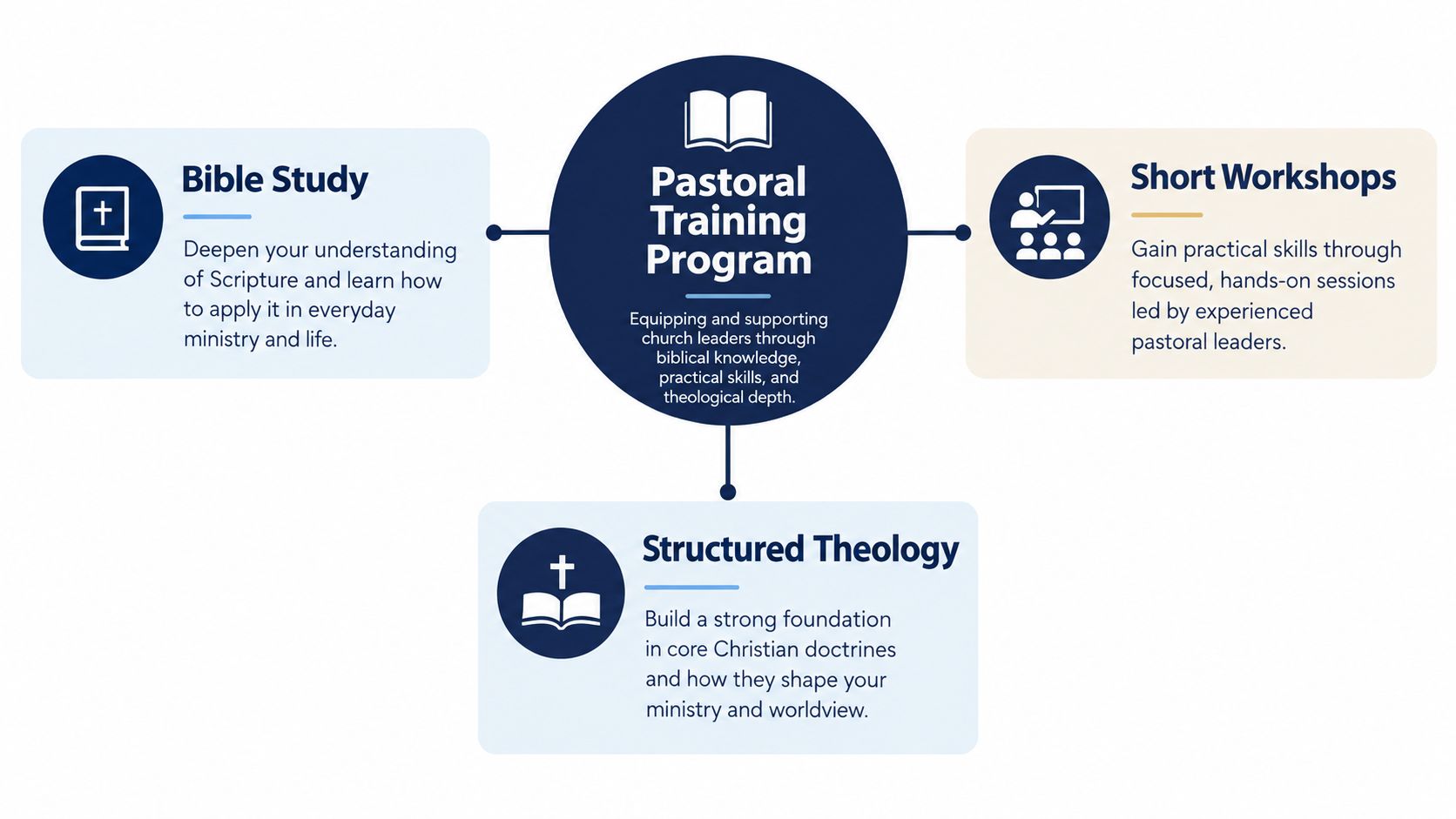
A weekly Bible study can nourish faith and build community. A short workshop can introduce a useful skill, such as hospital visitation or sermon preparation. Both have value. Neither necessarily provides the sequence, assessment, faculty guidance, and supervised ministry practice associated with structured theological formation.
Three layers of preparation
Bible study asks what Scripture says, how it fits within the whole biblical story, and how its original context shapes interpretation. A pastor preparing to preach from the Gospels, for example, needs more than a collection of memorable observations. The pastor must understand the passage, its literary setting, its relationship to the Old Testament, and its fulfillment in Christ.
Theological reflection asks how the church should understand God, salvation, the church, humanity, sin, mission, and Christian hope. It connects doctrine to decisions. A pastor caring for someone facing suffering needs theology that speaks plainly about lament, providence, prayer, and the hope of resurrection.
Ministry practice turns knowledge into faithful action. Students may preach, counsel, lead meetings, complete field assignments, observe experienced ministers, and reflect on what happened. Supervision matters because ministry decisions affect people, families, congregations, and communities.
A useful comparison is medical residency. Medical students learn in classrooms, but they also learn under supervision while serving patients. Pastoral students likewise need both instruction and guided practice. Exams can assess knowledge, but they can't by themselves show whether a future pastor listens well, protects confidentiality, manages conflict, or applies Scripture with wisdom.
A church board evaluating programs should ask whether the curriculum provides clear learning outcomes, qualified faculty, practical ministry experience, and meaningful feedback. Those features distinguish thorough formation from a brief introduction.
Core Curriculum Components You Should Expect
A competent program connects subjects that are sometimes treated as separate. Scripture gives the foundation. Theology helps the pastor think faithfully about Scripture and the church's confession. Ministry practice tests whether learning can serve people with humility, clarity, and courage.
Before enrolling, ask for a curriculum map. A thoughtful step-by-step curriculum design process can help educators connect learning objectives, assignments, and outcomes instead of just collecting interesting courses.
A connected curriculum
Old and New Testament studies should help students read the Bible as a unified account of God's redemptive work. Biblical languages, when included, give students tools for closer examination of Hebrew and Greek texts. They don't make a pastor spiritually superior, and they don't remove the need for faithful translation and wise interpretation. They can, however, sharpen attention to grammar, context, and significant word choices.
Systematic theology helps organize biblical teaching into coherent categories. Church history shows how Christians have defended truth, addressed error, practiced mission, and sometimes failed their neighbors. Pastoral counseling, homiletics, leadership, ethics, and supervised ministry then bring that knowledge into congregational life.
The following checklist can help you evaluate a program:
Area | Purpose | Ministry Outcome |
|---|---|---|
Old and New Testament | Read Scripture in context and as a unified witness to Christ | More faithful teaching and preaching |
Biblical languages | Examine important features of the biblical text | Greater care in interpretation |
Systematic theology | Relate doctrines to the whole counsel of God | Clearer answers to congregational questions |
Church history | Learn from the church's faithfulness and failures | More informed leadership and discernment |
Pastoral care and counseling | Respond to suffering, conflict, and spiritual need | Safer, wiser care for people |
Homiletics | Develop biblical sermons with clear application | Preaching that explains and calls for response |
Ministry practice | Apply learning under supervision | Demonstrated readiness for ministry responsibilities |
A course in pastoral care becomes stronger when students apply it to a case involving bereavement, then receive feedback on listening, theological language, boundaries, and referral decisions. A preaching course becomes more useful when a student delivers a sermon, reviews it, and revises it.
The Bible Seminary's resource on pastoral care training illustrates why care should be treated as a discipline requiring preparation, not merely as an expression of good intentions. Look for programs that connect classroom learning with the people and situations you already serve.
Degree vs Certificate Pathways Explained
The right pathway depends on your calling, current preparation, church expectations, and available time. A degree usually offers a broad sequence of study. A certificate concentrates on a defined area and may serve someone who needs focused development without beginning a full graduate curriculum.
Master of Divinity
The Master of Divinity is generally the broadest professional pathway for students preparing for pastoral leadership across the full range of ministry. It commonly includes biblical studies, theology, church history, preaching, pastoral care, leadership, ministry practice, and, depending on the institution, biblical languages.
Choose this route if you sense a call to senior pastoral ministry, church planting, chaplaincy, or another role requiring broad preparation. Confirm the expectations of your denomination and prospective ministry setting before enrolling, because educational and ordination requirements vary.
Master of Arts
A Master of Arts offers focused graduate study. One student may concentrate on biblical studies, another on theology, and another on ministry leadership or pastoral care. This can suit a pastor already serving who wants greater depth in a particular area, or a ministry professional whose vocation doesn't require the full breadth of an MDiv.
The key question isn't which degree sounds more impressive. Ask which formation your ministry responsibilities require. A pastor trying to strengthen preaching may need a different pathway from a nonprofit leader developing theological understanding for community ministry.
Certificates and continuing education
A certificate can provide targeted preparation in areas such as pastoral counseling, missions, leadership, preaching, or Bible teaching. Certificates may also offer an accessible starting point for experienced ministers who want structured learning before committing to a degree.
Use this decision guide:
Full pastoral preparation: Explore an MDiv or comparable in-depth degree.
Focused theological depth: Consider an MA aligned with your ministry responsibilities.
Specific ministry development: Begin with a certificate or continuing-education pathway.
Experienced pastor with limited flexibility: Ask about modular, online, audit, and cohort options.
Your choice should preserve both rigor and sustainability. A pathway that allows you to remain engaged with your congregation may be more faithful to your current calling than one that requires you to step away from people who depend on your ministry.
The Global Gap Between Informal and Formal Training
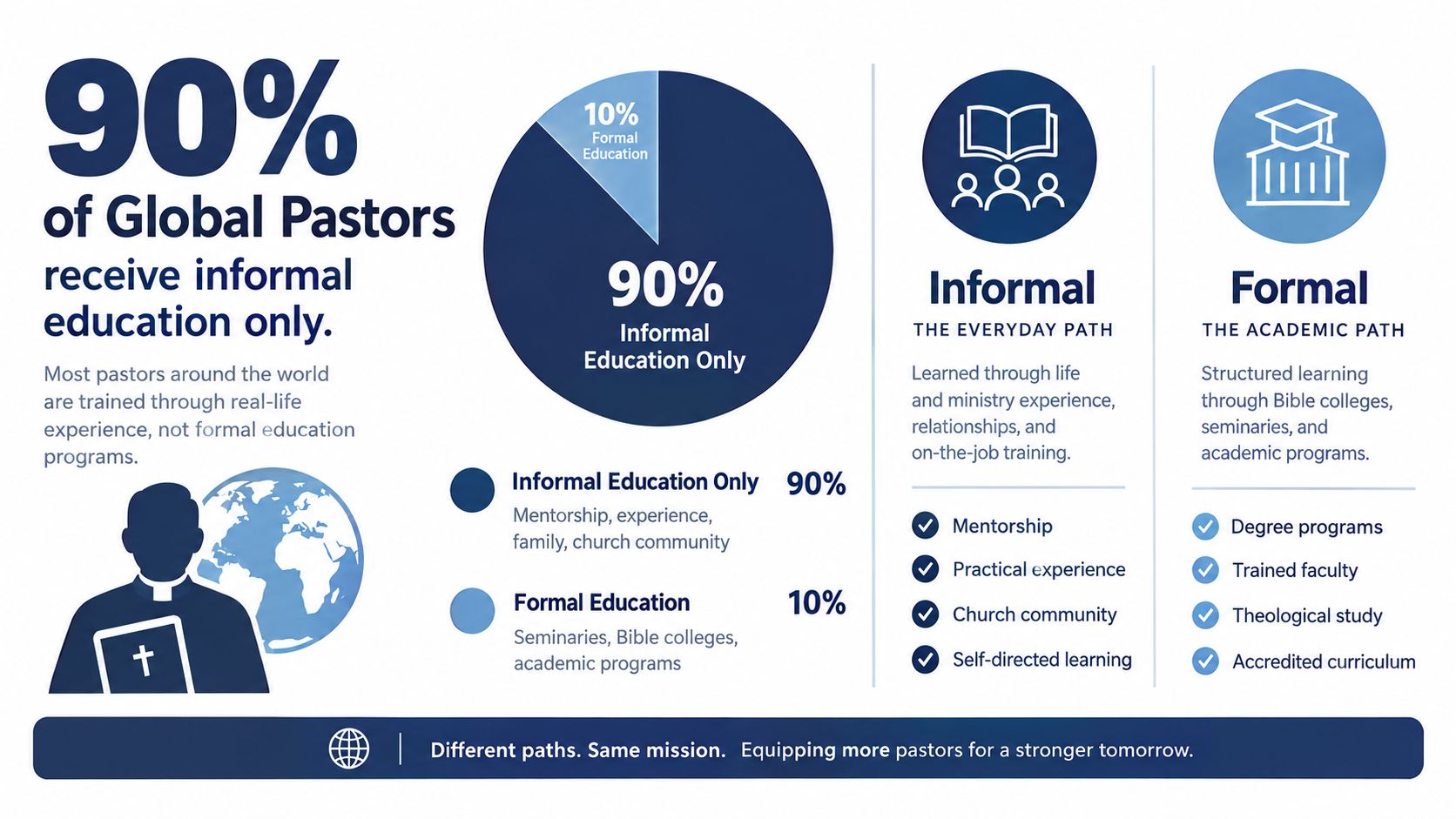
The global need for pastoral formation is substantial. A Lausanne Movement analysis reports that approximately 5% of pastors and priests across Christian traditions worldwide have completed formal theological education leading to an officially recognized degree, while more than 90% have received only informal or non-formal theological education. The same analysis estimates that at least 40,000 informal or non-formal theological training programs operate globally. Lausanne's analysis of ministry training distinguishes basic ministry preparation from structured graduate-level formation.
Informal learning can be faithful and fruitful. Many pastors study Scripture diligently through local courses, mentoring relationships, preaching communities, and church-based instruction. The concern isn't that informal training has no value. The concern is that it may not provide the breadth, sequence, accountability, and supervised practice needed for the full range of pastoral responsibility.
Unequal access creates practical consequences
One global estimate places the ratio at approximately one trained pastor for every 230 people in the United States, compared with one trained pastor for every 450,000 people outside the United States. These broad estimates aren't a standardized global census, but they show the extreme imbalance in access to trained ministry leadership. A global pastoral-training overview connects this disparity to uneven development of seminaries, faculty, libraries, and accessible degree programs.
Cost, scheduling, distance, language, internet access, and family responsibilities all shape whether a pastor can study. A 2025 pilot study involving church leaders in Kenya and Tanzania found that more than 90% lacked bachelor's-level theological training. In that study, 87.9% identified cost as the main barrier, 27.4% cited scheduling conflicts, and 23.6% cited inadequate access to quality institutions. The pilot study materials show why flexible programs must address implementation, not merely publish course lists.
For a bivocational pastor, a modular course, mentoring structure, audit option, or distance pathway may preserve local ministry continuity. Churches and donors can help by supporting tuition, technology, translation, transportation, and protected study time. Accessible training isn't a lower standard. It is a different delivery model for leaders who are already carrying significant responsibility.
How The Bible Seminary Approaches Pastoral Formation
The Bible Seminary offers one example of an integrated approach to pastoral formation. Its Bible-centered graduate education combines study of all 66 books of Scripture with historical, theological, and practical disciplines. Students can pursue graduate majors and flexible options such as certificates, audited courses, dual-degree completion, and on-demand seminars, depending on their goals and circumstances.
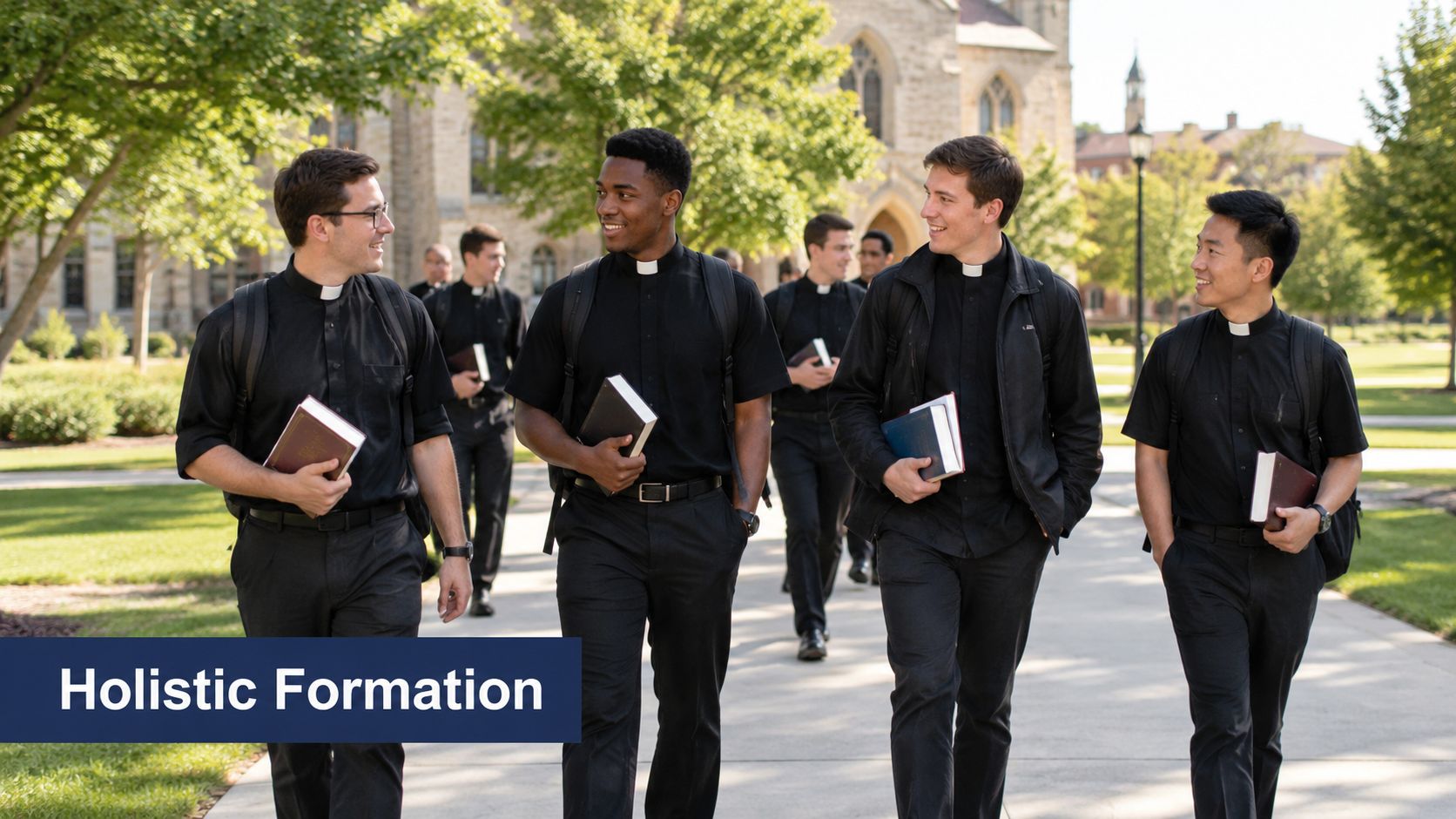
That combination matters because pastoral formation should shape more than a student's information base. It should cultivate the ability to read Scripture carefully, think theologically, serve people wisely, and lead a church with integrity. Faculty expertise and community life add relational dimensions that independent study can't fully reproduce.
The 3J Museum extends biblical learning into historical and archaeological context. It offers nearly 200 artifacts, with over 90% described as authentic, drawn from Khirbet el-Maqatir near Jerusalem. Responsible archaeology doesn't prove every theological conclusion, and artifacts must be interpreted with care. It can, however, help students engage the material world connected to biblical history and ask better historical questions.
Formation requires more than knowing about ministry. It requires learning how knowledge, character, prayer, and practice belong together.
Community initiatives such as the Public Reading of Scripture, Just Show Up Book Club, podcasts, and Nehemiah Press publications create additional settings for learning and spiritual encouragement. These activities support a culture in which scholarship remains connected to worship, conversation, and service.
The following video offers another way to encounter the seminary's educational vision:
A seminary should serve the local church while maintaining a global horizon. The Bible Seminary describes a vision of training 5,000 ministry leaders who collectively impact a million souls for God's Kingdom. That vision reflects a multiplication mindset, but every number in a mission statement ultimately represents a person, a congregation, a family, or a community needing faithful Christian leadership.
How to Choose the Right Training Program for You
Begin with calling, but don't stop there. Ask what kind of ministry you believe God is placing before you. Full-time pastoral leadership, church planting, chaplaincy, missions, parachurch service, teaching, and deeper formation may require different kinds of preparation.
Examine your present season
Your responsibilities should shape your pathway. A single student with room for residential study may choose differently from a pastor supporting a family, working another job, or leading a congregation through transition. Online, modular, cohort, audit, and certificate options can help working ministers continue serving while they study.
Consider these questions:
What does your church need? Identify the ministry challenges you regularly face, such as preaching, counseling, leadership development, conflict care, discipleship, or evangelism.
What can you sustain? Compare tuition, reading load, travel, technology, family commitments, and the time required for fieldwork.
What does your church or denomination expect? Confirm ordination, credentialing, language, residency, and degree requirements before applying.
Who will teach you? Review faculty bios, ministry experience, theological commitments, research interests, and availability for mentoring.
How will learning be assessed? Look for supervised practice, observed ministry, case analysis, reflective writing, and feedback, not only examinations.
Where do graduates serve? Ask about alumni roles and how the program follows up on ministry outcomes.
Doctrinal alignment deserves careful attention. Read the institution's statement of faith and ask how it understands Scripture, Christ, salvation, the church, spiritual formation, and ministry ethics. You don't need every instructor to share your personal style, but you do need confidence that the program's core convictions are compatible with the church you serve.
Speak with your pastor, elders, trusted mentors, and admissions advisers. Bring them a written comparison rather than relying on reputation alone. A wise decision considers both the direction of your calling and the people God has already placed in your care.
Begin Your Journey in Pastoral Formation
Pastoral education reaches its purpose when it strengthens ministry beyond the classroom. A well-prepared pastor opens Scripture with reverence, preaches Christ clearly, listens to suffering people, develops other leaders, and helps a congregation grow in love and obedience. Training hearts and minds for kingdom service means preparing leaders who can remain faithful when ministry becomes demanding.
The need is global, but the response often begins locally. A church can encourage a bivocational pastor to pursue a certificate. A donor can help create accessible study opportunities. A ministry leader can ask for supervision rather than carrying every decision alone. A prospective student can take one honest step toward deeper preparation.
The Bible Seminary's vision is to equip leaders to impact the world for Christ through the union of scholarship, spiritual formation, and hands-on ministry. Its academic pathways, archaeological resources, faculty community, and ministry initiatives provide several ways for students and working leaders to continue growing. The aim isn't academic achievement separated from service. It is faithful preparation for the work Christ gives His people.
“And he himself gave some to be apostles, some prophets, some evangelists, some pastors and teachers, to equip the saints for the work of ministry, to build up the body of Christ.”Ephesians 4:11-12, CSB
If you're uncertain where to begin, start with a conversation. Review your calling, your current responsibilities, your church's needs, and the kind of formation that would help you serve with greater wisdom. You may need a degree, a certificate, a single course, or a structured plan for continued learning. The important question is how you can prepare faithfully for the people God has entrusted to you.
The Bible Seminary offers Bible-centered graduate degrees, certificates, flexible study options, archaeological learning, and practical ministry formation for pastors and ministry leaders. Visit The Bible Seminary to explore a pathway that can help unite rigorous study with spiritual formation and hands-on service.