
Theology of Leadership: A Faith Guide for Pastors

A pastor closes the office door after a long Wednesday and realizes he hasn't solved the conflict that consumed the afternoon. The sermon is drafted, but it feels flat. Volunteers are tired, the board wants clarity, and the pastor's leadership podcast queue offers plenty of advice about vision, influence, and organizational health, yet little language for the sacred weight of caring for people before God.
Many ministry leaders know this tension. Leadership advice can improve a meeting, but it can't by itself answer what authority is for, why a shepherd should sacrifice, or how a servant leader remains faithful when the work is hidden and the results are uncertain. Those questions belong to the theology of leadership, where leading is understood as a vocation shaped by God, Scripture, Christ, and the mission of the church.
Christian leadership is not just management with religious vocabulary. It involves formation, accountability, spiritual gifts, ethical responsibility, and the patient work of helping people grow in faithful service. A theological approach won't remove every burden, but it can place that burden within a truer story.
When Ministry Feels Heavy and Theology Offers a Way Forward
The pastor sits at the desk, rereading an email from a church member who felt overlooked. He thinks about the staff conversation that became defensive, the volunteer who stepped away, and the sermon that seemed to reach no one. The temptation is to measure the day by visible outcomes and conclude that better leadership would have prevented every difficulty.
That conclusion places too much weight on technique. A pastor's calling includes learning to lead wisely, but it also includes receiving leadership as a trust under God's authority. Scripture presents Christian leadership through stewardship, service, modeling, accountability, and protection of those entrusted to a leader's care. A biblical-theological analysis of Genesis 2:15, Matthew 20:25–28, and 1 Peter 5:2–3 frames authority as entrusted rather than possessed, with leaders responsible to God and called to promote the flourishing of others (biblical-theological analysis of Christian leadership).
A different question for a difficult day
Instead of asking only, “How can I become more effective?” a ministry leader can ask:
Whom has God entrusted to my care?
What kind of person am I becoming while I lead?
Does this decision protect people and strengthen their calling?
Where does my desire for control need to yield to faithful service?
These questions don't excuse poor preparation or weak administration. They place competence inside a larger framework. A leader can learn to plan, communicate, resolve conflict, and develop volunteers while remaining attentive to character, doctrine, and the spiritual good of the community.
A hard ministry week isn't always evidence that you're failing. It may reveal where your understanding of leadership needs deeper theological roots.
The theology of leadership gives us language for that deeper work. It helps pastors read biblical narratives with leadership in view, compare different models of authority, evaluate modern challenges such as artificial intelligence and clergy well-being, and pursue training that unites scholarship, spiritual formation, and hands-on ministry.
What the Theology of Leadership Is
The theology of leadership asks how God leads, how Christ leads His people, and how God's self-revelation forms those who lead others. It begins with Scripture and Christian doctrine, then brings those convictions into the decisions, relationships, and responsibilities of ministry. Leadership therefore works like a compass: it helps leaders judge which goals and methods fit their calling.
Secular leadership theory may ask how a team can increase productivity or how an organization can reach its goals. Christian theology asks a prior question: What does faithful leadership look like under the authority of God? Results matter, yet they do not provide the whole measure. A ministry leader must consider faithfulness to Scripture, conformity to Christ, responsible use of spiritual gifts, and service to God's mission in the world. In seminary training, these convictions belong alongside modules in biblical interpretation, doctrine, spiritual formation, pastoral care, conflict work, and ministry administration. A scholarly review of Christian leadership theology describes four recurring foundations: leadership is God-governed, Christ-centered, Scripture-based, and directed toward using believers' gifts for God's mission.
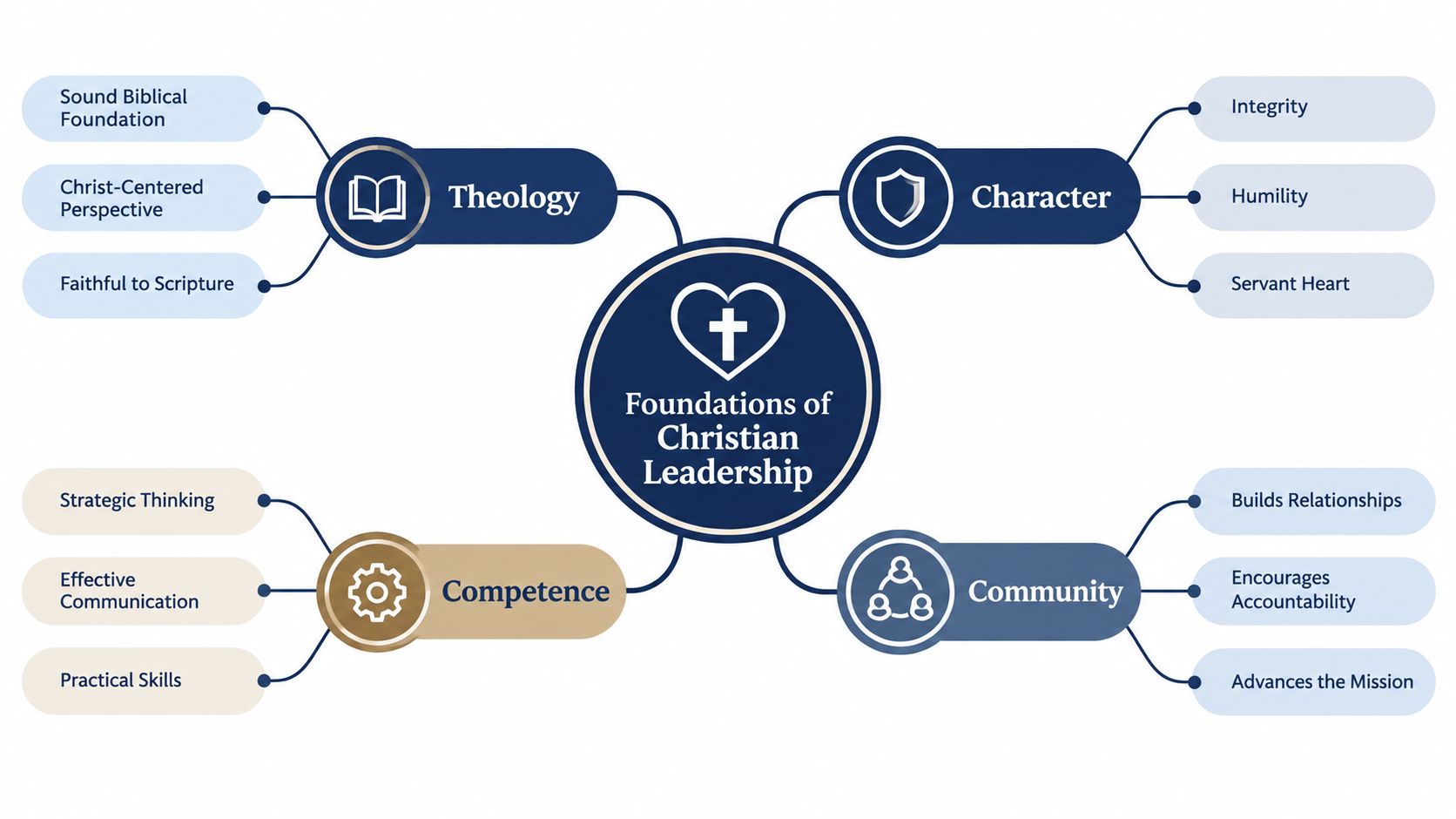
Four biblical foundations
Creation teaches that human authority is received, not owned. Humanity receives responsibility in God's world, while God remains the owner of His people and creation. Christian leadership begins with stewardship.
Covenant teaches accountability. Leaders serve within promises made by God and relationships that require faithfulness. A leader's words, conduct, and decisions should reflect the character of the God who keeps covenant.
The cross redefines power. In Mark 10:42–45, Jesus contrasts the domination of worldly rulers with the service required of His disciples. His mission is service and self-giving, so Christian authority includes sacrifice.
The church teaches shared vocation. The Spirit gives gifts for the common good. Ministry should not depend on one personality or place every responsibility on one individual. Leaders equip others to serve and refuse to make themselves indispensable.
A useful definition for a staff meeting is this: Christian leadership is the faithful stewardship of influence and responsibility, under God's authority, for the good of people and the mission of Christ. It helps a ministry recognize when leadership has drifted toward status, control, efficiency, or personal branding.
Biblical Models That Shape How We Lead
Moses doesn't begin as a confident executive. At the burning bush, he resists God's call and names his weakness. The story in Exodus shows that divine initiative precedes human ability. Moses must obey before he feels ready, and his authority remains dependent on the God who calls, speaks, and accompanies him.
His leadership also includes intercession. After Israel's rebellion in Exodus 32, Moses stands before God on behalf of the people. He doesn't treat them as a failed project to be discarded. He carries their need before the Lord, a pattern that challenges pastors who are tempted to view congregations mainly through attendance, conflict, or organizational metrics.
David offers a different portrait. He moves from shepherding to kingship, but his story never becomes a simple celebration of giftedness. His confrontation with Nathan exposes serious sin, and David's repentance shows that failure must be answered with truth before it can be answered with strategy. The psalms associated with David also give God's people words for worship, grief, confession, trust, and hope.
Leadership under weakness
Paul's ministry adds another necessary correction. In his letters, he presents weakness not as a platform for self-promotion but as a place where Christ's power becomes evident. His farewell to the Ephesian elders in Acts 20 joins teaching, vigilance, tears, endurance, and care for the church.
These leaders don't provide a formula for personality. Moses is hesitant, David is morally compromised, and Paul is marked by suffering and dependence. Their stories show that calling, failure, repentance, and weakness aren't interruptions to theological leadership. They are occasions in which a leader learns that ministry belongs to God.
A seminary classroom can use these narratives for more than devotional inspiration. Students can ask how each leader responds to correction, how each understands responsibility, and whether each leader's authority draws people toward God or toward the leader's own importance.
Biblical leadership doesn't hide human weakness. It teaches leaders to bring weakness, failure, and responsibility under God's gracious authority.
Three Leadership Frameworks Rooted in Scripture
Scripture offers several leadership images because each one corrects a different distortion. Servant leadership addresses domination. Shepherd leadership addresses detachment. Kingly leadership addresses corruption and the misuse of public responsibility.
Jesus' teaching in Mark 10:42–45 places service at the center. The disciples are tempted by status, and Jesus responds by rejecting the pattern of rulers who “lord it over” others. In His community, greatness is measured through service, and authority is directed toward the good of others. A scholarly study of Mark 10:42–45 connects this teaching with Christian service, the concept of diakonia, and the ministry of deacons (study of servant leadership in Mark 10).
The shepherd image adds personal presence. Psalm 23 presents the Lord as one who provides, guides, restores, and protects. Jesus' teaching in John 10 portrays the good shepherd as one who knows the sheep and lays down his life for them. First Peter 5:2–3 calls leaders to care for God's flock willingly and to become examples rather than domineering authorities.
Kingly leadership concerns vision, justice, and public responsibility. Scripture's royal material must be read under covenant accountability, not as permission for personal power. A ruler's task is to seek the people's good, uphold justice, and govern as one who answers to God.
Framework | Key Scriptures | Core Quality | Failure It Corrects |
|---|---|---|---|
Servant | Mark 10:42–45 | Self-giving service | Domination |
Shepherd | Psalm 23, John 10, 1 Peter 5:2–3 | Protection and presence | Detachment |
Kingly | 2 Samuel 5, Psalm 72 | Justice and responsible vision | Corruption |
Christ integrates these images. He serves without becoming passive, shepherds without becoming distant, and exercises authority without becoming corrupt. Ministry leaders therefore need more than a preferred leadership style. They need Christ-shaped discernment about when to listen, protect, decide, confront, and sacrifice.
Servant Leadership as a Christ-Centered Practice
Servant leadership isn't merely a management theory that churches have imported from the business world. In Christian theology, it arises from Christ's identity and mission. Matthew 20:25–28 and Mark 10:43–45 show Jesus correcting the desire for status and directing His followers toward service. He doesn't erase responsibility. He changes the purpose of authority.
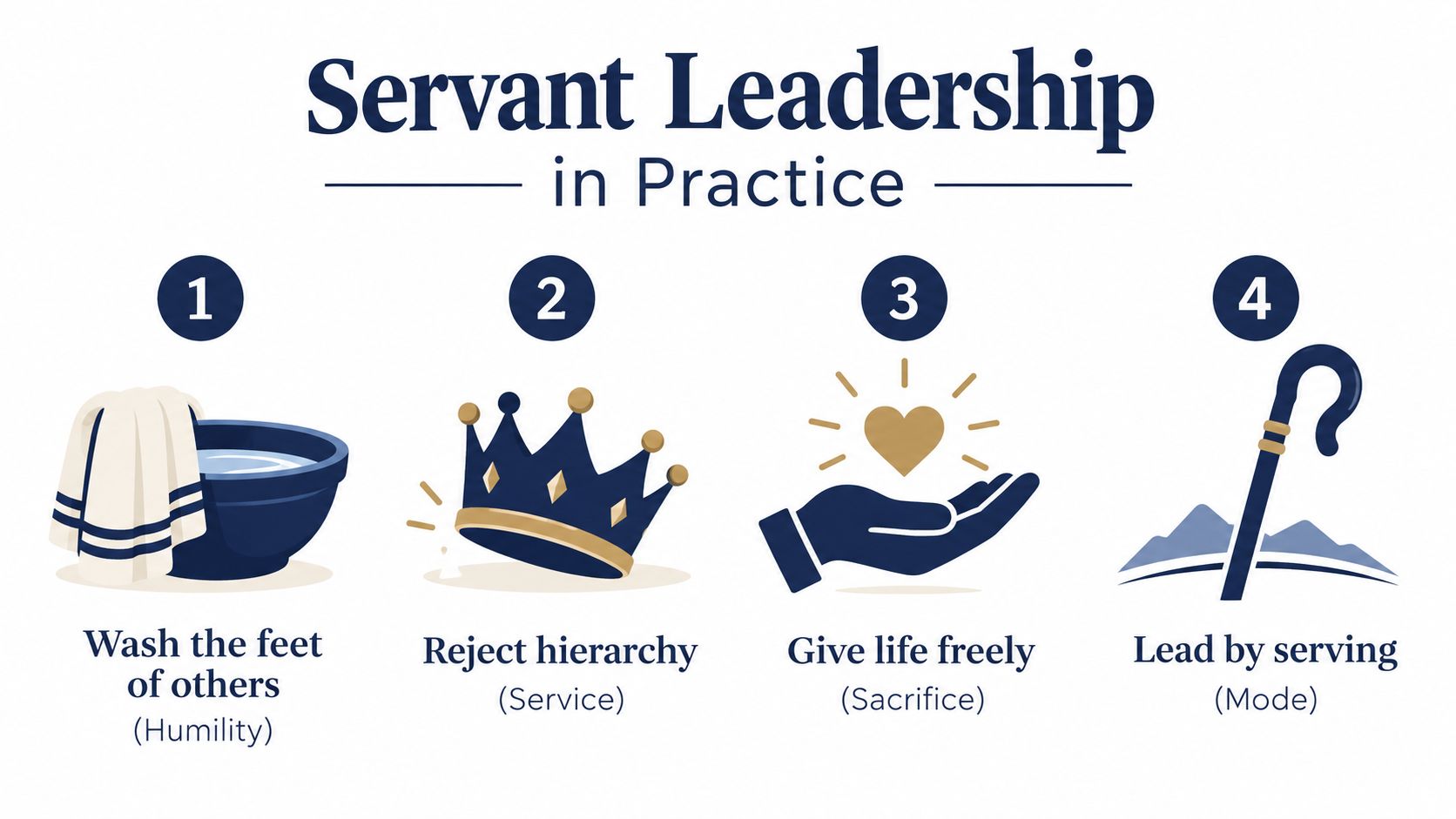
Six practices leaders can observe
Yield preferences for the team's good. A servant leader doesn't need every decision to reflect personal taste. Choosing a workable song, schedule, or ministry process may require surrendering a preference so others can participate faithfully.
Listen before directing. Jesus asked questions, received people who interrupted His plans, and responded to the person in front of Him. Listening doesn't mean avoiding decisions. It means refusing to decide from assumption alone.
Absorb complaints without retaliation. Leaders still need boundaries and truthful correction, but they shouldn't punish people for raising concerns. A complaint may reveal grief, confusion, injustice, or a process that needs attention.
Do unseen work with joy. Christ's model removes the false division between visible ministry and humble tasks. Preparing a room, checking on a discouraged volunteer, or cleaning after an event can express the same love as public teaching.
Mentor successors instead of building dependence. A leader who must remain indispensable has confused influence with ownership. Servant leadership equips others to exercise their gifts for the common good.
Accept costly decisions for the flock's benefit. Service sometimes requires difficult truth, patient reconciliation, or a decision that protects vulnerable people even when it creates inconvenience for the leader.
A 2023 peer-reviewed study describes servant leadership as relational, ethical, emotional, and spiritual, with an emphasis on enabling followers to grow into what they can become (peer-reviewed study of servant leadership). That description gives churches observable questions about trust, integrity, emotional attentiveness, spiritual direction, and the development of others.
Ask yourself: Are people becoming more faithful and capable through my leadership, or more dependent on my personality?
How This Theology Developed Through Church History
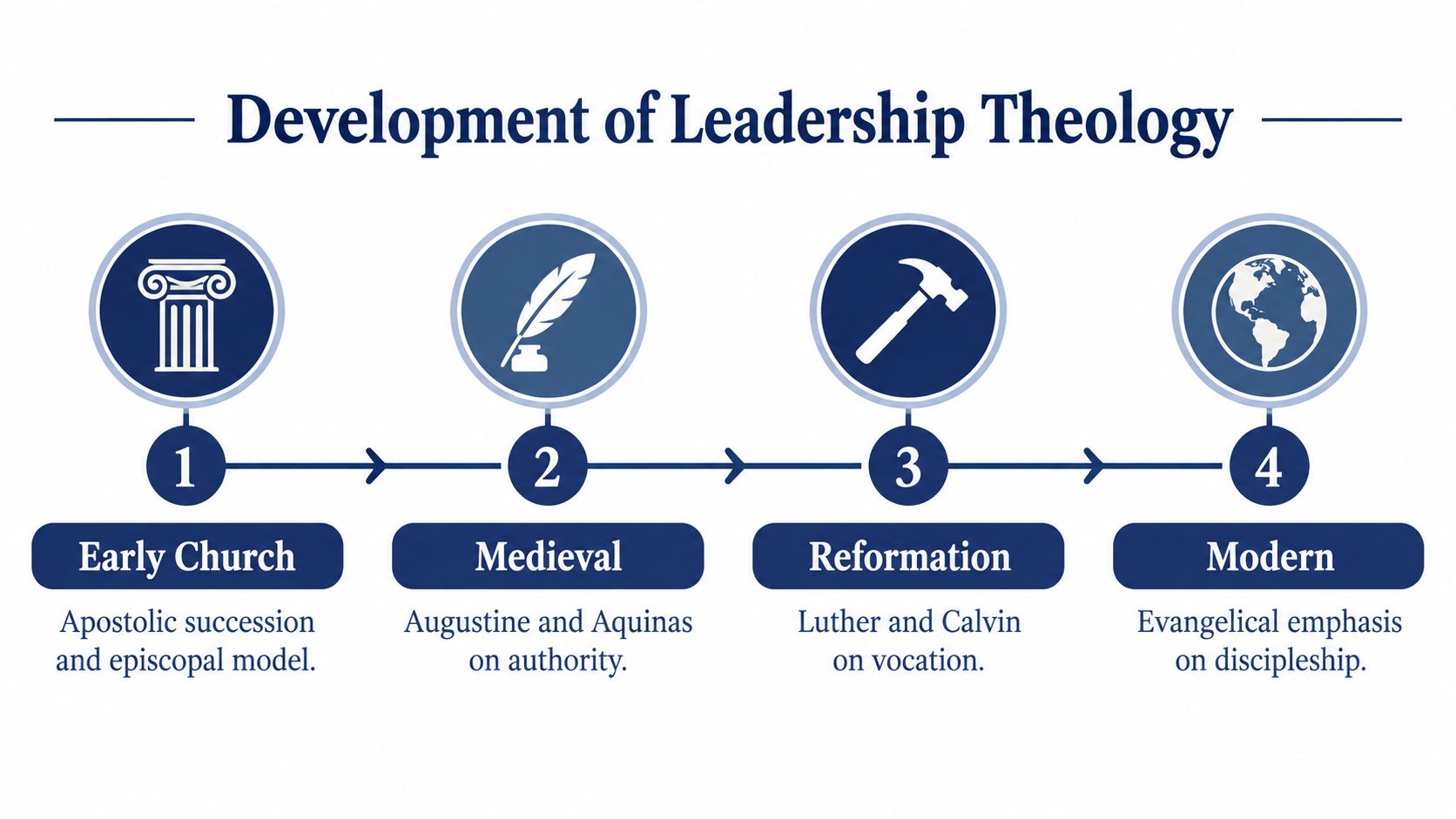
A pastor preparing a sermon, a seminarian learning to lead a meeting, and a bishop examining a church's care for the vulnerable all face the same question: what kind of authority reflects Christ? Christian leadership has never been treated as a value-neutral technique. Across the centuries, churches have returned to Scripture to examine who may lead, how authority should be exercised, and how leaders should be formed.
Early Christian communities gave sustained attention to teaching, oversight, worship, discipline, and care. Their patterns remind us that leadership served the worshiping community rather than standing apart from it.
Benedictine communities later connected leadership with disciplined communal life through the Rule of Benedict. Prayer, moral formation, obedience, and daily work belonged together. The abbot's authority was therefore tested by responsibility for the community, not merely by rank.
The Reformation brought another important question. Martin Luther's doctrine of vocation challenged the assumption that only clergy served God. Ordinary believers also received callings through which they could serve neighbors and participate in God's work. That shift shaped how Christians understood pastoral responsibility, Scripture, and the church's life.
These developments do not form a neat story in which one period solved the failures of the previous one. Each tradition carries strengths and blind spots. A church may confess clear doctrine while neglecting pastoral care. Another may cultivate warmth while lacking accountability. A ministry may celebrate shared gifts without establishing responsible decisions.
What historical awareness contributes
Historical study helps ministry students distinguish biblical principles from inherited customs. It also teaches humility. Leadership habits can feel self-evident because a tradition, culture, or institution formed them, not because they represent the only faithful approach.
A review of the development of leadership theology describes the field's movement toward understanding leadership as a vocation shaped by Christian doctrine and communal mission. Historical awareness gives that idea texture by showing how communities tested authority through worship, formation, service, and accountability.
A strong seminary curriculum places biblical interpretation, theology, church history, spiritual formation, ethics, and supervised practice in conversation. Students learn to examine whether a leadership model is faithful to Scripture, suitable for its church context, and visible in concrete behavior.
Applying Theology of Leadership in Real Ministry
A theology of leadership becomes credible when it changes the way a pastor prepares, listens, decides, rests, and develops others. A weekly rhythm can help leaders notice whether their ministry is being shaped by shepherding and service or by anxiety and performance.
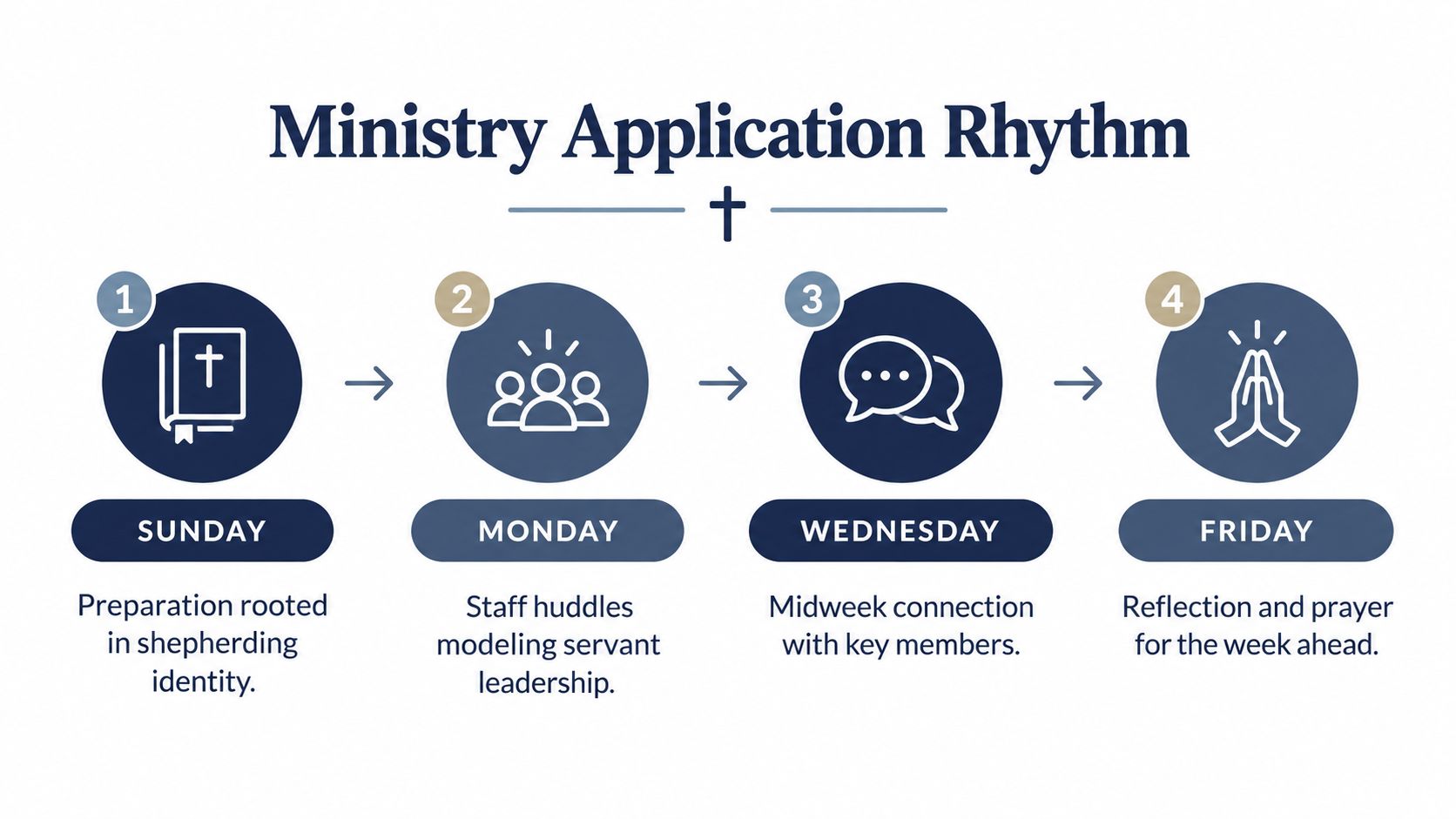
A weekly rhythm for pastors
Sunday preparation, shepherding identity. Read Psalm 23 not only as material for a sermon, but as a reminder that the congregation belongs first to the Lord. Ask, “Am I preparing to perform for people, or to serve people entrusted to God's care?”
Staff and volunteer huddles, servant leadership. Use Mark 10:43–45 to shape the tone of meetings. Invite honest observations, clarify responsibility, and identify who needs support rather than treating the huddle as a venue for one-way instruction. Ask, “Who will be strengthened by the way I lead this conversation?”
Midweek pastoral care, personal presence. First Thessalonians 2:7–8 presents ministry through tender, relational language. Make room for a call, visit, prayer conversation, or attentive message that isn't tied to an immediate organizational objective. Ask, “Do the people I lead experience my care as personal, or only as functional?”
Sabbath and solitude, surrendered authority. Luke 5:16 shows Jesus withdrawing to pray. Rest doesn't mean neglecting responsibility. It acknowledges that the church's life doesn't depend entirely on the leader's constant activity. Ask, “What am I trying to control that I need to place before God?”
For ministry leaders without a pulpit, the same principles apply. An executive can begin a board meeting with the people and mission behind the agenda. A ministry director can equip volunteers by admitting uncertainty and sharing responsibility. A Christian entrepreneur or organizational leader can seek communities where faith, work, and ethical decision-making receive serious attention, including the ForumSpace directory entry as one possible resource for connecting with faith-driven professionals.
A planning review can also include the vision-casting resource for churches, especially when a ministry needs to connect mission, communication, and shared participation.
A one-page self-audit
Before planning the week, write brief answers to these questions:
Calling: What responsibility has God entrusted to me in this season?
Character: Where might fear, pride, resentment, or ambition be shaping my decisions?
Community: Whose gifts have I overlooked or failed to develop?
Protection: What ethical, spiritual, or relational risk needs attention?
Presence: Which person needs care rather than another program?
Rest: What practice will help me receive my limits as part of faithful discipleship?
Honest Questions Leaders Are Asking Right Now
A thin theology of leadership struggles when new tools and old pressures expose its assumptions. Two questions deserve particular attention: how churches should govern artificial intelligence, and how churches should care for the mental health of their leaders.
Who remains responsible when churches use AI
A 2025 survey of more than 600 pastors and church staff across over 20 denominations reported that 61% used AI tools daily or weekly, compared with 43% the previous year, and that 64% used AI for sermon preparation. The same report stated that 73% of churches had no AI policy, while 12% of pastors felt comfortable teaching congregants how to use AI ethically (2025 survey of AI use among pastors and church staff). These figures describe a particular survey and shouldn't be treated as a universal picture of every church.
The central issue isn't whether a tool can save time. It is whether leaders remain accountable for truth, authorship, privacy, bias, pastoral presence, and the formation of disciples. A church that uses AI for communication or sermon preparation still needs a human leader who can examine the content, disclose meaningful use when appropriate, protect confidential information, and refuse material that distorts Scripture or harms people.
Ask two questions:
Discernment: Does this tool help us serve people, or does it mainly help us increase output?
Accountability: Who will answer if the tool produces false, biased, or pastorally damaging content?
When resilience becomes a substitute for care
Clergy well-being also requires more than encouragement to endure. Duke's 2025 clergy well-being report found that 72% of clergy reported high positive mental health, compared with 70% in 2023 (Duke's 2025 clergy well-being report). That finding doesn't prove that ministry systems are healthy. It invites a more careful question about which protective practices help some leaders flourish while others remain vulnerable.
Churches should connect biblical teaching about Sabbath, embodied limits, shared burdens, and mutual submission with practical structures such as peer consultation, confidential counseling, appropriate leave, succession planning, and transparent responses to misconduct. Perseverance is a Christian virtue, but it mustn't become a spiritual-sounding excuse for avoidable harm.
Ask two more questions:
Structure: Does our ministry culture make honest confession and help-seeking safer, or does it reward concealment?
Responsibility: What obligations do the church and governing bodies carry for preventing unnecessary harm?
Each church should identify another modern gap. It might involve plagiarism in preaching, financial opacity, political partisanship, or the misuse of authority. The answer shouldn't come from trend pieces alone. Let Scripture, the example of Christ, accountable community, and careful theological reflection form the verdict.
A sound theology of leadership prepares ministry leaders to use tools wisely, receive correction humbly, protect people attentively, and serve Christ without confusing visibility with faithfulness. It equips leaders to impact the world for Christ by training hearts and minds for kingdom service, uniting scholarship, spiritual formation, and hands-on ministry.
The Bible Seminary offers Bible-centered graduate education, ministry leadership preparation, theological study, and flexible learning pathways for people serving or preparing to serve in Christ-centered ministry. Explore how its academic and practical formation can help you grow as a faithful leader, then visit The Bible Seminary to take your next step.