
What Is the Purpose of the Church and How It Shapes You

Many people can describe what happens in a church building, but can they explain what is the purpose of the church beyond a worship service? If the answer is only “to hold Sunday gatherings,” we've reduced a living body of believers to an event. If the answer is only “to serve the community,” we may lose sight of the gospel that gives Christian service its meaning.
The church is a worshiping community, a discipling family, a praying people, and a mission-sending body. These purposes belong together. Worship directs us toward God, teaching shapes our minds and character, fellowship gives faith a shared life, prayer expresses dependence on the Spirit, and mission carries the good news of Jesus Christ into the world.
This question matters because many people feel uncertain about church. Some have experienced sincere community but little biblical formation. Others have heard strong preaching but found no meaningful belonging. Some wonder whether their congregation still has a purpose in a culture marked by isolation, distrust, and rapid change.
A biblical answer helps us evaluate both our churches and ourselves. It shows why gathering matters, why serving matters, why leaders need training, and why every believer has a place in the body of Christ. It also gives future pastors, teachers, missionaries, counselors, and ministry leaders a framework for faithful service.
We'll begin with the church's identity, then trace its central purposes in Scripture, consider how those purposes have developed across history, and apply them to everyday congregational life. Along the way, we'll keep one conviction in view: Christ forms his people so they can worship God faithfully, build one another up, and bear witness to the gospel.
Understanding What the Church Is Biblically
The church isn't first a building, denomination, program, or weekly appointment. In the New Testament, the word commonly translated “church” refers to an assembly or gathering of people. The church is therefore defined by people called together under the lordship of Jesus Christ.
That identity changes how we understand purpose. A building can host ministry, but it can't worship. A schedule can organize activities, but it can't love a neighbor. The church exists as a people who belong to God through Christ and who share life with one another through the Holy Spirit.
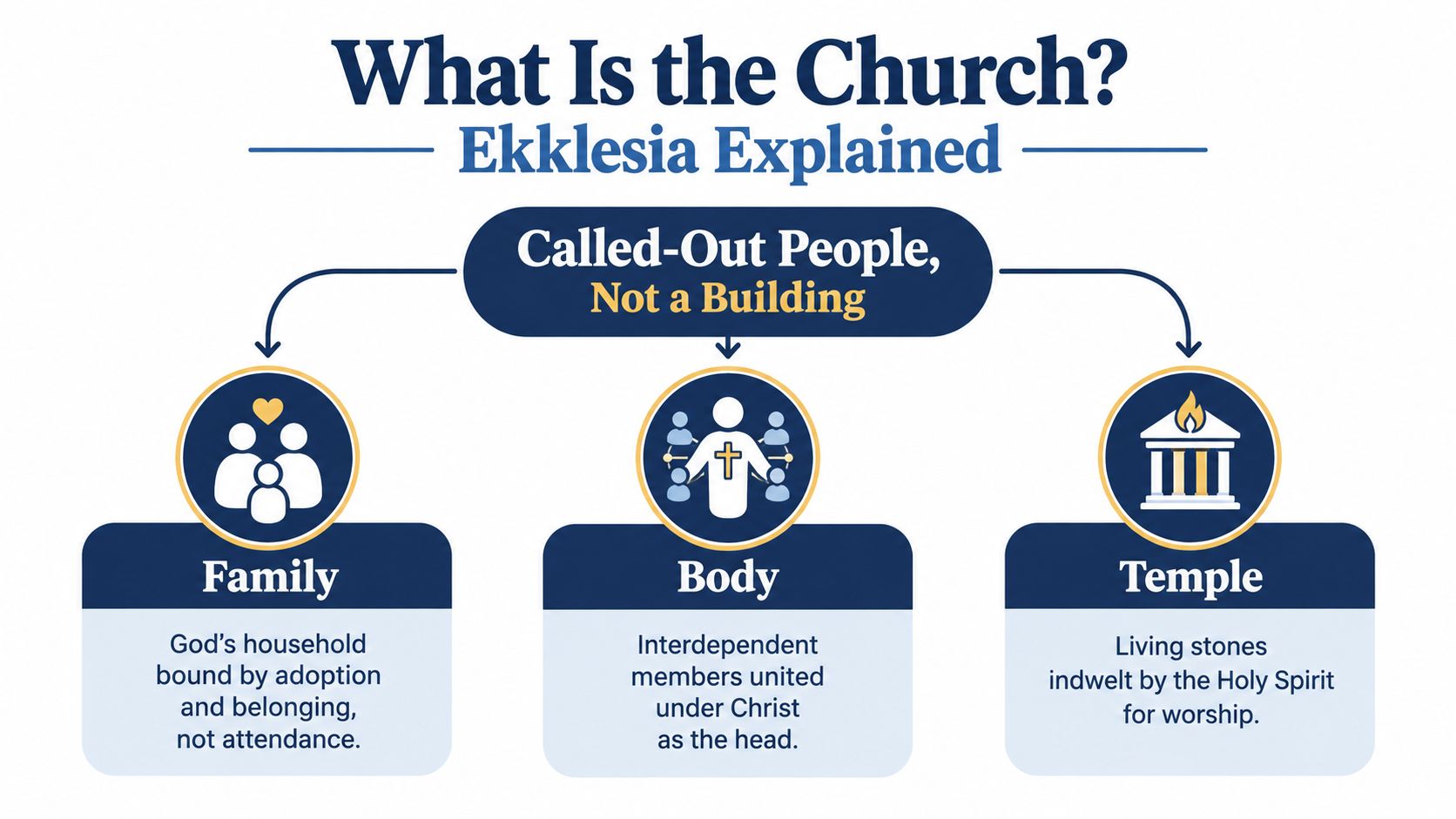
Three biblical pictures of the church
Scripture uses several images to help us grasp this identity.
Family: Believers are received into God's household. This language emphasizes adoption, belonging, responsibility, and care. Church members aren't consumers choosing religious services. They're brothers and sisters learning to love one another.
Body: Christ is the head, and believers are members with different gifts and responsibilities. Paul's teaching in 1 Corinthians 12 shows that no faithful member is unnecessary because their role is less visible.
Temple: In the New Testament, God's presence is associated with his people. Believers are described as living stones being built into a spiritual house, and the Spirit dwells among them. This makes holiness, worship, and mutual care central to church life.
These images also protect us from two opposite mistakes. One mistake treats the church as an invisible idea with no embodied relationships. The other treats it as an institution whose programs matter more than its people. Biblical church life is both spiritual and concrete. It includes doctrine, prayer, meals, generosity, leadership, correction, and service.
Universal and local
The church is universal because all who belong to Christ are part of one people across cultures and generations. It's local because disciples gather in particular places with particular leaders, needs, neighbors, and opportunities.
A congregation in Katy, Texas, won't have exactly the same ministry expression as a rural congregation, an immigrant church, or a congregation serving a university community. Yet each can pursue the same biblical identity. The setting may change, but Christ remains the head and Scripture remains the foundation.
The Core Purposes of the Church in Scripture
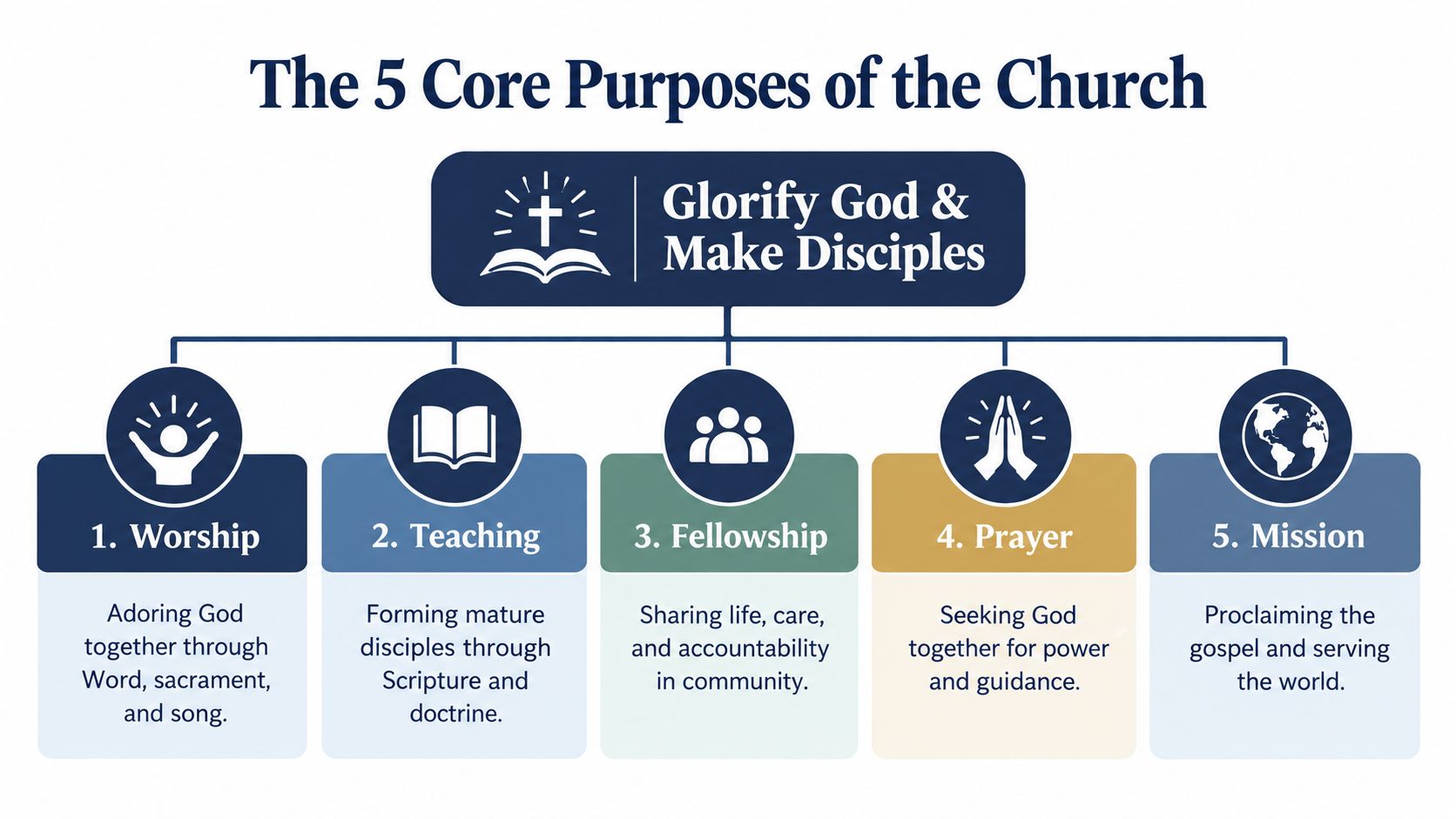
A healthy church doesn't treat worship, teaching, fellowship, prayer, and mission as competing departments. These practices form an equipping ecosystem. Worship gives the church its center, teaching gives it truth, fellowship gives it shared life, prayer gives it dependence, and mission gives it direction beyond itself.
Acts 2:42 offers a concise picture of the earliest believers:
“They devoted themselves to the apostles' teaching, to the fellowship, to the breaking of bread, and to prayer.”Acts 2:42, CSB
This verse names four recurring rhythms. The church listened to authoritative teaching, shared life together, broke bread, and prayed. Worship is woven through all four, because the believers gathered around the risen Christ rather than around personal preference.
Worship as the church's center
Worship is more than music. It includes hearing and responding to God's Word, receiving the ordinances Christ gave his church, confessing sin, giving thanks, and offering our whole lives to God. Corporate worship teaches us whom we serve and reorders our desires around God's glory.
Teaching and formation
The church teaches so believers can know the truth, recognize error, obey Christ, and mature in character. Ephesians 4:11–13 connects church leadership with this work:
“To equip the saints for the work of ministry, to build up the body of Christ.”Ephesians 4:11–13, ESV
Teaching isn't complete when people can repeat theological terms. It reaches its goal when Scripture shapes decisions, relationships, habits, and ministry.
Fellowship and prayer
Fellowship means more than friendly conversation after a service. It involves sharing burdens, practicing hospitality, correcting one another with gentleness, and remaining present through suffering. Prayer acknowledges that the church can't fulfill its calling through technique or effort alone.
The breaking of bread in Acts points toward shared meals and the church's sacramental life. Together, these practices make Christian faith visible and durable.
Mission and disciple-making
Jesus gives the church its outward direction in Matthew 28:18–20. He claims all authority, commands his followers to go, tells them to make disciples of all nations, calls them to baptize, and instructs them to teach obedience to everything he commanded. The Great Commission passage therefore includes proclamation, incorporation into the church, and lifelong formation.
A practical test: A church is healthiest when its gathered life prepares believers for faithful witness in ordinary life.
Mission isn't an optional project for a specialized group. It includes evangelism, mercy, justice, reconciliation, hospitality, vocational faithfulness, and the sending of trained leaders. The church gathers to worship and be formed, then scatters to serve and testify.
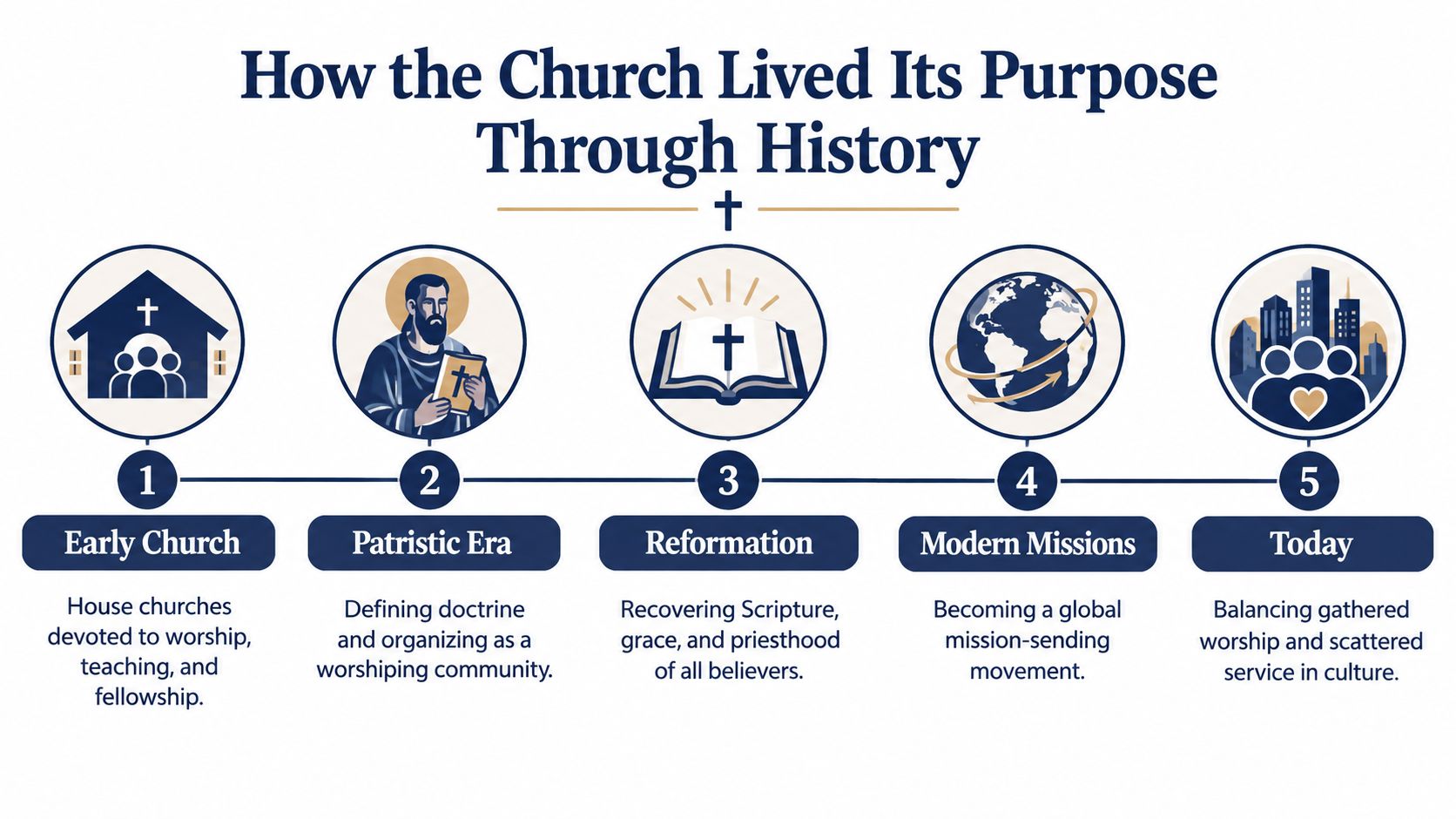
How the Church Has Lived Its Purpose Through History
Historically, Christians have understood the church as both a worshiping community and a mission-sending institution. That dual identity has remained steady even as the church's geography, structures, languages, and cultural settings have changed.
The shift in global Christian distribution makes this especially clear. In 1900, more than 80% of the world's Christians lived in Europe or North America, while today only about 25% do, according to Lausanne's 2024 missions reporting. Christianity is no longer centered primarily in the regions that shaped much of modern Western theology and church administration.
A global mission mandate
Lausanne's reporting describes a world with about 450,000 Christian missionaries, yet roughly 97% are sent to people who already have access to the gospel. At the same time, more than 40% of the world remains unevangelized, and about 3.34 billion people have still not heard the gospel. These figures don't diminish the work already being done. They clarify the continuing need for churches to pray, train, send, and partner across cultures.
The theological lesson is important. The church can't define faithfulness by preserving one cultural expression or remaining focused on one geographic center. Christ's command reaches all nations, and the global church now gives visible evidence that Christian witness belongs to every major region.
Formation across generations
The church's historical purpose has also included preserving Scripture, teaching doctrine, and equipping leaders. Church statistics literature from the Church of England and Gordon-Conwell describes statistics as tools for understanding the church's past, analyzing its present, and planning its future. The Church of England used statistical work to help estimate clergy needs and maintain ministry strength, while Gordon-Conwell notes the value of comparing generations and tracing expansion in church history. This historical methodology shows that organization can serve spiritual faithfulness when it supports wise stewardship.
Structures don't replace the Spirit's work. They can, however, help churches recognize needs, prepare leaders, and sustain ministry beyond one generation. A congregation that teaches children, mentors emerging leaders, and sends workers into new contexts participates in the same enduring purpose as the earliest Christian communities.
What the Purposes Look Like in Everyday Church Life
The purpose of the church becomes easier to understand when we watch it unfold in ordinary relationships. A new believer arrives uncertain and carries questions about prayer, Scripture, suffering, and Christian community. A mature member welcomes that person, a teacher opens the Bible carefully, a small group provides friendship, and the congregation prays for growth. Mission begins before anyone travels overseas. It starts when believers help one another follow Jesus faithfully.
A congregation as a network of trust
Churches create social capital through repeated relationships and shared responsibilities. Research on churches as civil-society institutions describes both bonding ties within congregations and bridging ties to outside groups, connecting church life with information sharing, public performance, social justice, reconciliation, and peacebuilding. The research on churches and civil society helps explain why a congregation's ministry can reach beyond its Sunday gathering.
A church may organize volunteers to support families, share information about community needs, accompany people through hardship, or cooperate with organizations serving the public. These actions don't turn the church into a political club or social agency. They show how Christian fellowship can create trustworthy relationships that serve neighbors.
A farming-community case study found that church social capital helped move the community from dependence toward greater self-reliance through joint development initiatives. Another long-term study concluded that church presence and activity can provide a foundational bedrock for social capital in small communities, particularly where formal institutions are weak or fragmented. The community-development research offers a useful reminder that faithful presence can have stabilizing effects.
Ordinary practices with spiritual weight
Consider how the five purposes appear in a typical week:
Worship: The congregation sings, reads Scripture publicly, hears preaching, confesses, gives thanks, and responds to God.
Teaching: A pastor, ministry leader, or Bible study facilitator helps people interpret a passage in context and obey its wisdom.
Fellowship: Members share meals, visit the sick, welcome newcomers, and bear one another's burdens.
Prayer: The church intercedes for families, local needs, persecuted believers, missionaries, and gospel opportunities.
Mission: Members serve neighbors, explain the gospel, mentor others, and participate in works of mercy and justice.
Music ministries can also support this shared life when they serve congregational worship rather than performance alone. Leaders who are organizing or renewing a choir may benefit from this practical guide to buying choir robes, especially when they're considering consistency, care, and participation across the group.
The same principle applies to doctrine. Practicing Christian doctrine becomes meaningful when belief shapes worship, relationships, leadership, and public service.
Common Misconceptions About the Purpose of the Church
The church is only a Sunday service
Sunday worship matters, but it's the gathered expression of a larger life. A church that sings and listens together yet never practices care, discipleship, prayer, or mission has separated activities that Scripture holds together.
The church is only a social club
Belonging matters because God creates a people, not isolated religious consumers. Yet Christian fellowship has a defined center. The church gathers around Jesus Christ, receives the authority of Scripture, and calls people toward faith and obedience.
The church is only a mission agency
Mission is essential, but the church can't sustain public witness without worship, teaching, prayer, and mutual formation. A congregation that sends people without preparing them may confuse activity with maturity.
Every church should look the same
Purpose is shared, but expression differs. A small congregation may know members personally and rely on broad volunteer participation. A larger congregation may offer specialized ministries, broader training, and more complex systems. Neither size automatically proves faithfulness.
Recent engagement data also cautions against simplistic conclusions. In 2025, average in-person attendance rose for the first time in about 25 years, but the gains were uneven. Forty-three percent of congregations grew by at least 5%, while 46% declined by at least 5%, according to recent congregational research. These figures describe varied experiences, not one universal story.
Generational and gender patterns add another layer. Barna reported in 2025 that men attended church more regularly than women for the first time in 25 years, with 43% of men and 36% of women reporting regular attendance, while Gen Z and Millennial men particularly contributed to the shift. Other recent research found the median in-person congregation rose to 70 adults, with growth concentrated in larger churches and smaller churches more likely to keep shrinking. The reporting on these attendance patterns should lead us to ask better questions about context, discipleship, and access.
PRRI data further complicates broad revival claims. Only 26% of Americans attended weekly in 2025, unchanged from 2024, according to the same reporting. A church can experience renewed local interest without broad institutional recovery, and a congregation can serve its calling faithfully even when its attendance is modest.
Living the Purpose and Taking Your Next Step
You don't need a platform to participate in the church's purpose. Begin by receiving the Word attentively, joining a community where people know you, praying with others, and accepting a concrete opportunity to serve. Then ask how your work, family, neighborhood, and relationships can become places of faithful witness.
Church leaders can use the five purposes as a diagnostic tool. Does worship center on God and the gospel? Does teaching produce obedience? Does fellowship include the vulnerable? Does prayer shape decisions? Does mission move beyond church activities into the surrounding community and across cultures?
Future leaders need more than information. They need training hearts and minds for kingdom service, spiritual formation that produces humility, and hands-on ministry experience that connects classroom learning with real people. The church needs pastors, teachers, counselors, missionaries, church planters, worship leaders, and educators who can unite biblical conviction with patient service.
At The Bible Seminary, we understand this work as equipping leaders to impact the world for Christ. Bible-based, Christ-centered, Spirit-led, and ministry-focused education can help you read Scripture carefully, think theologically, serve wisely, and join the global mission of the church. Where the Bible comes alive, archaeology and Scripture can also come together responsibly, helping students and visitors engage the historical world of the biblical text.
The purpose of the church isn't merely to maintain an institution or fill a calendar. It's to glorify God by forming a people who know Christ, love one another, proclaim the gospel, and serve their neighbors with hope.
Explore The Bible Seminary to learn about Bible-centered degree programs, certificates, and ministry training that unite scholarship, spiritual formation, and hands-on service. Whether you're preparing for pastoral ministry, deepening your biblical foundation, or seeking resources for your church, take the next step toward faithful kingdom service with us.