
What Is Premillennialism and Why It Matters Today

Premillennialism is the Christian view that Jesus Christ will physically return before a future 1,000-year reign on earth described in Revelation 20. In contemporary evangelical circles, it remains a major position. In one 2023 EFCA doctrinal survey, 76% of respondents identified as premillennial, including 28% dispensational premillennial and 48% historic premillennial.
Why does that matter? Because many Christians think the only real question is whether Jesus will return at all. Premillennialism says the order of end-times events matters, and that order shapes how you read Revelation, the prophets, the Gospels, and even the promises of bodily resurrection and future hope.
This is also where confusion usually starts. Some believers hear “premillennialism” and assume it always means one exact chart of the future, one rapture view, or one approach to Israel and the church. That isn't so. Churches that agree Christ returns before the millennium still differ on the tribulation, the rapture, and how prophetic promises should be arranged.
At The Bible Seminary, we want to help readers think carefully, biblically, and hopefully about difficult doctrines. Equipping leaders to impact the world for Christ includes learning how to handle topics like eschatology without fear, speculation, or unnecessary division. When we read Scripture well, hard doctrines become occasions for worship, patience, and steady confidence in Christ.
What Premillennialism Actually Means
Premillennialism is the conviction that Jesus Christ will return bodily before a literal thousand-year reign on earth. That simple sentence answers the basic question, “What is premillennialism?”
The word itself tells you the sequence
The term breaks down into two parts:
Pre means before.
Millennial points to the millennium, the thousand years of Revelation 20.
So the heart of premillennialism is sequence. Christ's return comes before the millennium, not after it.
That may sound like a small detail, but it changes the whole storyline. Premillennialism teaches that the kingdom in its millennial form is not produced by human progress, political reform, or gradual moral improvement. Christ's return is the event that brings it about. Britannica summarizes the view this way in its article on premillennialism: Jesus' Second Coming precedes the millennium and initiates that reign.
Revelation 20 is the key passage
Premillennialists usually anchor their reading in Revelation 20:1-6. In that passage, John describes Satan being bound, thrones being set, the saints reigning with Christ, and a thousand years being named repeatedly.
“They came to life and reigned with Christ for a thousand years.” (Revelation 20:4, CSB)
Readers often get stuck here because Revelation contains symbols. That's true. But premillennialists argue that symbolic imagery can still point to real future events. In this case, they understand Revelation 20 to describe an actual future reign of Christ on earth.
A basic historic premillennial sequence often looks like this:
Tribulation and conflict unfold in history.
Christ returns in power and glory.
Satan is bound.
The saints reign with Christ for the millennium.
Satan is released briefly, followed by final judgment and the eternal state.
That broad sequence is reflected in a summary of historic premillennial chronology at Thirdmill.
What premillennialism is not
Premillennialism is not a different gospel. It doesn't deny salvation by grace through faith, and it doesn't replace heaven with a political program. It is an eschatological framework. In plain terms, it's a way of understanding how God brings history to its appointed goal in Christ.
It also isn't “belief in the Second Coming.” All orthodox Christians affirm Christ's return. The difference lies in what follows, how Revelation 20 should be read, and whether the millennium is future and earthly or symbolic and present.
A helpful rule: When someone says they're premillennial, ask what they mean by the millennium, the tribulation, and the rapture. The label alone doesn't answer all three questions.
The next layer of the discussion is biblical. Why do premillennialists think Scripture points to a future kingdom in this way?
The Biblical Case for a Future Millennium
Premillennialists don't build their view from one verse alone. They read Revelation 20 as the clearest millennial passage, but they connect it to the broader biblical storyline of kingdom, resurrection, judgment, and restoration.
Revelation 20 in its plain force
The strongest textual anchor is still Revelation 20:1-6. Premillennial readers notice the concrete elements in the chapter: Satan is bound, martyrs come to life, thrones are occupied, and a thousand years is named as a distinct period. They take that as future-oriented, not merely a symbolic description of the church age.
“Blessed and holy is the one who shares in the first resurrection.” (Revelation 20:6, ESV)
That phrase matters. Premillennialists commonly argue that if the resurrection of the saints is bodily and future, the reign associated with it is also future and concrete.
The larger kingdom story
Revelation 20 doesn't stand by itself. Premillennial readings often draw support from several major passages:
Daniel 2 and Daniel 7 portray God's kingdom overcoming earthly powers and giving dominion to the Son of Man.
Isaiah 11 and Isaiah 65 describe the Messiah's righteous rule and a renewed creation.
Ezekiel 37 presents national restoration imagery that many premillennial interpreters connect to Israel's future.
1 Corinthians 15:20-28 speaks of Christ reigning until all enemies are placed under his feet, with death as the last enemy to be destroyed.
These passages don't all mention the millennium directly. Still, premillennialists see them as fitting naturally with a future phase of Christ's reign before the final eternal state.
How premillennialists read prophecy
Premillennial interpretation usually rests on a few habits of reading:
Literal-grammatical priority means interpreters try to read prophetic texts according to normal language unless the text itself signals symbolism.
Kingdom stages means they recognize that God's kingdom is already present in one sense, but not yet fully manifested in history.
Israel and the church remain a live interpretive question, especially when Old Testament land and national promises appear to await fulfillment.
Britannica's discussion of patristic and medieval millennialism also notes that premillennialism expects escalating trouble and divine intervention before the kingdom arrives, rather than gradual improvement producing the kingdom.
A fair word about disagreement
Amillennialists push back at this point. They often read Revelation 20 symbolically, understand the binding of Satan in relation to Christ's present reign, and see the millennium as the current church age rather than a future earthly kingdom. Postmillennialists also differ, though in another direction, by expecting the gospel to bring broad historical blessing before Christ returns.
That disagreement is real. But it's also worth noting that all three views aim to honor Scripture and confess the same returning Lord.
Historic and Dispensational Premillennialism Compared
Why do two Christians both say, “I'm premillennial,” and then disagree about the rapture, the tribulation, and Israel? The answer is simple. They share the same basic map of the end, but they place some landmarks in different spots.
That distinction matters because premillennialism is more than a label. It shapes how a believer reads prophecy, connects the Old and New Testaments, and waits for Christ with hope.
What both branches affirm
Historic and dispensational premillennialists stand together on the main structure of the view:
Christ returns before the millennium
The millennium is future
Jesus' return is bodily and decisive
Revelation 20 points to a real reign of Christ
History reaches its climax through God's intervention
So the disagreement is family disagreement, not a completely different faith in the future. Both branches expect the world's story to end with the appearing of Jesus, not with human progress bringing in the kingdom.
Where they differ
The clearest differences show up in three connected questions. How should we relate Israel and the church? When does the rapture happen in relation to tribulation? How should Old Testament kingdom promises be applied?
Historic premillennialism usually stresses the unity of God's people across redemptive history. Dispensational premillennialism usually keeps a sharper distinction between Israel and the church and therefore reads many prophetic promises as still awaiting fulfillment for ethnic Israel. If you want a fuller explanation of that framework, our article on dispensationalism explained lays out its basic structure in plain language.
The rapture question often grows out of those larger commitments. Historic premillennialists commonly place the church's gathering to Christ after a period of tribulation, or very near Christ's public return. Dispensational premillennialists commonly place the rapture before a distinct tribulation period. “Commonly” matters here, because these are patterns, not airtight rules for every writer or church.
A helpful way to picture the difference is to compare two readers using the same Bible atlas. Both agree Jesus is coming to reign. One tends to read the route as one continuous arrival of Christ with his people gathered to him. The other tends to read the route as including a prior catching up of the church and a later public return in judgment and kingdom glory.
According to the Encyclopaedia Britannica article on dispensationalism, dispensational theology took recognizable modern form in the 19th century through John Nelson Darby, and its influence spread widely through the 1909 Scofield Reference Bible. Those historical developments help explain why many people in popular evangelical settings hear “premillennialism” and immediately assume a pretribulational rapture, even though historic premillennialists do not make that assumption.
Historic vs. Dispensational Premillennialism
Feature | Historic Premillennialism | Dispensational Premillennialism |
|---|---|---|
Millennium | Future, literal reign of Christ | Future, literal reign of Christ |
Christ's return | Before the millennium | Before the millennium |
People of God | Usually stresses one people of God across redemptive history | Usually maintains a clearer distinction between Israel and the church |
Tribulation | Often expects the church to endure tribulation | Commonly expects a distinct tribulation period before the kingdom |
Rapture | Often post-tribulational or closely tied to Christ's visible return | Usually pretribulational |
Reading of prophecy | Future-oriented, with less emphasis on separate dispensations | Future-oriented, with more defined dispensational distinctions |
Why the distinction matters in church life
These differences do not stay in academic charts. They affect sermons on Isaiah and Revelation, the way Christians pray about suffering, and the way a church speaks about hope.
They also prevent a common misunderstanding. Premillennial does not automatically mean pretribulational. A report in The Christian Post's coverage of a Lifeway Research survey noted that many Protestant pastors identify as premillennial without all landing in the same place on the rapture.
For ordinary believers, that can be clarifying. Two pastors may both love Christ's appearing, both teach a future millennium, and still differ over whether the church passes through tribulation. The shared hope is Christ himself. The debated question is the sequence of events surrounding his coming.
How Premillennialism Developed Through Church History
How did a view taught by many Christians today travel from the early church, through long centuries of debate, into its modern forms? The answer is not a straight line. It is more like a river that narrows, widens, and divides into branches while still carrying the same basic question. When and how does Christ bring his kingdom to earth?
Early Christians and later shifts
Premillennialism has old roots, even if the modern labels came later. Several early Christian writers expected a future earthly reign of Christ after his return. Papias is often mentioned first, though we know his view mainly through later reports, especially Eusebius' discussion of him in Ecclesiastical History (Eusebius, Church History 3.39). Justin Martyr also described believers who expected a future millennium, while admitting that not every orthodox Christian agreed with him.
Irenaeus gives one of the clearest early witnesses. In Against Heresies, he tied the promises of resurrection, judgment, and kingdom hope to a future reign of Christ, which makes him a major source for understanding early premillennial thought (Irenaeus, Against Heresies 5.32-36). Those texts matter because they let readers see the argument close to its source, rather than relying on a modern summary alone.
That does not mean every Christian in the first centuries held the same eschatology. Church history is rarely that tidy. A better way to say it is that premillennial expectation was a visible and respected stream in early Christianity, especially among some ante-Nicene fathers, as patristic surveys often note.
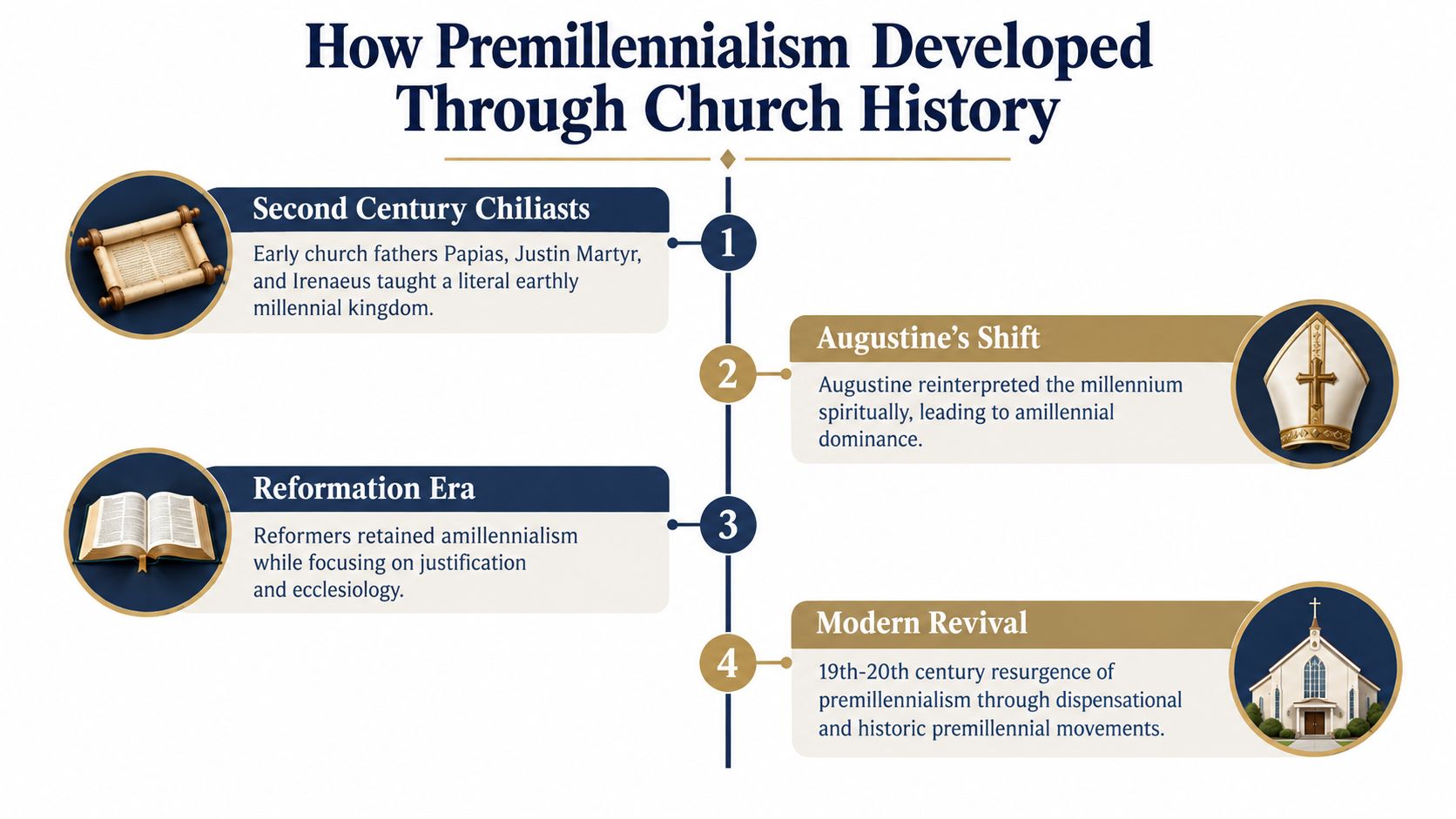
Later, the center of gravity shifted. As allegorical interpretation gained influence in some parts of the church, and as Augustine read the millennium of Revelation 20 in a more spiritual sense, amillennialism gradually became dominant in much of Christian theology. Augustine's reading worked like a change in lens. The same biblical text remained on the page, but many readers now saw the “thousand years” as describing Christ's present reign rather than a future kingdom after his return.
A story of continuity and renewal
The Reformation did not place premillennialism at the center of Protestant thought. The great battles of that era focused more on authority, grace, justification, and the shape of the church. Still, millennial hope never disappeared. It continued in smaller streams, sometimes at the margins, sometimes in revival settings, and sometimes in close study of prophecy.
In the nineteenth century, premillennialism gained fresh visibility. Dispensationalism gave it a new framework, especially through Bible conferences, reference Bibles, and later seminaries and missions movements. Historic premillennialism also remained present, though usually with less institutional spotlight. That part of the story matters because it keeps readers from assuming that premillennialism and dispensationalism are the same thing.
They are related, but not identical.
History helps ordinary Bible readers. Historic and dispensational premillennialists agree on a future return of Christ before a real millennial kingdom. They part company over questions such as Israel and the church, the structure of prophecy, and often the timing of the rapture in relation to tribulation. So the historical development of premillennialism is not only about dates and names. It explains why two Christians can both read Revelation with a future hope, love Christ's appearing, and still map the sequence differently.
Why this history helps readers today
Church history teaches patience. It reminds us that careful believers have read these passages for centuries and have not all arranged them in the same order.
It also teaches proportion. The bodily return of Christ belongs near the center of Christian hope. The exact timing of the rapture and tribulation belongs to a more debated circle. Premillennialism shapes how many Christians read prophecy, but its deepest pastoral effect is simpler than a timeline chart. It trains believers to expect a real intervention of Christ in history, a real defeat of evil, and a real kingdom that does not rise from human progress alone.
That hope is not abstract. It steadies suffering Christians, sharpens prayer, and teaches the church to say, with both confidence and humility, “Come, Lord Jesus.”
Premillennialism, Amillennialism, and Postmillennialism
Once you understand premillennialism, the natural next question is how it differs from the other major millennial views. The biggest contrasts involve timing, interpretation, and expectations for history.
Three ways Christians read the millennium
Premillennialism teaches that Christ returns before a future millennium. Amillennialism usually reads the millennium as symbolic of Christ's present heavenly reign and the church age. Postmillennialism expects the gospel to bring increasing kingdom influence in history before Christ returns.
A concise definition from the Hartford Institute for Religion Research puts the basic issue clearly. Premillennialism is the view that Christ returns before the millennium described in Revelation 20. That “pre” timing is the defining feature of the position.
Three Views of the Millennium Side by Side
Question | Premillennial | Amillennial | Postmillennial |
|---|---|---|---|
How is Revelation 20 read? | Future-oriented, with a literal thousand-year reign | Usually symbolic of the present church age | Usually symbolic of a future era of gospel success |
When does Christ return? | Before the millennium | After the symbolic millennium | After the gospel-shaped millennial era |
What brings in the kingdom age? | Christ's direct intervention | Christ's present reign through his church | Gospel expansion in history under Christ's lordship |
How is history expected to unfold? | Through tribulation and divine intervention | Mixed conflict and victory until the end | Increasing gospel influence before Christ returns |
What is the church doing now? | Witnessing, suffering, discipling, waiting in hope | Witnessing, suffering, reigning spiritually with Christ | Witnessing, discipling, expecting wider historical fruit |
How is Israel viewed? | Varies, especially between historic and dispensational forms | Often fulfilled in Christ and his people | Often similar to amillennial readings, though views vary |
What is the millennium's tone? | Future earthly reign | Present spiritual reign | Future golden age before the return |
Why this comparison helps
These are not merely abstract systems. They shape how Christians hear sermons on prophecy, pray for cultural renewal, and process seasons of hardship.
One often overlooked difference is the expected direction of history. Premillennialism generally anticipates worsening conflict before Christ establishes his kingdom. Amillennialism expects ongoing struggle between the kingdom of God and the powers of this age. Postmillennialism is more optimistic about the historical triumph of the gospel before the return of Christ.
Recent public discussion shows why that matters. Coverage summarizing Pew-reported findings noted that 40% of U.S. adults said humanity is living in the “end times,” 20% said they expect conditions to worsen before Jesus returns, and only 3% favored a postmillennial reading, as reported by Charisma News.
Pastoral note: Your millennial view doesn't determine whether you love Christ. It does influence how you connect prophecy, perseverance, and hope.
Pastoral and Practical Implications for the Church
Eschatology isn't only for classroom debates. It reaches the pulpit, the counseling room, the mission field, and the prayer meeting. Premillennial convictions, when handled responsibly, can produce steadiness rather than anxiety.
How this view shapes ministry
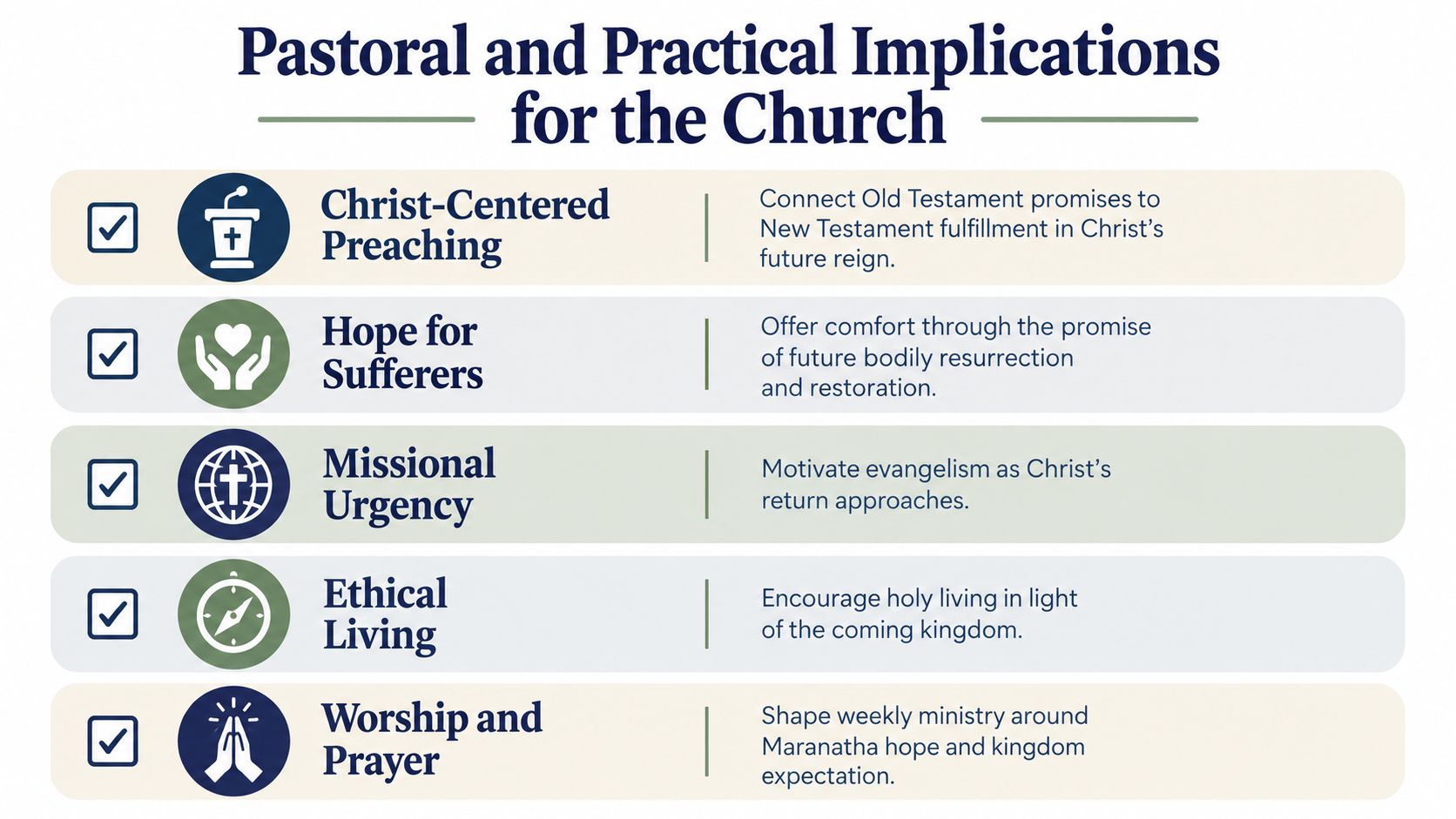
A church shaped by premillennial hope often emphasizes several practices:
Christ-centered preaching that ties Old Testament promises to their fulfillment in Jesus and his coming reign.
Comfort for suffering believers through the promise of resurrection and restoration, not mere escape from hardship.
Missional urgency because history is moving toward Christ's return and the gospel must be proclaimed.
Ethical seriousness because the coming King calls his people to holy living now.
Persistent prayer marked by longing for God's kingdom to come in fullness.
“For the Lord himself will descend from heaven with a shout.” (1 Thessalonians 4:16, ESV)
That verse doesn't settle every sequence question. It does remind the church that Christian hope is personal, bodily, and Christ-centered.
It affects ordinary discipleship
Premillennialism can help a believer think clearly about disappointment in this age. Marriage won't be perfect. Governments won't redeem the world. Ministry plans can bear fruit, yet still unfold in a broken setting. The kingdom comes in fullness because Christ comes.
That can produce realism without despair. Believers can work patiently, suffer faithfully, and serve joyfully because they know the future doesn't depend on human control.
Why training matters
Pastors need more than slogans on this topic. They need biblical theology, church history, and interpretive skill. A seminary classroom can help leaders compare views, handle Revelation carefully, and preach hope without sensationalism.
One option for that kind of study is The Bible Seminary, where students can pursue Bible-centered theological training in conversation with church history, ministry practice, and spiritual formation. That combination matters if we want to unite scholarship, spiritual formation, and hands-on ministry.
For churches, this isn't just about settling a doctrinal chart. It's about training hearts and minds for kingdom service.
Common Questions and Honest Clarifications
What questions usually surface once someone hears that premillennialism expects Christ to return before a future thousand-year reign? Two come up again and again. Does this view pull Christians away from present obedience, and does it require a single end-times chart on every detail?
Are premillennialists escapist
Premillennialism does not have to produce retreat from the world. A Christian can expect severe trouble before Christ's return and still love neighbors, pursue justice, raise children faithfully, and serve the church with patience.
In healthy teaching, future hope works like a steady horizon for a traveler. The horizon does not distract him from the road under his feet. It helps him keep walking in the right direction. In the same way, believers who expect Christ's reign should become more faithful in ordinary duties, not less.
That matters pastorally.
Some people hear “the world will not be fixed before Christ returns” and assume that effort is pointless. Premillennialism does not say that. It says human history will not reach its God-appointed goal through human progress alone. Christ must come. That conviction can produce realism without apathy.
Does every premillennialist believe in a rapture
Premillennialists generally agree that believers will be caught up to meet Christ. The main question is timing. Does that gathering happen before a period of tribulation, after it, or in a way that is coordinated with Christ's public return?
Here the difference between historic and dispensational premillennialism becomes clear. Dispensational premillennialists usually teach a pretribulational rapture. Historic premillennialists usually place the church's gathering to Christ after tribulation or closely alongside his visible return. So the word “premillennial” answers one question, when Christ returns in relation to the millennium, but it does not answer every question about the rapture.
That distinction helps readers of Scripture. It keeps a believer from assuming that one premillennial chart represents the whole view. It also encourages patience with fellow Christians who share the same broad hope in Christ's reign while arranging some passages differently.
What about Israel and the church
This is one of the clearest differences within premillennial thought. Dispensational premillennialists usually maintain a more defined distinction between Israel and the church. Historic premillennialists usually stress the deeper continuity of one redeemed people across the story of Scripture.
A simple image may help. Both views are reading the same Bible, but they place different weight on different map lines. One emphasizes distinctions that remain visible. The other emphasizes how the lines converge in Christ. That affects how each view reads Old Testament promises, Romans 11, and prophetic passages about the future.
Care is needed here. A Christian who expects a future role for ethnic Israel is not denying salvation through Christ alone. A Christian who stresses the unity of God's people is not dismissing God's covenant faithfulness. The task is to read each text in its setting and to let clearer passages guide the harder ones.
Is premillennialism always sensationalistic
It should not be.
Popular end-times teaching has sometimes trained believers to chase headlines, assign dates, or treat every global crisis as a code to crack. That approach weakens biblical judgment and often produces fear rather than hope.
A responsible premillennial reading stays anchored in the text of Scripture. It pays close attention to Revelation 20, but it also asks how the prophets, the Gospels, and the epistles speak about Christ's return, resurrection, judgment, and kingdom. The goal is not excitement. The goal is faithfulness.
Christian hope grows strongest when it is tied to Christ's promises, not to speculation.
Why this doctrine can still nourish hope
Premillennialism gives believers a future that is personal and concrete. Jesus Christ returns bodily. Evil is judged. The dead are raised. History does not drift forever. It reaches the kingdom of God through the victory of the King.
That hope shapes daily reading of the Bible. A believer starts to notice how often Scripture points forward, how often promises remain unfinished, and how often suffering is answered not by escape from the body but by resurrection and renewal. Premillennialism is not only a timeline claim. It is a way of reading the Bible with expectation that God will complete in history what he has promised in Christ.
That can steady a grieving pastor, a thoughtful student, or a tired church member. Their hope rests neither in cultural success nor in interpretive certainty on every minor detail. Their hope rests in Jesus, who will keep his word.
If you want to study doctrines like this with greater biblical depth and pastoral clarity, The Bible Seminary offers Bible-centered graduate education, certificate pathways, and ministry training that unite scholarship, spiritual formation, and hands-on service. We invite you to explore how deeper training in Scripture, theology, and church history can help you serve Christ and his church with wisdom and hope.