
What Is Dual Degree Program: A Biblical Perspective

A dual degree program enables you to complete two separate degrees, often in related fields, with limited shared coursework. In one Seton Hall pathway, the combined B.A. in History and M.S. in Business Analytics is designed for completion in five years, with 120 undergraduate credits, 9 graduate credits replacing undergraduate electives, and 21 remaining graduate credits completed in the fifth year (Seton Hall's program catalogue).
But what if the better question isn't, “How can I earn two credentials?” What if the deeper question is, “How can my education faithfully prepare me to serve Christ, strengthen His Church, and meet the needs of the people God has entrusted to me?”
For a pastor, ministry leader, educator, or prospective seminary student, choosing a degree path can feel daunting. You may want deeper biblical knowledge and stronger practical skills, yet you may not want to repeat years of similar coursework. A dual degree can offer an intentional way to bring complementary areas of study together, but it requires prayerful discernment, careful planning, and a clear understanding of the rules.
Understanding the Dual Degree Concept
Could one course of study prepare you for both deeper theological work and a practical ministry responsibility? A pastor may recognize the need for stronger counseling support, more effective leadership development, better educational programming, or greater cross-cultural awareness. Beginning a second program from the start can feel overwhelming, especially when time and energy are already committed to serving others.
A dual degree program brings together two separately approved academic programs. You are admitted to both, complete the requirements for each, and receive two distinct degrees or completion credentials. Some approved courses may count toward both degrees, but each program retains its own learning outcomes, progression rules, and graduation requirements (Northern Arizona University's dual-degree policy).
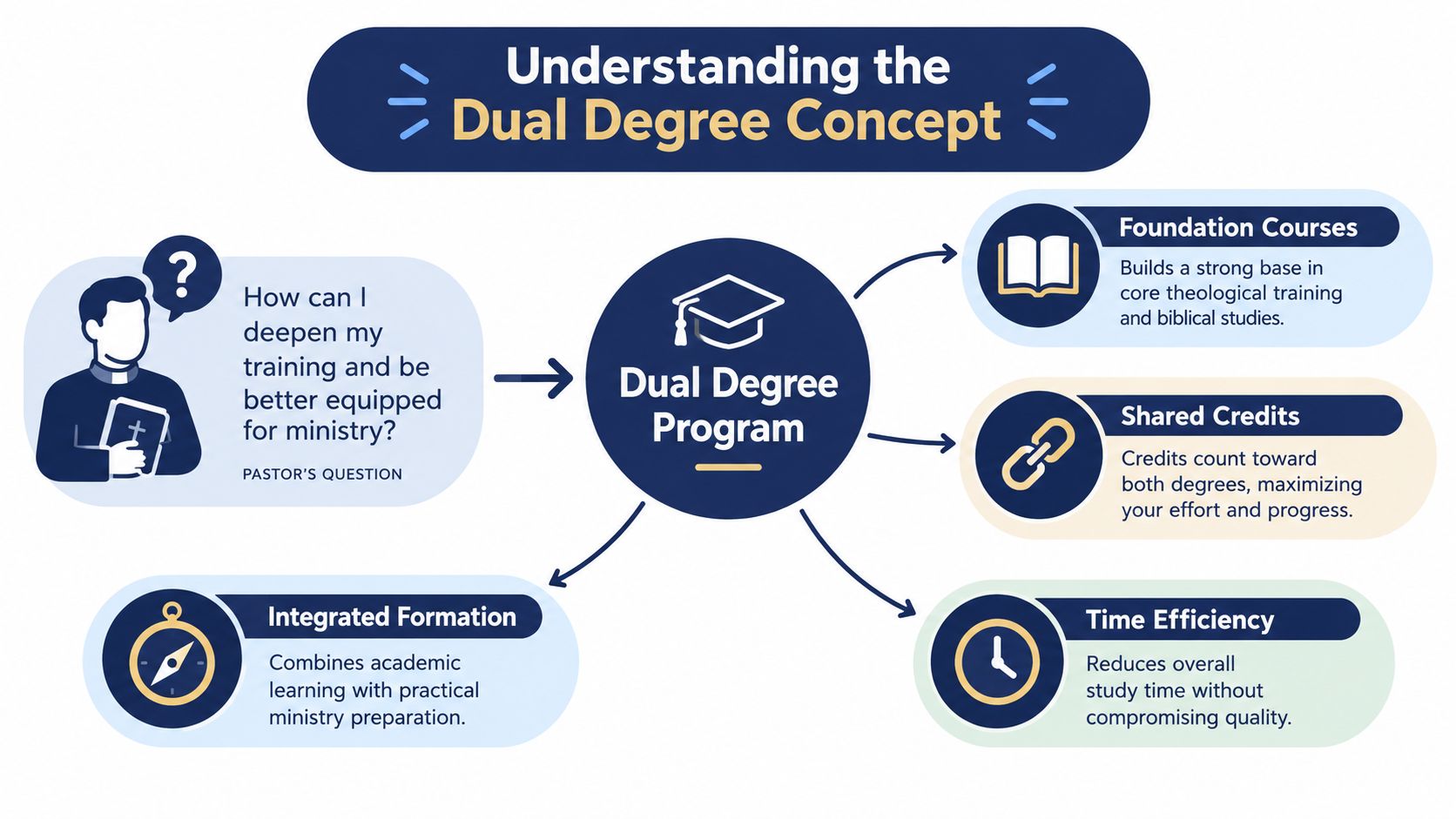
Three terms that students often confuse
A double major generally produces one degree with two fields of study. A dual degree produces two separate degrees. A joint degree usually follows an integrated curriculum developed by collaborating institutions and results in one jointly recognized award. Institutional definitions can vary.
The distinction becomes clearer through a house analogy:
Double major: One house with two rooms, each assigned a different purpose.
Dual degree: Two distinct rooms, each built to meet its own standards, with a connecting doorway where approved.
Joint degree: One intentionally designed house built through cooperation between two academic partners.
The connecting doorway represents shared coursework, not an open route through the entire curriculum. The programs must decide in advance which courses satisfy both sets of learning objectives. You still complete separate disciplinary cores, practicums, research expectations, and final assessments when required.
Practical rule: Choose a dual degree because the two fields genuinely strengthen the ministry or vocation to which God is calling you, not simply because earning two degrees sounds faster.
The purpose reaches beyond collecting credentials. It is to bring scholarship, spiritual formation, and practical preparation into a coherent pattern of stewardship, so your education equips you to serve people wisely and faithfully.
Why Dual Degrees Matter in Ministry Formation
Christian ministry calls for both faithful biblical conviction and wise application. Scripture presents teaching as something that should be entrusted carefully and multiplied through prepared people. Paul told Timothy to entrust what he had learned to faithful people who would be able to teach others also, a pattern of formation that reaches beyond private knowledge and toward responsible service (2 Timothy 2:2, CSB).
Paul also describes the purpose of ministry leadership as equipping believers for the work of service and building up the body of Christ (Ephesians 4:12, ESV). A dual degree can support that kind of preparation when the two disciplines meet a real ministry need. The value isn't found in academic prestige. It's found in whether your training helps you interpret Scripture faithfully, understand people carefully, and lead with humility.
Stewardship involves more than time
The biblical idea of stewardship includes the faithful use of gifts, opportunities, relationships, and resources. That doesn't mean every student should pursue the most ambitious academic route. It means you should ask whether a particular program is a wise response to your calling, responsibilities, financial circumstances, family commitments, and capacity for sustained study.
A student preparing for pastoral ministry may benefit from pairing an M.Div. with a field that supports a specific area of service. A student preparing for missions may seek additional preparation in intercultural studies. Someone serving Christian educators may need stronger formation in biblical studies and teaching. These combinations can be meaningful when they help the student serve real people in real settings.
Integration must remain Christ-centered
Two disciplines can also create tension. A program may become so demanding that prayer, worship, family life, and local church service receive little attention. A student may develop broad knowledge without developing the character required for shepherding others.
For that reason, discernment should include questions about spiritual formation:
Will this program deepen my love for God and neighbor?
Will the workload allow me to remain faithfully present in my church and family?
Does each degree contribute to the ministry context I hope to serve?
Will I receive guidance from faculty and mentors who understand both scholarship and ministry?
A dual degree is a tool, not a calling. The calling comes from God, and education should serve that calling with humility.
Common Dual Degree Structures in Theological Education
The structure of a theological dual degree depends on the institution, the disciplines involved, and the formal agreement between programs. Common combinations may join pastoral preparation with a related field, such as an M.Div. with an M.A. in Biblical Studies, counseling, missions, Christian education, or another ministry discipline.
Consider an illustrative M.Div. and M.A. in Biblical Studies pathway. The M.Div. may include broad preparation in biblical interpretation, theology, preaching, pastoral care, church leadership, and practical ministry. The M.A. in Biblical Studies may pursue more concentrated work in language, exegesis, biblical backgrounds, and research. The degrees complement one another, but they aren't interchangeable.
For a helpful discussion of theological study and degree planning, prospective students can review The Bible Seminary's degree in theology resource.
How shared credits work
Shared credits are the main academic mechanism that can reduce duplication. A course may count toward both degrees only when it meets the learning objectives and academic standards of both programs. The overlap must be approved, documented, and limited.
The boundaries vary considerably:
VCU policy: Approved combinations of graduate or professional programs may share up to 20% of applicable credits (VCU's graduate degree definitions).
WSCUC policy: Graduate-level or upper-division overlap may be limited to 25%, while at least half of the credits for the accredited institution's degree are expected to be earned through that institution's own courses and faculty (WSCUC dual-degree policy).
West Virginia University policy: Approved dual-degree programs may share no more than 20% of the combined credits, with an absolute ceiling of 24 shared credits. The policy also preserves at least 18 credits for each individual degree and requires at least 48 total credits in the dual-degree program (WVU dual-degree policy).
These examples don't establish a universal rule. They show why students must ask each institution for its written policy.
A simple planning formula
Begin with the standalone requirements for Degree A and Degree B. Add them together, subtract only the shared credits formally authorized by both programs, and then add any requirements that aren't captured by the credit total, such as residency, internships, language work, practicums, theses, or capstones.
A dual degree normally requires more work than one degree. It may require less duplicated work than completing the programs sequentially, but that benefit is conditional. Ohio State requires students in a dual graduate-degree program to complete at least 50% of the credit hours for each degree through courses unique to that degree, and individual committees may require more (Ohio State's graduate dual-degree guidance).
The key question isn't, “How many degrees can I earn?” It's, “How many credits are unique, how many are approved for sharing, and what ministry preparation will remain after the plan is complete?”
A Student's Journey From Doubt to Calling
Consider Maya, a representative student story rather than a report of a particular individual. She had served faithfully in her church and felt drawn toward pastoral ministry, but she also noticed how often families arrived carrying grief, conflict, anxiety, and questions about identity. She wondered whether theological training alone would prepare her to respond wisely.
At first, the idea of an M.Div. and a related counseling degree seemed too demanding. Maya worried that choosing two programs would reflect ambition rather than obedience. She also wasn't sure whether the degrees would overlap enough to make the path responsible.
Discernment came before enrollment
Maya began by meeting with church leaders, praying with trusted mentors, and writing down the ministry situations she hoped to serve. She then compared program requirements instead of relying on promotional language. Her questions focused on the two degree titles, distinct requirements, shared courses, faculty support, clinical or supervised experiences, and the way each credential would be conferred.
That process clarified the difference between a broad interest and a genuine vocational need. Maya didn't pursue a second degree because it sounded impressive. She pursued a structured combination because she wanted theological depth and additional preparation for caring for people in complex circumstances.
Formation became more integrated
In the classroom, Maya learned to read Scripture with greater care and to recognize the limits of her own experience. In ministry settings, she practiced listening before offering advice. Her theological studies helped her keep Christian hope at the center, while her additional training encouraged appropriate boundaries, humility, and referral when a situation required specialized care.
The result wasn't that she became qualified for every kind of counseling or every pastoral challenge. Rather, she became more aware of what she knew, what she didn't know, and how to serve responsibly.
A faithful education doesn't remove the need for wisdom. It helps you recognize where wisdom is needed and prepares you to seek it.
That distinction matters. A dual degree won't guarantee a particular ministry position or eliminate the challenges of leadership. It can, however, give a student a broader framework for understanding people, Scripture, institutions, and service when the two degrees have been chosen with care.
Navigating Admissions and Credit Transfer
A wise decision begins with documents, not assumptions. Program names can sound similar while carrying different requirements, approval processes, and completion timelines. Before applying, obtain the official catalogue materials for both degrees and ask the admissions office to explain how the programs function together.
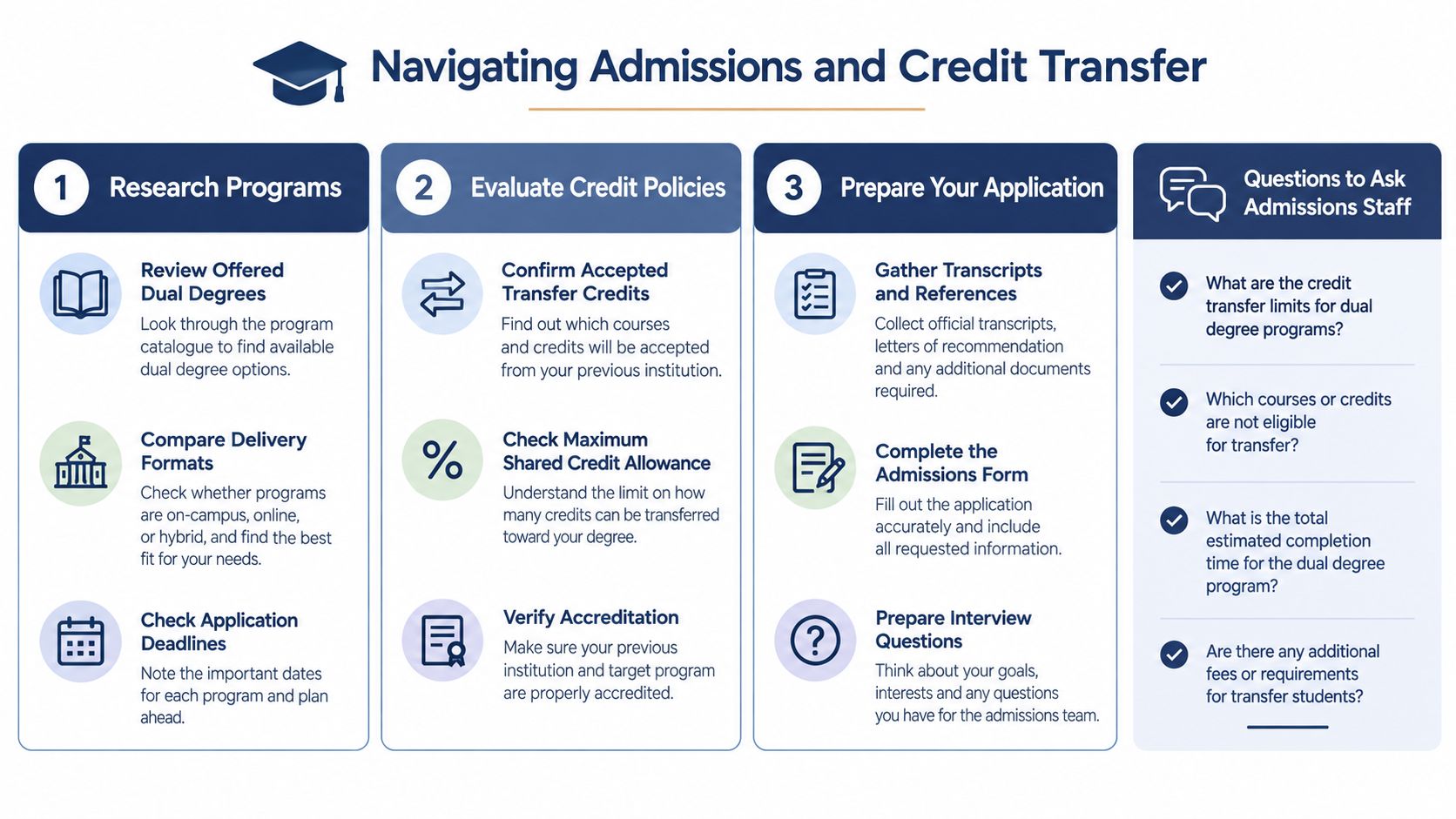
Start with the institutional structure
Find out whether both degrees are offered by one institution or through a partnership. Collaborative programs can involve different calendars, transfer rules, residency expectations, admissions decisions, and graduation dates. A student may complete one credential before the other if the programs award degrees in different terms.
Ask for written answers to these questions:
Program approval: Is the dual-degree arrangement formally approved by both academic units?
Admissions status: Must you apply to both programs separately, or is there one coordinated application?
Credential titles: What exact names will appear on the two diplomas or completion records?
Conferment schedule: Are both degrees awarded together, or can they be awarded in different terms?
Shared coursework: Which specific courses may count toward both programs?
Transfer credit: Which prior courses can be accepted, and do transfer credits count toward both degrees?
Unique requirements: What percentage or number of credits must remain unique to each degree?
Residency rules: Must you complete a particular portion of each program through the institution?
Final projects: Does each degree require its own thesis, capstone, practicum, internship, or final assessment?
Request a written degree audit
A verbal explanation can be helpful, but a written degree audit protects you from misunderstanding. The audit should identify the two credential titles, required credits, shared courses, minimum grades, residency rules, thesis or capstone obligations, and the order in which milestones must be completed.
George Mason University uses a formula to calculate the maximum credits that may transfer from one component degree to the other. Its policy also treats a dual degree as two separate programs producing two separate completion credentials (George Mason's dual-degree arrangements). Ohio State and other universities may impose their own unique-credit requirements, so the policy for one school shouldn't be applied to another.
Count the full cost
Tuition is only one part of the decision. Consider fees, books, travel, technology, reduced work hours, childcare, and the possibility of an additional semester. The University of Georgia states that dual-degree students may pay tuition at the rate of the more expensive program while still completing both approved degree programs (University of Georgia's dual-degree policy).
Write down the total financial and family commitment before you enroll. Stewardship means receiving sound counsel and counting the cost, not assuming that shared credits automatically produce a major financial advantage.
Making Your Decision with Confidence
Could combining two degrees become a wise act of stewardship, or would it place more weight on your family and ministry than you can faithfully carry? The answer depends on your calling, academic readiness, family responsibilities, financial resources, ministry context, and the actual policies of the programs you are comparing.
Start with the people you hope to serve. What needs, questions, or hardships may they bring? Which second field would strengthen your ability to teach, lead, counsel, evangelize, disciple, administer, or serve across cultures? A degree combination should function like a well-fitted tool. Its value rests on whether it helps you serve real people with greater wisdom and skill.
Then ask how the academic pathways fit together. A sound plan explains the relationship between the degrees without treating them as interchangeable. It identifies shared courses, distinct requirements, and practical experiences that contribute to your formation. The goal is not just to collect credentials. It is to receive training that supports faithful kingdom service.
Use discernment rather than comparison pressure
You do not need two degrees to prove that your calling is genuine. A focused degree, certificate, audited course, continuing education, mentoring relationship, or supervised ministry may serve your situation more wisely. A dual degree may be appropriate when two fields offer complementary preparation and the institution has designed a clear way to combine them.
Medical education shows how varied these arrangements can be. Combined M.D./Ph.D. programs emerged in the 1950s, the first federally funded Medical Scientist Training Program began at Albert Einstein College of Medicine in 1964, and by 2023, approximately 10% of U.S. medical students earned their medical degree through a dual-degree program; in 2024, the United States had 159 allopathic medical schools, including approximately 122 offering M.D./Ph.D. programs, 80 offering M.D./M.P.H. programs, 70 offering M.D./M.B.A. programs, 14 offering M.D./J.D. programs, and 50 offering M.D./M.S. programs (Academic Medicine's discussion of dual-degree programs).
These examples do not establish a template for theological education. They show that institutions can connect professional preparation with research, public health, business, law, or another specialized discipline when they design the pathway intentionally. Ask whether your proposed combination has that same clarity and purpose.
Keep the mission in view
Christian education forms hearts and minds for kingdom service. It should help students handle Scripture responsibly, reason carefully, love the Church, and serve neighbors with competence and compassion. That formation may involve rigorous study, archaeological and historical work, practical ministry, spiritual growth, and life with faculty and fellow students.
“What is dual degree program” has a technical answer. A dual degree is two approved academic pathways leading to two credentials, with limited and documented overlap. Your personal decision rests on whether those pathways serve your calling and help you equip others for ministry.
Discuss the choice with admissions staff, faculty, church leaders, family members, and trusted mentors. Look for a program that treats Scripture as authoritative and foundational, values Christ-centered and Spirit-led formation, and connects scholarship with the needs of the people you hope to serve.
The Bible Seminary offers Bible-centered graduate education, Master of Arts and Master of Divinity pathways, flexible certificates and continuing education options, and a Dual Degree Completion program for eligible students. Visit The Bible Seminary to review its academic options and begin a conversation about training for kingdom service.