
Degree in Theology: Programs, Careers, and How to Choose

You may sense God leading you toward deeper ministry training while staring at a confusing list of degrees, certificates, delivery formats, and denominational expectations. Perhaps you're serving faithfully on Sundays, teaching a class, counseling people, or preparing sermons, yet you want stronger biblical foundations and wiser tools for the people entrusted to your care.
A degree in theology can provide that formation, but it shouldn't be treated as a credential alone. At its best, theological education trains your mind to handle Scripture carefully, shapes your character for servant leadership, and equips your hands for faithful ministry. It joins scholarship, spiritual formation, and practical service under the lordship of Christ.
Answering the Call to Deeper Ministry Training
Consider a ministry leader who has spent years answering questions after Bible studies, visiting people in crisis, and helping a church work through difficult decisions. The leader may already possess compassion and practical experience, yet still feel uncertain when interpreting a difficult passage, explaining doctrine, or responding to cultural pressure. A desire for deeper study often grows from that very tension, not from a desire for status.
The right program helps connect calling with preparation. Paul's instruction to Timothy emphasizes both faithful character and careful handling of God's Word:
“Be diligent to present yourself to God as one approved, a worker who doesn't need to be ashamed, correctly teaching the word of truth.”2 Timothy 2:15, CSB
A theology program can't manufacture spiritual maturity, and a diploma can't replace prayer, obedience, or the life of the local church. It can, however, give you disciplined habits of interpretation, historical awareness, theological clarity, and supervised opportunities to apply what you learn.
Formation for a complicated ministry context
Church leaders serve people shaped by digital media, competing worldviews, family pressures, grief, migration, economic uncertainty, and questions about faith. Passion matters, but passion without preparation can leave both the leader and the congregation vulnerable. Rigorous, Bible-centered training gives you a framework for listening carefully, distinguishing central doctrines from secondary questions, and communicating truth with humility.
The historic Christian conviction that Scripture is authoritative and inspired should remain central. Studying the Bible academically doesn't push faith aside. Done faithfully, it encourages reverence, careful observation, and a deeper understanding of the God who has revealed himself through his Word.
A degree as a tool for kingdom service
The Association of Theological Schools describes graduate standards as appropriate to an advanced degree in theology and aligned with an institution's mission and resources ATS standards of accreditation. That emphasis matters. Your studies should lead somewhere practical, whether toward preaching, teaching, chaplaincy, missions, Christian education, nonprofit leadership, or more informed service as a lay leader.
At The Bible Seminary, the stated mission is equipping leaders to impact the world for Christ. That vision places academic work within a larger purpose, training hearts and minds for kingdom service while helping students connect biblical study with the needs of churches and communities.
Comparing MA, MDiv, and Certificate Programs
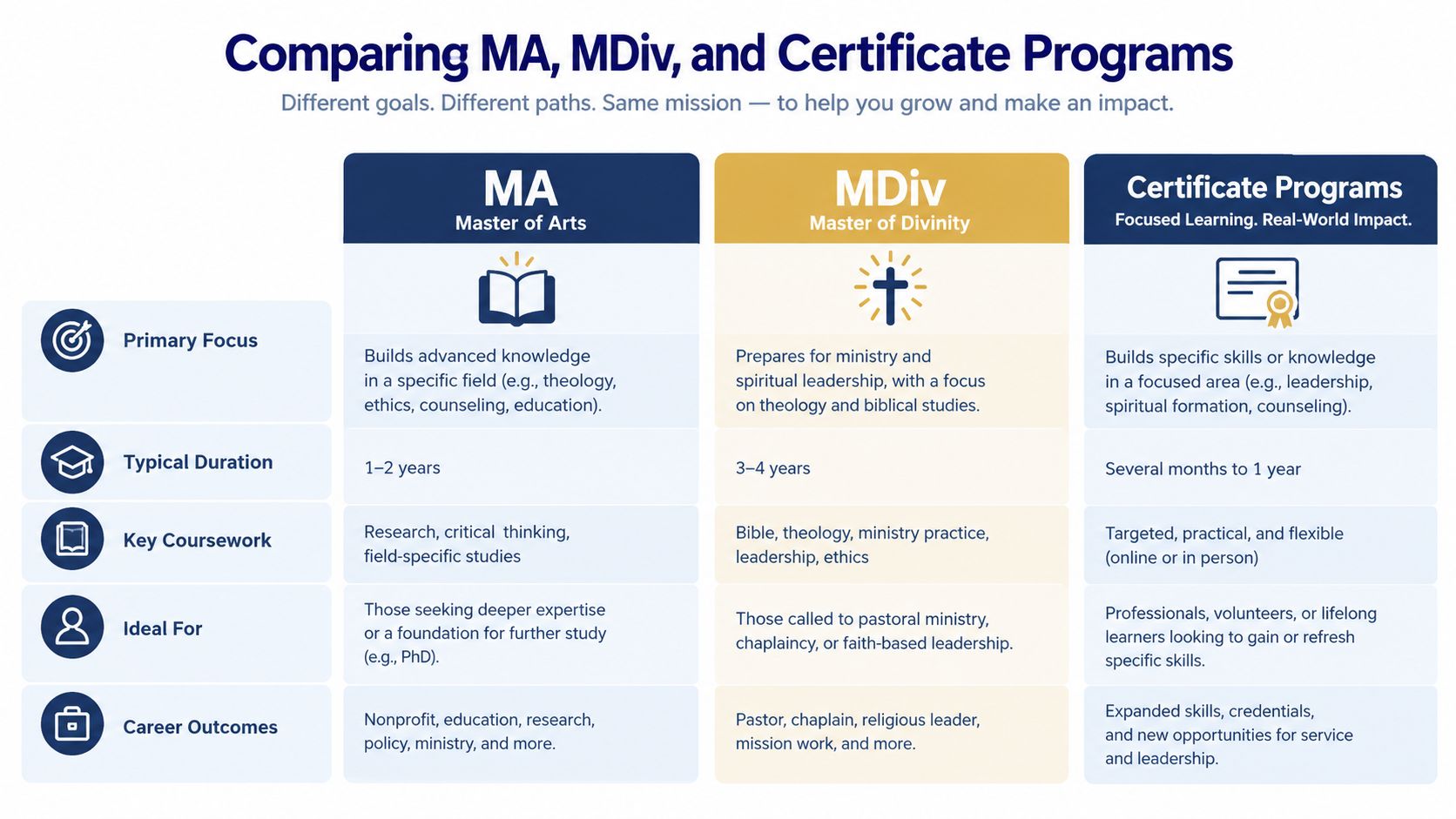
The most suitable credential depends on your ministry responsibility, academic preparation, available time, and desired outcome. An MA, MDiv, and graduate certificate can all support Christian service, but they serve different purposes.
Master of Arts
A Master of Arts usually offers focused graduate study in a defined area. Depending on the institution, that area might include church history, theology, biblical studies, Christian education, or another ministry-related discipline. This pathway can suit educators, missionaries, lay leaders, ministry professionals, and students who want substantial theological preparation without pursuing the broad professional scope of an MDiv.
An MA can also serve as preparation for further academic work. If your goal is teaching, writing, curriculum development, research, or specialized ministry, ask whether the curriculum provides the methods and depth your intended role requires. The degree title alone won't answer that question.
Master of Divinity
The Master of Divinity, commonly called the MDiv, is the substantial professional degree traditionally associated with pastoral preparation and ordination pathways. It generally brings biblical interpretation, theology, church history, preaching, pastoral care, leadership, and field education into one integrated course of study.
An MDiv may be the stronger fit if you're preparing for pastoral ministry, church planting, chaplaincy, or a role that expects broad ministerial formation. Ordination requirements differ by denomination, so speak with your church or denominational authority before enrolling.
Graduate certificates
A graduate certificate offers targeted study without the full commitment of a master's degree. It may serve a bivocational pastor, church volunteer, educator, or ministry leader who needs focused development in a particular area. Certificates can also help you test your readiness for graduate study.
A certificate isn't a lesser form of obedience. For some students, it's the wisest pathway for a demanding season of work, family responsibilities, or ministry transition. Compare the distinctions in certificate program versus degree study, including how credits, admissions, and future progression are handled.
Pathway | Often suits | Questions to ask |
|---|---|---|
MA | Specialized ministry, education, research, or focused theological study | Does the concentration match your intended service? |
MDiv | Broad pastoral and professional ministry preparation | Does it meet your church or denomination's expectations? |
Certificate | Continuing education, exploration, or focused skills | Can it lead into a later degree if your calling develops? |
Program length and credit requirements vary. One theological studies master's example requires 42 semester hours, courses in 3-credit increments, and a minimum GPA of 3.0 LMU theological studies graduate programs. Treat that as a concrete illustration of program structure, not a universal rule.
Core Curriculum and Biblical Specializations
A strong theology curriculum should help you read Scripture faithfully, understand its historical setting, articulate Christian doctrine, and serve people wisely. Students often encounter Old and New Testament studies, hermeneutics, systematic theology, church history, biblical languages, spiritual formation, and practical ministry.
The Bible Seminary describes its graduate majors as engaging all 66 books of Scripture alongside historical, theological, and practical disciplines. That breadth matters because ministry problems rarely arrive neatly labeled. A pastor may need to connect biblical theology with pastoral care. A Christian educator may need historical context and teaching skill. A missionary may need doctrinal clarity, cultural sensitivity, and resilient spiritual practices.
Four layers of useful study
Biblical study focuses on what the text says, how its parts fit within the canon, and how responsible interpretation honors its literary and historical context. Learning Hebrew or Greek can deepen this work by allowing students to engage the languages in which much of Scripture was written.
Historical study places theological questions within the life of the church. Students encounter the development of doctrine, major movements, historical figures, and the ways Christians have responded to changing contexts. History can cultivate humility because it shows both the church's faithful witness and its failures.
Theological study asks how Christian beliefs cohere. Doctrine shouldn't remain abstract. The Trinity, creation, salvation, the church, and the return of Christ shape worship, ethics, discipleship, preaching, and pastoral decisions.
Practical study prepares students to communicate and serve. Depending on the program, this may include preaching, teaching, pastoral care, leadership, missions, counseling support, or field education.
Specializations that serve particular callings
A specialization can make your education more purposeful. Biblical history may suit a student interested in Scripture's ancient setting. Pastoral ministry may serve someone preparing for congregational leadership. Christian education may support teachers, curriculum writers, and discipleship leaders.
Biblical archaeology can add another dimension by connecting material evidence and historical context with careful study of Scripture. The responsible approach is neither to force archaeology to “prove” every interpretation nor to dismiss evidence that raises meaningful questions. At The Bible Seminary, the 3J Museum presents biblical history through nearly 200 artifacts, with over 90% identified as authentic, from Khirbet el-Maqatir near Jerusalem. Explore the seminary's archaeology resources to see how archaeology and Scripture can be studied together responsibly.
Real-World Career and Ministry Outcomes
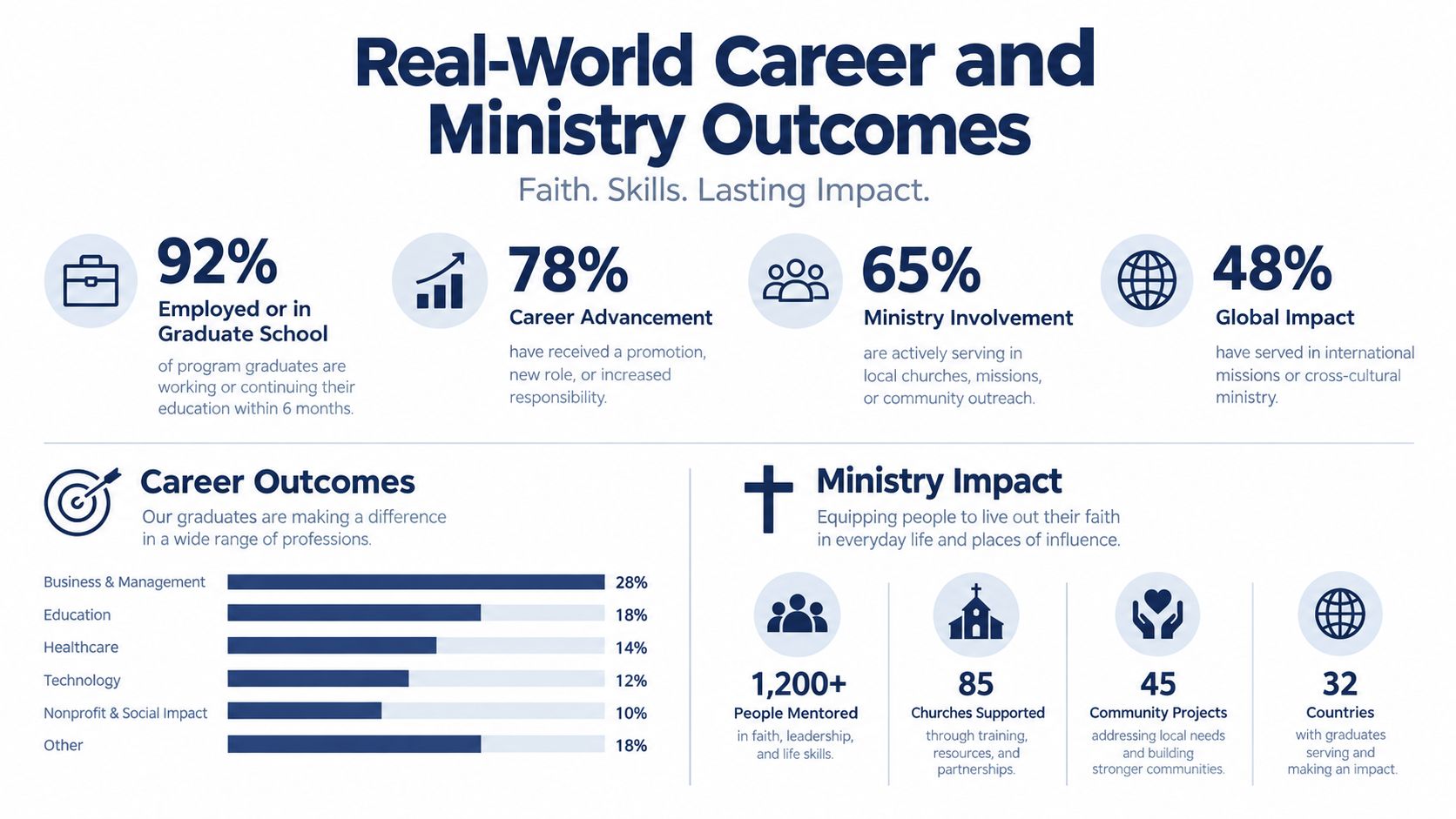
A theology degree doesn't point every graduate toward the same job. Ministry placement may involve a church, school, hospital, nonprofit, missions organization, counseling setting, or educational institution. Your concentration, field experience, relationships, denominational context, and willingness to serve in varied settings all influence the path.
A 2026 graduate outcomes survey across theology, ministry, and Christian education programs reported that 82% of graduates found employment or ministry placement within 9 months Christian Degree. The placements included pastoral ministry at 28%, Christian education at 18%, chaplaincy at 15%, missions and cross-cultural work at 12%, and counseling at 10%, while 6% entered academia and 3% entered apologetics or research. These figures show why prospective students should ask role-specific questions rather than assume that “ministry” means only the pastorate.
What the broader evidence reveals
Graduate tracking at Harvard Divinity School illustrates the range of outcomes. Among 107 graduates one year out, 65% were employed full-time, 24% were enrolled in graduate school, and fewer than 5% were still seeking work Harvard Divinity School employment reports. Within that cohort, 24% were ordained ministers, 12% pursued lay ministry and chaplaincy, 29% entered education, and 20% entered business or nonprofit management or consulting.
A separate institution's report of 257 known MDiv outcomes showed 67% vocational placement and 26% continued further study, according to the same employment-report resource. The results vary by school and network, so they shouldn't be treated as a promise for an individual student. They do show that theological education can support both professional ministry and further specialization.
A broader North American and European picture also deserves attention. In Canada and the United States, 74,283 individuals pursued graduate theological degrees in the most recently reported year, the largest number since the Association of Theological Schools began tracking enrollment in 1969 theology major facts and statistics. In Europe, a 2023 analysis reported 78.4% employability within three years, compared with a European higher-education average of 86.7%. About 60% continued further study, roughly one in five relied on missionary support, about one in three participated in unpaid volunteer work, and the average salary was about €30,000, with a median wage near €29,700, according to that analysis.
Practical rule: Choose the role first, then work backward to the concentration, field experience, relationships, and credential that support it.
If your academic journey eventually leads to doctoral study or commencement, specialized resources such as doctor of theology gowns can help you understand the formal traditions surrounding advanced theological education. The ceremony matters, but the deeper question remains how your learning will serve Christ and his people.
Navigating Admissions, Accreditation, and Financial Aid
Admissions becomes clearer when you treat it as a sequence rather than a mystery. Begin by identifying the degree that fits your calling, then verify its entry requirements, accreditation, delivery format, and expectations for ministry experience.
Start with the academic pathway
Many graduate theology programs require prior accredited study. Duke's admissions guidance lists a regionally accredited bachelor's degree for several divinity degrees, while more advanced doctoral programs require an ATS-accredited MDiv or equivalent Duke Divinity admissions. If your undergraduate background is different, ask whether bridge coursework, a dual-degree completion pathway, or another route can prepare you.
Then gather the usual materials: transcripts, references, a personal statement, and any ministry or vocational information the school requests. Use the statement to explain your calling clearly. Admissions teams need to understand not only what you've accomplished, but also how you hope to serve.
Understand accreditation
Accreditation provides a framework for evaluating academic quality and institutional accountability. ATS standards address advanced theological study, ministry formation, research capacity, program outcomes, mission alignment, and available resources. An ATS-accredited graduate degree may also offer a useful benchmark for transferability and ministerial credibility, though churches and denominations retain their own requirements.
Ask direct questions:
Program approval: Is the institution accredited, and is the relevant program recognized within its theological context?
Learning outcomes: What should graduates be able to interpret, communicate, research, and practice?
Supervised ministry: Does the program include field education, mentoring, or ministry assessment?
Progression: Can certificate work or a completed degree lead into another credential?
Make a financial plan
Don't wait until admission to discuss cost. Create a simple plan that includes tuition, books, travel or residency expenses, technology needs, and the time required for study. Then contact the school about institutional aid, payment arrangements, scholarships, church partnerships, denominational assistance, and employer support.
Financial stewardship is part of discernment. A lower-cost option isn't automatically wise if it fails to meet your ministry goals, and a more demanding program isn't automatically faithful if it creates an unsustainable burden. Seek counsel from your pastor, family, and trusted ministry leaders before committing.
Choosing Between Online, Hybrid, and On-Campus Formats
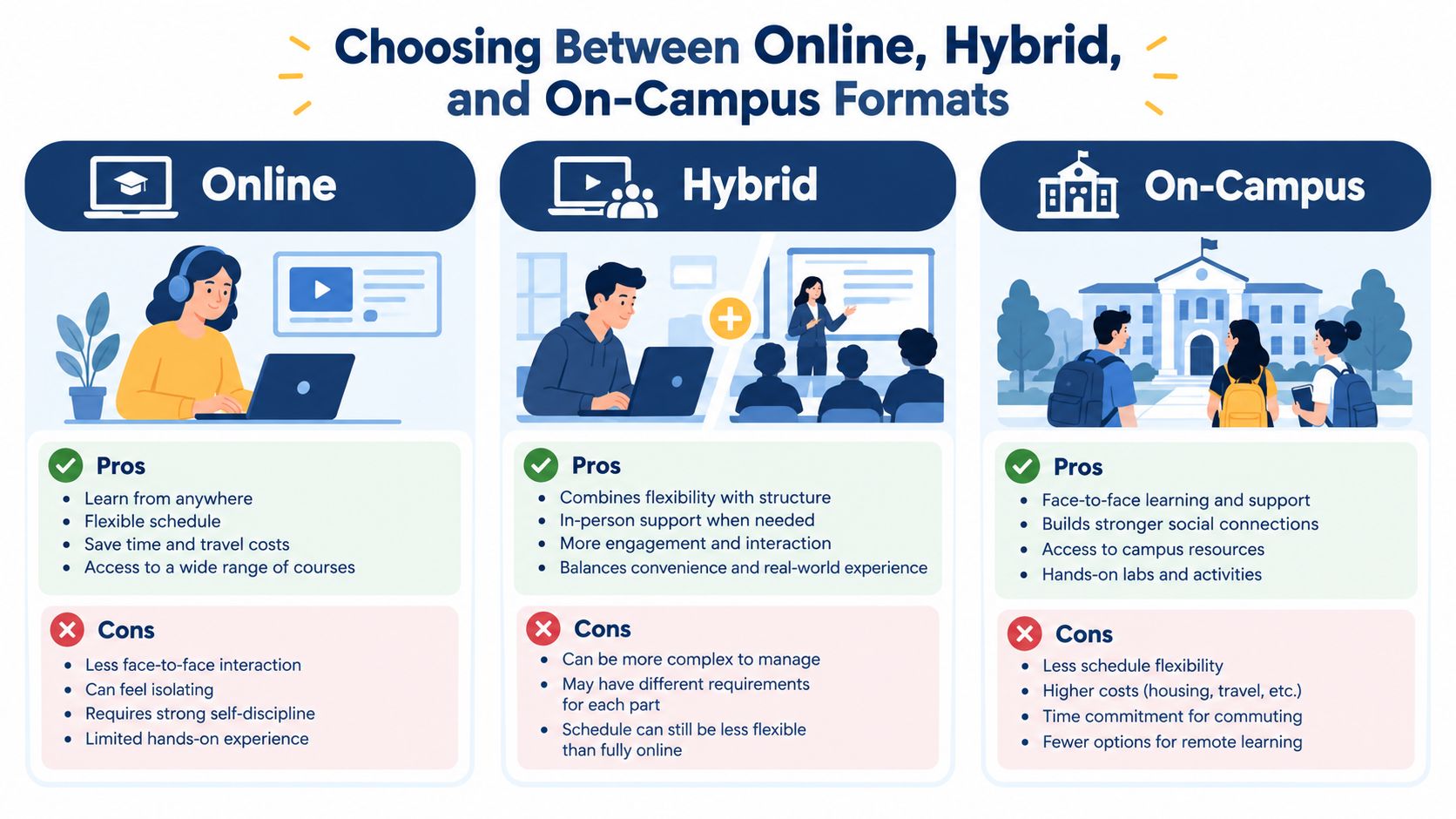
Theological education is becoming more differentiated. A 2025 empirical analysis reported that distance education rose from 25% of enrollment in 2014 to 63% of all enrollment, with nearly 48,000 of 76,000 students in fall 2023 studying at a distance In Trust on changing theological education. The shift isn't just a move toward more screens. It reflects the need for pathways that fit working pastors, parents, international students, educators, and church volunteers.
Online study
Distance education can remove geographic barriers and allow you to remain in your current church or ministry setting. It often suits students with employment, caregiving responsibilities, or established local ministry relationships.
The tradeoff is that you must create structure. Ask how faculty provide feedback, how students build community, whether courses are synchronous or asynchronous, and how practical ministry formation occurs. Online study should still include meaningful relationships, not just independent reading.
Hybrid learning
Hybrid programs combine online coursework with scheduled in-person experiences. This format may provide flexibility while preserving concentrated time for worship, discussion, mentoring, or hands-on training. It can work well for students who need to remain employed but value periodic campus connection.
Check the calendar before enrolling. Required intensives, travel, and group work can affect your family and ministry responsibilities even when most coursework takes place remotely.
On-campus study
Residential education offers regular access to faculty, classmates, chapel life, library resources, and informal conversations. Those relationships can shape spiritual formation in ways that are difficult to schedule. On-campus learning may be especially helpful for students preparing for a major ministry transition or seeking a concentrated season of formation.
Yet residential study requires relocation or a consistent commuting plan. The best format is the one that supports faithful learning and sustainable service.
In Trust reported that 63% of new students in 2025 chose full-time study, while institutions were also expanding competency-based education and non-degree or certificate options, according to the same source. That combination points toward differentiated pathways, including flexible degrees, modular learning, certificates, and on-demand seminars.
Finding the Right Program for Your Kingdom Calling
A faithful decision begins with honest questions. What kind of service do you believe God is placing before you? Do you need broad professional preparation, focused theological study, or a flexible way to strengthen your current ministry? Which relationships and learning environments will help you grow in both competence and character?
Use your answers to test each program against five criteria:
Biblical depth: Will you study Scripture carefully across the canon, with attention to interpretation, theology, and context?
Formation: Will faculty and mentors help you grow as a servant of Christ, not merely complete assignments?
Ministry application: Can you practice preaching, teaching, leadership, pastoral care, education, missions, or another relevant form of service?
Academic fit: Do the admissions requirements, course expectations, and specialization match your preparation and goals?
Sustainable delivery: Can you complete the program while honoring family, church, employment, and financial responsibilities?
A certificate may be the right next step for a church volunteer. An MA may serve a Christian educator or a leader seeking specialized study. An MDiv may provide the breadth required for pastoral or chaplaincy preparation. None of these paths should be chosen because it sounds more impressive. Choose the pathway that best equips you to love God, handle his Word faithfully, and serve people well.
The Bible Seminary offers M.A. and M.Div. programs, certificate options, auditing, dual-degree completion, and on-demand seminars. Its approach joins Bible-based scholarship, Christ-centered spiritual formation, practical ministry training, and the study of archaeology, including resources connected with the 3J Museum in Katy, Texas. Prospective students can review The Bible Seminary's degree programs, learn about academic offerings, and speak with admissions before making a decision.
Training leaders for kingdom service is a shared work. Churches, families, donors, faculty, and students each contribute to a learning community where scholarship becomes ministry and spiritual formation becomes faithful action. The question isn't whether your degree will make you important. It's whether your preparation will help you become more useful, more discerning, and more faithful in the places Christ has called you to serve.
The Bible Seminary offers Master of Arts, Master of Divinity, certificate, dual-degree completion, and flexible learning pathways for students pursuing a degree in theology. Visit The Bible Seminary to explore your options, connect with admissions, and take the next step toward training your heart and mind for kingdom service.