
What Is an MDiv Degree? a Complete Guide for 2026

An MDiv is a professional graduate degree, typically requiring 72 to 90 credits or more, designed to prepare students for ordained ministry, pastoral leadership, and other Christian service roles through integrated study of Scripture, theology, church history, and supervised ministry practice. It's broader than many academic master's degrees because it forms both your mind and your ministry.
You may be serving faithfully in a church, leading worship, teaching a Bible study, or sensing a call to pastoral ministry. The question often surfaces: Do I need an MDiv, and what would it prepare me to do? Choosing seminary is a significant decision, especially when you're balancing work, family, church responsibilities, and a desire to follow Christ with integrity.
We believe theological education should serve the church, not merely produce credentials. An MDiv can help you read Scripture carefully, think theologically, communicate truth clearly, care for people wisely, and lead with humility. It can also help you discern whether a particular ministry path is really yours.
What You Need to Know About the Master of Divinity
You may already be doing real ministry. Perhaps you lead worship each week, preach as a bivocational pastor, teach Scripture to a small group, or sit with people in grief and wonder whether you need deeper preparation for the calling God has placed before you. In that moment, the question is not only, “What is an MDiv?” It is also, “Is this the right path for the kind of ministry I am being asked to carry?”
The MDiv, or Master of Divinity, is the standard professional graduate degree for broad preparation in Christian ministry. In accredited schools across the United States and Canada, the Association of Theological Schools sets the minimum MDiv length at 72 semester credits (ATS standards). Many schools require more. That matters because the degree is built to form a whole minister, not merely add a biblical studies credential to your resume.
An MDiv works like residency training for ministry. You study Scripture and theology, but you also learn to preach clearly, care for people wisely, lead faithfully, and examine your own character before God. The goal is faithful formation joined to practical preparation. For some callings, that breadth is a good fit. For others, a more focused theology degree, certificate, or ministry training path may serve you better. Wise discernment asks what kind of shepherding, teaching, or leadership you are preparing to offer.
“And what you have heard from me in the presence of many witnesses entrust to faithful men who will be able to teach others also.”2 Timothy 2:2, ESV
At The Bible Seminary, we understand ministry training as uniting scholarship, spiritual formation, and hands-on ministry. We want theological education to serve the church and help you test your calling. A degree should do more than signal academic achievement. It should shape how you read Scripture, love people, and serve Christ in the practical conditions of ministry.

Understanding the MDiv Degree Structure
If you are weighing an MDiv, it helps to ask a practical question early. What kind of ministry is this degree designed to form? The answer shapes whether this path fits your calling, or whether a narrower degree, certificate, or ministry training route would serve you better.
An MDiv is a professional graduate degree ordered toward ministry practice. It prepares you for work that calls for studied judgment, spiritual maturity, and supervised experience over time. That usually includes preaching, teaching, pastoral care, discipleship, leadership, and public Christian service. In that sense, the degree works like professional preparation in other fields. You do not only gather information. You learn to serve real people with wisdom and accountability.
Four dimensions of formation
A healthy MDiv is structured to form the whole minister, not just the classroom student. Most programs bring several areas together so that each one corrects and strengthens the others:
Religious heritage and Scripture: You study the Bible and the history of Christian faith and practice.
Cultural and social context: You learn to serve people in real communities shaped by different histories, questions, and needs.
Personal and spiritual formation: You attend to character, prayer, vocation, and maturity.
Ministerial and public leadership: You develop skills for preaching, teaching, pastoral care, administration, and congregational service.
Those parts belong together. Biblical languages can train you to read texts more carefully. Theology and church history give you categories and context, so your interpretation does not drift with the moment. Formation work presses the truth into your own life. Supervised ministry asks whether you can embody that truth patiently, clearly, and faithfully when people are hurting, conflicted, or confused.
This is why program structure matters. Many schools spread the degree across a three-year full-time pattern, while part-time students often complete it over a longer season. Ministry internships, field education, or supervised ministry are often distributed through the program rather than left to the end. That pacing helps you connect what you study on Monday with what you encounter in a hospital room, classroom, church office, or pulpit later that week.
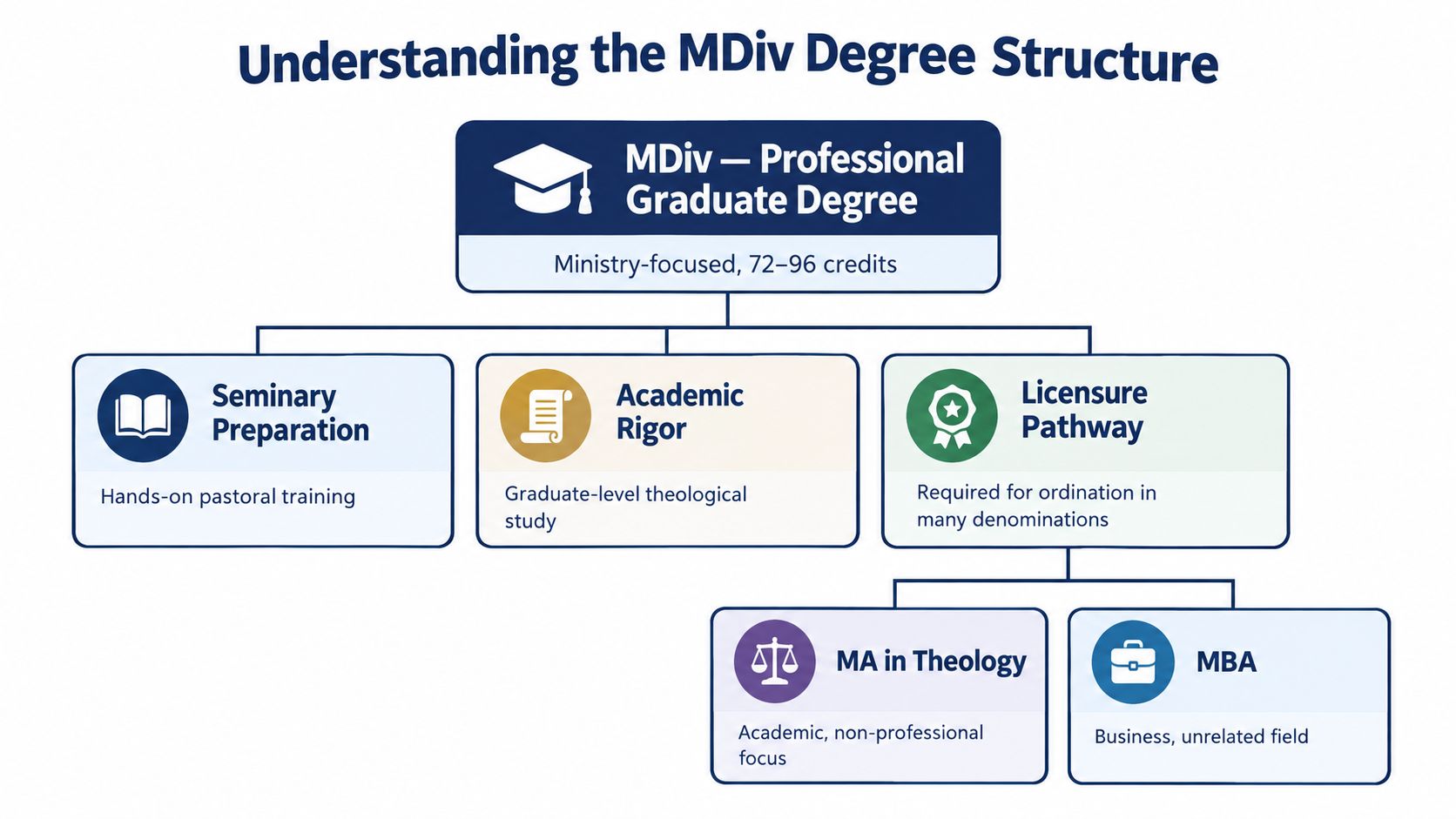
As you compare schools, look past the course list alone. Ask how the structure forms biblical depth, pastoral judgment, and practical readiness together. That is often the difference between earning a credential and being prepared for the particular ministry God may be calling you to serve.
Typical MDiv Curriculum Areas
An MDiv curriculum makes the most sense when you read it as preparation for real ministry situations. You may be teaching a Bible study on Wednesday, visiting a grieving family on Thursday, and preaching on Sunday. The question is not only, “What classes will I take?” It is, “What kind of servant will this course of study help me become?”
Scripture and biblical languages
Most MDiv programs begin by grounding you in Scripture itself. You will usually study the Old Testament and New Testament through interpretation, exegesis, and theological reflection. Many schools also require Hebrew, Greek, or both, because working with the text in its original languages trains careful reading. You begin to see patterns in grammar, repeated words, literary design, and interpretive tensions that are harder to notice in translation alone.
For some students, language study feels intimidating at first. In practice, it works much like learning the tools of a craft. You may not use every tool in the same way every week, but knowing how the text works helps you teach and preach with greater clarity and care.
Theology, history, and ethics
Scripture does not stand alone in ministry preparation. Theology gives you categories for speaking faithfully about God, creation, sin, salvation, the church, and Christian hope. Church history shows how believers in different eras have taught, defended, practiced, and sometimes distorted the faith. Ethics brings those convictions to questions about leadership, suffering, justice, relationships, and public responsibility.
These areas keep ministry from becoming shallow, reactive, or untethered from the church's wisdom.
Ministry practice and spiritual formation
An MDiv also asks whether you can live and serve what you study. That is why practical ministry courses usually sit beside formational ones. A typical sequence may include preaching, pastoral care, worship, leadership, Christian education, supervised ministry, and habits of prayer and character formation.
Preaching and public communication, including sermon preparation and delivery.
Pastoral care, including presence, listening, prayer, and appropriate boundaries.
Church leadership, including congregational decision-making and team development.
Worship and Christian education, connecting gathered worship with lifelong discipleship.
Supervised ministry, where mentors and supervisors help evaluate your growth.
Spiritual formation, cultivating prayer, character, dependence on God, and faithful service.
One published example appears in the Yale Divinity School requirements, which include Hebrew Bible and New Testament, theology, ethics, historical studies, global Christianity, religious diversity, preaching or public address, leadership or religious education, and a six-credit internship. That kind of framework shows how these areas work together. If you are comparing the MDiv with other paths, this breadth is one of the clearest signs that the degree is designed for whole-person ministry formation, not only academic specialization.
MDiv Versus Other Theology Degrees
A student sensing a call to serve often faces a real question here. Do you need the wide formation of an MDiv, or would a more focused degree better match your next step?
The clearest difference is purpose. The MDiv is built for people preparing to serve others through preaching, care, leadership, and ministry oversight. An MA in Theology or Biblical Studies usually narrows the field. It lets you concentrate on one area of study with greater intensity, but it often does not aim at the same breadth of ministerial preparation. A ThM goes further into advanced academic work and commonly fits students who already have substantial graduate theological training.
Degree | Primary emphasis | Common fit |
|---|---|---|
MDiv | Broad biblical, theological, practical, and formational preparation | Pastoral ministry, chaplaincy, missions, church leadership |
MA in Theology or Biblical Studies | Focused academic study in a defined area | Teaching support, personal study, specialized theological preparation |
ThM | Advanced research and specialization | Preparation for doctoral study or scholarly work |
One way to sort this out is to ask what kind of formation your calling requires. If your future work will regularly bring together Scripture, doctrine, spiritual care, public teaching, and leadership in a ministry setting, the MDiv usually makes the most sense. It is shaped for ministry that asks you to carry several responsibilities at once. An MA can be a wise choice if you want stronger grounding in a discipline without the same emphasis on supervised ministry or pastoral practice.
A ThM serves a different purpose. It is less about initial ministry preparation and more about sharpening a scholar's focus for research, teaching, or later doctoral study. If you are comparing longer academic paths, our degree in theology resource can help you consider how each option relates to vocation, church service, and future education. Students who continue into doctoral work may also encounter formal academic traditions, including doctoral theology regalia at Grad Store.
The right degree is the one that fits the work God is calling you to do. If you need broad preparation for ministry in real people's lives, an MDiv often fits best. If your goal is focused study in one area, an MA may serve you well. If sustained research is drawing you, a ThM may be the better next step.
Career Paths After an MDiv
An MDiv doesn't determine one job title. It develops a range of abilities that can serve the local church, specialized ministry settings, missions, education, and further study. Ordination requirements vary by denomination, and completing an MDiv does not itself confer ordination. You'll need to ask the relevant church body about its additional expectations.
Congregational ministry
Many graduates pursue roles such as:
Senior or lead pastor, providing preaching, pastoral care, vision, and congregational leadership.
Associate pastor, serving alongside a lead pastor in teaching, discipleship, care, or administration.
Youth or family ministry leader, guiding younger believers and supporting parents.
Church planter or missionary, developing gospel-centered communities in new or underserved settings.
The curriculum connects directly to these responsibilities. Exegesis supports faithful preaching. Theology strengthens doctrinal clarity. Pastoral care develops listening and presence. Leadership courses help you serve teams and congregations with wisdom rather than personality alone.
Chaplaincy, education, and missions
Some MDiv graduates serve as chaplains in hospitals, military settings, prisons, universities, or other institutions. Others enter Christian education, retreat leadership, missions, or community ministry. These contexts require the ability to listen across differences, communicate carefully, respect institutional boundaries, and apply Christian convictions with compassion.
Practical rule: Choose your ministry context early enough to ask whether the program's internships, electives, and mentoring will prepare you for that setting.
Graduates who pursue teaching, research, or seminary instruction may need additional graduate education. If you're evaluating ministry-related roles beyond the pulpit, a resource on career advice can help you organize your goals, experience, and communication for professional conversations.
Admissions and How to Choose a Program
You may sense a clear call to preach, counsel, plant a church, or serve in another ministry setting, yet still wonder whether an MDiv is the right next step. That is a wise question. Admissions is not only about getting accepted. It is about discerning whether a school, and even the degree itself, fits the kind of servant the Lord is shaping you to become.
Most MDiv programs ask for evidence that you are ready for graduate study and ministry formation. Schools commonly require a bachelor's degree, transcripts, recommendations, a personal statement, and sometimes an interview. Some also consider substantial ministry experience or ask for a testimony and church background. The goal is not paperwork for its own sake. It is to see whether you can handle serious study while remaining teachable, faithful, and rooted in the life of the church.
A strong application does more than list accomplishments. It shows that you understand your calling with humility. It names areas where you still need growth. It explains how you hope to serve Christ's people with clarity rather than polished religious phrasing.
Questions to ask before enrolling
Choosing a program works a bit like choosing a ministry field. The visible parts matter, but so do the underlying commitments that will shape your formation over time. As you compare schools, ask questions such as these:
Theological alignment: Does the school's doctrine fit your convictions and the church tradition in which you serve?
Curricular breadth: Will you study Scripture, theology, history, ethics, practical ministry, and spiritual formation?
Supervised practice: Does the program include field education, internships, preaching evaluation, or ministry mentoring?
Format and schedule: Can you study full time, part time, online, or in a hybrid pattern that matches your responsibilities?
Faculty and community: Will professors know your work and help you grow as both a student and a servant?
Ministry outcomes: Does the program prepare students for the ministry contexts and denominational expectations you are pursuing?
Recent reporting noted 74,283 people pursuing graduate theological degrees in Canada and the United States, the highest total recorded by the Association of Theological Schools since tracking began in 1969. Roughly one-third were pursuing an MDiv (In Trust Magazine). The same report also found that 63% of new students chose full-time study, compared with a 58% to 60% range since 2020.
Those patterns are helpful, but your decision is still personal. If you need broad biblical and theological formation, supervised ministry experience, or preparation for denominational requirements, an MDiv may be the right path. If your present need is narrower, such as deeper skill in one area of ministry, a certificate, audited course, continuing education, or a different graduate degree may serve you better. The best choice is the one that matches your calling, your season of life, and the kind of ministry you are preparing to carry faithfully.
Why The Bible Seminary for Your MDiv Journey
The Bible Seminary in Katy, Texas, offers a Bible-centered setting where scholarship, spiritual formation, and hands-on ministry belong together. Our approach treats Scripture as authoritative and foundational while giving students room to engage historical, theological, archaeological, and practical questions with care.
We offer graduate study across nine majors, with in-depth attention to all 66 books of Scripture alongside historical, theological, and ministry disciplines. Students and ministry professionals can also consider flexible learning options, including certificates, audited courses, dual-degree completion, and on-demand seminars.
Our community extends beyond classroom instruction. The 3J Museum provides an opportunity to encounter biblical history through nearly 200 artifacts, with over 90% identified as authentic, drawn from excavations near Jerusalem. Through archaeology and Scripture together, we want to help students see how the Bible comes alive within real historical settings, while avoiding exaggerated conclusions that go beyond the evidence.
Initiatives such as the Public Reading of Scripture, the Just Show Up Book Club, podcasts, Nehemiah Press publications, and global partnerships create additional spaces for learning and service. Whether you're discerning a first call, strengthening an existing ministry, or preparing for further study, we want to walk with you in a posture of humility and dependence on the Holy Spirit.
An MDiv is a serious commitment, but it can also become a formative season. Through careful study, prayer, mentoring, and ministry practice, you can grow in grace and knowledge while preparing to equip others. That's part of our mission of equipping leaders to impact the world for Christ and training hearts and minds for kingdom service.
The Bible Seminary offers Bible-centered graduate education that brings together Scripture, theology, archaeology, spiritual formation, and practical ministry training. Visit The Bible Seminary to explore our MDiv and other degree options, learn about flexible pathways, and begin discerning how seminary preparation may serve your calling.