
Vision Casting for Churches: A Practical Guide

A pastor sits down on Monday with a sermon to prepare, a counseling conversation to return, a staff question to answer, and a church budget that needs attention. Somewhere in that crowded week, the congregation still needs to hear where God is leading. The vision may be sincere, biblical, and important, yet many members can't explain it by the next season of ministry.
That struggle doesn't mean you lack leadership. It means vision casting for churches requires more than a compelling announcement. It calls for prayerful discernment, careful listening, clear communication, and patient formation. A faithful vision helps a church recognize its calling, steward its gifts, and serve its neighbors with Christ-centered purpose, even when attendance plateaus or participation becomes more fragmented.
The Reality of Vision Casting in Modern Ministry
Many pastors assume that a clear vision should emerge naturally from spiritual conviction. Conviction matters, but clarity also requires time, communal listening, and disciplined communication. A pastor may know what burdens the heart, yet still struggle to express that burden in a way that a congregation can understand, pray over, and faithfully practice.
A 2022 Lifeway Research study found that 45% of pastors identified establishing a compelling vision as a pressing ministry difficulty. The same article notes that pastors often spend about 12 hours preparing a weekly sermon. That comparison helps explain why vision casting can receive less sustained preparation, even though vision and preaching both shape the church's life.
The answer isn't to treat vision like another polished sermon. A sermon proclaims and applies God's Word to the people gathered. Vision casting describes a faithful ministry direction in light of Scripture, prayer, the church's calling, and the needs of its community. The two belong together, but they aren't interchangeable.
Vision is a recurring discipline
A church vision shouldn't be a slogan unveiled at a special service and then placed in a folder. It should become a recurring discipline that shapes preaching, prayer, leadership meetings, volunteer training, membership conversations, and ministry evaluation.
A durable vision is announced clearly, practiced visibly, and remembered together.
Scripture presents leadership as a work of faithful stewardship, not personal branding. Paul tells the Ephesian elders that he didn't shrink from declaring the whole purpose of God (Acts 20:27, ESV). That kind of ministry requires both theological depth and sustained attention. Leaders must keep bringing the church back to what God has entrusted to it.
Growth isn't the only faithful horizon
A church may be growing numerically, plateaued, slowly recovering, or carrying internal strain. Each condition raises different pastoral questions. A vision that assumes expansion is the only evidence of faithfulness may discourage congregations that are called, in a particular season, to deepen discipleship, rebuild trust, strengthen families, or serve a neglected neighborhood.
Vision gives a church a way to pursue obedience without pretending that every congregation shares the same circumstances. The question isn't, “How can we become larger?” It may be, “How is Christ calling us to become more faithful, more loving, and more useful for his mission here?”
Diagnosing Current Reality and Shared Identity
Before drafting a future statement, leaders need an honest picture of the church's present reality. Assessment isn't a vote against faith. It's an act of stewardship that helps a congregation distinguish between nostalgia, anxiety, genuine opportunity, and the work God may already be doing.
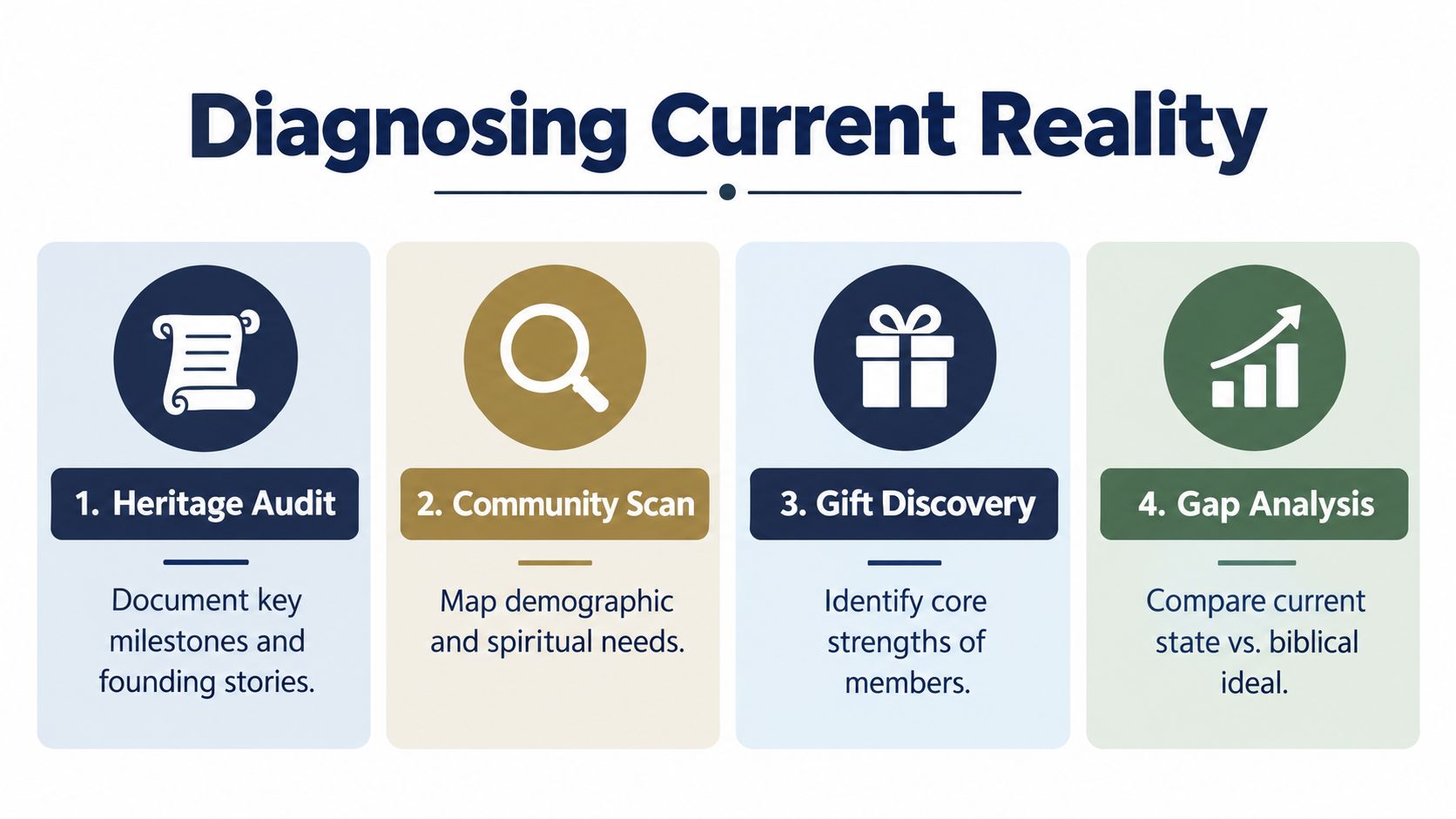
Begin with four forms of listening:
Heritage audit: Gather founding stories, major transitions, seasons of faithfulness, painful conflicts, and moments when the congregation adapted to changing needs.
Community scan: Study the people, institutions, challenges, and spiritual questions present in the surrounding community.
Gift discovery: Ask where members already demonstrate spiritual maturity, practical competence, hospitality, compassion, teaching ability, or cross-cultural sensitivity.
Gap analysis: Compare the church's current practices with its biblical responsibilities, stated mission, and actual opportunities for ministry.
Recover the congregation's shared memory
A parish vision-casting toolbox recommends a historical inventory built on a long sheet of paper divided into decades. Congregants add notes about important events, crossroads, changes, and pivot points. The method is simple, but it gives people a structured way to remember together rather than allowing the loudest interpretation of the past to dominate the room.
Invite older members to describe what previous generations valued. Ask newer members what first drew them into the church. Listen for recurring themes. Perhaps the congregation has repeatedly welcomed immigrants, supported bivocational pastors, cared for vulnerable families, or equipped people for local service. Those patterns may reveal identity more accurately than a recently written slogan.
A useful companion is the purpose of the church, which can help leaders distinguish the church's unchanging biblical calling from the particular expression that fits its present context.
Assess without manipulating
Assessment should lead to prayerful discernment, not predetermined approval of the pastor's preferred plan. One academic leadership source warns against imposing a pastor's vision unilaterally. A congregation takes ownership when its members can recognize their own gifts, burdens, history, and responsibilities in the direction being proposed.
That includes practical stewardship. A financial review, ministry inventory, volunteer conversation, and community assessment can reveal whether an idea is sustainable. Leaders who need a structured way to examine financial health can browse the scorecard tool as one resource for disciplined reflection.
End this phase by naming what you know, what you don't know, and what requires further prayer. Humility at the beginning protects the church from false confidence later.
Adapting Vision for Shifting Congregational Demographics
A church may faithfully pursue its mission without experiencing steady attendance growth. That reality changes how leaders should frame vision. A congregation that has plateaued doesn't need inflated promises. It needs a credible picture of faithfulness that addresses its actual people, place, and capacity.
PRRI reported that 26% of Americans attended church weekly in 2025, unchanged from 2024, while the share who seldom or never attend reached 53%, up from 42% in 2013. These figures come from PRRI's church attendance reporting. They don't describe every community, but they do challenge the assumption that a single national growth story can guide every local church.
Other findings point to selective recovery rather than uniform revival. One report found that the median congregation grew from 65 in 2020 to about 70 in 2025, while another found that 52% of congregations increased worship attendance by at least 4% in the past two years, leaving 48% flat or declining. The same report is valuable precisely because it shows variation, not because it supplies a universal formula.
Segment the message without dividing the church
Engagement patterns also differ among demographic groups. Gallup reported that young men's monthly-or-more religious attendance rose to 40% in 2024–2025, the highest level since 2012–2013, and reported that 40% of young men continued attending about weekly or monthly in 2026. Barna has likewise reported that men now outpace women in attendance, with the widest gap among Gen Z. These findings invite careful attention, not a ministry strategy built around one demographic.
Ask how different people hear your language:
Older members may need reassurance that honoring the past doesn't mean refusing necessary change.
Young adults may ask whether the church offers serious discipleship, meaningful responsibility, and an honest account of suffering.
Families may need a vision that connects worship, home formation, friendship, and service.
Seekers and occasional participants may need a clear explanation of belonging before they can imagine commitment.
A 2026 ministry-trends summary also noted that over two-thirds of churches offer online or hybrid services. Digital participation isn't merely a technical supplement. It changes how people encounter preaching, pastoral care, prayer, and community. A vision should explain how online participants are discipled and connected, not assume that Sunday attendance in one room is the only meaningful pathway.
Emphasize depth and trust
For a plateaued church, a compelling vision might describe becoming a congregation where neighbors are known by name, members practice reconciliation, children encounter Scripture, and believers serve consistently. Numerical growth may come, but it shouldn't carry the entire theological burden of the vision.
Resilience, discipleship depth, and local trust give people a faithful way to act now. They also help the congregation measure fruit through stories of obedience, restored relationships, spiritual maturity, and service, rather than through attendance alone.
Defining the Future State and Strategic Horizons
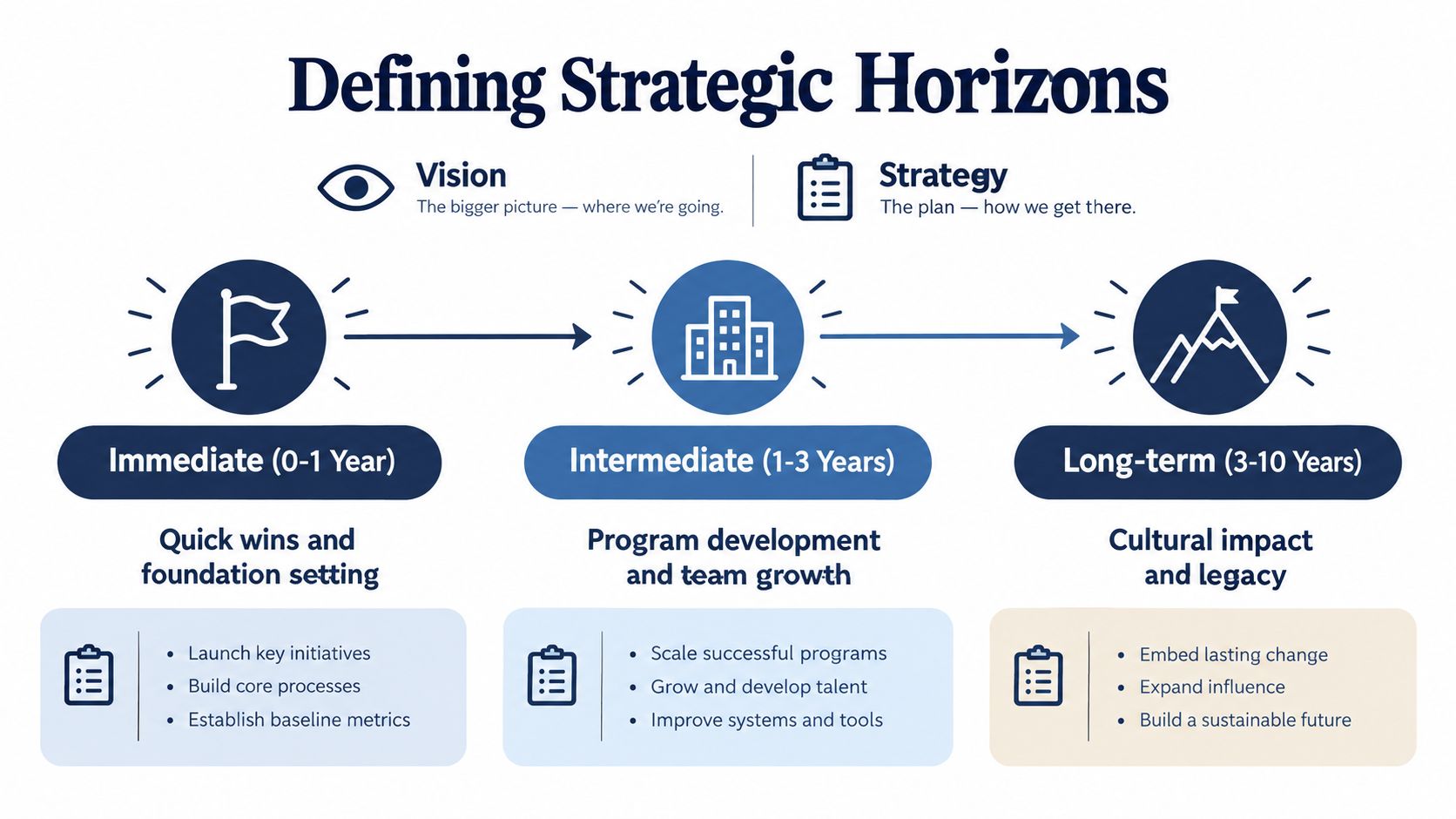
A vision answers where the church is going. Organizational planning answers how the church will move in that direction. Confusing those categories creates two opposite problems: a beautiful statement with no path forward, or an active calendar with no coherent purpose.
One church strategic-planning guide describes vision as what the church and community may look like in the next 3–5 years. That horizon is long enough to encourage meaningful change and short enough to keep leaders accountable. A separate planning resource says long-range vision and identity planning may happen every 5–10 years, while organizational planning addresses the steps required to move toward that future.
Write a future picture people can repeat
A first-time hearer should understand the vision without needing a committee report. Compress it until it becomes:
Biblical: It reflects the church's calling under Scripture.
Contextual: It addresses actual local needs and opportunities.
Vivid: It helps people picture the kind of community they're becoming.
Repeatable: Members can explain it in ordinary conversation.
Practical: It points toward recognizable patterns of obedience.
For example, “We want to be a faithful church” is true but too broad to guide decisions. “We are becoming a church where every generation follows Jesus, welcomes our neighbors, and serves the vulnerable together” gives people a clearer picture. It still needs refinement, but it offers language that can enter prayer, preaching, training, and evaluation.
Move from vision to action
A practical sequence uses three questions:
Which goals express the vision? Choose a few priorities that align with the church's long-term direction.
Which strategies could reach those goals? Consider ministries, partnerships, training, communication, and pastoral practices.
Which options fit the mission and capacity? Evaluate each possibility against biblical purpose, finances, strengths, staffing, and congregational readiness.
This keeps the church from adopting every attractive opportunity. The vision should help leaders say both yes and no.
Digital communication can support this clarity when it serves pastoral purpose rather than replacing relationship. Leaders looking for actionable digital outreach tips may find useful ideas for extending invitations, communicating ministry rhythms, and serving people who participate beyond the main gathering.
Building Congregational Ownership and Lasting Momentum
A pastor can announce a vision alone. A congregation can only embody it together. That distinction matters because people rarely develop deep commitment to a direction they experience as someone else's project.
The first task is shared prayer. Give people room to ask whether the proposed direction reflects Scripture, the church's calling, and the Spirit's work. Acts 13:1–3 shows church leaders worshiping, fasting, listening, and sending workers together. The passage doesn't present mission as the product of one personality's private ambition. It presents a worshiping community responding to God's direction.
Let leaders model the future
Members watch what leaders celebrate, fund, attend, and tolerate. If the vision emphasizes neighborly hospitality but leaders remain inaccessible, the congregation receives a competing message. If the vision calls for intergenerational discipleship but every ministry is planned in isolation, people learn that the stated future has no operational expression.
Leader modeling should appear in ordinary practices:
Elders and staff use the same language when explaining priorities.
Ministry teams connect their plans to the shared vision.
New volunteers receive training that includes the church's theological purpose.
Leaders tell specific stories of people living the vision.
Regular reviews ask what practices are helping or hindering faithful movement.
People own a vision when they can see it in the conduct of trusted leaders and in their own acts of service.
Historical precedent reinforces this principle. In the Church of Jesus Christ of Latter-day Saints, the First Vision is dated to spring 1820, when Joseph Smith was about 14 years old. The event became a core organizing story for that church's identity, and a short film adaptation was introduced in 1976. Whatever one's theological assessment of that tradition, its communication history illustrates a general principle: religious organizations preserve identity by retelling formative stories through changing cultural formats. The historical account is available in the church's history resource.
Reinforce without exhausting people
Repetition doesn't mean repeating the same speech. Use the vision in a sermon illustration, a volunteer orientation, a membership class, a prayer gathering, a ministry update, and a testimony. Change the format while preserving the core meaning.
Patience matters. Congregational ownership grows through prayer, encouragement, participation, and time. Leaders should welcome questions without treating every question as resistance, and they should explain what will change, what will remain, and how the church will evaluate progress.
The vision becomes durable when members can retell it in their own words and connect it with concrete obedience. That is the difference between remembering a phrase and carrying a calling.
Equipping Leaders for Kingdom Impact
Vision casting is finally a theological task because leaders must discern what kind of future is worth pursuing. A church can become more organized without becoming more faithful. It can expand programs while neglecting prayer, Scripture, holiness, mercy, and the formation of disciples who obey Jesus.
Jesus commands his followers to make disciples of all nations, teaching them to observe everything he has commanded (Matthew 28:18–20, CSB). That commission gives churches an enduring center. Local vision should clarify how a particular congregation will worship Christ, form disciples, love neighbors, and participate in God's mission without reducing ministry to a management plan.
Formation strengthens communication
Pastors need more than presentation skills. They need biblical literacy, theological judgment, historical awareness, pastoral wisdom, and the capacity to listen well. Those qualities help leaders distinguish a genuine ministry burden from a passing trend and translate conviction into practices that a congregation can sustain.
Communication tools can help with consistency. A church may use email to share prayer prompts, ministry stories, invitations, and progress updates. Leaders comparing the best tools for church email lists should still ask a prior pastoral question: will this communication help people know, pray, serve, and belong?
The Bible Seminary offers graduate degree programs, certificates, auditing options, dual-degree completion, and on-demand seminars for people pursuing deeper Bible-centered preparation. Its educational approach brings together study of all 66 books of Scripture, historical and theological disciplines, practical ministry training, spiritual formation, and archaeology, reflecting a commitment to training hearts and minds for kingdom service.
That combination matters for vision work. Scripture provides authority, theology provides understanding, spiritual formation shapes the messenger, and hands-on ministry tests whether a proposed direction serves real people. Through faculty expertise, community life, archaeology resources, and ministry-focused education, TBS seeks to equip leaders to impact the world for Christ.
A church's vision becomes trustworthy when its leaders pursue both faithful doctrine and faithful presence.
Healthy vision casting doesn't promise control over outcomes. It calls a congregation to obedient faithfulness in a particular place and season. Churches need leaders who can unite scholarship, spiritual formation, and hands-on ministry, while keeping Christ at the center of every strategic decision. That is how the Bible comes alive in ministry, with archaeology and Scripture together, and how leaders learn to serve the church with humility and courage.
The Bible Seminary equips pastors and ministry leaders through Bible-centered degree programs, certificates, flexible learning options, and practical ministry training that supports faithful vision casting. Visit The Bible Seminary to explore how rigorous scholarship, spiritual formation, and hands-on service can prepare you to equip leaders and impact the world for Christ.