
Treasures in Jars of Clay: Meaning and Ministry Impact

A pastor finishes a difficult counseling conversation, checks a demanding email, and then steps toward the pulpit with little emotional strength left. The congregation may see a composed leader, but the person behind the microphone knows how easily courage can crack. Ministry often places the glory of the gospel in the hands of people who feel painfully ordinary.
That tension stands at the heart of treasures in jars of clay. In 2 Corinthians 4:7, Paul doesn't hide human weakness or present ministry as a performance of personal strength. He shows how God displays His power through fragile servants, so that the attention belongs to God rather than to the vessel.
Understanding the Paradox of Treasures in Jars of Clay
A young ministry leader prepares a sermon after a week of disappointment. A church member has criticized the message, a team conflict remains unresolved, and the leader wonders whether anyone is being helped. The temptation is to project confidence, conceal fatigue, and speak as though faithful ministry requires constant emotional strength.
Paul offers a different picture.
“But we have this treasure in jars of clay, so that the surpassing power belongs to God and not to us.”2 Corinthians 4:7
The verse appears within Paul's defense of his ministry, but he doesn't defend himself by pointing to prestige, polish, or personal invulnerability. Instead, he acknowledges that the gospel is carried by people who suffer, struggle, and remain dependent on God. The surrounding passage uses language of affliction, perplexity, persecution, and being struck down, while also testifying that God preserves His servants.
The phrase treasures in jars of clay therefore holds two realities together:
The treasure is extraordinary. The gospel reveals God's glory in Jesus Christ.
The jar is ordinary. The messenger remains human, limited, and vulnerable.
The power belongs to God. Ministry effectiveness doesn't originate in the personality or status of the minister.
Why the tension matters
We often evaluate leaders by visible qualities. Can they speak clearly? Do they appear confident? Can they organize people, manage conflict, and maintain momentum? Those abilities can serve the church, but they aren't the source of the gospel's power.
Paul's image would have made immediate sense to his first-century readers. Clay vessels were common, fragile, and low-cost, so his contrast was not an abstract lesson about humility. It was a concrete picture of priceless content carried in an unimpressive container, as the historical context of 2 Corinthians 4 makes clear.
Pastoral insight: Your weakness doesn't make the gospel weak. It reminds the church where the gospel's power comes from.
This truth doesn't excuse careless leadership, hidden sin, poor preparation, or neglect of the body and soul. It does free faithful servants from the impossible task of appearing self-sufficient. The gospel doesn't require you to disguise your humanity. It calls you to depend on Christ within it.
Exploring the Historical and Literal Context
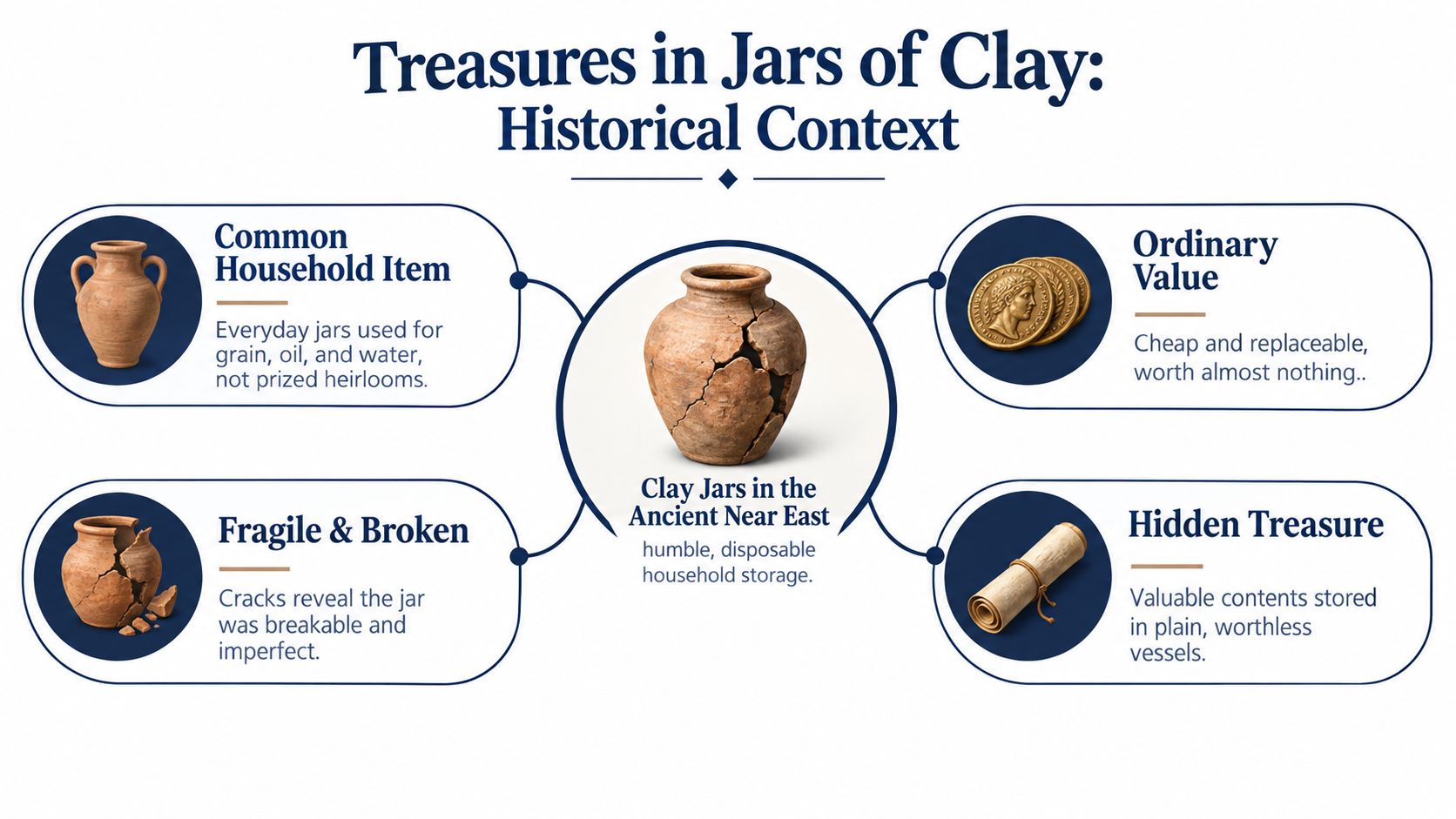
Paul's metaphor becomes sharper when we understand the material world behind it. In the ancient Near East and Mediterranean, clay jars were ordinary household containers used for water, oil, grain, and other necessities. They weren't prized heirlooms. They were practical objects that could be replaced when cracked.
That everyday status explains why the image communicates both humility and fragility. A clay jar could hold something important, but its value as a vessel didn't compare with the value of its contents. The container directed attention away from itself.
Archaeological evidence reinforces the ordinary character of pottery. Clay jars appear at major sites associated with the biblical world, including Qumran, Capernaum, Corinth, and Jerusalem. Pottery fragments also remain common in excavations because ceramic material often survives after organic materials disappear. The historical summary at Bible Hub's study of treasure in clay jars notes that some jars associated with the Dead Sea Scrolls were about 60 centimeters high and 25 centimeters wide, and that whole jars are rare because they were fragile and easily discarded when cracked.
A practical storage technology
The low status of pottery didn't make it useless. Quite the opposite. Clay vessels were abundant and inexpensive, which made them suitable for ordinary storage and concealment. Valuable contents could remain unnoticed inside an unremarkable container.
The Dead Sea Scrolls offer a historically meaningful illustration. Precious texts were preserved in ordinary earthenware, showing how a humble vessel could safeguard something of immense value. The same archaeological discussion notes that sealed clay vessels could preserve precious contents for nearly two millennia, as illustrated by the Copper Scroll in Cave 3, which remained sealed for almost 2,000 years.
This doesn't mean the jars were magical, nor does the discovery prove every detail of Paul's intended imagery. It does show that his audience understood the basic logic: a container could be cheap and breakable while its contents were precious.
Some scholars also connect the image with small clay lamps common around the Mediterranean in the first century. Since Paul has just described the gospel in terms of light, that possibility gives the metaphor another ordinary household reference, as discussed in the Yale Bible Study guide on clay vessels. Whether Paul intended a lamp specifically or a storage vessel more generally, the central contrast remains clear. The vessel is not the treasure.
Analyzing the Theological Significance of the Treasure
The historical image matters because Paul uses it to make a theological argument. The treasure isn't merely a useful idea, a religious tradition, or a minister's private experience. In the immediate context, the treasure is connected with the light of the gospel and the knowledge of God's glory in the face of Jesus Christ.
Earlier in the chapter, Paul describes God shining light into human hearts so that people might know His glory through Christ. The treasure, then, is the saving revelation of God centered on Jesus. It includes the gospel message proclaimed by the apostles and the transforming knowledge of Christ received by those who believe.
“For God, who said, ‘Let light shine out of darkness,’ has shone in our hearts to give the light of the knowledge of the glory of God in the face of Jesus Christ.”2 Corinthians 4:6, ESV
Content and container
Paul separates content value from vessel value. That distinction protects the church from confusing the messenger with the message.
A gifted preacher may communicate with clarity, but eloquence doesn't create the gospel. A compassionate pastor may serve people faithfully, but personal warmth doesn't generate spiritual life. A respected ministry leader may help a congregation listen, but social credibility doesn't produce the surpassing power Paul describes.
The technical explanation of 2 Corinthians 4:7 emphasizes this cause-and-effect relationship. The extraordinary power is God's because the human vessel cannot claim responsibility for producing it. Human ministers matter, and faithful preparation matters, but the efficacy of the gospel rests on God.
This distinction also gives leaders a proper view of failure. A minister's weakness can damage relationships and should never be dismissed. Leaders must repent of sin, pursue accountability, repair harm, and grow in wisdom. Yet ordinary limitation, emotional fatigue, physical vulnerability, and lack of social prestige don't invalidate the gospel.
Freedom without carelessness
The doctrine of jars of clay doesn't tell ministers to stop learning or to lower moral standards. It tells them to stop treating personal perfection as the foundation of ministry. You can prepare carefully without believing that preparation saves people. You can speak with courage without assuming that courage itself changes hearts.
When quoting or reproducing biblical passages in teaching materials, educators should also consider copyright rules for Scripture quotes, including the requirements associated with particular Bible translations. Responsible handling of Scripture reflects the same humility Paul teaches. We serve the Word rather than treating it as material for personal display.
The minister's task is faithful stewardship. The treasure belongs to God, the message centers on Christ, and the servant remains dependent. That arrangement doesn't diminish ministry. It places ministry on its proper foundation.
Confronting Modern Misconceptions About Ministry
Many churches have absorbed a leadership ideal that prizes constant strength. The ideal preacher is always composed, the worship leader is always energized, and the ministry director always appears to have a solution. Public communication, branding, and careful presentation can help a church serve people, but they can also create the illusion that spiritual authority depends on polish.
Paul's metaphor challenges that illusion without celebrating incompetence.

A congregation can value clear preaching, wise administration, responsible stewardship, and appropriate evaluation. Those practices help leaders serve well. But they can't become substitutes for spiritual dependence. When attendance, fundraising, platform size, or charisma becomes the main measure of ministry worth, the church risks evaluating the jar while neglecting the treasure.
The danger of the polished vessel
The pressure to appear unbreakable often produces predictable habits:
Leaders hide exhaustion until they can no longer function.
Churches reward image management more than honest shepherding.
Congregations confuse confidence with spiritual maturity.
Ministers fear admitting uncertainty because they expect every answer to be immediate.
The gospel becomes associated with a leader's public persona.
Paul's argument in Corinthians confronts the desire for impressive spiritual representatives. His ministry credibility doesn't rest on creating an image of superiority. It rests on the truth of Christ and God's power working through a suffering servant.
The church doesn't need leaders who pretend to be more than human. It needs leaders whose dependence on Christ is visible and trustworthy.
Digital tools can reduce repetitive communication work. For example, a ministry team may use congregation content automation to organize and repurpose teaching material, freeing people to invest more attention in prayer, pastoral presence, and personal care. The tool can support ministry administration, but it cannot replace discernment, holiness, or the shepherd's responsibility to love people.
Weakness isn't a credential
The passage doesn't make suffering an automatic proof of faithfulness. A leader can suffer because of opposition, poor judgment, unhealthy systems, or personal sin. Scripture calls us to discern the difference.
The point is more precise. When faithful ministry involves visible limitation, rejection, or hardship, those conditions don't prove that God has abandoned the work. They can reveal that the work's power never came from human impressiveness. Weakness is not the goal of ministry, but dependence on God is.
That correction creates a healthier standard. Churches can ask whether leaders are truthful, teachable, faithful, and enduring, rather than asking whether they always look successful. They can honor competence without worshiping charisma.
Applying the Metaphor to Pastoral Resilience
Pastoral resilience begins with a truthful identity. You aren't the treasure, and you aren't the source of the power. You're a servant entrusted with something that belongs to God.
That confession can change daily leadership decisions. A pastor who believes ministry depends entirely on personal performance may avoid difficult conversations, overprepare every message, or interpret criticism as a threat to personal worth. A pastor who knows the treasure belongs to God can pursue excellence while remaining free to admit limits.
The archaeological background gives this application a concrete shape. Ancient treasures were commonly hidden in clay jars because ceramic vessels were cheap, abundant, and disposable, making them practical for concealment and storage. As the archaeological discussion of treasures in clay jars explains, the ordinary container could protect attention from the valuable contents. Applied to ministry, that suggests a durable strategy under pressure: don't overinvest in image management. Endurance, rather than polish, becomes the more useful observable measure of spiritual effectiveness.
Four practices for leaders
Name the limitation accurately. Instead of saying, “I'm failing because I feel tired,” identify what is happening. You may need rest, wiser delegation, counseling, medical care, or a conversation with a trusted overseer. Naming a limit isn't surrendering your calling.
Prepare without pretending. Study the biblical text carefully, clarify the structure of the sermon, and practice communicating its central truth. Then release the demand to control every response. Faithful preparation is your responsibility. Regeneration and transformation belong to God.
Receive criticism with discernment. Not every complaint is a command, and not every criticism is persecution. Ask whether the feedback identifies sin, confusion, poor communication, or merely a preference. A clay jar doesn't need to defend its dignity every time someone notices a crack.
Measure endurance carefully. Look for faithfulness over time, not just visible response in the moment. Are you continuing to teach Scripture, love people, confess sin, repair relationships, and seek wisdom? Those practices reveal resilience more reliably than a carefully maintained public image.
Pastors serving through pastoral care training can connect theological reflection with the practical demands of listening, crisis response, and shepherding. This kind of formation helps leaders carry responsibility without pretending they can carry it alone.
Applications in ordinary ministry
In preaching, the jar-of-clay perspective allows a leader to explain the text plainly rather than trying to manufacture a dramatic experience. In counseling, it permits the pastor to listen with compassion while referring people to additional help when a situation exceeds pastoral competence. In administration, it encourages shared leadership rather than the belief that one indispensable person must hold every responsibility.
The aim isn't passivity. It is faithful action without self-exaltation. A fragile servant can still make courageous decisions because confidence rests in God's treasure, not in the servant's ability to appear invulnerable.
Developing Sermon Outlines and Study Questions
A sermon on 2 Corinthians 4:7 should help listeners move from the physical image to the theological claim and then into faithful practice. The historical background serves the text. It shouldn't become an archaeological detour that leaves the congregation unsure what Paul wants them to believe.
A sermon outline for 2 Corinthians 4:7
Text: 2 Corinthians 4:7–15
Big idea: God places the treasure of the gospel in fragile human servants so that His power, not human prestige, receives the glory.
Opening tension: Begin with a familiar ministry experience. A leader may teach faithfully and still feel exhausted, criticized, or inadequate. Ask the congregation whether they have assumed that weakness disqualifies someone from being useful to God.
Movement one, identify the treasure. Read the surrounding verses, especially 2 Corinthians 4:6. Explain that the treasure is the knowledge of God's glory revealed in the face of Jesus Christ. The gospel isn't valuable because the messenger is impressive. The gospel is valuable because Christ is glorious.
Movement two, identify the jar. Describe clay vessels as ordinary, low-cost, and breakable household containers. Help listeners understand that Paul isn't using “jar of clay” as a sentimental image for hidden potential. He is emphasizing the low status and vulnerability of the messenger.
Movement three, locate the power. Read the conclusion of verse 7. The power belongs to God and not to us. Ask what changes when a church stops treating charisma, polish, or social prestige as the source of spiritual effectiveness.
Movement four, interpret suffering. Use the language of the surrounding passage. Paul is afflicted but not crushed, perplexed but not driven to despair, persecuted but not abandoned, struck down but not destroyed. The text doesn't deny pain. It shows God's sustaining presence within it.
Movement five, practice faithful dependence. Invite the congregation to name one area where they are trying to appear self-sufficient. Then direct them toward prayer, honest community, wise limits, and renewed confidence in Christ.
A strong conclusion should return to the contrast. The church doesn't gather to admire the vessel. It gathers to receive the treasure and praise the God whose power sustains weak servants.
Questions for a Bible study
Use these questions with a small group, ministry team, classroom, or preaching cohort:
What does the immediate context of 2 Corinthians 4:6–15 reveal about the identity of the treasure?
Why would a clay jar communicate humility and fragility to Paul's original audience?
Which forms of ministry prestige are most tempting in your setting?
How can a church honor excellence without confusing excellence with spiritual power?
What is the difference between acknowledging weakness and using weakness as an excuse for irresponsibility?
Where do you feel pressure to appear stronger than you are?
How does the resurrection hope in the surrounding passage shape the way you understand present suffering?
What practice could help your ministry team value endurance, truthfulness, and dependence on God?
How might this passage change the way you evaluate a pastor, teacher, volunteer, or worship leader?
What would it look like to proclaim Christ rather than subtly promote yourself?
Ministry Resilience Framework
Focus Area | Worldly Approach | Biblical Approach |
|---|---|---|
Identity | Build worth through visibility, approval, and achievement | Receive identity as a servant entrusted with God's treasure |
Preparation | Prepare to control every response | Prepare faithfully and trust God with the results |
Weakness | Hide limitations to protect an image | Name limitations honestly and seek wise support |
Leadership | Centralize responsibility around the most impressive person | Share responsibility and cultivate dependence on Christ |
Evaluation | Prioritize polish, popularity, and immediate response | Look for truthfulness, faithfulness, endurance, and spiritual fruit |
Suffering | Treat hardship as proof of failure | Discern its cause while trusting God's sustaining power |
Public ministry | Protect the vessel's reputation | Keep attention on the gospel and the glory of Christ |
Frequently asked questions
What is the treasure in jars of clay?
The treasure is the gospel and the knowledge of God's glory revealed in Jesus Christ. Paul presents this treasure as something God entrusts to human ministers, not something they create through talent or status.
What do the jars of clay represent?
They represent human servants who are ordinary, fragile, and limited. The image doesn't say that people have no value. It distinguishes the value of the messenger from the immeasurable value of the message.
Does weakness make someone a better ministry leader?
Weakness itself doesn't make a person mature or faithful. The passage teaches that human limitation can display God's power when a servant depends on Him, receives correction, and continues in faithful obedience.
How should churches evaluate leaders?
Churches should consider biblical character, doctrinal faithfulness, wisdom, competence, humility, and endurance. They shouldn't treat charisma or polished presentation as proof of spiritual authority.
How can this passage help with burnout?
It releases leaders from the belief that they must be self-sufficient or flawless. It also encourages practical honesty, including rest, accountability, delegation, wise boundaries, and appropriate pastoral or professional support.
The Bible Seminary provides Bible-centered graduate education, ministry training, and study opportunities that unite scholarship, spiritual formation, archaeology, and hands-on service. If you want to prepare your heart and mind for kingdom service while exploring how Scripture speaks to fragile leadership, visit The Bible Seminary to learn about available programs and resources.