
The Parable of the Landowner: Matthew 20 and 21 Explained

If you search for the parable of the landowner and open your Bible expecting one story, which one will you find, the owner who pays every worker the same wage, or the owner whose tenants murder his son? Most readers don't realize they're holding two different parables. We want to help you sort them out patiently, read each one in context, and take the hard questions seriously.
Which Parable of the Landowner You Are Studying
You're not confused because you missed something. You're confused because two passages in Matthew share a landowner, a vineyard, and a kingdom lesson, yet they aren't the same story.
Matthew 20:1 to 16 is usually titled the Parable of the Workers in the Vineyard. Many readers call it the parable of the landowner because the owner hires, returns, pays, and answers the complaint. Matthew 21:33 to 46 is the Parable of the Wicked Tenants, where a landowner plants and leases a vineyard, then sends servants and finally his son.
Two passages called the parable of the landowner
Feature | Matthew 20:1–16 | Matthew 21:33–46 |
|---|---|---|
Common title | Parable of the Workers in the Vineyard | Parable of the Wicked Tenants |
Who the landowner deals with | Day laborers hired at five times | Tenant farmers who lease the vineyard |
Central conflict | Pay that seems unequal to the workers | Tenants reject the owner's servants and son |
Main lesson | God's generosity beyond merit | Accountability for entrusted stewardship |
Setting in Matthew | Follows Peter's question about reward (19:27) | Follows the challenge to Jesus' authority (21:23) |
Context explains the difference. In Matthew 19:27, Peter asks what the disciples will receive for leaving everything, so Jesus tells a story about reward and comparison. In Matthew 21:23, temple leaders challenge Jesus' authority, so Jesus tells a story about leaders who reject God's messengers.
Here's a simple test you can use in seconds. If the story turns on wages and invitation, you're reading Matthew 20. If it turns on tenants, harvest, and rejection, you're reading Matthew 21.
Keep your passage in view as you read. Mixing the lessons together is where most misreadings start.
We'll walk through the workers first, then the tenants. After that, we'll look at the Old Testament background and the fairness question most readers bring.
Workers in the Vineyard and the Five Hiring Times
Jesus begins. A master of a house goes out early in the morning to hire laborers for his vineyard.
He agrees with the first group for one denarius for the day and sends them in. That agreement matters, because everything that follows is measured against a promise kept, not a promise changed.
The day unfolds hour by hour
The owner keeps returning to the marketplace. According to Matthew 20 in the NIV, NET, ESV and KJV on Bible Gateway, the landowner hires laborers at five distinct times, early morning, the third hour, the sixth hour, the ninth hour, and the eleventh hour (Matthew 20:1–7), a workday measured through Jewish-Roman timekeeping, with the final group hired only about one hour before the day ended.
Notice what the later workers hear. The third hour group is promised whatever is right. The sixth and ninth hour groups are sent on the same terms, and the eleventh hour group is sent with no wage stated at all.
Five hiring times in Matthew 20:1–7
Hiring time | Approximate clock time | Terms stated | Pay received |
|---|---|---|---|
Early morning | About 6 a.m. | Agreed to one denarius | One denarius |
Third hour | About 9 a.m. | Promised whatever is right (20:4) | One denarius |
Sixth hour | About noon | Sent in on the same terms as the third hour (20:5) | One denarius |
Ninth hour | About 3 p.m. | Sent in on the same terms as the third hour (20:5) | One denarius |
Eleventh hour | About 5 p.m. | Sent in with no wage stated (20:7) | One denarius |
At evening, the owner reverses the order we'd expect. He tells his foreman to pay beginning with the last hired and ending with the first, so the all day workers watch the one hour workers receive a full denarius.
That coin isn't a token. A denarius was a standard daily wage for a first-century day laborer in Palestine, enough provision for a day. The late workers receive mercy they couldn't have calculated, and the early workers receive exactly what they agreed to receive.
The complaint and the owner's answer
The first workers grumble that the latecomers have been made equal to them. The owner answers one of them directly.
"Friend, I am doing you no wrong. Did you not agree with me for a denarius?" (Matthew 20:13 ESV)
He then asks the searching question of the parable.
"Is your eye evil because I am good?" (Matthew 20:15 ESV)
Jesus closes with the frame that also opened the teaching, "So the last will be first, and the first last" (20:16 ESV). The point isn't that hours don't matter in ordinary life. It's that the owner keeps his agreements and remains free to be generous with what's his.
Try this check before you move on. Can you name each hiring time, the terms given, and the pay received without looking? If you can, you've got the structure Jesus built the lesson on.
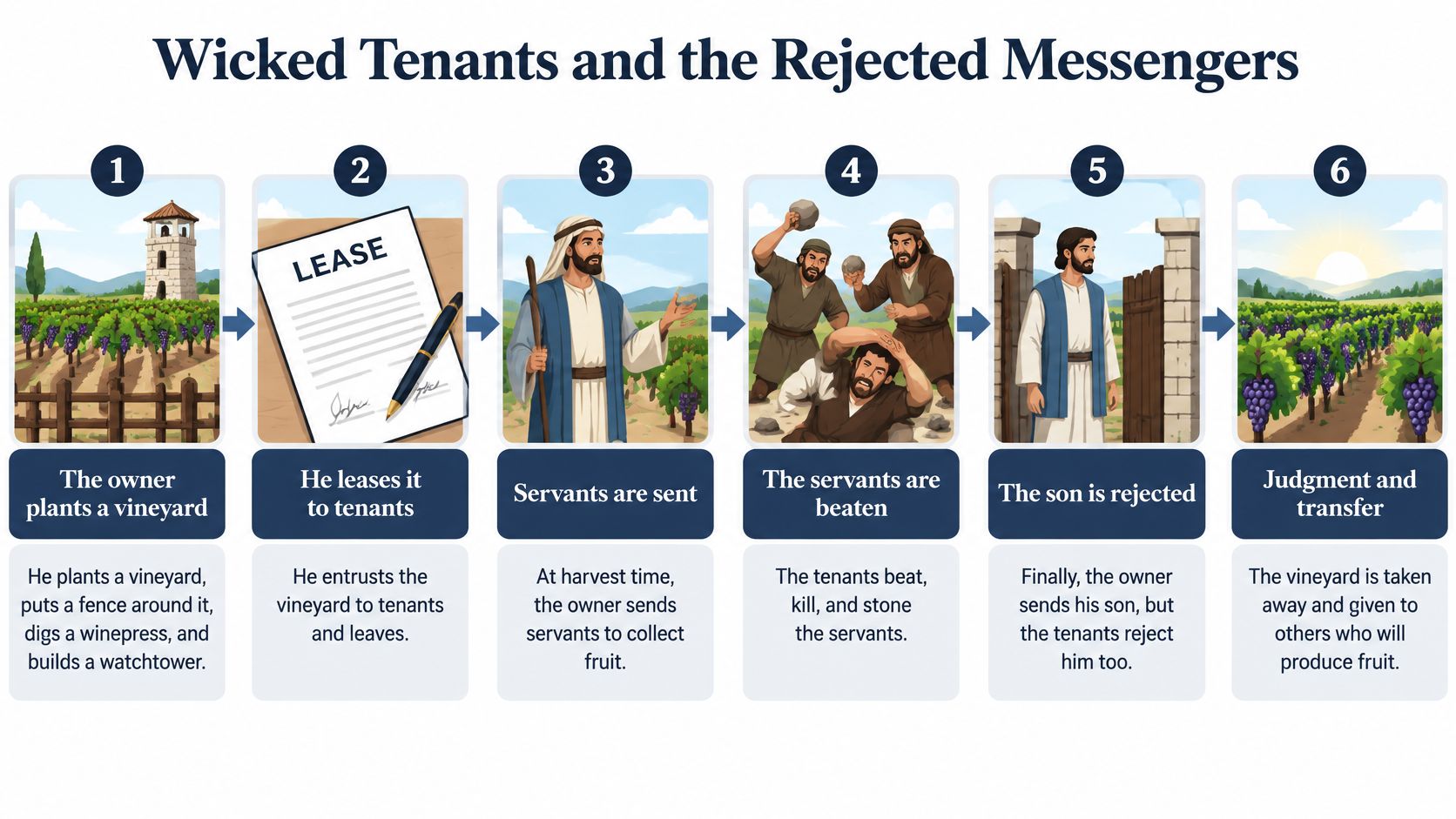
Wicked Tenants and the Rejected Messengers
Matthew 21 tells a darker vineyard story, and the tension builds step by step. A landowner prepares everything his tenants will need, then trusts them with it.
As Matthew 21 in the GNT, NRSVUE, NLT and NIV on Bible Gateway records, the account identifies four concrete features of the vineyard's preparation, the landowner plants it, places a fence around it, digs a winepress, and builds a watchtower. He leases it to tenants and goes into another country.
An escalating pattern of rejection
When harvest draws near, the owner sends servants to collect his fruit. The tenants beat one servant, kill another, and stone a third.
You'd expect the story to end there, but the owner sends a second, larger group of servants. They receive the same treatment. Patience is being shown, and it's being refused.
First response: Violence against the servants who ask for the fruit
Second response: The same violence, repeated against more servants
Third response: Murder of the son in hopes of seizing the inheritance
Finally the owner sends his son, saying they'll respect him. The tenants reason among themselves that if they kill the heir, the inheritance will be theirs, so they throw him out of the vineyard and kill him (Matthew 21:38 to 39).
The hearers pronounce their own verdict
Jesus asks what the owner will do when he comes. His hearers answer that he'll destroy those tenants and lease the vineyard to others who will give him the fruit in season.
Jesus then turns to Psalm 118.
"The stone that the builders rejected has become the cornerstone" (Matthew 21:42 ESV)
Matthew tells us the chief priests and Pharisees recognize Jesus is speaking about them. They seek to arrest him, but they fear the crowds who regard him as a prophet (21:45 to 46).
Don't miss the stewardship point. The tenants didn't plant the vineyard or finance its fence, winepress, and tower. They are stewards of a prepared property, and stewards remain accountable to the owner.
Retell the sequence in your own words today. If you can name the preparation, the two servant missions, and the son, you'll feel why Jesus' hearers understood this as judgment, not farming advice.
Isaiah 5 and the First-Century Vineyard Setting
Jesus' first hearers would've heard an older song behind Matthew 21. That song is Isaiah 5:1 to 7, and it's the key that keeps this parable from becoming a generic business lesson.
In Isaiah 5 in the NASB, NIV and ICB on Bible Gateway, the prophet presents a vineyard song identifying the vineyard as “the house of Israel” and the people of Judah as God's cherished planting (Isaiah 5:1–7). Isaiah is explicit, so we don't have to guess what the image meant.

What Isaiah stresses, and what Matthew changes
Isaiah describes careful work, clearing stones, planting choice vines, building a watchtower, and preparing a winepress. Despite that investment, the vineyard yields worthless grapes, and God explains that he looked for justice and righteousness from his people.
Matthew reuses the same framework, vineyard, protective boundary, winepress, and watchtower. But Matthew shifts the focus from bad fruit on the vines to tenants who refuse the owner his harvest and attack his representatives.
Isaiah 5: The vineyard itself fails to produce good fruit
Matthew 21: Entrusted tenants withhold fruit and reject messengers
Both passages: Privileged care creates real accountability
Isaiah's audience also lived under the threat of Assyria, so a warning of judgment wasn't abstract for them. The song pressed a present danger, not just a future idea.
Why leasing made sense to Jesus' listeners
The first century setting is ordinary, not fanciful. Absentee owners leased vineyards to tenant farmers who owed an agreed share of the crop, and vines took years before they produced income.
That means the owner's share isn't an arbitrary demand dropped on strangers. It's the contractual return on land, plants, and infrastructure he provided long before harvest day arrived.
A humble reading rule: Read a parable in its Gospel setting and in the wider storyline of Scripture before you apply it to your setting.
When you keep Isaiah 5 in view, you won't reduce Matthew 21 to tenant relations. You'll hear a covenant story about God's people, God's messengers, and leadership that must answer to God.
Fairness, Grace and How Readers Interpret the Parable
Let's name the objection plainly. The first workers bore the burden of the day and the scorching heat, then watched men who worked one hour receive the same pay. If that feels unfair to you, you're feeling the tension Jesus intended.
The question is whether the text presents injustice, or something else. As Matthew 20 in the NIV on Bible Gateway shows, the passage distinguishes between workers who explicitly agreed to a denarius and later workers whom the landowner promised to pay “whatever is right,” and a denarius was the ordinary daily wage for a first-century laborer, so the earliest workers receive the negotiated standard wage rather than being underpaid.
Three readings readers encounter
First, the historic Christian reading sees a picture of God's gracious kingdom. Grace isn't wages calculated by comparison, and the parable exposes envy when we resent generosity shown to someone else.
Second, many commentaries connect the last first frame to Jewish and Gentile inclusion in God's kingdom. We present that as a view scholars hold and debate, not as a detail Matthew spells out in these verses, and tools for weighing such claims are covered in our guide to New Testament interpretation.
Third, don't import Matthew 21's leadership judgment into Matthew 20. Both parables are true, but each makes its own point in its own context.
What Matthew 20 clearly says: The owner keeps his agreement and gives generously
What readers debate: How far to press each detail as a picture of salvation history
What the parable doesn't teach: That exploitative pay is acceptable
That last boundary matters for pastors and teachers. This story shouldn't be used to defend flat wages regardless of effort, broken agreements, or removing workplace standards. Generosity that exceeds justice isn't the same as injustice dressed up as grace.
Three test questions for any interpretation
Ask these before you teach the passage. Does it honor the text's own explanation? Does it fit the Gospel context? Does it avoid turning a parable into a prooftext?
If an application fails those tests, slow down. The parable challenges merit based comparison while still affirming explicit agreements, and holding both together is the faithful work.
Preaching and Teaching the Parable Today
Good teaching keeps each parable's own point clear. You don't need to force Matthew 20 and Matthew 21 into one sermon to honor both.
The leasing background helps your hearers more than you may expect. The Working Preacher commentary on Matthew 21:33-46 notes that vineyard cultivation required substantial upfront capital and several years before vines generated income, making the owner's expected harvest a contractual return on investment rather than an arbitrary demand, and that for ministry teaching, entrusted authority is legitimate only when it produces the owner's required “fruit.”
For pastors preaching Matthew 20
God's grace isn't earned by hours worked: The eleventh hour workers receive provision they didn't secure by seniority
The owner keeps his agreements and still gives generously: Preach both truths, not one against the other
The last are invited and not forgotten: Name the people in your congregation who feel they've arrived too late
For Matthew 21, frame the sermon around accountability for fruit. Authority entrusted to leaders is judged by the harvest the owner expects, not by how long leaders have held the keys.
For educators and homeschool families
Read both passages aloud: Keep Matthew 20 and Matthew 21 in separate readings
Identify the agreement in each story: Ask who promised what, and who kept it
Compare how the owner responds: Generosity in one story, judgment in the other
Say a family reads Matthew 20 on Monday and Matthew 21 on Thursday. By Friday, a child can often tell you which story is about pay and which is about tenants, and that clarity is real biblical literacy.
For ministry leaders reflecting honestly
Ownership or stewardship: Where have I treated my role as mine to protect?
People still waiting: Who in my church or community hasn't yet been invited in?
Expected fruit: What fruit is the owner expecting from my season of service?
This week: Choose one application only, thank God for grace you didn't earn, invite someone who's been waiting, or name one fruit you'll pursue faithfully.
That's training hearts and minds for kingdom service in ordinary practice. Small obedience, tied closely to the text, will outlast a clever outline.
Frequently Asked Questions About the Parable of the Landowner
Does Matthew 20 contradict Matthew 21
No. Matthew 20 teaches God's generosity within his agreements, while Matthew 21 teaches accountability for entrusted fruit. Different contexts produce different lessons, and both belong to Jesus' teaching in Matthew's Gospel.
Is the landowner a picture of God
In both parables, the owner represents God's authority, and in Matthew 20 also his generosity. Workers and tenants picture human response, but you should be cautious about treating every small detail as a one to one allegory.
Jesus' parables usually press one main point through a story. Pressing every fence post and coin into a hidden meaning often takes you away from what the passage clearly says.
Can children learn from these parables
Yes, with short and honest versions. Younger children can learn that God keeps his promises, God invites everyone, and God asks his people to bear fruit.
Older learners can go further. Ask them to compare the agreements in each story, name who kept a promise, and explain why the endings differ.
Younger children: Focus on the owner's kindness and promise keeping
Older children: Compare workers and tenants side by side
Teens and adults: wrestle with envy, stewardship, and accountability
If a question still troubles you, return to the matching passage and read it slowly again. Most confusion clears when the right story stays in view.
Study the Parables in Depth at The Bible Seminary
At The Bible Seminary in Katy, Texas, we train students to read parables in their Gospel, historical, and theological settings. Our aim is equipping leaders to impact the world for Christ by uniting scholarship, spiritual formation, and hands-on ministry.
That approach grows from our core values, which include the Lordship of Christ, the Bible as the fully true Word of God, Prayer, Unreached Peoples, The Local Church, Community, and Compassion. Those commitments guide how we read a text before we rush to apply it.
We are Bible-based, Christ-centered, Spirit-led, and ministry-focused. In practice, that means you learn to trace Isaiah behind Matthew, notice agreements inside a story, and preach with humility toward the people in front of you.
Keep studying after today
Take Matthew 20 and 21 back to your table this week. Use the hour by hour check for the workers and the three test questions for interpretation, and let the text correct your first impressions.
Explore our degree programs at The Bible Seminary and begin your journey toward deeper biblical training, starting with our academics overview and degree programs. You can also visit our campus in Katy to learn more about classes and resources available to you.
Lord, teach us to receive your generosity without envy and to bear your fruit without pride. Keep us close to your Word, and make us faithful stewards of all you've entrusted to us.
If these two vineyard parables have stirred a desire to study Scripture carefully and teach it faithfully, we invite you to explore graduate training that unites academics, archaeology, and ministry preparation. Partner with us in training the next generation of Christian leaders, and visit The Bible Seminary to take your next step.