
The Bible and Culture: A Biblical Framework for Engagement

The Bible's cultural reach expanded from 33 translations around 1450 to 71 by about 1800, and by the late twentieth century the complete Bible existed in more than 250 languages, with portions in more than 1,300 languages. The Bible isn't a static artifact preserved behind glass. Faithful biblical engagement requires understanding both Scripture's ancient context and the contemporary cultures it addresses.
Why, then, do we often frame the Bible and culture as a simple contest between belief and secularization? A young woman may read Scripture on a subway, hear a biblical idea in a podcast, discuss suffering with a friend, or encounter a Christian claim in a short video. Her questions may never begin in a church building, yet they still concern identity, justice, forgiveness, hope, and the meaning of life.
Pastors, educators, and ministry leaders serve people in that reality. We must honor the authority of God's Word without assuming that everyone receives it through the same institutions, language, or social network. At The Bible Seminary, we believe training hearts and minds for kingdom service requires both careful exegesis and attentive listening.

Introduction - The Living Word in a Changing World
A pastor once notices a familiar pattern in a young adult Bible group. The participants respect Scripture, but they struggle to connect an ancient passage with online hostility, family expectations, workplace anxiety, and questions about belonging. One person asks whether the Bible has anything to say about digital identity. Another wonders how a text written in ancient languages can speak meaningfully to a multicultural neighborhood.
The difficulty isn't that the Bible has become irrelevant. The difficulty is that readers often approach it without enough attention to either context. They may treat the text as a detached collection of sayings, or they may force contemporary concerns onto a passage without first asking what the biblical writer communicated to the original audience.
A faithful reading listens in two directions: it hears what Scripture meant in its historical setting and considers how that truth addresses people in their present setting.
The Bible has always engaged real cultures. The prophets spoke to communities shaped by power, idolatry, injustice, and covenant responsibility. Jesus taught farmers, fishermen, religious leaders, grieving families, and outsiders through images drawn from daily life. Paul addressed particular congregations with particular conflicts, including questions about unity, public witness, spiritual gifts, and life among neighbors who worshiped other gods.
That pattern gives us a theological foundation for ministry today. We don't change the gospel to make it acceptable, and we don't preserve unfamiliar cultural forms as though they were themselves the gospel. We seek to communicate God's unchanging truth with clarity, humility, and love.
The Bible's global history reinforces this point. Translation enabled biblical stories, ethical concepts, literary patterns, and religious vocabulary to enter societies far beyond the world of the original authors. The same text has been heard through many languages and interpreted within many communities, while remaining grounded in the revelation of the one God and the saving work of Jesus Christ.
This is why the study of the Bible and culture matters for every ministry context. Whether you serve in Katy, Texas, another part of the United States, or a cross-cultural setting, you'll meet people whose assumptions about authority, family, suffering, and hope differ from your own. You need more than enthusiasm. You need biblical depth, cultural intelligence, and spiritual discernment.
Historical Context - The Bible in Cultural Transition
The Bible's cultural influence cannot be separated from its translation history. Translation wasn't merely a technical exercise in replacing words. It required interpreters to understand ancient institutions, genres, idioms, historical assumptions, and the worldview of the receiving community.
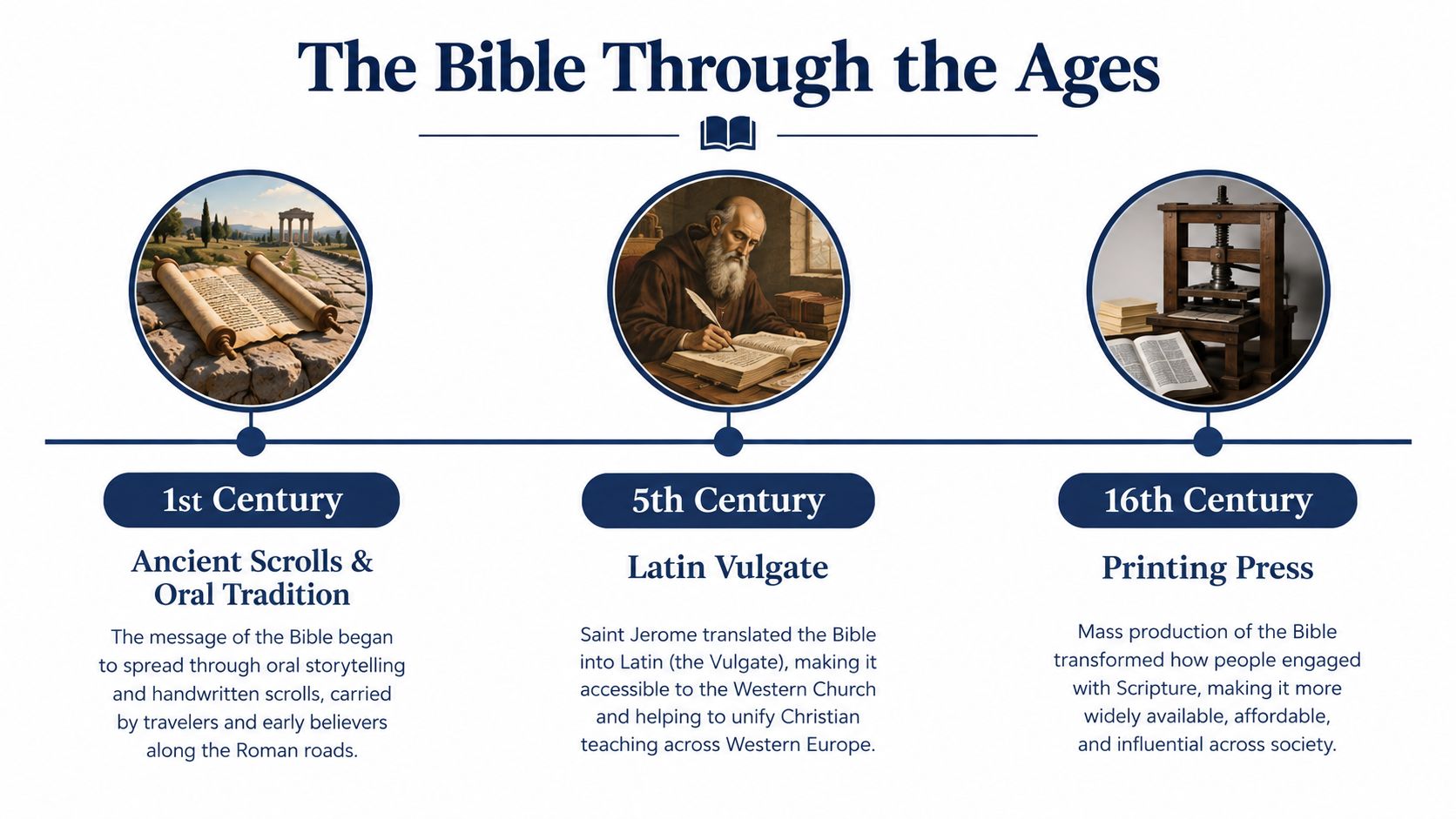
Around the invention of printing in approximately 1450, Britannica records 33 different Bible translations. By about 1800, that number had increased to 71. By the late twentieth century, the complete Bible had been translated into more than 250 languages, while portions had been published in more than 1,300 languages. These figures are documented in Britannica's overview of biblical translation.
Several milestones show how the Bible moved across linguistic and cultural boundaries:
The Septuagint: The Hebrew Scriptures were translated into Greek during the third and second centuries BCE, giving Greek-speaking Jewish communities access to Scripture in a language used across a broad cultural world.
Major textual traditions: Latin, Syriac, German, English, and other traditions carried biblical language into new communities and shaped worship, education, literature, and public life.
The printing press: Johannes Gutenberg selected the Latin Vulgate for his landmark movable-type project in the mid-fifteenth century. The choice demonstrated the Bible's importance as a major test of early European printing technology.
American publishing: An American Bible Society initiative printed more than 1 million Bibles during the three years after 1829, and by the 1840s nearly 200 publishers in almost 50 American cities had produced more than 350 Bible editions, according to Mark Noll's account of the Bible and American culture.
The growth of English-language editions also illustrates how technology and distribution changed public engagement. Editions rose from nearly 300 by 1820 to almost 1,900 by 1870, according to the same historical source. Readers encountered Scripture in homes, schools, churches, reform movements, and public debates.
History cautions us against confusing one translation or cultural form with Scripture itself. A translation can faithfully communicate biblical truth while carrying a particular register, rhythm, and set of interpretive choices. That's why students preparing for ministry should compare major translations and ask how language affects comprehension.
The Oxford Reference discussion of biblical translation emphasizes that translators model both the source culture and the receptor culture. For pastors, this means exegesis should distinguish the meaning of the Hebrew, Aramaic, or Greek discourse from the effects of a particular English formulation. Legitimate translations may differ in emphasis without undermining biblical authority.
Theological Frameworks for Engaging Culture
Christians need more than a method for making the Bible sound familiar. We need a theology of culture that begins with God's revelation, takes human sin seriously, and recognizes the church's calling among all peoples.
The first framework is faithful contextualization. Contextualization means communicating biblical truth in forms people can understand within their language, history, and social world. It doesn't mean changing the gospel. It means removing unnecessary barriers so that people can hear the gospel clearly.
Jesus modeled this approach. He spoke about seeds, lamps, shepherds, vineyards, household work, and family relationships. These images weren't decorative. They were recognizable entry points into truths about God's kingdom, human responsibility, judgment, grace, and discipleship.
Paul also adjusted his approach without changing his message. In settings shaped by Jewish Scripture, he reasoned from the Scriptures. In Athens, he began with the religious context of his audience before proclaiming the true God and the resurrection of Jesus. The difference was not doctrinal compromise. The difference was pastoral wisdom.
A second framework is cultural discernment. Every culture contains practices that reflect God's common grace, along with beliefs and behaviors that conflict with Scripture. Christian leaders must resist two opposite errors:
Cultural rejection: Treating every unfamiliar custom, artistic form, technology, or social practice as morally suspect.
Cultural surrender: Accepting every cultural assumption without testing it against God's Word.
Romans 12:2 calls believers to refuse conformity to the pattern of the world while pursuing renewed minds. That command doesn't authorize isolation from neighbors. It calls us to think carefully so that we can recognize what pleases God.
A third framework is counter-cultural witness. The church doesn't exist to mirror its surroundings. Jesus forms a people whose love, holiness, generosity, truthfulness, and care for the vulnerable display an alternative way of life. Yet counter-cultural witness should never become cultural contempt. We speak truth as servants, not as detached judges.
The fourth framework is transformation under Christ's lordship. Scripture doesn't limit discipleship to private belief. The gospel addresses families, work, money, power, education, public speech, justice, worship, and community life. We should ask not only whether a cultural practice appears religious, but whether it helps people love God and neighbor faithfully.
Contextualization changes the doorway, not the destination.
The church's global identity reinforces this theological posture. Pew Research Center reported that the worldwide Christian population grew from approximately 2.1 billion in 2010 to 2.3 billion in 2020, a 6% increase, while Christians' share of the global population declined from 31% to 28.8%. During that period, sub-Saharan Africa surpassed Europe as the region containing the largest Christian population. In 2020, sub-Saharan Africa contained 30.7% of the world's Christians, compared with 22.3% in Europe, according to Pew Research Center's analysis of Christian population change.
These figures don't establish the truth of Christianity. They do challenge Western assumptions about where Christian life is centered. The body of Christ includes African, Latin American, European, Asian, Middle Eastern, and diasporic communities. Unity in Christ doesn't erase cultural difference. It orders difference toward mutual service, as Paul teaches in 1 Corinthians 12.
Case Studies - Biblical Engagement in Action
Compare two approaches to a neighborhood Bible discussion.
In the first, a leader distributes a familiar study guide, assumes everyone understands its illustrations, and treats questions about culture as distractions. Participants may learn vocabulary, but they may not know how Scripture speaks to their actual relationships, fears, and responsibilities.
In the second, the leader begins with the biblical passage and listens to the group's questions. A multilingual family discusses honor and shame. A college student raises questions about online identity. An older member connects the text to workplace conflict. The leader doesn't replace exegesis with personal experience. Instead, the leader uses those experiences to clarify how the passage addresses real people.
The difference lies in posture. The first approach assumes that one cultural form carries biblical faith naturally. The second distinguishes the authority of Scripture from the habits of one community. It asks how the biblical message can be understood without demanding that every listener adopt the leader's cultural preferences.
Archaeology offers another helpful comparison. At Khirbet el-Maqatir, archaeological work that began in 1995 identified evidence from four major occupation periods: a Bronze Age fortress, an Iron Age I–II village, a small Late Hellenistic/Early Roman town, and a Byzantine monastery. Fourteen excavation seasons revealed a site shaped across many centuries. Researchers have proposed connections between the remains and biblical locations such as Ai, Ephron, and Ephraim, but those proposals shouldn't be presented as unquestionable identifications. The published overview is available through the archaeological study of Khirbet el-Maqatir.
This example models responsible Christian scholarship. Archaeology can illuminate settlement patterns, architecture, trade, conflict, and religious life. It can help readers understand the world behind biblical narratives. It doesn't automatically prove every interpretation, and artifacts don't replace Scripture as the authoritative foundation for faith and ministry.
A similar discipline applies to digital ministry. A short video may open a conversation, but conversation isn't the same as discipleship. A podcast may introduce a biblical theme, but introduction isn't the same as careful interpretation. A meal may build trust, but hospitality must eventually make room for truth, repentance, faith, and life together in Christ.
Watch the following resource with that distinction in mind. Media can serve ministry when leaders pair it with biblical explanation, prayer, and relational follow-up.
Practical Strategies for Pastors and Leaders
Cultural engagement begins with disciplined attention. Before you answer a community's questions, learn how people are asking them.
A 2025 United Bible Societies and Gallup survey of 91,000 people in 85 countries found that many respondents no longer expect churches to answer life questions. Instead, they turn to friends, videos, podcasts, and other digital resources. The research identified 64 types of Bible users and seven global faith cultures, challenging the assumption that audiences can be divided merely into believers and nonbelievers. The survey discussion on where people seek answers shows why pastors need frameworks for digital, relational, and interfaith contexts.
Use four movements to guide your practice.
Study the biblical context
Start with the passage, not the trend. Identify the historical setting, literary genre, original audience, argument, and place within the whole biblical story. Ask what the text reveals about God, humanity, sin, redemption, covenant, worship, and life under Christ's lordship.
Then compare translations. Note where wording differs and investigate why. If a metaphor depends on an ancient practice, explain that practice before applying the metaphor to a modern setting.
Observe the people you serve
Listen before designing a ministry response. Learn where people gather, which voices they trust, what language they use for suffering, and how they describe hope. A pastor serving a multilingual congregation may need both written materials and oral explanation. A youth leader may need to address questions that first appear in videos or group chats.
Observation isn't approval. It's an act of neighbor love because it prevents us from answering questions people aren't asking.
Discern truth and cultural baggage
Separate biblical commands from inherited ministry preferences. A congregation may have strong traditions about music, clothing, meeting spaces, teaching formats, or leadership style. Some traditions serve the church well. Others may merely reflect one generation or region.
Ask three questions:
What does Scripture require? Identify convictions that must remain central, including the identity of Jesus, the authority of Scripture, the call to repentance and faith, and the shape of Christian love.
What does culture contribute? Look for language, art, stories, technology, hospitality patterns, and community practices that can help people understand and practice biblical truth.
What must be challenged? Name assumptions that deny human dignity, excuse sin, distort worship, or divide Christ's body.
The TBS resource on vision casting for churches can help leaders connect ministry direction with shared biblical purpose rather than short-term activity.
Speak with grace and form disciples
Choose the communication form that helps people understand, then connect it to accountable Christian community. A short-form video can invite someone to read a passage. A podcast can raise a question for a small group. A meal can create space for honest conversation. None of these should stand alone as the whole ministry.
Build a pathway:
Encounter: Help people meet a biblical idea in a form they can understand.
Examine: Invite questions and return to the text.
Practice: Show how obedience affects relationships, habits, work, and worship.
Belong: Connect learners with mature believers and the life of the local church.
Multiply: Equip them to explain Scripture faithfully to others.
Leaders should also remember that access remains unequal. Wycliffe Global Alliance reported that, as of August 1, 2025, 544 of the world's 7,396 living languages still awaited the beginning of Bible translation. Those languages represented approximately 36.8 million people. Translation work was in progress in 4,457 languages, although 1,712 of those languages did not yet have a single translated verse, according to Wycliffe's 2025 Scripture access statistics.
That reality should shape our ministry humility. Not every community has equal access to written Scripture, theological education, digital tools, or trained teachers. Cross-cultural ministry may require oral communication, local language partnerships, literacy support, and patient discipleship.
Conclusion - Equipping Leaders to Impact Culture
The central question isn't whether culture influences biblical engagement. It does. The question is whether that influence will be examined faithfully.
Some leaders assume that protecting biblical authority requires avoiding cultural engagement. The history of translation, the global shape of Christianity, and the ministry patterns of Jesus and Paul point in another direction. Scripture has always been communicated through languages, communities, institutions, and relationships. The church's responsibility is to ensure that these forms serve the gospel rather than replace it.
Other leaders assume that relevance requires constant adaptation. That approach can confuse accessibility with faithfulness. A message may become familiar while losing its biblical center. Cultural translation must therefore remain accountable to Scripture, the historic Christian faith, wise pastoral oversight, and the transforming work of the Holy Spirit.
We need both courage and humility. Courage enables us to name sin, proclaim Christ, and resist ideas that oppose God's revealed will. Humility reminds us that our own cultural habits aren't identical to biblical commands. We listen to believers from other regions and generations. We learn from the worldwide church. We test our assumptions against Scripture.
The Bible's global reach shows what happens when translation makes the Word accessible. Its history also warns us that every translation carries choices that affect how readers understand the text. That makes theological education more, not less, important.
For a pastor, this may mean studying biblical languages and ancient cultures before preaching a familiar passage. For a church educator, it may mean explaining why a translation uses an unfamiliar expression. For a youth leader, it may mean helping students move from a viral biblical quotation to the passage's actual context. For a ministry partner, it may mean supporting leaders who bring rigorous training into communities shaped by many languages and histories.
At The Bible Seminary, we describe this calling as equipping leaders to impact the world for Christ. We unite scholarship, spiritual formation, and hands-on ministry because faithful service requires all three. Biblical study should deepen worship. Cultural understanding should strengthen compassion. Archaeology should help students see how Scripture comes alive within real places and histories, without overstating what artifacts can prove.
The church doesn't need leaders who merely repeat religious language. It needs pastors, educators, missionaries, and ministry professionals who can open the Bible carefully, listen to people attentively, and speak about Jesus clearly.
Training hearts and minds for kingdom service means learning to carry ancient truth into present conversations without losing either truth or love.
The work begins with a question: Where are the people you serve already searching for meaning? Begin there, return to Scripture, and invite them toward the living Christ.
The Bible Seminary offers graduate degree programs, certificate options, and ministry-focused education that connect biblical studies with culture, archaeology, theology, and practical service. Visit The Bible Seminary to explore how you can deepen your preparation for cross-cultural ministry and help equip leaders to impact the world for Christ.