
Masters in Bible Studies: Your Guide to Graduate Training

Many ask the wrong first question about a masters in Bible studies. They ask, “Will this make me a pastor?” A better question is, “What kind of person, interpreter, and servant of Christ will this training help me become?”
That shift matters. Graduate Bible study isn't only about standing behind a pulpit. It can prepare you to teach Scripture wisely, write faithfully, serve in chaplaincy or parachurch leadership, support Christian education, and handle God's Word with greater care in every setting where truth must be spoken clearly.
At The Bible Seminary, we care about that kind of formation. We want to keep equipping leaders to impact the world for Christ, training hearts and minds for kingdom service, and uniting scholarship, spiritual formation, and hands-on ministry. If you're sorting through your next step, this guide will help you think clearly and prayerfully.
“Be diligent to present yourself to God as one approved, a worker who doesn't need to be ashamed, correctly teaching the word of truth” (2 Timothy 2:15, CSB).
Is a Masters in Bible Studies Right for Your Calling
Should you spend a few years in graduate study, or would you grow faster by staying in the field and learning as you go?
That's an honest question. For some people, ministry experience is the next right step. For others, experience without deeper training can leave real gaps in biblical interpretation, theological clarity, and spiritual discernment. A Master's in Bible Studies is best understood as a focused season of formation, not just an academic badge.
Four callings that often fit this degree well
Some students come because they sense a future in pastoral or ministry leadership but don't yet need the full professional ministry framework of a larger divinity degree. They want stronger habits of interpretation, more confidence in teaching, and a firmer grasp of the whole Bible.
Others are writers, teachers, and curriculum developers. They may serve in schools, churches, publishing, discipleship ministries, or nonprofit settings. They need more than enthusiasm. They need the ability to trace themes across Scripture, read carefully, and communicate truth with integrity.
A third group includes missionaries and cross-cultural workers. In unfamiliar settings, weak interpretation travels poorly. Careful exegesis helps you avoid importing assumptions into the text and then into ministry practice.
Then there are serious lay students. Some aren't seeking a formal ministry title at all. They want substantial training so they can disciple others, lead Bible studies, serve their churches well, and love God with both heart and mind.
When a shorter path may serve you better
A full master's degree isn't automatically the right answer.
If you need immediate ministry tools: A certificate may fit better than a graduate degree.
If you're exploring your calling: Auditing a course can help before you commit.
If your role is highly specialized: A focused ministry credential may be wiser than a broad biblical studies track.
If life season is tight: It's okay to choose a slower on-ramp.
Pastoral wisdom: The right program doesn't only match your interests. It matches your assignment, your season, and your stewardship.
At The Bible Seminary, our book-by-book philosophy helps many students clarify that calling. Studying all 66 books of Scripture in community, with attention to context, theology, and archaeology, often does more than build knowledge. It helps you see where your gifts and your burden for service meet.
What You Will Actually Study in a Bible Studies Masters
When people hear “Bible studies,” they sometimes imagine a graduate version of a church survey class. Serious master's work is much more demanding than that.
In many programs, the curriculum combines Scripture, theology, interpretation, and research. One published MA in Biblical Studies includes outcomes such as interpreting texts from multiple historical and contemporary perspectives, using critical methods, applying biblical Hebrew to exegesis, and applying New Testament language knowledge to critical interpretation through United Theological Seminary's MA in Biblical Studies outcomes. Another graduate curriculum highlights advanced hermeneutics, analysis of biblical history and background, scholarly research papers, and an advanced exegetical project through the South Florida Bible College MABS curriculum.
The main pillars of the curriculum
A strong masters in Bible studies usually has a clear spine. In our view, that spine should be the Bible itself, studied book by book.
Here's a simple way to picture the layers:
Curriculum Pillar | Sample Credits | Sample TBS Courses |
|---|---|---|
Book-by-book Bible survey | 12 | Old Testament book study, New Testament book study |
Hermeneutics and exegesis | 6 | Foundations of interpretation, exegetical methods |
Biblical languages | 6 | Hebrew for exegesis, Greek for New Testament study |
Theology and church history | 6 | Biblical theology, systematic theology, church history |
Archaeology and context | 3 | Biblical geography, archaeology and the world of the Bible |
Research and capstone | 6 | Research seminar, thesis or comprehensive project |
These sample categories help explain how the pieces fit together. Languages sharpen exegesis. Exegesis strengthens theology. Archaeology and geography ground the text in real places and cultures. Research training teaches you to make an argument responsibly.
How this differs from a broader ministry degree
A Bible studies MA is usually more compact than a professional divinity degree. One published MA in Biblical Studies is a 39-credit curriculum that can be completed in as little as two years full-time or up to four years part-time according to Colorado Christian University's program page. By contrast, one accredited MDiv degree plan requires 78 total semester hours, including 15 hours of Biblical Studies, 15 hours of Historical and Theological Studies, and 33 to 34 hours of Ministry Studies according to Campbell Divinity School's MDiv degree plan.
That comparison helps many students. The MA often gives you concentrated biblical and interpretive depth. The MDiv adds a much larger layer of professional ministry preparation.
Why archaeology matters here
Archaeology doesn't replace Scripture, and we should never overstate what artifacts can prove. But context matters. Geography, material culture, and the physical world of the Bible can sharpen how you read.
That's one reason many students are drawn to a seminary model where the Bible comes alive, archaeology and Scripture together. When you study texts alongside place, language, and history, your teaching becomes more careful and more vivid.
MA in Bible Studies vs MDiv Which Path Fits You
An MA in Bible Studies and an MDiv aren't rivals. They answer different callings.
If you compare them, the choice becomes less about prestige and more about fit. Some students need a tightly focused biblical studies degree. Others need the wider ministry formation that an MDiv is designed to provide.
A side-by-side look
Dimension | MA in Bible Studies | MDiv |
|---|---|---|
Overall shape | Focused biblical and theological study | Broad professional ministry degree |
Credit hours | Often around the upper-30s to low-40s range in many programs | Often much larger; one published example is 78 semester hours |
Time commitment | Often around two years full-time, with part-time flexibility in some programs | Commonly longer because of broader coursework |
Language emphasis | Usually includes interpretive language work tied to exegesis | Often includes language and more extensive ministry integration |
Ministry training | Limited or selective practical ministry coursework | Substantial coursework in preaching, care, leadership, and ministry practice |
Common vocational fit | Teaching, writing, chaplaincy pathways, parachurch, further study | Ordained pastoral leadership and comprehensive ministry preparation |
For students exploring the divinity route, this Master of Divinity in Biblical Studies overview can help you compare expectations in a more concrete way.
Three questions that usually clarify the choice
First, do you need broad ministry preparation or concentrated biblical depth? If you already serve effectively in ministry but need stronger exegetical skill, the MA may fit better.
Second, what kind of work do you sense ahead? If your path points toward teaching, writing, discipleship leadership, chaplaincy, or ministry-adjacent service, an MA can be a strong launchpad.
Third, are you trying to build one degree or a longer educational stack? Some students use the MA as a foundation and later add counseling, education, or other specialized study.
Some callings need a wide ministry toolkit. Others need a sharper interpretive blade. Wisdom is knowing which one you need right now.
A Week in the Life of a Bible Studies Student
Graduate study becomes easier to picture when you attach it to a real weekly rhythm.
Meet Maya, a second-year Bible studies student. Monday morning begins with Greek exegesis in Philippians. She works line by line through the text, paying attention to grammar, lexical choices, and why one translation decision may carry different interpretive weight than another.
Monday through Wednesday
By Tuesday, the focus shifts. In Systematic Theology, the class discusses the doctrine of the church and asks how biblical teaching shapes actual congregational life. Later that day, Maya spends time in an archaeology lab exercise, learning how material culture can illuminate the world behind the text without making claims the evidence can't sustain.
Wednesday feels more like a research day. In seminar, she uses tools such as Logos Bible Software and major commentary databases to refine a thesis prospectus. Her topic is in Ephesians, and now she must move from interest to argument. That means a research question, a method, a bibliography, and the humility to revise.
Thursday through the weekend
Thursday usually includes faculty office hours and a peer study group. Those spaces matter more than prospective students often realize. Graduate school isn't only about lectures. It's also about learning how to ask better questions and receiving correction without defensiveness.
Friday chapel resets the week. Scripture is read, prayed, and preached in community. That rhythm keeps academic work from becoming detached from devotion.
Classroom learning: Exegesis, theology, and research sharpen the mind.
Community life: Peer conversations often clarify what lectures introduce.
Spiritual formation: Chapel and prayer remind students that biblical study serves worship.
Contextual learning: Museum visits or archaeology experiences connect text to place.
By Saturday, Maya may visit a museum or continue thesis reading with friends over coffee. That's closer to seminary life than many expect. It's rigorous, yes. But it's also communal, prayerful, and ordered toward faithful service.
Admissions Prerequisites and How to Apply
Admissions can feel intimidating until you break it into pieces. Most applicants don't need mystery. They need a clear checklist and a sense of what each item is meant to show.
What schools commonly look for
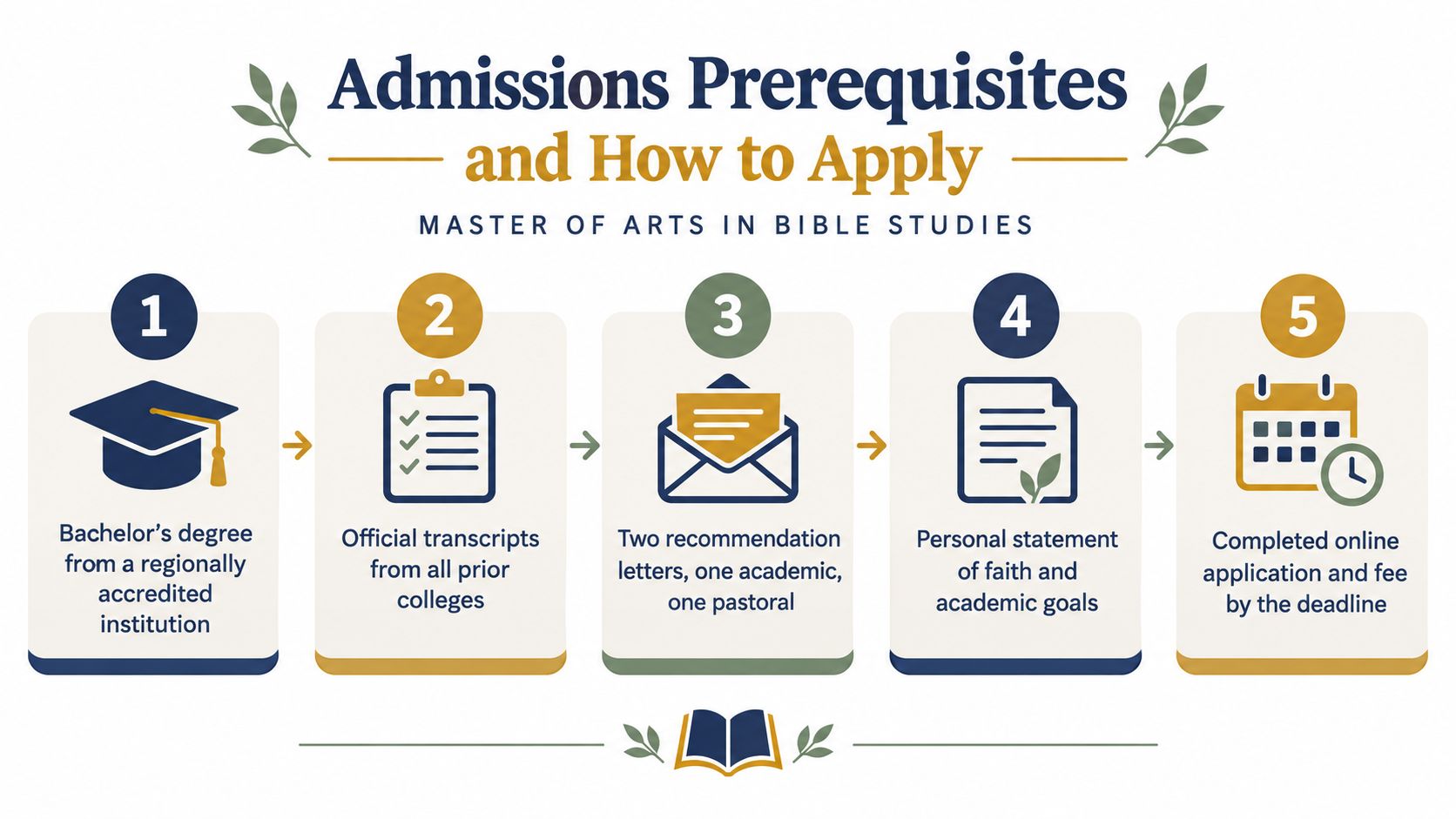
Most seminary master's programs begin with a bachelor's degree from an accredited institution. After that, schools often ask for official transcripts, recommendations, and a personal statement that helps them understand your calling, church involvement, and academic goals.
Some programs may also ask for a writing sample or interview. That isn't meant to make the process burdensome. It helps the school see how you read, write, and think about Scripture.
A practical application checklist
Academic readiness: Gather transcripts from prior colleges and universities early.
Pastoral and academic references: Choose people who know both your character and your capacity to learn.
Personal statement: Explain why you're pursuing graduate biblical study now, not just someday.
Writing preparation: Polish any sample you submit so it reflects your actual voice and care.
Interview readiness: Be ready to speak about your testimony, your church life, and your goals.
If you're updating your academic documents, a practical guide like guided CV writing from StoryCV can help you present prior ministry, research, and education clearly.
Application tip: Don't try to sound impressive. Sound truthful, prepared, and teachable.
One option to explore during that process is The Bible Seminary academics and degree pathways, where prospective students can review graduate offerings, certificates, and study formats in one place.
Flexible Learning Options Beyond the Traditional Degree
Not everyone can step into a standard residential pattern. Many faithful students are balancing work, family, church service, military commitments, or cross-cultural ministry. A healthy seminary ecosystem should recognize that.
Several on-ramps can serve the same calling
Some students begin with a graduate certificate rather than a full degree. That's often wise if you want concentrated biblical training in a specific area before making a larger commitment.
Others choose single-course auditing. Auditing can be a strong fit for pastors, lay leaders, teachers, and retirees who want enrichment without entering a degree track.
A third path is the part-time degree route. The previously cited MA example at Colorado Christian University shows how some programs are built with fixed credit targets and flexible pacing, which can help working adults stay in ministry while studying.
Pathway | Credit Hours | Typical Length | Best For |
|---|---|---|---|
Certificate | Varies by school | Shorter-term | Focused training and discernment |
Audit | Non-degree | Course by course | Personal enrichment or ministry refresh |
Part-time MA | Program-based | Extended pacing | Working adults and bi-vocational leaders |
Intensives | Program-based | Concentrated sessions | Students who can't attend weekly on campus |
Online or hybrid study | Program-based | Flexible | Distance learners and international access |
Why flexible formats matter now
The broader graduate market is getting tighter. One report notes that theological graduate enrollment reached 74,283 in the latest reporting year, while master's enrollment overall fell 1.3% to 2.0 million in spring 2026, according to this analysis of seminary enrollment and graduate market pressure. That doesn't make theological study less meaningful. It makes wise program design and clear vocational purpose more important.
Flexible pathways can widen access without lowering seriousness. If your season requires evening learning, low-bandwidth delivery, or stackable credentials, that can still support deep formation when the curriculum remains anchored in Scripture.
Career Outcomes Where a Bible Studies Masters Can Lead
The narrow version of this conversation goes like this: “You study the Bible, so you must be preparing only for church employment.” That picture is too small.
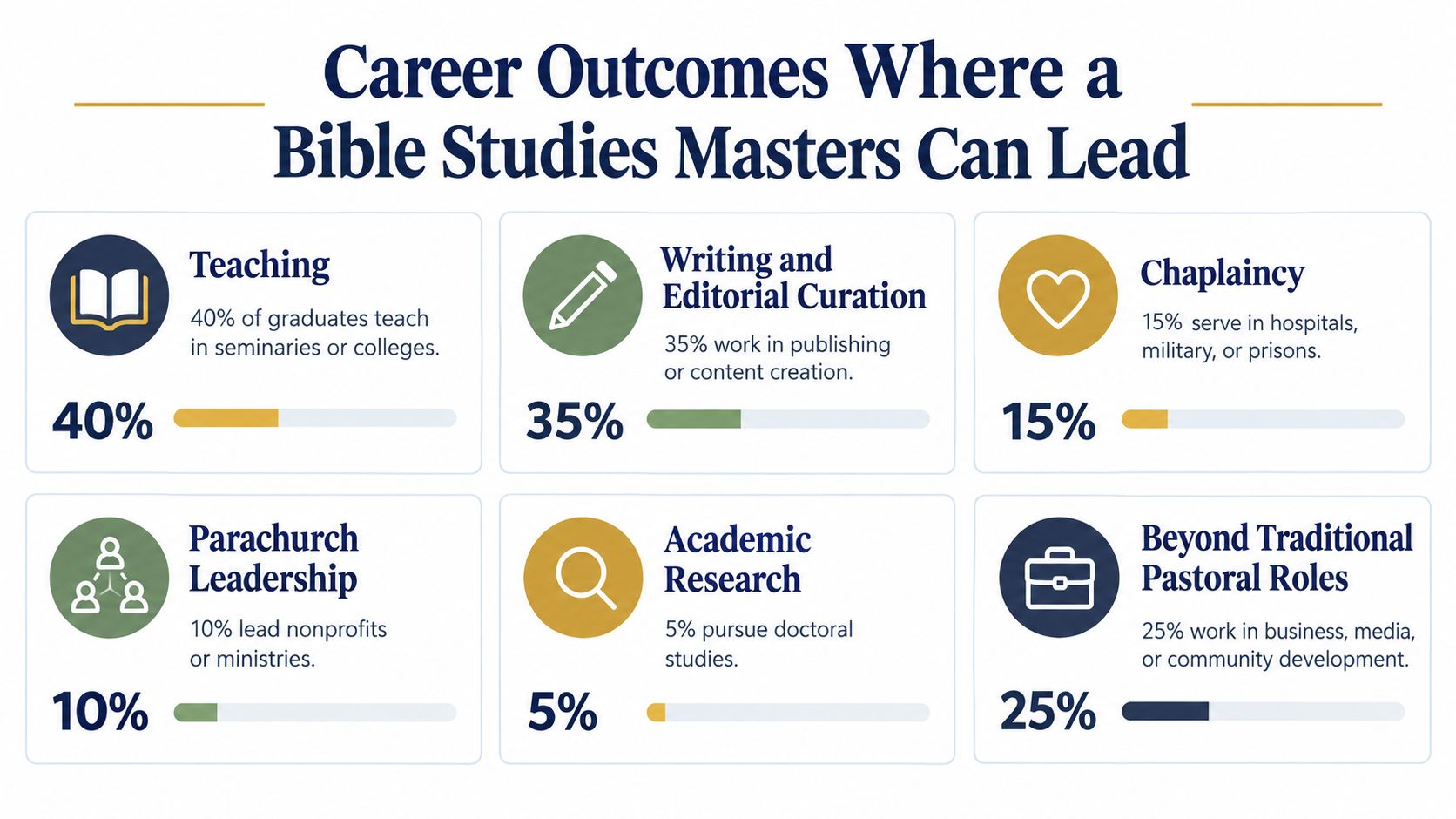
A masters in Bible studies develops portable abilities. You learn to interpret difficult texts, communicate clearly, synthesize theology, research responsibly, and read cultures with more care. Those skills matter in congregational ministry, but they also matter in teaching, writing, curation, spiritual care, and ministry-adjacent leadership.
The market is narrower in some places and wider in others
Theological education has shifted over time. An analysis drawing on NCES data reports that theology bachelor's degrees rose from 3,720 in 1971 to a peak of 7,845 in 2012, then declined to 6,855 by 2020. The same analysis notes that, by 2020, master's awards accounted for 54% of all theology degrees, while bachelor's degrees made up 38%, according to the NCES IPEDS table summarized here. That tells us graduate theological formation now sits much closer to the center of the field than many people assume.
At the same time, outcomes vary by program and vocational track. One theological outcomes summary notes that MDiv graduates cluster more in church and parachurch ministry, while other graduate theology students more often move into broader societal occupations. The same summary reports that 63.2% of MACS students found work within 6 months versus 68.5% of MDiv students, as discussed in the In Trust report on changing seminary students and vocational breadth.
Where graduates may serve
Teaching and education: Bible teaching, Christian school settings, discipleship formation, curriculum development
Writing and editorial work: Devotional publishing, study resources, content editing, research assistance
Chaplaincy and spiritual care: Settings that value biblical wisdom, listening skill, and theological steadiness
Parachurch leadership: Nonprofits, missions support, training ministries, community outreach
Research and curation: Museum interpretation, archival support, historical projects, educational programming
The point isn't to promise a simple path. The point is to name the path accurately. A Bible studies degree can function as a launchpad into a wider skills economy, especially when students understand how exegesis, communication, and contextual awareness transfer into real work.
Faithful preparation doesn't lock you into one narrow title. It equips you to serve Christ wherever careful truth-telling is needed.
Your Next Step and Common Questions Answered
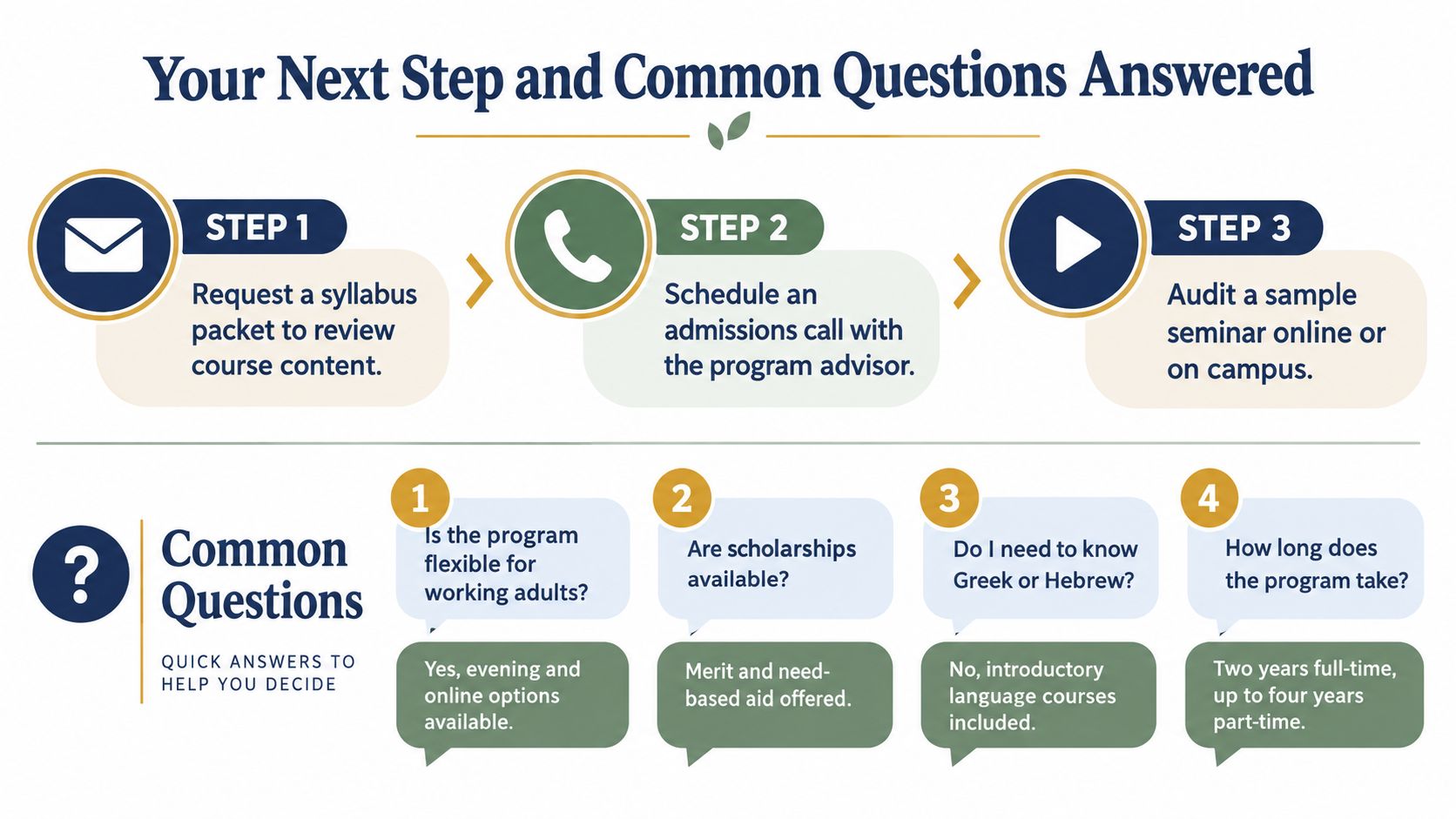
Discernment gets easier when your next step is small and concrete. You don't need to solve your whole future this week. Start by asking for a syllabus packet, scheduling an admissions conversation, or auditing a class so you can see what the work feels like.
Four common questions
Is accreditation important?Yes. Accreditation matters because it affects academic credibility, transfer expectations, and long-term educational planning. Ask the admissions team direct questions and get clear answers in writing.
Can I study online if I'm a working adult?Many prospective students need flexible delivery. Ask whether the program offers online, hybrid, evening, or intensive formats, and whether those options still preserve faculty interaction and community life.
Will I have access to archaeology resources or travel study?That depends on the school's structure. Ask whether the program connects biblical studies with museum learning, archaeology labs, or study travel, and how those experiences fit students who are not residential.
What about cost and payment planning?Always ask for a transparent breakdown of tuition, fees, scholarships, and payment options. Good stewardship isn't a lack of faith. It's wisdom.
If you're already thinking ahead to commencement, even small practical matters can reduce stress later. Some students appreciate resources like masters graduation regalia tips as they picture the finish line and what that milestone involves.
A final encouragement. Keep your questions honest, but keep them prayerful too. The goal isn't to earn a credential. It's to steward a calling before the Lord with humility, courage, and joy.
At The Bible Seminary, we offer Bible-centered graduate training that joins scholarship, spiritual formation, and ministry practice, including study that helps Scripture come alive through history and archaeology. If you're considering a masters in Bible studies and want a clearer next step, visit The Bible Seminary and begin a conversation about where God may be leading you.