
Master a small group bible study guide for transformative sessions

A great small group Bible study isn't just about having a list of questions. It's really about creating a blueprint for a space where people can genuinely connect with God and with each other. It's that sweet spot where deep biblical truth meets real, practical, everyday life—transforming a simple get-together into a hub for authentic spiritual growth and community.
Building the Foundation for Your Small Group
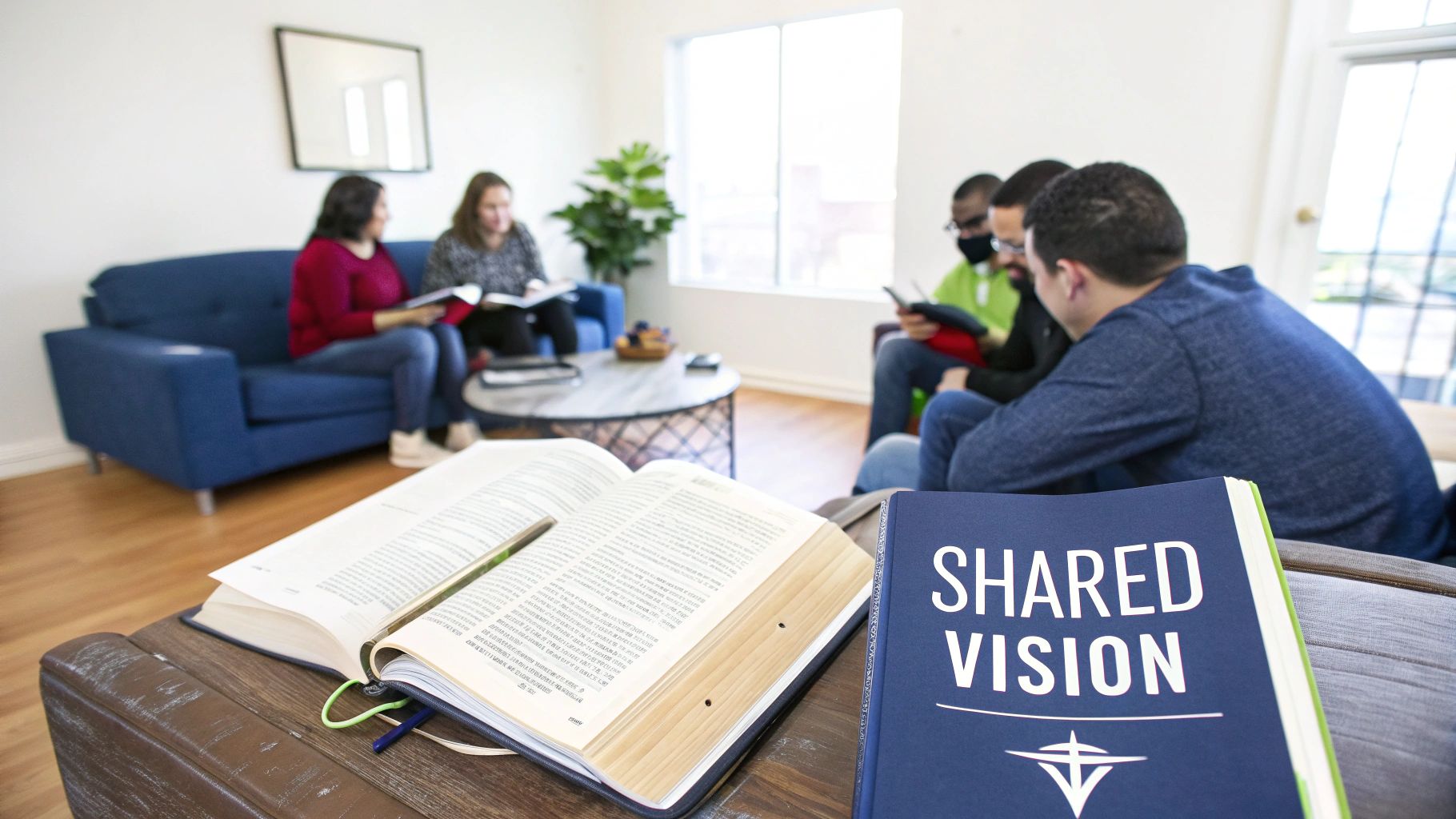
Before anyone even cracks open a Bible, the most impactful small groups start by getting crystal clear on their purpose. This isn’t about writing corporate-style mission statements; it's about figuring out your group’s unique identity and what you’re trying to accomplish together. Without that clarity, it's easy for a group to just drift, eventually losing focus and momentum.
This desire for intentional community is something we're seeing more and more. People are looking for something deeper than a traditional classroom setting. A 2023 study actually showed that 58% of practicing Christians now take part in a home Bible study. That's a huge jump—a 38% increase from just four years ago! This trend is especially strong among younger believers, which tells us there’s a real hunger for genuine connection centered around God's Word.
Defining Your Group's Core Purpose
The "why" behind your group is going to guide everything else—from the study you pick to the way you structure your time together. Is the main goal to dig deep into theology? Is it to build close-knit relationships? Or is it about equipping people for service? There isn't a single right answer, but you need to have an answer.
Think about what you really want to achieve. A few common goals include:
Biblical Literacy: A deep dive, often book-by-book, to give everyone a solid grasp of Scripture.
Authentic Community: Creating a safe space for people to be vulnerable, pray for each other, and offer real support.
Practical Application: Focusing on how the Bible's truths connect directly to work, family, and daily challenges.
Outreach and Service: Studying the Word to equip members to go out and serve the church and their neighbors.
Once you land on a primary focus, try to boil it down into a simple, memorable sentence. This isn't for a plaque on the wall; it's to keep everyone on the same page. Something like: "Our group exists to explore God's Word deeply so we can live it out boldly."
A group without a shared purpose is just a meeting. A group with a shared purpose is a ministry. This distinction is the bedrock of any small group that hopes to foster lasting spiritual growth.
Choosing the Right Study Model
Once you know your purpose, picking a study model becomes much easier. The structure you choose gives your weekly gatherings a predictable rhythm, which helps everyone know what to expect.
While there are many great study formats, it's worth noting that many of the same principles apply across different types of groups. In fact, some of the practical advice on how to start a thriving book club can be incredibly helpful for a Bible study, especially when it comes to group dynamics and discussion.
Comparing Small Group Bible Study Models
Choosing a model for your Bible study is a key decision that shapes the group's entire experience. Each format offers a unique way to engage with Scripture. The table below breaks down a few of the most common approaches to help you decide which one best fits your group's purpose and personality.
Model Type | Primary Focus | Best For | Potential Challenge |
|---|---|---|---|
Book-by-Book Study | Deep understanding of a single biblical book's context, themes, and narrative flow. | Groups committed to long-term, in-depth learning and biblical literacy. | Can feel slow-paced for those seeking immediate topical relevance. |
Topical Study | Exploring what the entire Bible says about a specific subject like prayer, forgiveness, or marriage. | Groups addressing specific life stages, struggles, or interests. | Risk of taking verses out of context if not handled carefully. |
Sermon-Based Study | Discussing and applying the previous Sunday's sermon in a smaller, more interactive setting. | Churches seeking to create alignment and deepen the impact of their preaching. | Can feel repetitive if not supplemented with fresh insights. |
Remember, this choice isn’t set in stone. A group might spend a semester doing an in-depth study of Philippians and then switch to a topical study on spiritual gifts. The goal is to pick the format that serves your group's purpose right now. Nailing down these foundational pieces is the first critical step toward a healthy, growing small group.
How to Choose the Right Bible Study Curriculum
Picking the right curriculum for your small group is a huge decision. It shapes pretty much every conversation and insight your members will share. You’ve got a ton of options out there—from video series by popular speakers to deep-dive workbooks—so the trick is to look past the familiar name on the cover and find a resource that truly serves your group's specific mission.
A solid small group bible study guide is more of a catalyst than a textbook. It should spark genuine discussion, not just encourage passive listening. Think of it this way: you can either attend a lecture or a workshop. A lecture tells you about something, but a workshop gives you the tools to experience it yourself. Your curriculum should feel like a workshop, equipping members to actually observe, interpret, and apply Scripture directly.
First Things First: Align Curriculum with Your Group's Purpose
Before you even start browsing Amazon or Christianbook.com, circle back to the core purpose you set for your group. Is the main goal deep theological training? Building authentic community? Or is it all about practical, real-world application? Whatever you decide, your curriculum needs to line up perfectly with that goal.
It’s just common sense, right? A group for young moms trying to build community needs something very different from a group of seminary students prepping for ministry. The first group might thrive with a study on grace-filled parenting that has lighter homework, while the second needs a rigorous, verse-by-verse guide through Romans. A mismatch here is a recipe for frustration and disengagement.
A curriculum is a tool, not a master. The best study guide serves your group's spiritual goals and creates an environment where people feel equipped—not intimidated—to engage with God's Word.
Getting this right is incredibly important, especially when you zoom out and see the big picture. Christianity is a global faith of roughly 2.6 billion people, and in many parts of the world, small groups are exploding. In places like Asia and Africa, they’re often the main hub for discipleship. (You can learn more about these trends from The Center for the Study of Global Christianity). Choosing materials that are both accessible and profound ensures your group is being nurtured effectively, just like millions of others around the globe.
Next Up: Evaluate the Theological Soundness
Once you’ve got a few options that seem to fit your purpose, it’s time to vet their theology. You have to be sure the material handles Scripture faithfully and responsibly. Don't just take the author's word for it; do a little homework yourself.
Here are a few practical ways to check for theological integrity:
Check the Author's Background: Who actually wrote this thing? Do they have a solid theological education or a track record of sound teaching? A quick Google search will often tell you a lot about their doctrinal leanings.
Examine How Scripture Is Used: Does the guide push your members to read verses in their full context? Or does it tend to "proof-text" by yanking isolated verses to prop up a point? Good curricula always point back to the Bible as the final authority.
Read Reviews and Recommendations: See what trusted pastors, theologians, or ministry organizations are saying. Do they flag any doctrinal concerns?
This really comes down to good stewardship. You're stewarding your group members' time and their spiritual health, so making sure the teaching is biblically solid is non-negotiable. If you want a great framework for this, digging into guides on how to read the Bible for all it's worth can be a huge help for both you and your group.
Finally: Assess the Format and Engagement Factor
Last but not least, think about the nuts and bolts of the curriculum. The most profound content on the planet will fall flat if the format doesn't work for your people. A great small group bible study guide should get people talking, not shut them down.
As you look over a potential study, ask yourself these questions:
What's the weekly workload like? Is the amount of reading or homework realistic for the season of life your group is in? Overburdening people is the fastest way to kill their enthusiasm.
What kind of questions does it ask? Are they just simple "yes" or "no" comprehension questions? Or are they open-ended, designed to spark reflection, real discussion, and life application?
Does it require a "guru" to lead it? A good guide should equip any willing facilitator, not demand a seminary professor. The material itself should do the heavy lifting, freeing up the leader to simply guide the conversation.
By thoughtfully weighing purpose, theology, and format, you can confidently land on a curriculum that won’t just inform your group, but will actually help transform them through a deeper, more personal engagement with Scripture.
Crafting Engaging Sessions Week After Week
Having a solid curriculum is a great starting point, but the real ministry happens in the flow of your weekly meetings. Leading a compelling discussion is definitely an art, but it's one you can learn. A great small group bible study guide is so much more than a list of questions; it's a blueprint for connection, discovery, and genuine transformation.
The key is to create a predictable yet dynamic rhythm. When people know what to expect, they feel more comfortable and are quicker to participate. A repeatable structure also frees you up as a leader. You’re no longer reinventing the wheel every single week, which lets you focus on what really matters—the people in the room and the Scripture you're exploring together.
The Anatomy Of A Great Session
Think of each gathering as a complete journey. You want to move your group from that initial connection, into deep scriptural engagement, and finally toward practical, real-life application. This isn't a rigid formula, but it is a flexible framework that helps you cover all the bases for meaningful growth.
The first few moments really set the tone for everything else. An intentional time of welcoming and connection is non-negotiable.
Arrival and Welcome (10-15 minutes): This is the casual "hang out" period. It’s where people catch up, share stories from their week, and create a relaxed atmosphere before diving into the heavier topics.
Icebreaker or Opening Question (5-10 minutes): A good icebreaker isn’t just filler; it’s a bridge to the study. Keep it low-pressure, but try to connect it thematically to the passage you’ll be discussing.
Transition to Study (5 minutes): A brief prayer or a short intro to the day’s passage helps shift everyone’s focus from fellowship to study. It creates a clear pivot point.
This simple, deliberate structure helps everyone mentally move from the busyness of their day into a mindset of learning and sharing.
I've found this simple blueprint for a 90-minute session to be incredibly effective. It provides a reliable flow that you can adapt to any topic or group dynamic.
Sample Bible Study Session Blueprint
Time Allotment | Activity | Purpose & Example |
|---|---|---|
0-15 min | Welcome & Fellowship | Create a warm, inviting space. Members arrive, grab a snack, and casually chat about their week. |
15-25 min | Opening & Icebreaker | Transition the group's focus. Example: "Share one high point and one low point from your week." |
25-30 min | Vision & Prayer | Center the group on God's Word. Example: A short prayer asking the Holy Spirit for wisdom and understanding. |
30-70 min | Scripture & Discussion | Engage with the text together. This is the core study time, guided by open-ended questions. |
70-85 min | Application & Prayer | Connect the text to daily life. Members share takeaways and pray for one another. |
85-90 min | Closing & Dismissal | End the meeting on time with a final blessing or announcement for the upcoming week. |
This structure ensures you hit all the key elements—community, study, and application—without feeling rushed or disorganized.
Guiding A Spirit-Led Discussion
This is the heart of your meeting, where you open God’s Word as a community. Your role as a facilitator isn’t to be a teacher with all the answers. Instead, you're a guide who asks great questions. Your aim is to foster an environment where people can discover truth for themselves.
The most effective small group leader doesn't provide all the right answers; they ask the right questions. The goal is to move truth from the leader's head to the members' hearts through personal discovery.
To do this, you’ll want to lean heavily on open-ended questions—the kind that can't be answered with a simple "yes" or "no." For even richer discussions, you might encourage your group members with skills like how to summarize a book, which can help them better articulate what they're learning from their own reading. This shifts the dynamic away from a leader-centric model and empowers everyone to contribute.
And people are hungry for this kind of direct engagement. A Barna Group report recently highlighted a massive resurgence in Bible reading, with weekly readership among U.S. adults climbing to 42%. A huge driver of this is Gen Z, whose weekly Bible reading jumped from 30% to 49% in just one year. This shows a powerful desire to get into the text directly. You can read the full research on this exciting trend.
Moving From Insight To Application
The final part of your session is arguably the most critical. This is where you help your group bridge the gap between an ancient text and their modern lives. A study that stays purely informational has missed the point. We are aiming for transformation.
End your time by asking questions that challenge your group to consider what they will do with what they've just learned.
"How does this truth challenge a belief you currently hold?"
"What is one specific action you can take this week based on our discussion?"
"Who in your life needs to hear the hope we've talked about today?"
This focus on practical steps is essential. For more ideas on digging into Scripture in a way that naturally leads to life change, our guide on how to study the Bible effectively and deepen faith offers some incredibly valuable frameworks.
The visual below shows a simple process for choosing curriculum that will set your group up for these kinds of life-changing discussions.
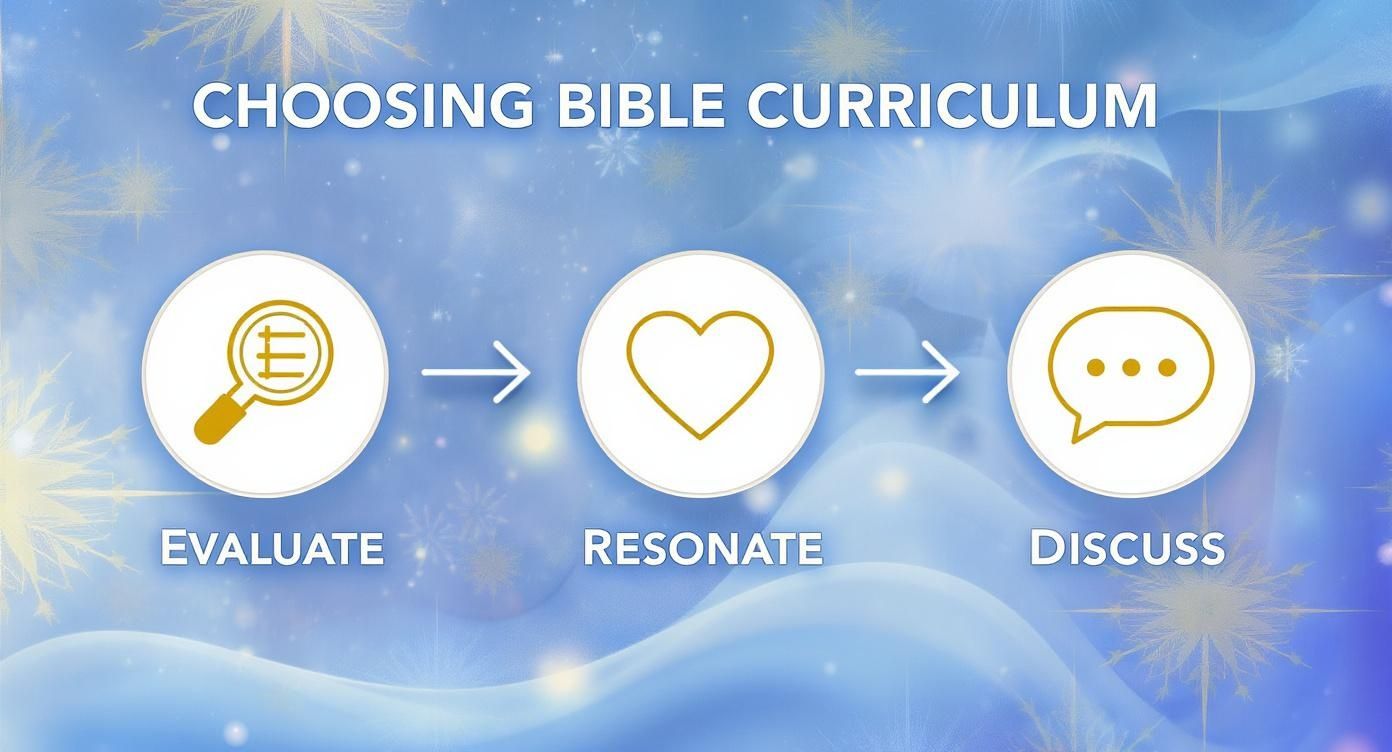
This process—evaluating the material's depth, ensuring it resonates personally, and fostering rich discussion—is key to creating sessions that stick with people long after they leave the living room.
Developing Your Skills as a Group Facilitator

Leading a small group well is less about being a biblical scholar with all the answers and more about becoming a skilled facilitator of spiritual conversation. Your main role isn't to lecture; it's to guide and create an environment where everyone feels safe to explore God's Word and their own faith journey.
This is a critical shift in mindset, from teacher to shepherd.
Too many small groups accidentally become centered on the leader. Members show up, listen, and go home, but they don't develop the skills to study the Bible for themselves. Your goal should be to equip them, not just inform them. You want to foster a dynamic where everyone in the circle grows in confidence and competence with Scripture.
Mastering the Art of Active Listening
One of the most powerful tools you have is active listening. This isn't just waiting for your turn to talk. It's about hearing the words someone is saying and also trying to understand the emotion and meaning behind them. It means giving your full attention, making eye contact, and showing genuine curiosity.
When a group member shares, resist the urge to immediately jump in with your own thoughts. Instead, focus entirely on them. A simple nod or a phrase like, "Tell me more about that," can make all the difference, validating their contribution and encouraging them to go deeper. This simple practice builds incredible trust.
Navigating Common Group Dynamics
Every small group will face relational challenges at some point. Thinking about them ahead of time helps you respond with grace instead of reacting with anxiety. Three of the most common hurdles are the over-talker, the quiet member, and the unexpected, difficult conversation.
The Dominating Voice: Gently redirect the conversation. You could say something like, "Thanks for sharing that, John. I'd love to hear what someone else thinks about that verse."
The Quiet Member: Create low-pressure opportunities for them to speak. You might ask a direct but non-intimidating question, like, "Sarah, what one word or phrase stood out to you in that passage?"
The Tough Conversation: When discussions get heavy or deeply personal, your role is to keep the space safe and biblical. Affirm the person's vulnerability and gently guide the conversation back to Scripture, asking, "What does God's Word have to say about this kind of situation?"
The health of a small group is often determined not by the depth of its Bible knowledge, but by the safety of its relational environment. A facilitator's primary job is to protect that safety so that true spiritual growth can happen.
Handling these moments well is a form of ministry itself. You're shepherding hearts, not just managing a meeting.
Fostering an Atmosphere of Trust
Vulnerability doesn't happen by accident; it grows in an atmosphere of intentional trust. As a leader, you set the tone by being appropriately vulnerable yourself. This doesn’t mean oversharing or making the group about you. It simply means admitting when you don't have an answer or sharing a personal struggle that relates to the study.
This kind of modeling gives others permission to be real. Praying specifically for your members throughout the week also deepens your connection and care for them, which will naturally overflow into your group time.
As you grow, you'll find that a solid small group bible study guide provides a framework that allows you to focus more on the people and less on the content. For specific topics, like spiritual gifts, using a targeted resource like The Gifts of the Holy Spirit Study Guide can equip both you and your members for much richer conversations.
Measuring Growth and Planning Your Next Steps
How can you really tell if your small group is working? It's easy to just count the number of people who show up each week, but real impact—the kind that lasts—goes so much deeper.
Healthy groups produce tangible spiritual fruit. Learning to spot it is one of the most important parts of shepherding your members well and figuring out what God has next for your group.
True growth isn't always loud or dramatic. More often, it shows up as quiet, consistent changes in a person’s character, their priorities, and their relationships. It’s the difference between someone just knowing the information in a small group bible study guide and actually starting to live out its truths.
Looking Beyond Attendance Numbers
Instead of just counting heads, start looking for the signs of genuine spiritual transformation. A healthy group is an active one. Members aren't just passive consumers of content; they're being actively shaped by God’s Word in the context of community.
When you see these signs, make a point to celebrate them. They're evidence of God at work.
What are some of these meaningful metrics?
Spiritual Curiosity: Members start asking deeper, more thoughtful questions about the text. They move past surface-level comprehension and begin to wrestle with what it means for their actual lives.
Increased Vulnerability: People feel safe enough to share real struggles. They pray for one another with genuine empathy and trust, not just out of obligation.
Active Service: Members begin looking for ways to serve each other and the wider church community without being prompted. It might be as simple as bringing a meal to a new parent or jumping in to help with a church event.
These are the indicators that your group is becoming a place of genuine discipleship, not just another meeting on the calendar.
Gathering Honest and Helpful Feedback
To get a clear picture of your group's health, you have to hear directly from your members. But sending out a formal, corporate-style survey can feel awkward and impersonal. The goal here is to create natural opportunities for honest conversation, not to conduct a performance review.
Honestly, informal chats are usually the most effective way to do this.
Ask a member to grab coffee and just ask, "How are you really doing with the group? What's been most helpful for you, and where do you think we could improve?" This one-on-one approach almost always yields more insightful feedback than a group discussion.
If you want something a bit more structured, you could try a simple, anonymous survey with just two or three open-ended questions:
What is one thing you love about our group?
What is one thing that could make our group even better?
How has God been using our time together in your life?
The feedback you get is a gift. It helps you tweak your leadership, pick a better study for the next season, and ultimately serve your people more effectively.
The ultimate measure of a small group's success isn't the leader's performance, but the members' growth. When you equip them to engage with God's Word for themselves, you are building a ministry that can multiply.
Planning for the Future: Multiplication
A healthy small group should eventually grow. I don't just mean in numbers, but in its capacity for ministry. This naturally leads to the idea of multiplication. The goal isn’t to build one massive group; it's to raise up new leaders who can start new groups, extending the reach and impact of the ministry.
This whole process starts by identifying potential leaders within your current group. Look for the people who demonstrate faithfulness, a teachable spirit, and a genuine care for others. They don't need to be Bible experts. They just need to be willing shepherds.
Once you’ve spotted them, you can start intentionally investing in them.
Give them a chance to lead a small part of the discussion.
Meet with them outside the group to talk about leadership principles.
Encourage them to practice asking good, open-ended questions of the text.
Training them to lead isn't just about delegation; it's about discipleship. You're fulfilling the command to equip the saints for the work of ministry, ensuring that the impact of your small group continues to expand and bear fruit for years to come.
Answering Your Small Group Leadership Questions
Every small group leader, no matter how seasoned, eventually hits a wall. You're trying to foster community, dive deep into Scripture, and navigate all the quirky dynamics of your group, and suddenly a question pops up that leaves you stumped. It happens.
This isn't about having all the answers. Your role isn't to be the sage on the stage, but the guide on the side, creating a space where people can find answers together in Scripture. Think of these tough questions not as roadblocks, but as opportunities to lean more on God’s wisdom and the collective strength of your group.
What If No One Talks During Discussion?
Ah, the dreaded silence. Every leader has been there. You toss out what you think is a fantastic question, only to be met with blank stares and the sound of crickets. The temptation to panic and just answer it yourself is real.
Don't do it.
First, just wait. Give it a beat. Silence isn't always a bad thing; sometimes it means people are actually thinking. People need a moment to process the question and formulate a thought before they're ready to jump in.
If the silence stretches on, try rephrasing the question. You could also take a step back and ask something more observational, like, "What's one word or phrase that just popped out to you in this passage?" It's a low-stakes way to get the ball rolling.
Another fantastic technique is to break the larger group into pairs or trios for just a few minutes. This smaller, less intimidating setting often encourages the quieter folks to open up. When you bring everyone back together, you'll be surprised how the dynamic has shifted.
A leader's comfort with silence can be a powerful tool. It communicates that thoughtful reflection is valued more than quick, easy answers, giving members permission to truly wrestle with the text.
How Do I Handle Doctrinal Disagreements?
If people are genuinely engaging with the Bible, disagreements are going to happen. The key isn't to avoid them, but to handle them with grace and a fierce commitment to unity. Your job is to keep the space safe and respectful, a place where different ideas can be explored without blowing up the group.
When a touchy subject comes up, gently pull the conversation back to the text itself. Ask things like, "Where are we seeing that idea in this passage?" or "What other scriptures might shed some light on this?" This keeps the focus on what the Bible says, not just on who has the strongest opinion.
For really thorny doctrinal issues, it is perfectly okay to say, "That's a great and important question. Let's all agree to study that more this week and come back to it when we're better prepared." This affirms the person asking while keeping the group from getting completely sidetracked. Always, always prioritize the core truths of the faith and extend charity on the non-essentials.
How Much Preparation Is Enough for Each Meeting?
This is a balancing act. If you under-prepare, you'll feel flustered and disorganized. But if you over-prepare, you can become rigid, leaving no room for the Holy Spirit to move in the conversation. The sweet spot is knowing the material well enough to guide the discussion without being chained to your notes.
I recommend focusing your prep time on three key areas:
Personal Study: Before you can lead anyone else, you have to let God speak to you through the passage. Pray, reflect, and do your own homework first.
Master the Big Idea: What is the one central truth or main point of this passage? Every question you ask should, in some way, serve to uncover this core message for your group.
Prepare Key Questions: You don't need a full script, just a roadmap. Craft a handful of solid, open-ended questions that will get people talking and thinking about how to apply the truth to their lives.
Focus your prep this way, and you'll walk in feeling ready to lead while still being flexible enough for the conversation to go where it needs to go.
At The Bible Seminary, we are dedicated to equipping leaders like you for effective, Bible-centered ministry. Explore our graduate programs and resources to deepen your own understanding and sharpen your leadership skills. Learn more at our website.
