
8 Foundational Worshiping God Scriptures for 2025

Worship is a cornerstone of the Christian faith, yet its true meaning can often be confined to Sunday mornings and familiar songs. The Bible, however, paints a much richer and more expansive picture. It reveals worship not just as an event, but as a continuous posture of the heart that transforms every aspect of our lives. To truly grasp this, we must turn to the foundational texts that define it.
This guide explores eight essential worshiping God scriptures, moving beyond surface-level reading to uncover their deep theological context and offer actionable steps for integrating them into your daily walk. Each verse serves as a unique lens, revealing a different facet of what it means to offer our lives as an act of worship.
Whether you are a student of theology, a ministry leader, or simply seeking a deeper connection with God, these passages provide a roadmap to a more authentic and powerful worship experience. You will learn to see worship not just in music, but in sacrifice, in truth, in thanksgiving, and in the very way you live your life. We will delve into what it means to worship in Spirit and truth, present your body as a living sacrifice, and enter His gates with a grateful heart. Let’s explore the scriptures that call us to a deeper, more holistic understanding of worship.
1. John 4:24 - Worship in Spirit and Truth
In a groundbreaking conversation with a Samaritan woman, Jesus redefines the very essence of devotion, establishing a principle that remains one of the most vital worshiping god scriptures. He declares, "God is spirit, and his worshipers must worship in the Spirit and in truth." This statement moves the act of worship beyond physical locations like Jerusalem or Mount Gerizim and centers it on the internal state of the worshiper. It's a call for authenticity over ritual.
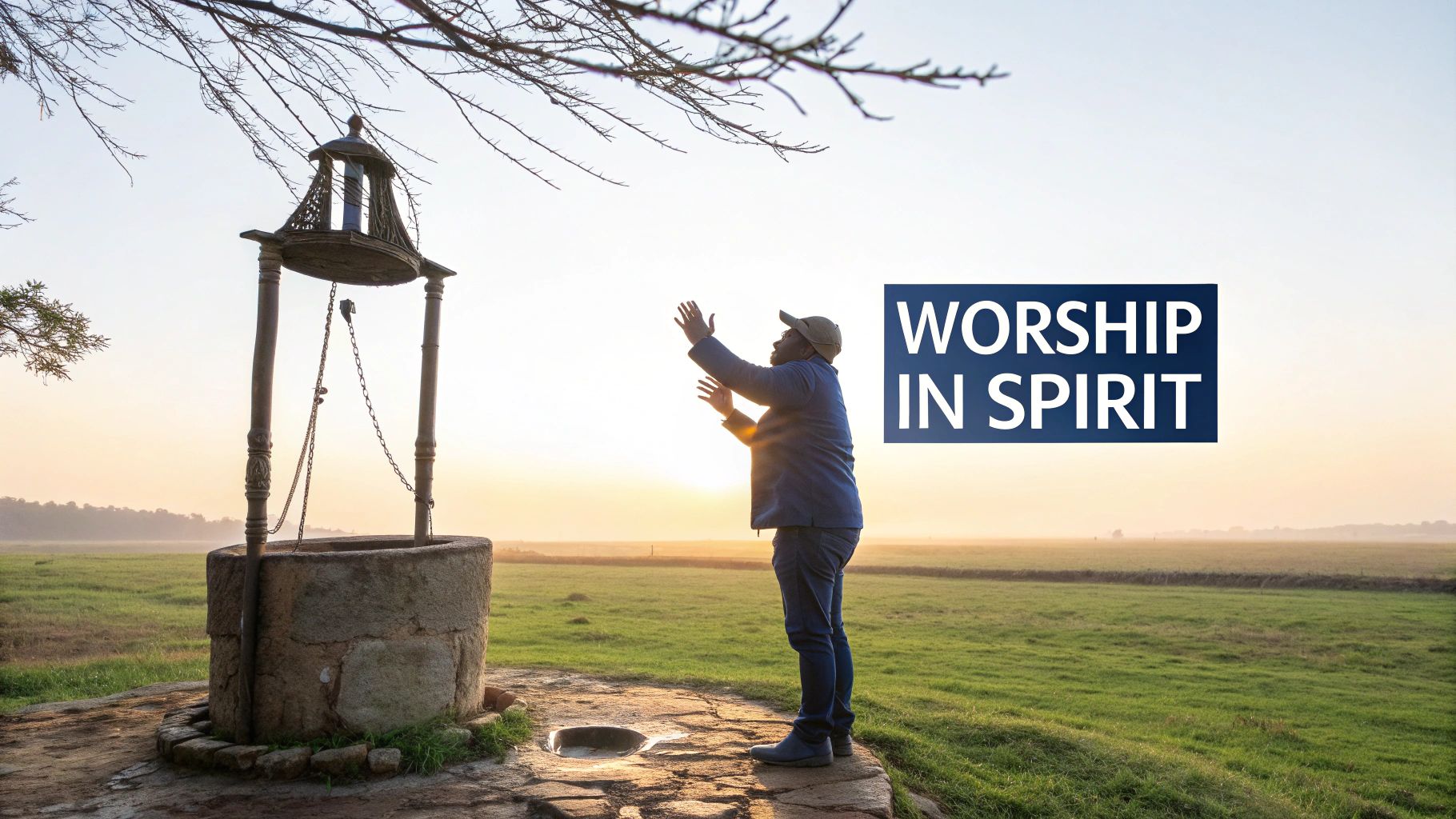
Worshiping "in Spirit" means engaging our inner being, our heart and soul, energized by the Holy Spirit. It is an experience that transcends mere intellectual agreement or outward performance. Worshiping "in truth" signifies that our devotion must be grounded in the reality of who God is as revealed in Scripture, aligning our actions with His character and commands.
Practical Application
This principle applies to every form of worship, from corporate gatherings to private moments of reflection. It challenges us to look past the style of music or the elegance of a sanctuary and focus on the sincerity of our hearts and the theological soundness of our praise.
Small Group Worship: A prayer group meeting in a living room, where members share honestly and pray with genuine passion, perfectly embodies this principle. The location is irrelevant; the spiritual connection is paramount.
Individual Devotion: A personal time of prayer and meditation, free from distraction, where you honestly confess your struggles and praise God for His attributes, is a powerful act of worship in spirit and truth.
Actionable Tips
To cultivate this type of worship, consider these intentional steps:
Examine Your Motives: Before a worship service or prayer, take a moment to ask yourself why you are there. Shift your focus from what you might get out of it to what you can offer to God.
Align Beliefs and Actions: Ensure the songs you sing and the prayers you pray reflect solid biblical truth. If you want to dive deeper into this concept, you can explore its meaning and how to respond in simplicity.
Foster Authentic Connection: Don’t be afraid to be vulnerable before God. True worship involves our emotions, intellect, and will, all submitted to Him in sincerity.
2. Psalm 95:1-7 - Come Let Us Bow Down and Worship
This passage from the Psalms issues a vibrant, communal call to worship, showcasing both joyful praise and humble reverence. The psalmist beckons believers, "Come, let us sing for joy to the Lord; let us shout aloud to the Rock of our salvation." This scripture demonstrates that worship is an active, vocal, and communal experience, acknowledging God's ultimate sovereignty as "the great God, the great King above all gods." It stands as one of the most foundational worshiping god scriptures for its holistic view of devotion.
The psalm beautifully transitions from exuberant, audible praise to profound, physical acts of submission. Verses 6-7 invite us to "bow down in worship" and "kneel before the Lord our Maker." This instruction emphasizes that true worship engages our entire being, not just our hearts or minds but our physical bodies as well. It’s a call to express our inner reverence through outward posture, recognizing our relationship to God as our creator and shepherd.
Practical Application
This psalm provides a powerful blueprint for both corporate and personal worship, encouraging a full-bodied expression of faith. It reminds us that our physical actions can be a meaningful part of our communication with God, reflecting the humility and awe we feel inwardly.
Corporate Worship Services: Many liturgical and charismatic traditions incorporate these verses directly. A congregation singing joyfully, then kneeling together for a moment of corporate prayer, is a direct application of this psalm’s model.
Family Devotions: A family gathering to sing a hymn of praise and then taking a moment to kneel in prayer together before bed brings this scripture to life in a personal, intimate setting.
Actionable Tips
To integrate the holistic worship of Psalm 95 into your life, consider these practices:
Engage Your Body: Don't be afraid to use physical postures in your worship. Whether it's lifting your hands, kneeling in prayer, or even dancing, allow your body to express the praise that is in your heart.
Embrace Vocal Praise: Make "a joyful noise" to God. Singing, whether you feel you are good at it or not, is a biblically encouraged form of worship that unites believers and declares God’s greatness.
Acknowledge God’s Sovereignty: Before worship, take a moment to reflect on who God is: the Creator, the Rock, the King. This focus helps shift your perspective from your own circumstances to His unchanging, majestic character.
3. Romans 12:1 - Present Your Bodies as a Living Sacrifice
The Apostle Paul radically expands the concept of worship in Romans 12:1, urging believers, "to offer your bodies as a living sacrifice, holy and pleasing to God-this is your true and proper worship." This verse is a cornerstone among worshiping god scriptures because it shifts the focus from temporary, external rituals to a continuous, internal state of devotion. It redefines worship not as something you do for an hour on Sunday, but as who you are every moment of every day.
This call to be a "living sacrifice" contrasts sharply with the Old Testament sacrifices, which were dead. Paul's instruction is for a dynamic, ongoing offering of our entire selves: our energy, our time, our decisions, and our actions. It is a holistic life-worship where every part of our existence, from our work to our relationships, becomes an act of devotion to God.
Practical Application
This scripture transforms the mundane into the sacred, making every daily activity an opportunity for worship. It challenges the separation between "spiritual life" and "secular life," integrating them into a single, unified offering.
Ethical Business Decisions: A business owner who chooses honesty and integrity over a more profitable but unethical path is worshiping God through their work. Their commitment to godly principles is a living sacrifice.
Service and Volunteering: When a person volunteers at a local shelter or helps a neighbor in need, they are presenting their time and energy as an act of worship, demonstrating God's love through tangible action.
Actionable Tips
To live out this principle of holistic worship, consider the following steps:
View Every Choice as Worship: Begin to see daily decisions, no matter how small, as opportunities to honor God. Whether it's how you speak to a coworker or what you choose to watch, frame it as an act of worship.
Align Habits with Values: Intentionally develop daily habits that reflect your spiritual commitments. This could mean starting your day with prayer, practicing patience in traffic, or showing kindness to a difficult family member.
Practice Intentionality: Before starting a task, whether it's a work project or household chores, take a moment to dedicate it to God. Ask Him to be glorified through your efforts and attitude.
4. Revelation 4:8-11 - Holy, Holy, Holy Worship in Heaven
In a breathtaking apocalyptic vision, the Apostle John provides a glimpse into the very throne room of heaven, offering one of the most powerful worshiping god scriptures. He describes four living creatures who never cease to cry out, "Holy, holy, holy is the Lord God Almighty, who was, and is, and is to come." This unending anthem of adoration establishes worship as the central, perpetual activity of heaven and directs our focus toward God’s supreme holiness and eternal nature.
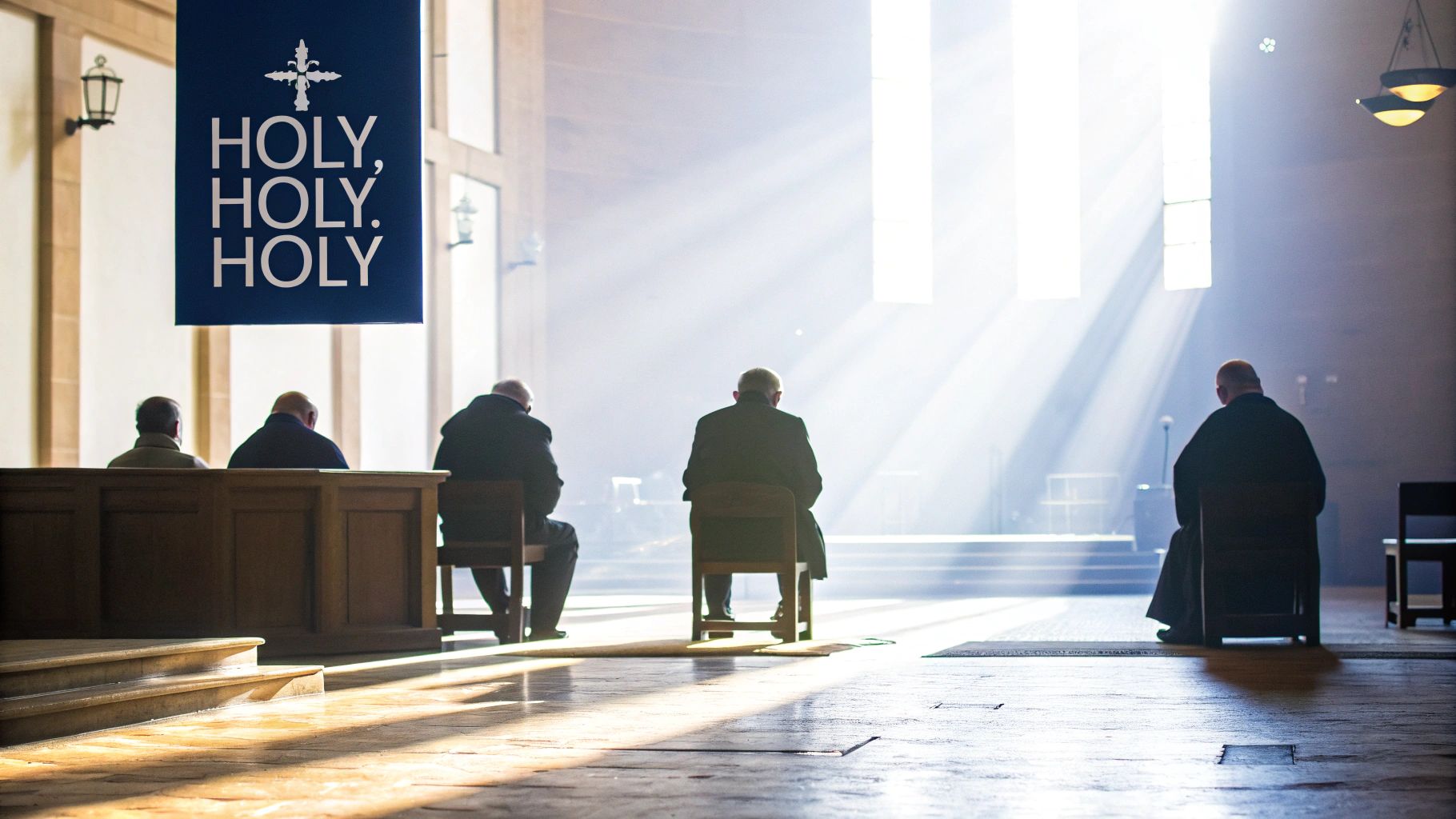
This passage reveals that true worship is a response to who God is, His very character. The praise is not based on what He has done for the individual, but on His intrinsic worthiness as Creator and King. When the creatures give glory, the twenty-four elders fall down, casting their crowns before the throne, acknowledging that all authority and honor ultimately belong to Him alone. It is a model of selfless, God-centered adoration.
Practical Application
This heavenly scene serves as a blueprint for our earthly worship, encouraging us to lift our eyes beyond our immediate circumstances and fix them on God's transcendent majesty. It reminds us that our worship here is a participation in an eternal reality.
Corporate Worship: A service that incorporates hymns or choruses like "Holy, Holy, Holy" directly connects the congregation to this heavenly scene, unifying believers across time and space in the same eternal song.
Contemplative Prayer: Meditating on God’s attributes of holiness, omnipotence, and eternality can transform personal prayer from a list of requests into a profound act of worship.
Actionable Tips
To infuse your worship with the spirit of this heavenly vision, try these practices:
Focus on God's Attributes: Begin your worship time by specifically meditating on an attribute of God, such as His holiness, faithfulness, or creative power. Let your praise flow from that reflection.
Use Repetitive Proclamation: Incorporate simple, repetitive phrases of praise like "You are worthy" or "You are holy" into your prayer or singing to deepen your focus and align your heart with the ceaseless worship of heaven.
Practice Humility: Symbolically "cast your crowns" by consciously laying down your own achievements, worries, and sense of self-importance before God, acknowledging Him as the source of all good things.
5. Philippians 3:3 - Worship by the Spirit of God
The Apostle Paul, in his letter to the Philippians, draws a sharp contrast between religious legalism and authentic devotion. He asserts, "For it is we who are the circumcision, we who serve God by his Spirit, who boast in Christ Jesus, and who put no confidence in the flesh." This passage is one of the most definitive worshiping god scriptures, establishing that true worship is not about external rites or human effort but about an internal reality empowered by the Holy Spirit. It shifts the focus from what we do to who we are in Christ.
Worshiping "by the Spirit of God" means that our praise and service are initiated, guided, and energized by the Holy Spirit. This is a dynamic, living form of worship, distinct from simply following a prescribed ritual. Paul emphasizes that our confidence and boasting are to be in Christ Jesus alone, not in our own accomplishments or pedigree. This verse calls us to a worship that is Spirit-led, Christ-centered, and free from self-reliance.
Practical Application
This principle encourages a more dynamic and responsive approach to worship, whether in a large congregation or in solitude. It’s a call to move beyond mere performance and allow the Holy Spirit to genuinely lead our expressions of praise. It liberates worship from being a static event and transforms it into a living encounter.
Charismatic Worship Services: Services that allow for spontaneous prayer, prophetic words, or unplanned songs are a direct application of this principle, creating space for the Spirit to lead.
Personal Prayer: Instead of only reciting a list of requests, a person might spend time in silence, asking the Holy Spirit to guide their prayers and bring to mind what is on God's heart.
Actionable Tips
To cultivate worship by the Spirit, consider these intentional practices:
Create Space for Spontaneity: In your personal or group worship, intentionally leave unstructured time. Don't fill every moment; allow for silence and listening to what the Spirit might be prompting.
Focus on Christ's Work: Center your thoughts, prayers, and songs on the finished work of Jesus on the cross. This humility shifts the focus away from "the flesh" and onto His glory.
Cultivate Sensitivity: Practice listening for the Holy Spirit’s guidance throughout your day, not just during designated "worship times." This increases your sensitivity to His leading when you gather to praise.
6. Psalm 100 - Enter His Gates with Thanksgiving
Psalm 100 offers a vibrant and prescriptive entryway into God's presence, establishing it as one of the most foundational worshiping god scriptures. This brief psalm provides a clear template for approaching the Creator: "Enter his gates with thanksgiving and his courts with praise." It frames gratitude not merely as an optional feeling but as the very key that unlocks the door to profound worship. This moves worship from a somber duty to a joyful celebration.
The Psalm's instruction is rooted in a profound theological reality: "Know that the Lord is God. It is he who made us, and we are his." This acknowledgment of God as our Creator and faithful Shepherd is the source of our thanksgiving. Worship, therefore, begins with remembering who God is and what He has done, allowing a spirit of genuine gratitude to shape our entire posture of praise.
Practical Application
This principle transforms how we initiate worship, shifting the focus from our needs or feelings to God's inherent goodness. It serves as a powerful starting point for both corporate and personal devotion, setting a tone of joy and reverence from the outset.
Corporate Worship: Many traditional services open with a "Call to Worship" directly from this Psalm, using hymns of thanksgiving to collectively turn the congregation's hearts toward God before any other element of the service begins.
Family Devotions: A family can start their time together by going around the circle, with each person sharing one specific thing they are thankful for from their day. This simple act aligns with the Psalm’s command to enter with thanksgiving.
Actionable Tips
To intentionally cultivate a worship attitude rooted in Psalm 100, consider these steps:
Start with Gratitude: Before you pray or sing, pause and list three specific things you are thankful for. This simple habit reorients your mind and prepares your heart for worship.
Use It as a Liturgy: Read Psalm 100 aloud at the beginning of your personal quiet time or a small group meeting to set a joyful and thankful tone.
Practice Thankfulness in Hardship: Even when circumstances are difficult, find something to be thankful for. This practice builds spiritual resilience and acknowledges God’s sovereignty over all situations. You can explore the discipline of always giving thanks to deepen this practice.
7. Exodus 34:14 - Worship the Lord Alone
In a powerful moment of covenant renewal with Moses, God reveals a core aspect of His nature that defines the very foundation of devotion. He commands, "Do not worship any other god, for the Lord, whose name is Jealous, is a jealous God." This declaration is one of the most definitive worshiping god scriptures, establishing the exclusive and relational nature of true worship. It moves beyond mere action and speaks to the allegiance of the heart.
The concept of God being "jealous" is not rooted in human insecurity but in a holy and protective love for His people. He demands undivided devotion because He alone is worthy of it, and any divided loyalty (idolatry) is spiritually destructive. This verse frames worship not as an optional activity but as a covenantal requirement, a commitment of total allegiance to the one true God.
Practical Application
This principle directly confronts the modern tendency to compartmentalize faith. It calls for an examination of anything in our lives that competes with God for our ultimate loyalty, whether it be wealth, career, relationships, or entertainment.
Church Reform: Historically, reformations that purged churches of idols or practices that distracted from pure worship were direct applications of this command. They sought to restore the exclusive focus on God.
Personal Inventory: An individual who prayerfully assesses where their time, money, and emotional energy are truly spent is living out this scripture. They are identifying and dismantling modern-day idols in their life.
Actionable Tips
To cultivate a worship of undivided allegiance, consider these intentional steps:
Identify Competing Loyalties: Regularly ask yourself what you worry about most, what you sacrifice for, and what brings you the greatest sense of security. These are often indicators of where your true worship is directed.
Practice Saying 'No': Intentionally decline opportunities or activities that you know will pull your focus and devotion away from God. This builds the muscle of undivided commitment.
Renew Your Covenant: Periodically, and intentionally, recommit your life to God as your sole Lord. This can be done through prayer, fasting, or participating in communion with a renewed sense of allegiance.
8. Colossians 3:16 - Let the Message of Christ Dwell Richly
In his letter to the Colossians, the Apostle Paul provides a powerful directive for communal life that stands as one of the most practical worshiping god scriptures. He instructs, "Let the message of Christ dwell among you richly as you teach and admonish one another with all wisdom through psalms, hymns, and songs from the Spirit, singing to God with gratitude in your hearts." This verse beautifully integrates worship through music with deep theological instruction. It reveals that sung worship is not merely an emotional prelude to a sermon but a core method for embedding spiritual truth into the community.
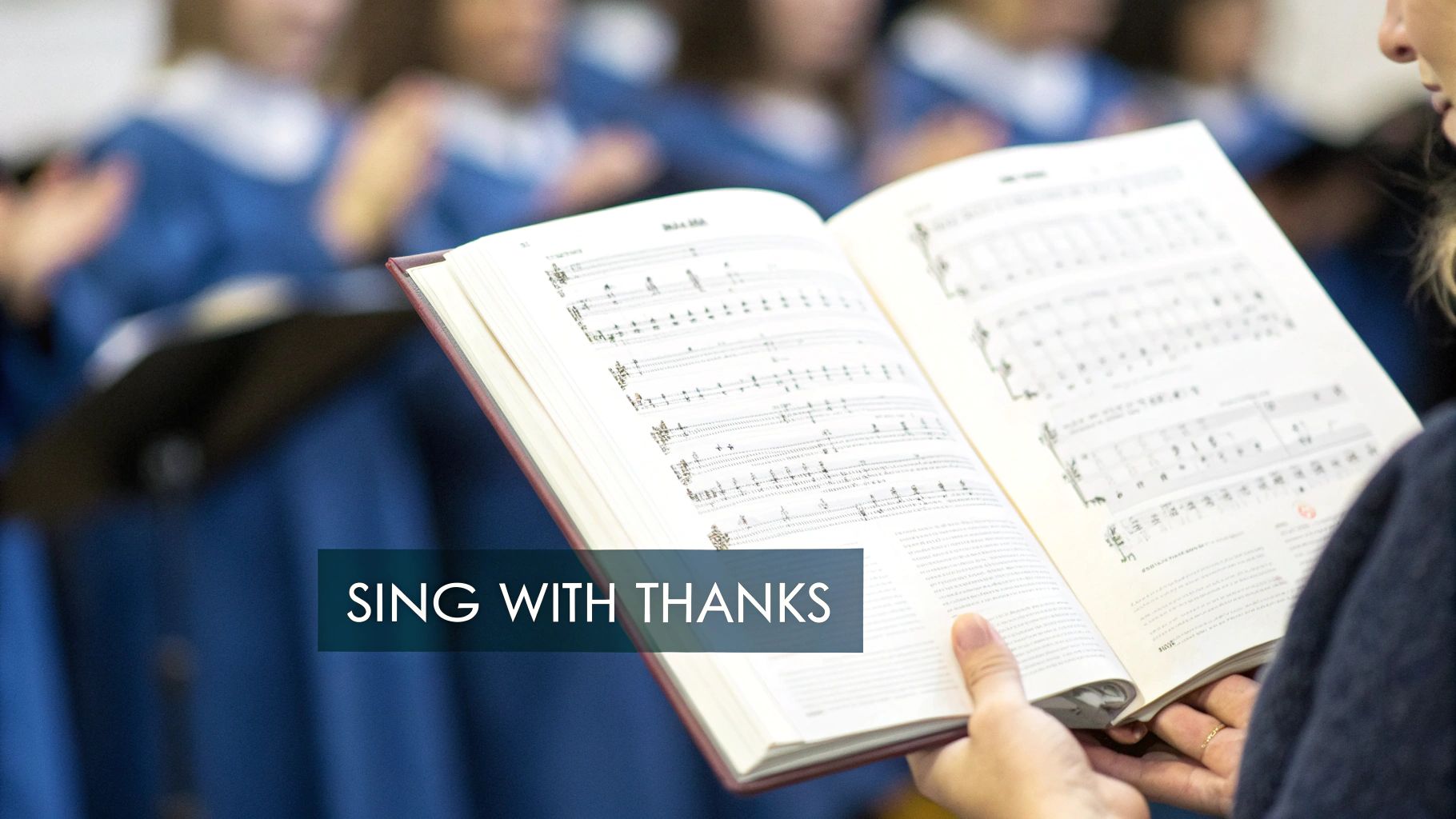
This passage shows how doctrinal truth and emotional expression are designed to work together. The "message of Christ" is the foundation, and it dwells "richly" within the church community through the very act of singing. This form of worship reinforces spiritual formation, allowing believers to teach and correct one another through biblically sound lyrics, all while offering heartfelt gratitude to God.
Practical Application
This principle validates the central role of music in both corporate and personal worship, emphasizing the content of the songs as much as the act of singing. It encourages a vibrant, participatory musical life within the church that is theologically robust.
Congregational Singing: A church that intentionally selects hymns and contemporary songs with rich biblical content is actively living out this verse, teaching doctrine as the congregation sings together.
Family Worship: Parents teaching their children songs based on Scripture verses or biblical stories are using music to help the message of Christ dwell richly within their home.
Actionable Tips
To apply this scripture effectively, focus on the substance and purpose of your musical worship:
Choose Songs with Lyrical Depth: Prioritize songs, whether traditional or modern, that are packed with biblical truth and accurately reflect the character of God.
Use Music to Memorize Scripture: Find songs that are direct musical settings of Bible verses. Singing is a powerful mnemonic device that helps internalize God's word.
Encourage Active Participation: Foster an environment where congregational singing is strong and heartfelt, reminding everyone that their voices are teaching and admonishing those around them. This aligns with the community focus of the verse.
Connect Singing to Study: The richness of the message of Christ comes from a deep understanding of the text. For more guidance, you can learn how to read the Bible for all it's worth.
8-Scripture Worship Comparison
Passage | Implementation complexity | Resource requirements | Expected outcomes | Ideal use cases | Key advantages |
|---|---|---|---|---|---|
John 4:24 — Worship in Spirit and Truth | Moderate — requires inner authenticity and discernment | Minimal physical resources; spiritual maturity and guidance | Authentic, inclusive worship centered on truth | Personal devotion, small groups, cross-cultural ministry | Transcends location/ritual; emphasizes sincerity |
Psalm 95:1-7 — Come, Let Us Bow Down | Low — structured congregational practice | Musical leadership, gathered community, space for physical expression | Corporate praise, communal engagement, reverence | Corporate services, charismatic gatherings, liturgy | Engages body and voice; fosters unity |
Romans 12:1 — Living Sacrifice | High — lifestyle-level commitment and discipline | Ongoing spiritual formation, accountability, time | Holistic discipleship; ethical, everyday worship | Discipleship programs, vocational ethics, daily routines | Integrates faith into all life; practical holiness |
Revelation 4:8-11 — Heavenly Worship | Moderate — symbolic, contemplative implementation | Teaching, liturgy, imagination, contemplative practice | Awe-filled worship, eternal perspective, reverence | Contemplative services, doctrinal teaching, retreats | Provides transcendent model; focuses on God's worthiness |
Philippians 3:3 — Worship by the Spirit | Low to moderate — requires spiritual sensitivity | Openness to Spirit, discerning leadership, space for spontaneity | Joyful, Spirit-empowered, Christ-centered worship | Pentecostal/charismatic services, spontaneous prayer | Centers on Christ; emphasizes Spirit empowerment |
Psalm 100 — Enter with Thanksgiving | Very low — simple prescriptive practice | Minimal (leader prompts, singing or spoken thanks) | Focused gratitude, positive corporate tone | Service openings, family devotions, morning prayer | Simple, memorable framework; widely applicable |
Exodus 34:14 — Worship the Lord Alone | Moderate — requires clear teaching and commitment | Theological instruction, accountability, cultural discernment | Exclusive devotion, resistance to idolatry, covenant fidelity | Renewal ceremonies, teaching on idols, personal examination | Clarifies loyalty; protects worship integrity |
Colossians 3:16 — Let Christ Dwell Richly | Moderate — musical and doctrinal integration | Musicians, teaching resources, song selection | Spiritual formation through music; Scripture retention | Worship services, music ministry, children’s teaching | Combines Scripture with music; reinforces doctrine through song |
From Scripture to Lifestyle: Your Next Step in Worship
As we have journeyed through these foundational passages, a multi-faceted and deeply personal portrait of worship has emerged. We have seen that genuine worship transcends mere Sunday morning routines or musical preferences. It is a response to God's holiness that engages our entire being, shaping our thoughts, actions, and affections every day of the week.
The worshiping god scriptures we explored are not isolated commands but interconnected threads in a grander tapestry. John 4:24 calls us to an authentic, internal worship grounded in biblical truth, which is then given voice and posture in Psalm 95’s invitation to bow down in reverence. Romans 12:1 extends this posture into our daily lives, transforming mundane tasks into sacred offerings. This holistic approach, from the internal to the external, is what it means to truly live a life of worship.
Synthesizing a Life of Worship
The key takeaway is that biblical worship is both a disposition and a discipline. It is an internal orientation of the heart (Philippians 3:3) that expresses itself through external actions of thanksgiving and praise (Psalm 100). This requires intentionality. Colossians 3:16 reminds us that a rich indwelling of Christ’s message fuels our worship, while Exodus 34:14 guards its purity by demanding our exclusive allegiance to God alone.
To truly master these concepts, consider these actionable next steps:
Integrate One Scripture: Choose one of the eight verses that most challenged or inspired you. For the next seven days, begin your day by reading it and asking God how you can live it out. For example, if you choose Romans 12:1, you might consciously dedicate your workday to God, viewing your tasks as acts of service and worship.
Worship Audit: Take 15 minutes to reflect on your week. Where did your actions and attitudes reflect a heart of worship? Where did they fall short? This isn't about guilt, but about growing in awareness and dependence on God's grace.
Community Connection: Discuss these scriptures with a trusted friend, mentor, or small group. Ask each other: "How can we better embody worship in spirit and truth in our specific life contexts?"
Ultimately, the vision of worship presented in Revelation 4, with all of creation prostrate before the throne, is our ultimate destination and our present motivation. It reminds us that our small, daily acts of worship are a participation in an eternal, cosmic chorus of praise. By intentionally applying these worshiping god scriptures, you are not just learning about God; you are drawing nearer to Him, transforming your life from a series of disconnected moments into a continuous, vibrant act of worship. This is the path to a deeper, more profound relationship with the Creator who is worthy of all our praise.
Ready to move from personal study to influential leadership? If you feel a calling to deeply understand and teach the richness of God's Word, explore the graduate programs at The Bible Seminary. Our curriculum is designed to equip you with the theological depth and practical skills to lead others into a biblically-grounded, life-transforming worship. The Bible Seminary