
8 Manger Scene Ideas for Churches, Small Groups, and Homes

On the first Sunday of Advent, a family or church team stands before an empty stable and asks what the display should say. It can be beautiful, but its deeper work is to help people meet the story of Jesus through Scripture, thoughtful design, and shared attention.
A nativity can teach as much as it decorates. The familiar manger scene is rooted in the Gospel accounts, while many details people expect, from the cave setting to the ox and donkey, reflect Christian tradition and art rather than details explicitly stated in Scripture. Naming that distinction helps children and adults engage the story with integrity.
These eight manger scene ideas offer different ways to bring the birth of Christ into a church, small group, classroom, or home. Each pairs a practical visual approach with a Scripture connection and a note about what the display can, and can't, claim as history.
1. Living Nativity
A living nativity invites visitors to encounter the Christmas story through people, movement, and spoken Scripture. Mary, Joseph, shepherds, and angels can form a quiet tableau, while a narrator reads Luke 2:1–20. If you include the Magi, read Matthew 2:1–12 as a distinct part of the story rather than suggesting the Gospel places them at the manger on the night of Jesus' birth.
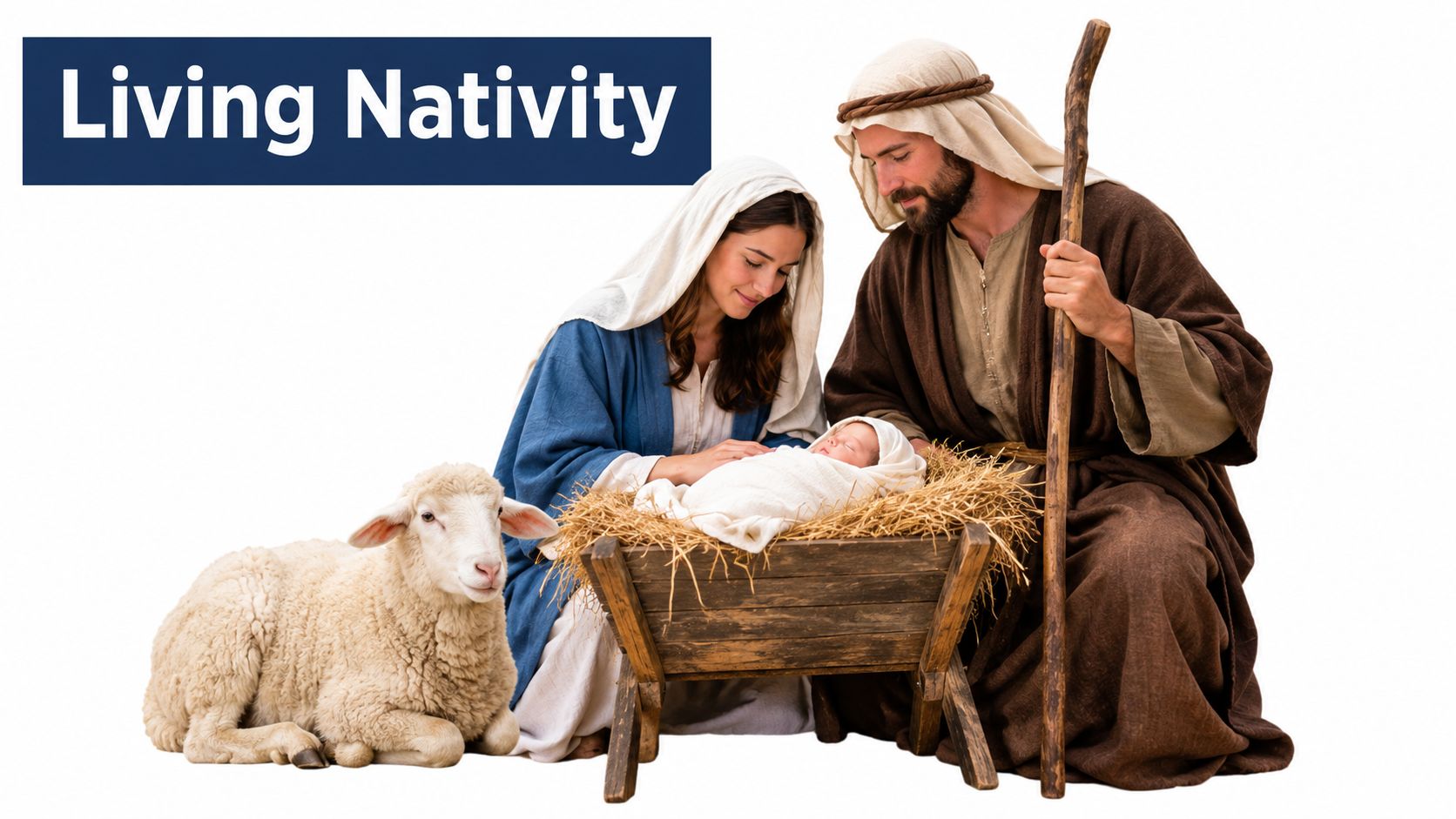
The idea has a notable precedent in the Greccio celebration organized by Francis of Assisi in 1223. The Vatican's account of the Greccio Nativity describes a manger with hay, an ox, and a donkey, and explains that Francis sought to make the humility of Christ's birth tangible to worshippers. The event is commonly associated with the later tradition of staged Nativity scenes.
Plan the experience, not just the costumes
Recruit readers and performers early, prepare a clear script, and designate a trained animal handler if live animals will be part of the event. Confirm local requirements for animals and public gatherings, and have an indoor alternative ready for bad weather. A short printed guide can help visitors follow the readings and understand which parts are directly from the Gospel accounts.
Keep the performance simple and reverent. The focus is Christ's coming, not elaborate acting or impressive sets. For example, a church could present the birth and shepherds' visit as a spoken tableau, then invite families to discuss what the angel announces in Luke 2.
Practical rule: Use costume and staging to serve the Scripture reading. Don't let spectacle drown out the story.
2. Bethlehem Cave Stable Display
A cave-style stable gives a manger scene a different visual setting from the familiar wooden barn. Use a dark, rocky backdrop, a simple feeding trough, and restrained lighting that draws attention to the child. Luke 2:7 names the manger, but the Gospel doesn't say whether it was inside a cave or a wooden stable.
The cave tradition has roots in early Christian memory. Britannica's overview of Nativity art describes how Eastern Christian art frequently showed the birth in a cave, reflecting the use of caves as animal shelters in Palestine. A placard can present this as an early Christian artistic tradition, not as a detail confirmed by Luke.
Let the setting support the text
For a church display, pair the scene with Luke 2:7 and a brief explanation of the cave tradition. Avoid filling the space with so many rocks, animals, and props that visitors lose sight of the manger. Soft side lighting can create depth, while keeping the manger itself visible from the main approach.
A small group could use the display to ask why Christians have pictured the birth in different ways across history. That conversation offers a natural opening to distinguish the Gospel's account from later artistic choices. In a home, a fabric backdrop or a few pieces of safely arranged cardboard can suggest a grotto without requiring a large build.
The trade-off is that a cave can feel unfamiliar to visitors accustomed to a stable. Explain the choice with a label, and let the biblical text remain the anchor.
3. Archaeology-Inspired First-Century Village Nativity
Instead of placing the Holy Family in a generic barn, build a modest village setting with objects that help visitors picture ordinary life: a clay-style oil lamp, storage jars, a grinding stone, and a feeding trough. The objects create a classroom-like display around Luke 2, connecting the birth narrative with the material world in which it took place.
The key is careful wording. Present the items as examples of objects associated with daily life in the ancient region, not as artifacts from Jesus' specific home or as proven objects from the Bethlehem scene. The Gospel doesn't identify the construction materials or furnishings of the place where Jesus was born.
Label objects with care
Use museum catalogs and reputable archaeology publications to guide your choices. A short label can say, for example, “Oil lamps provided light in ancient households,” then explain that Luke's account names the manger but doesn't describe the room's other contents. This teaches visitors how historical context can illuminate Scripture without turning a reconstruction into a claim of archaeological discovery.
For a classroom, arrange the display in stations. Students can examine a lamp replica, read Luke 2:1–7, and discuss what the passage says directly and what the objects help them imagine. A seminary or church educator can add a short guided conversation about how archaeologists study material remains and why evidence supports some conclusions more strongly than others.
The display works best when it's visually restrained and its labels are precise. A few well-explained objects teach more than a crowded collection of props presented without context.
4. Prophecy Path Advent Nativity
A prophecy path turns a nativity display into a walk through the Bible's story of promise and fulfillment. Set up several stations leading toward the manger, each with a short passage, a simple symbol, and a question for reflection. The final station can feature the Nativity with Matthew 1:23 or Matthew 2:5–6, where Matthew connects the birth of Jesus with earlier Scripture.
You might include Isaiah 9:6 and Micah 5:2, then read each passage in context. Matthew's use of Scripture helps Christians understand the relationship between Israel's Scriptures and Jesus, but a teaching display should avoid treating verses as isolated predictions without considering their original setting.
Give each stop a clear purpose
At home, a table can hold a small manger scene at one end and candles or printed verses along the way. In a church hallway, visitors can follow a short route at their own pace. A one-page guide with a question at each stop helps families and small groups respond rather than just read and move on.
Useful questions include: What hope does this passage express? What does Matthew say about its connection to Jesus? What does the passage reveal about God's faithfulness? The answers don't need to be lengthy. A thoughtful conversation rooted in the text is more valuable than a display with many verses and no time to consider them.
For an Advent gathering, you can add a candle at each station as the group moves toward the manger. Keep flames supervised, or use battery-operated candles where children or public foot traffic make open flames impractical.
5. Light of the World Lantern Nativity
Begin with a dim path and let warm lantern light lead visitors toward the manger. The visual movement from darkness to light creates a natural setting for Isaiah 9:2 and John 1:4–9, passages that speak of light and life. Put one Scripture reading near the entrance and another close to the manger so visitors can connect the image with the words.
Battery-operated LED lanterns are a practical choice for an indoor pathway or outdoor display. They're easier to manage than open flames and can be repositioned without handling hot glass. Test lights and extension cords before opening, route cables away from walkways, and choose fixtures and cords suitable for the venue.
Keep atmosphere and safety together
The appeal of this design is also its challenge: low light can make a space inviting, but it can hide steps, cables, and exits. Keep the route bright enough for safe movement, and don't use decorations that block exit routes, alarms, sprinklers, or fire equipment. University of Richmond fire-safety guidance advises using listed lighting, discarding damaged cords, unplugging displays each night, and avoiding untreated straw and hay indoors.
For a church evening event, set lanterns along a path and make the manger the brightest visual point. Use a gradual change in light rather than making the approach so dark that guests need to feel their way. A brief label at the end can connect John's language about light with the hope Christians celebrate in Christ.
6. Global Nativity Collection Display
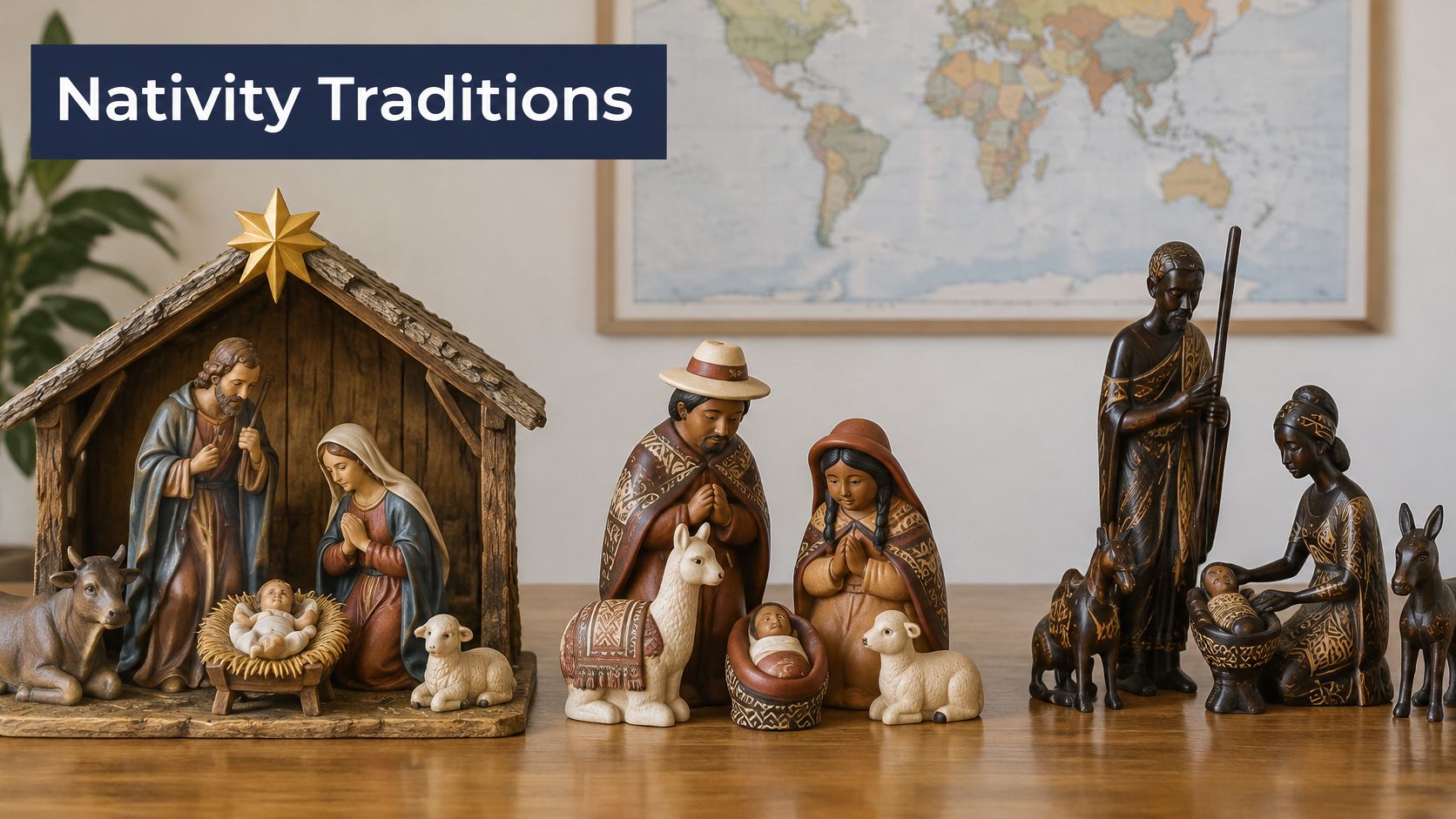
A collection of Nativity sets from different places can show how communities express the same Christian story through local materials, clothing, architecture, and artistic styles. Arrange each set with its own label and invite visitors to notice both the variety and the shared focus on Christ. Revelation 7:9 provides a fitting theme for prayer and reflection on the people of God from every nation.
Nativity traditions aren't limited to one visual style. A 2025 exhibition described by Glencairn Museum presented 63 Nativity scenes from 29 countries. One Kyrgyz example used a yurt, showing how a familiar biblical story can be represented through a local form of shelter.
Tell the story behind each set
Ask church members to lend pieces connected with their family heritage or travels, but don't assume that one person can speak for an entire culture. Check labels with knowledgeable community members or reputable museum and academic sources. Explain the makers and materials where that information is known, and be clear when a detail is uncertain.
A mission-minded congregation could place prayer cards beside the display, naming partner churches or ministry workers. In a classroom, invite students to compare how clothing or architecture changes while the manger remains central. The teaching point isn't that every tradition is interchangeable; it's that Christians around the world express their faith in distinct ways.
Avoid treating cultural objects as props or reducing them to decorative curiosities. Give each set space, accurate interpretation, and a respectful introduction. That approach makes the display more welcoming and helps visitors learn rather than just browse.
7. Public Reading of Scripture Nativity Stations
Give each Nativity station a passage to read, then invite visitors to follow the Christmas story through Scripture. A route might begin with the announcements surrounding Jesus' birth and continue through the accounts in Luke 1–2 or Matthew 1–2. Keep the display simple enough that the reading, rather than the decorations, holds the visitor's attention.
Choose a translation such as the CSB, ESV, or NIV, and identify it on printed materials. Schedule readers in manageable shifts so they can read clearly and steadily. Place stations far enough apart to prevent overlapping voices, especially if several groups will move through at once.
Make space for listening
At each stop, use a short passage and a clear transition. A reader can finish with a question such as, “What does this passage reveal about God's faithfulness?” At the final station, close with a brief prayer or a quiet moment rather than adding another long explanation.
The Bible Seminary's article on public reading of Scripture in the Bible offers a helpful connection for churches considering how communal reading serves the life of the church. For a practical example, a campus fellowship could set up several stations in a common room, with one reader at each stop and a guide showing the order of passages.
This approach requires less scenery than a large live production, but it does require preparation. Assign readers in advance, provide printed texts, and make the route accessible to visitors who may need seating or extra time.
8. Drive-Thru Community Nativity
A drive-thru nativity lets families experience the Christmas story from their cars. A route can pass a small number of scenes with costumed volunteers, simple backdrops, and a recorded or live reading. The format can serve people who find a walking event difficult, including older adults, families with young children, and visitors who prefer to avoid crowds.
Plan the route before recruiting performers. Contact the relevant city or county office early about permits and traffic requirements, then assign trained traffic marshals and place clear signs where drivers need to turn or stop. Keep each scene concise so cars move safely and volunteers aren't left managing an uncertain queue.
Make every stop easy to follow
Use a printed program or low-volume broadcast to guide visitors from scene to scene. If a narrator reads Scripture, make sure drivers can hear the words without distracting from safe driving. The final stop can offer a clear invitation to a church service, community gathering, or another local opportunity to learn more.
For example, a church in the Katy area could place the manger scene near the route's exit, where volunteers can hand out an invitation without asking drivers to leave their vehicles. A family-friendly route should have a clear beginning and end, a plan for bad weather, and a safe place for volunteers to wait between groups.
A drive-thru event can reach people beyond a congregation's regular gathering, but traffic management is part of the ministry, not an afterthought. Keep the route accessible, easy to understand, and centered on the Gospel.
How the 8 Manger Scene Ideas Compare at a Glance
Item | Best For | Setting | Main Challenge | Budget Level |
|---|---|---|---|---|
Living Nativity (Tableau Vivant) | All-ages, immersive community engagement | Outdoor or indoor staged scene | Coordinating volunteers, animals, and safety | High |
Bethlehem Cave Stable Display | Contemplative, historically informed displays | Small indoor spaces or church entryways | Creating realistic cave textures | Low to moderate |
Archaeology-Inspired First-Century Village Nativity | Bible education and archaeology audiences | Exhibit, classroom, or church display | Researching details and sourcing props | Moderate to high |
Prophecy Path Advent Nativity | Family devotion and Advent study | Indoor or outdoor walking route | Making the sequence and Scripture connections clear | Low to moderate |
Light of the World Lantern Nativity | Evening events and visual storytelling | Church campus or outdoor pathway | Safe, reliable lighting and power | Moderate |
Global Nativity Collection Display | Mission education and cultural learning | Church, school, or museum | Authentic labeling and careful handling | Moderate to high |
Public Reading of Scripture Nativity Stations | Scripture engagement and group reflection | Church, campus, or community route | Scheduling readers and managing sound | Low to moderate |
Drive-Thru Community Nativity | Accessible outreach to families and larger audiences | Parking lot or designated driving route | Traffic safety, permits, and coordination | High |
Choose Your Nativity and Build It This Advent
The best Nativity display isn't necessarily the largest or most elaborate. Choose an approach that fits your space, budget, available volunteers, and the people you hope to welcome. A family may want a small prophecy path on the dining table, while a church with a willing team may be ready for a living tableau or a public Scripture reading.
Start with one concrete step. Choose a passage, recruit a small team, or decide what you want visitors to understand when they leave. Then build the visual around that purpose. If you're creating a historical display, label the difference between what Scripture states and what later Christian art or tradition adds. If you're including cultural examples, ask whether the presentation is accurate and respectful.
You don't need perfect scenery to help someone encounter Christ. A plain manger, a well-chosen reading from Luke, and space for a family to reflect can make a meaningful display. Careful teaching doesn't weaken the wonder of the Nativity; it gives visitors a clearer way to understand what the story says and why Christians continue to tell it.
The Bible Seminary brings together biblical study, historical learning, and ministry preparation. Its work includes graduate education, flexible study options, the 3J Museum, and community resources that serve churches and learners. That combination can help Christian leaders approach displays not as decoration alone, but as opportunities for faithful teaching and service.
Visit The Bible Seminary's campus in Katy, Texas, to learn more about classes, events, and resources available to you.
Explore how The Bible Seminary brings biblical scholarship, archaeology, and practical ministry training together to serve churches and Christian leaders. Visit The Bible Seminary to learn about its programs, museum, and resources for deeper study of Scripture.