
Jesus and Melchizedek: Christ as Priest-King in Hebrews

Why does a king who appears for only three verses in Genesis become the key to explaining who Jesus is as priest? Many readers treat Melchizedek as a single hidden clue to decode. Scripture works differently. It builds a pattern across centuries, from an encounter, to a promise, to a full argument about Christ.
We invite you to follow Jesus and Melchizedek in canonical order. You'll see what each text says, what it doesn't say, and how the next text adds something new.
Melchizedek in Scripture at a Glance
Passage | What It Says About Melchizedek | Role in the Jesus Connection |
|---|---|---|
Genesis 14:18-20 | King of Salem and priest of God Most High, who blesses Abraham and receives a tenth | The original narrative encounter |
Psalm 110:4 | A priest forever according to the order of Melchizedek, spoken of a royal figure | A royal-priestly promise |
Hebrews 5:5-10 | Christ is appointed a priest according to the order of Melchizedek | The priesthood of Christ is introduced |
Hebrews 6:19-20 | Jesus entered the inner sanctuary as a forerunner, high priest forever according to the order of Melchizedek | The priesthood anchors Christian hope |
Hebrews 7:1-28 | Melchizedek is greater than Levi, and Jesus' priesthood is permanent | The full theological argument |
A Three-Part Pattern
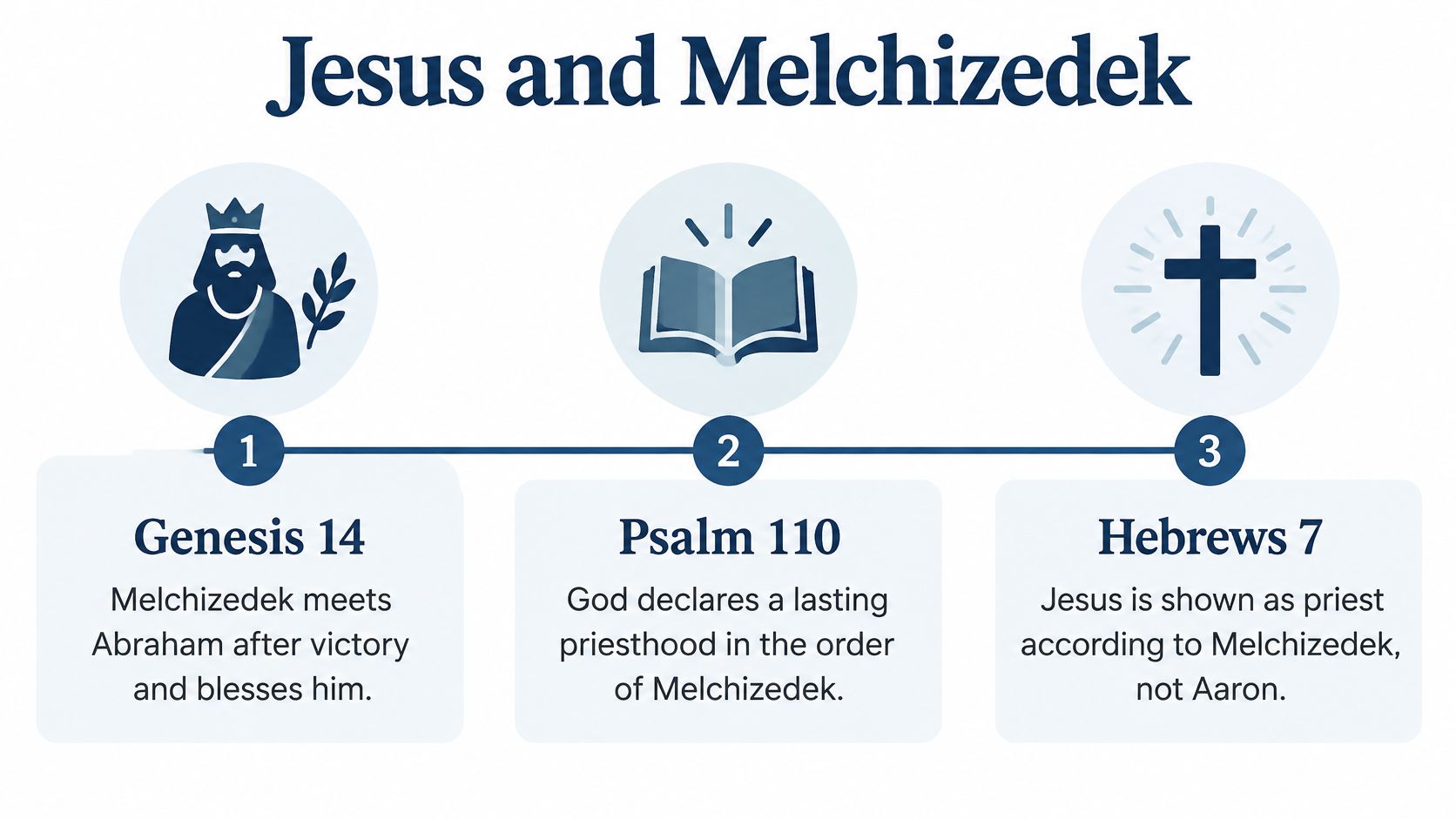
Genesis narrates an encounter. A priest-king meets Abraham, blesses him, and receives a tenth. No explanation follows, and Genesis moves on.
Psalm 110 makes a promise. God declares a coming royal figure to be a priest forever according to the order of Melchizedek. That phrase, order of Melchizedek, first appears in Psalm 110:4 and recurs throughout Hebrews. You can search for it in your own Bible and find the thread quickly.
Hebrews develops that promise into an argument. It asks how Jesus, who isn't from the priestly tribe, can serve as priest at all, and answers by returning to both Genesis and the psalm.
Reading rule: Let each passage do its own work before you ask what later passages do with it.
Use three simple habits as you read:
Read in context: Give each passage its own setting first, whether that's a battlefield return, a royal psalm, or a sermon-like letter.
Notice the kind of text: Ask whether you're reading a described event or a theological claim built from an event.
Track the growth: Note what each book adds that the earlier book didn't contain.
Keep this table open as you work through the passages that follow.
What Genesis 14 Records About Melchizedek
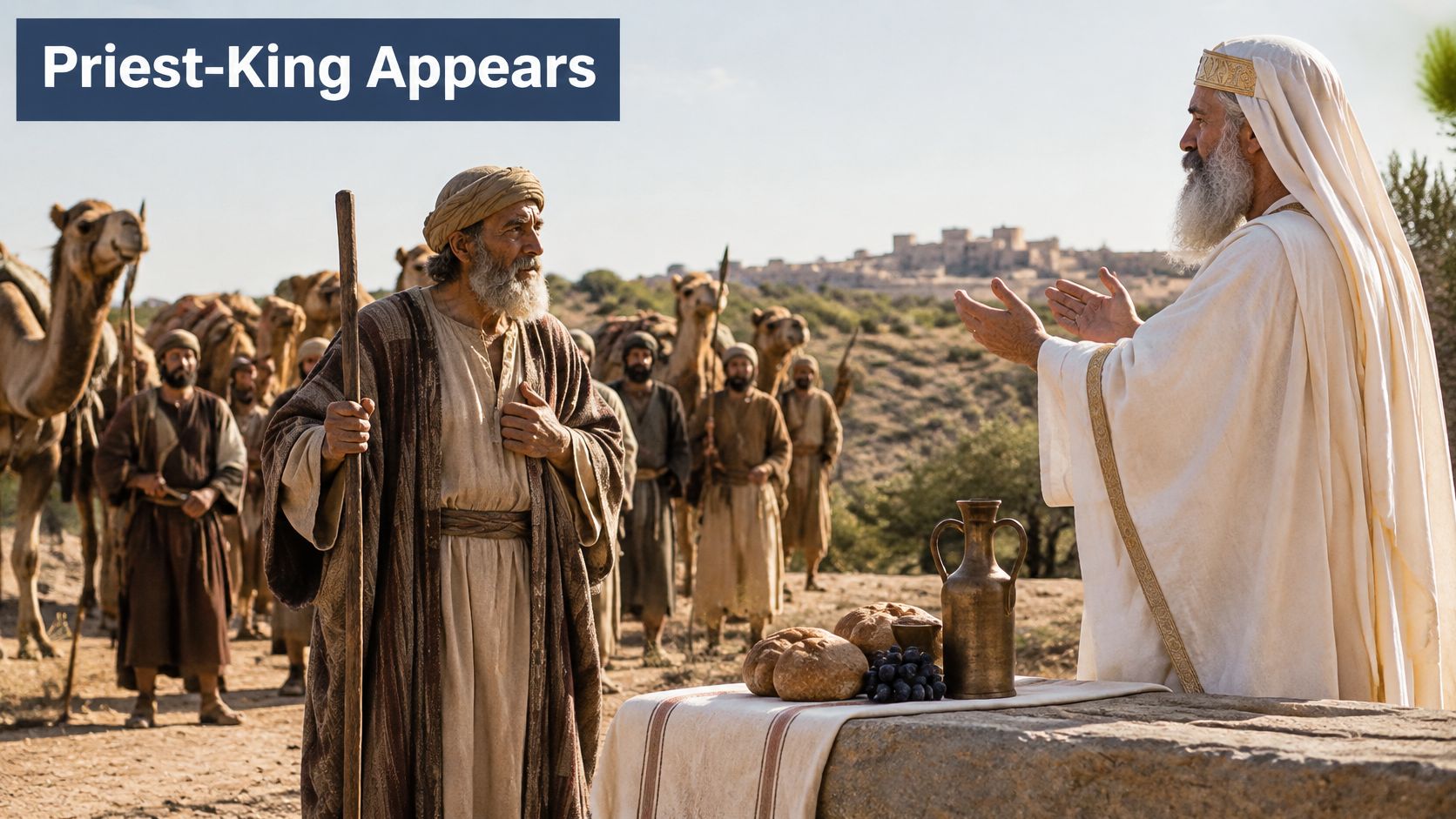
Abraham has just returned from defeating a coalition of kings led by Chedorlaomer, the Elamite king, and rescuing his nephew Lot. Two kings go out to meet him. One is the king of Sodom. The other appears without warning and changes the direction of the whole scene.
As you can read in the Genesis and Hebrews 7 passage in the NABRE, NIV, and ESV, Genesis 14:18-20 introduces Melchizedek as both "king of Salem" and "priest of God Most High," and Hebrews 7:2 interprets his name as "king of righteousness" and Salem as associated with peace.
Four Details in Three Verses
First, Melchizedek brings out bread and wine. It's a concrete act of provision after battle, not an abstract symbol floating free of the story.
Second, he blesses Abraham. He blesses Abraham by God Most High and blesses God, who delivered Abraham's enemies into his hand. The blessing points credit for the victory to God.
Third, Abraham gives him a tenth of the recovered goods. The covenant patriarch honors this priest-king, and that direction of giving matters later in Hebrews.
Fourth, notice a silence rather than a detail. Genesis records no ancestry and no death for Melchizedek. He enters with no genealogy and exits with no obituary, which Hebrews 7:3 later treats as a pattern pointing to Christ.
Salem is traditionally identified with Jerusalem. That identification matters for Christian reading, since Jerusalem becomes the city of David's kingship and of Jesus' death and resurrection.
Genesis gives a brief but concrete encounter. Don't reduce Melchizedek to a vague symbol when the text gives you specific actions to retell.
Say you're teaching a Sunday school class. You can retell this faithfully in four sentences using the four points above, and your students will have the whole scene. That's responsible interpretation, attending to narrative details before building theology.
Which of these details surprises you most, and why?
Psalm 110 and the Promise of a Priest Forever
Psalm 110 is a royal psalm associated with David. The New Testament quotes its opening line often, where the LORD invites David's lord to sit at His right hand. Verse 4 then adds something no reader under Moses' law would expect.
The LORD has sworn and will not change his mind, "You are a priest forever after the order of Melchizedek." (Psalm 110:4, ESV)
Why This Verse Startles
Under the law of Moses, priesthood belonged to the Levites and specifically to the line of Aaron. Kings ruled. Priests offered sacrifices. The roles stayed apart by divine command.
King Uzziah learned that the hard way. In 2 Chronicles 26:16-21, he entered the temple to burn incense himself, a priestly task, and was struck with leprosy. A king acting as priest wasn't a small procedural error. It was a serious violation.
So when Psalm 110 addresses a royal figure as priest, it isn't describing business as usual. It's announcing an exception God Himself authorizes.
Three Observations From the Wording
The oath is divine: "The LORD has sworn and will not change his mind" puts this priesthood on God's sworn word, not human appointment.
The duration is forever: This priest doesn't serve a term and hand the office to a son. The word forever stretches beyond any single lifetime.
The basis is an order, not a family line: Authority comes after the order of Melchizedek, a pattern, rather than through descent from Aaron.
For a fuller walk through this psalm, see our commentary on Psalm 110. Scholars debate the psalm's dating and original setting, so present the connection to Jesus as a reading the New Testament develops from the text, not as settled history everyone grants.
How Hebrews 7 Argues for Christ's Priesthood
Here's the core claim. Jesus serves as priest according to the order of Melchizedek rather than as a priest descended from Aaron, and as the Bible Odyssey article on Melchizedek explains, the argument draws on Genesis 14:18-20 and Psalm 110:4 to show how Jesus, associated with Judah rather than Levi, can hold priestly authority.
The Chronological Argument
Hebrews 7:4-10 reasons from timing. Abraham gave Melchizedek a tenth long before Levi was born. Levi, who later receives tithes through his descendants, was still in Abraham's line, unborn, at that meeting.
So Melchizedek's priesthood stands prior to Levi's, and the one who blesses is greater than the one blessed. Hebrews uses that order to show a priesthood older and greater than the Levitical system.
The Argument in Steps
Melchizedek is greater than Abraham's descendants. He blessed Abraham and received his tenth, so his standing precedes Levi's.
The Levitical system couldn't bring perfection. Hebrews 7:11 asks why another priest was promised at all if that system had finished the job.
A priest in a new order is needed. Psalm 110 already promised one, and Jesus, from Judah, fills that promise rather than the Aaronic line.
This priest holds an indestructible life. Hebrews 7:16 grounds His office there, and 7:24-25 concludes that He always lives to intercede.
Scan each row below against the Levitical model:
Feature | Levitical Priesthood | Order of Melchizedek |
|---|---|---|
Basis of appointment | Legal requirement concerning physical descent (Hebrews 7:16) | Power of an indestructible life (Hebrews 7:16) |
Tribal line | Levi and Aaron | Not traced in Genesis 14; Jesus is from Judah (Hebrews 7:14) |
Recorded ancestry | Genealogies kept in Scripture | No genealogy given in Genesis 14 |
Relation to Abraham | Descended from Abraham through Levi | Melchizedek receives a tithe from Abraham |
Duration | Succession of mortal priests (Hebrews 7:23) | Continues; Jesus lives forever (Hebrews 7:24-25) |
Hebrews 7:3 does not claim Melchizedek was an eternal, self-existent being. It describes the Genesis silence about his ancestry and death and uses that silence as a pattern pointing to Christ's enduring priesthood. As the Bible Hub entry on Hebrews 7:1 reflects, Melchizedek is presented as "made like the Son of God," a likeness in the biblical record, not equality with Jesus.
That's the heart of Jesus and Melchizedek in Hebrews. Jesus combines kingship and priesthood without depending on genealogical descent from Aaron, and because He lives forever, His intercession doesn't end.
Second Temple Readings and the Limits of the Qumran Scroll
Hebrews didn't introduce Melchizedek from nothing. By the Second Temple period, Jewish readers were already reflecting on this brief Genesis figure and asking what his unusual priesthood meant. Hebrews speaks into that conversation and directs it toward Jesus.
What 11Q13 Actually Is
The clearest example is 11Q13, also called 11QMelchizedek. The overview of 11Q13 describes it as a fragmentary text from Cave 11 generally dated to approximately the first century BCE and first published in 1965.
Contrast that with Genesis. There, Melchizedek is a historical priest-king who blesses Abram. In 11Q13, he appears in an expanded eschatological role connected with divine judgment, liberation, and conflict against forces of evil. The figure has grown from a king who meets a patriarch to an end-time agent.
Philo of Alexandria also discussed Melchizedek, reading him in allegorical terms. Different communities, different questions, same three verses in Genesis behind them all.
Three Ancient Readings
A model for priestly authority. Melchizedek shows a priesthood that doesn't run through Aaron's line.
A heavenly or end-time agent. Some texts lift him into judgment and liberation at the end of days.
A precedent for combining roles. He allows ancient readers to imagine royal and priestly authority in one figure.
The Popular Overstatement
Because the Qumran figure sounds exalted, popular content often treats the scroll as dramatic confirmation of Jesus. That skips dating, fragmentary transmission, genre, and dependence. The Marquette Dictionary of Early Judaism entry on Melchizedek identifies 11Q13 as a fragmentary Cave 11 Qumran text, and the manuscript survives with lacunae, so key readings remain debated.
Let's be plain about the limits. The evidence doesn't establish that the Qumran community identified this figure with Jesus, or that Hebrews directly copied the scroll. Similarity isn't the same as dependence.
Treat the scroll as evidence of a wider Second Temple Jewish heavenly-Melchizedek tradition, not as proof of a direct Jesus-Melchizedek identity.
A Careful Way to Use the Scroll
State what the text says. It portrays Melchizedek in an exalted end-times role involving liberation, judgment, and atonement.
Note its dating and gaps. A fragmentary manuscript with lacunae can't carry claims a complete text might.
Distinguish parallels from dependence. Shared themes show a common interpretive environment, not necessarily borrowing.
Let Hebrews carry its own claim. Hebrews argues from Genesis 14 and Psalm 110, and that's where the case for Jesus rests.
Used this way, the scroll still helps you. It shows the religious environment in which Hebrews presented Jesus as the definitive priest-king, an enduring priest whose ministry isn't temporary or genealogically restricted. You gain context without overstating conclusions, which is how we aim to handle archaeology and ancient texts, responsibly and factually.
Take Melchizedek into Your Study or Teaching
You don't need a specialist library to teach this well. You need a repeatable method that keeps text, context, and claims in the right order.
A Four-Step Study Path
Read the three passages in one sitting. Read Genesis 14:17-24, Psalm 110, and Hebrews 7 in the ESV, CSB, or NIV. Reading them together lets you feel how the pattern develops.
Check the lookup table. Mark what each text claims and what it leaves unsaid. If you're building discussion questions, understanding the three question layers can help you move a group from recall to application.
Write one claim and one open question. Name one teaching claim the text supports, and one question the evidence can't answer. Holding both keeps you accurate and humble.
Test your claim. Run it against the Qumran caveats and a reputable commentary before you teach it.
Say you're a pastor planning an adult class. Step three becomes your single discussion question. "What does Hebrews claim about Jesus that Genesis never claims about Melchizedek?" That's enough for a rich hour in a Sunday school lesson, a small group, or a short sermon series.
Our conviction: Training hearts and minds for kingdom service means teaching people to read carefully, not just to conclude quickly.
When you're ready to go deeper, explore our degree programs for training in biblical interpretation, including Dual Degree Completion, which pairs a Bachelor of Arts in Christian Studies with a TBS MA or MDiv. You can also explore our archaeology resources for studying Scripture in its historical setting, including a Holy Land study tour and archaeological excavation opportunities.
Frequently Asked Questions About Jesus and Melchizedek
Was Melchizedek a Pre-Incarnate Appearance of Jesus
Some readers take him that way, but Hebrews doesn't say so. It presents Melchizedek as a type, a pattern that points to Christ, while Jesus alone holds the permanent priesthood. Responsible reading keeps the connection at the level of pattern rather than identity.
Does Psalm 110 Name Melchizedek as the Messiah
No. The psalm doesn't present Melchizedek as Messiah at all. It speaks of a royal figure declared a priest forever after Melchizedek's order, and Hebrews develops the Christian link from that promise to Jesus.
Do I Need the Greek of Hebrews to Study This
No. English translations such as the ESV, CSB, or NIV are enough to follow the argument. Try comparing two translations of Hebrews 7:3 to see how each renders the description of Melchizedek without ancestry. You'll notice the translators working carefully with the same Genesis silence.
At The Bible Seminary, we're equipping leaders to impact the world for Christ by uniting scholarship, spiritual formation, and hands-on ministry. Explore our degree programs at The Bible Seminary and begin your journey toward deeper biblical training.
If tracing Jesus and Melchizedek from Genesis through Hebrews stirred your desire to read Scripture with greater care, we'd love to walk with you. At The Bible Seminary, we offer Bible-based, Christ-centered, Spirit-led, ministry-focused training in Katy, Texas and beyond, where the Bible comes alive with archaeology and Scripture together. Visit us to explore degree programs, certificates, and classes that fit your calling.