
What Is a Graduate Theological Foundation and Why It Matters

Is graduate theological education mainly about earning a credential, or about becoming the kind of leader people can trust with Scripture, suffering, conflict, and hope? A transcript can show what you've studied. It can't, by itself, show whether you've learned to interpret the Bible faithfully, listen patiently, lead wisely, and serve with Christlike character.
A graduate theological foundation addresses that deeper question. It joins biblical knowledge, theological reasoning, spiritual formation, and practical ministry so that study reaches beyond the classroom and into the life of the church. This is the kind of preparation needed by pastors, educators, missionaries, chaplains, church leaders, and ministry professionals serving in changing cultural and vocational settings.
What Makes Theological Education Meaningful
A student may know the structure of Romans yet struggle to explain its hope to a grieving congregation. A pastor may preach accurately yet find it difficult to work through conflict, mentor volunteers, or care for a family in crisis. These situations don't mean biblical knowledge is unimportant. They show that knowledge must mature into wisdom, character, and faithful action.
The meaningful question is not just, “What degree will I earn?” It's also, “What kind of servant will I become through this education?” Scripture presents Christian leadership as a work of equipping and maturity, not merely information transfer. Paul describes the purpose of ministry gifts as preparing believers for service and building up the body of Christ (Ephesians 4:11-13).

Formation beyond academic achievement
A strong seminary experience asks students to bring their learning into real ministry contexts. Biblical interpretation shapes preaching. Theology guides discipleship and pastoral decisions. Church history helps leaders recognize both faithful practices and recurring mistakes. Supervised ministry gives students opportunities to receive correction before they carry greater responsibility.
This approach also requires humility. No program can remove every difficulty from ministry, and no course can substitute for prayer, the local church, or dependence on the Holy Spirit. Yet careful education can give leaders better tools for serving people faithfully.
A meaningful theological education forms the whole person, not only the informed mind.
The Bible Seminary presents theological study as a union of scholarship, spiritual formation, and hands-on ministry preparation. That combination serves the church because leaders need more than answers. They need discernment, endurance, compassion, and the ability to apply truth wisely.
Understanding the Graduate Theological Foundation
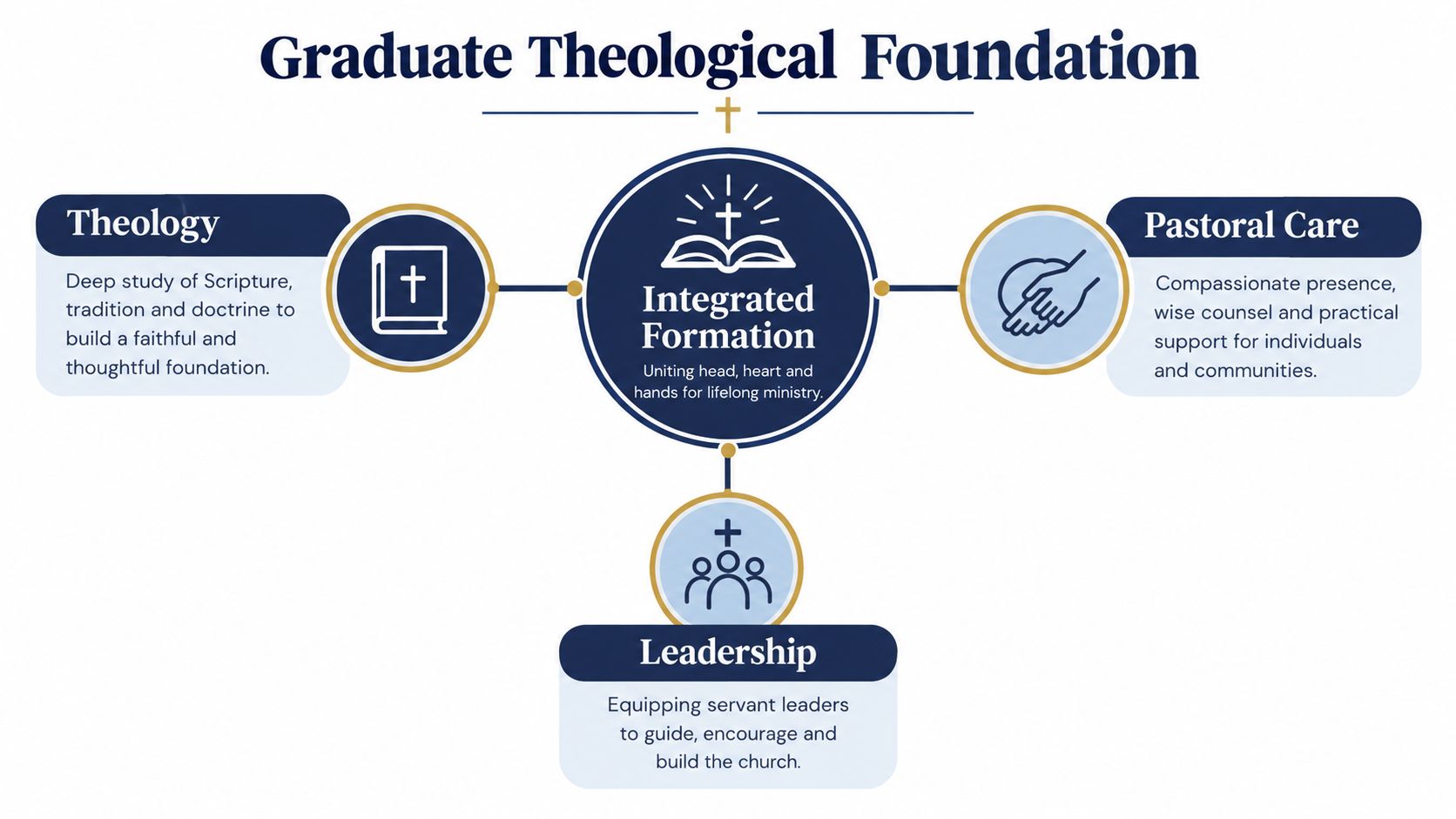
A graduate theological foundation is an integrated system of formation that prepares a person for faithful Christian service. It isn't merely a collection of courses completed in sequence. Each area of study should contribute to a coherent pattern of growth in understanding, character, and ministry practice.
The Association of Theological Schools' standards describe theological schools as communities of faith and learning. They identify intellectual, human, spiritual, and vocational formation as important dimensions of educational quality, alongside academic rigor, intercultural competency, global awareness, and lifelong learning.
Intellectual formation
This dimension develops the ability to read Scripture carefully, understand Christian doctrine, engage historical contexts, and reason theologically. Students learn not only what the church believes, but why those beliefs matter for worship, discipleship, ethics, preaching, and pastoral care.
Biblical languages, hermeneutics, theology, and church history can help students slow down and resist shallow conclusions. Intellectual formation gives ministry leaders a disciplined way to ask what a biblical text means, how it fits within the canon, and how it should be communicated to a particular community.
Spiritual formation
Spiritual formation concerns the person who is doing the studying. Prayer, worship, repentance, mentoring, reflection, and life in the local church help students place knowledge under the lordship of Christ.
This isn't an invitation to measure spirituality by outward performance. It's a call to become people whose lives increasingly reflect the character of the Savior they proclaim. A student may write a strong theological paper and still need growth in patience, honesty, emotional awareness, or dependence on God.
Vocational formation
Vocational formation connects learning with service. It includes preaching, teaching, counseling, leadership, communication, administration, cross-cultural ministry, and supervised field experience.
A program is stronger when it can show how students practice these skills and receive meaningful evaluation. The central question is simple: Can students carry what they've learned into the responsibilities they're preparing to accept?
Core Coursework and Learning Outcomes
Most graduate theological foundations include a broad biblical and theological core, followed by ministry application or specialized study. The exact sequence differs by institution, but the central purpose remains consistent: students should learn to interpret Scripture, understand Christian truth, serve people wisely, and continue growing throughout life.
The building blocks of study
Old Testament and New Testament courses develop scriptural fluency. Students encounter the Bible's literary forms, historical settings, major themes, and canonical unity. Biblical languages can deepen attention to words, grammar, and textual interpretation, while still requiring students to read every passage in context.
Systematic theology organizes the doctrines of the Christian faith and helps students think carefully about how beliefs relate to one another. Church history places theology and ministry within the life of the historic church, giving students perspective on councils, movements, controversies, missions, and patterns of renewal.
Pastoral ministry courses bring these disciplines into daily service. A student preparing for pastoral leadership might study preaching, counseling, discipleship, leadership, and church administration alongside advanced Bible and theology. That combination matters because a sermon isn't delivered to an abstract audience. It's preached to people with particular wounds, questions, cultures, responsibilities, and hopes.
Specialized tracks can extend this foundation into areas such as biblical studies, theology, archaeology, education, leadership, or ministry practice. Students should ask how electives support their calling rather than choosing courses only because they sound interesting.
Outcomes that can be demonstrated
ATS accreditation standards require programs to articulate mission-aligned learning outcomes, gather evidence through direct and indirect measures, involve relevant stakeholders in interpreting results, and use findings for continuous improvement. The ATS accreditation standards and annotations describe an approach that evaluates demonstrated learning and formation across delivery formats.
Direct evidence might include an exegetical paper, preaching evaluation, supervised ministry observation, or capstone project. Indirect evidence might include student surveys, alumni feedback, or ministry-placement information. A credible program doesn't merely claim that students are prepared. It identifies what preparation looks like and examines whether students are reaching those outcomes.
Students can apply the same discipline to their own work. A resource such as Kohru's academic success plan can help learners translate broad goals into manageable study practices, review points, and accountable progress.
From Knowledge to Ministry Competence
A pastor who understands Scripture but cannot listen to people may unintentionally turn ministry conversations into lectures. A leader with strong convictions but little emotional awareness may intensify conflict while trying to resolve it. A gifted communicator without accountable character can create trust problems that no polished sermon can repair.
Ministerial competence is therefore multidimensional. A mixed-methods study using practitioner interviews and a modified e-Delphi process organized competencies into knowledge, character, and skills, with behavioral descriptors and proficiency levels. The research found especially strong consensus around spiritual maturity, scriptural fluency, and community-engaged abilities. Its framework also includes biblical literacy, contextual awareness, empathy, resilience, emotional intelligence, conflict resolution, trauma counseling, and effective communication. Read the study on ministerial competencies.
Three domains in practice
Knowledge enables a leader to interpret Scripture and reason theologically. Students can develop it through exegetical assignments, doctrinal work, historical research, and contextual analysis.
Character shapes how that knowledge is carried. Reflective practice, spiritual disciplines, mentoring, and honest feedback can expose habits that require repentance and growth. Character isn't decorative. It affects safety, trust, judgment, and endurance.
Skills make ministry action possible. Role-play, supervised field education, preaching practice, counseling simulations, teaching exercises, and community projects can reveal whether students know how to serve in concrete situations.
A program should also respect cultural context. Pastoral leadership in a rural congregation, an international church, a multilingual community, and an urban ministry setting may require different examples and field assessments. The core commitments remain, but wise application requires attention to people and place.
Ask whether a program can show how students grow in what they know, who they are, and how they serve.
For a fuller discussion of measurable theological preparation, explore competency-based theological education. The practical value of a graduate theological foundation appears when students can transfer learning into congregational life, teaching, preaching, leadership, and care.
Choosing the Right Program Path
Graduate theological education now serves more than one audience. Some students are preparing for pastoral ministry. Others are already serving as educators, worship leaders, missionaries, chaplains, or lay ministry leaders and need focused study that fits existing responsibilities.
Compare the pathways
Pathway | Best suited for | Main emphasis |
|---|---|---|
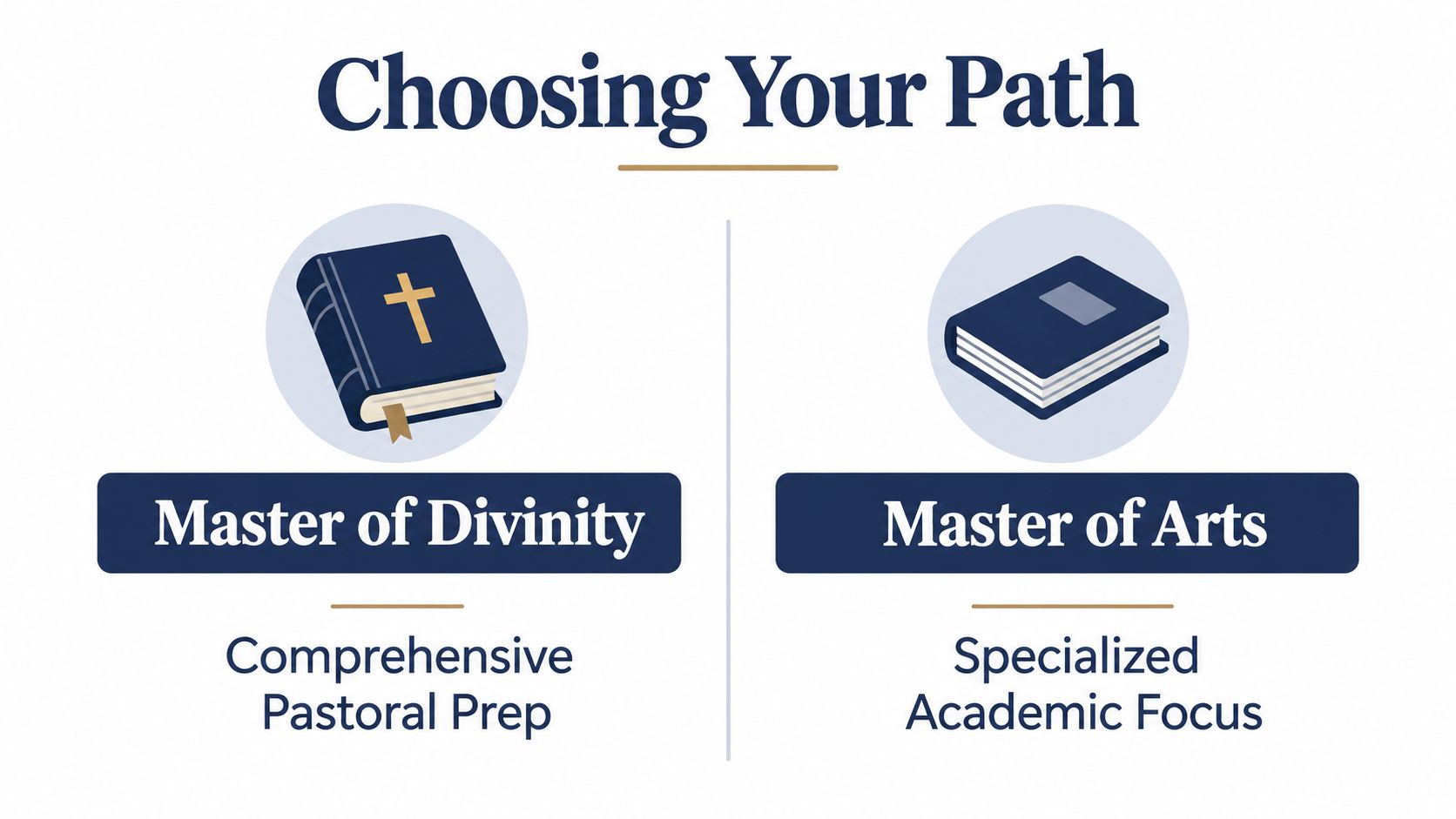
Master of Divinity | Students preparing for comprehensive pastoral or vocational ministry | Broad biblical, theological, historical, and practical preparation |
Master of Arts | Students seeking focused graduate study | Specialized areas such as biblical studies, theology, leadership, or archaeology |
Certificate | Ministry professionals and learners seeking targeted preparation | A defined area of study without committing immediately to a full degree |
Audited course or seminar | Those exploring theological education or pursuing continuing formation | Exposure to graduate-level learning with a flexible entry point |
The distinction isn't about which pathway has greater spiritual value. It's about fit. A prospective pastor may need the breadth of an MDiv, while a church educator may benefit from focused study in biblical interpretation or Christian education. A bivocational leader may need flexible scheduling, while an international student may need delivery options that reduce relocation barriers.
Enrollment data confirms this range. In fall 2024, ATS recorded 79,015 students across 281 member schools, a 3.7% increase from the prior year, with full-time-equivalent enrollment reaching 48,055. The same dataset included 18,770 full-time-equivalent MDiv students, 15,078 MA students, 7,838 students in Doctor of Ministry and other professional-doctoral programs, and 3,074 students in PhD or ThD programs. Review the reported ATS enrollment distribution.
Match study with calling
Start with the ministry responsibility you hope to carry. Then ask what knowledge, character development, and practical skills that responsibility requires. Don't choose a program only because of its title or delivery format.
A sound decision also considers accreditation, faculty expertise, community life, field education, stated learning outcomes, and the institution's theological identity. The program should help you grow in faithfulness, not merely accumulate credits.
Next Steps for Prospective Students
Discernment becomes clearer when you turn a general interest into specific questions. Begin by identifying the ministry settings that draw you, the gifts others recognize in you, and the areas where you need development. Pray with trusted church leaders, mentors, and family members who know your character and responsibilities.
Then investigate programs directly. Review the curriculum, faculty biographies, delivery format, student support, formation practices, and expectations for practical ministry. The Bible Seminary's academic offerings provide one place to examine degree and study options, while faculty biographies can help prospective students understand the expertise available in a learning community.
Questions worth asking
Learning outcomes: What should graduates be able to interpret, explain, practice, and demonstrate?
Formation: How does the program cultivate prayer, character, mentoring, and spiritual maturity?
Ministry practice: Where do students preach, teach, counsel, lead, or serve under supervision?
Flexibility: Can working, bivocational, or international students participate responsibly?
Assessment: How does the school use student work, feedback, and ministry evidence to improve its programs?
You don't always need to begin with a full degree. Auditing a course, pursuing a certificate, or attending an on-demand seminar may help you test your readiness and interests. A campus visit can also reveal whether the community feels prayerful, rigorous, relational, and aligned with your convictions.
For local readers, visiting the Katy, Texas, campus and learning about the 3J Museum can connect classroom study with biblical history. The archaeology resources offer another way to explore how material evidence can illuminate ancient contexts without replacing Scripture or exceeding what the evidence demonstrates. Spiritual growth may also take shape through the Public Reading of Scripture and Just Show Up Book Club.
Equipping Leaders for Kingdom Service
A graduate theological foundation matters because churches need leaders who can bring together truth, love, courage, and practical wisdom. The church doesn't need education detached from devotion, or devotion detached from disciplined study. It needs servants whose minds are trained, whose hearts are being shaped by Christ, and whose hands are ready for ministry.
At The Bible Seminary, students can pursue graduate study that joins biblical, historical, theological, and practical disciplines. The 3J Museum adds a distinctive setting for exploring biblical history through archaeological materials, including artifacts associated with the excavation context of Khirbet el-Maqatir. Published excavation materials identify four occupational phases at the site, including an Amorite Bronze Age fortress, an Israelite Iron Age I occupation, a later Hellenistic and Roman settlement, and a Byzantine monastery. The excavation project reported 14 summer seasons and 5 winter seasons between 1995 and 2016, with remains extending from the Middle Bronze Age through the Early Islamic period. Explore the published material on the coins of Khirbet el-Maqatir.
Archaeology can make ancient settings more tangible. Excavated dwellings, ritual baths, stone vessels, agricultural installations, storage features, cisterns, and a Late Second Temple period tomb offer concrete avenues for studying communal life. Reports also describe evidence suggesting destruction around 69 CE during the First Jewish Revolt against Rome. Review the summarized findings from Khirbet el-Maqatir. Responsible teaching keeps the conclusions proportionate. Material remains can illuminate context, but they don't automatically prove every theological interpretation.
The same balance applies to emerging ministry questions. Generative AI may support research, translation, discussion, or administration, but students need disciplined guidance concerning source verification, privacy, copyright, bias, assessment integrity, and the limits of machine-generated interpretation. A 2025 study of Catholic religious-education teachers in Germany and Poland found that 50.8% worried AI could misinterpret religious content, while support for including AI ethics in religious education reached 61.8% among German respondents and 82% among Polish respondents. Examine the study on generative AI and religious education.
This is why theological formation must remain Bible-based, Christ-centered, Spirit-led, and ministry-focused. It should prepare leaders to serve congregations, schools, missions, families, and communities with both conviction and compassion. It should also cultivate lifelong learners who can respond wisely as ministry settings change.
“Whatever you do, do everything for the glory of God.”1 Corinthians 10:31, ESV
We believe theological education is an investment in people who will teach the Word, shepherd the vulnerable, strengthen churches, and carry the gospel across cultures. It unites scholarship, spiritual formation, and hands-on ministry because kingdom service requires all three.
The Bible Seminary offers graduate degree programs, focused certificates, flexible study options, archaeological learning through the 3J Museum, and a community committed to training hearts and minds for kingdom service. Visit The Bible Seminary to explore your path toward deeper biblical training and faithful ministry leadership.