
Competency Based Theological Education Explained

A newly graduated ministry leader sits across from a grieving family and discovers that knowing the right theological vocabulary doesn't automatically make pastoral care easier. Another leader can explain biblical interpretation in a classroom but hesitates when asked to preach, counsel, resolve conflict, or guide a struggling congregation. These moments expose an important question: Does theological education prepare students to perform the work of ministry, or only to complete academic requirements?
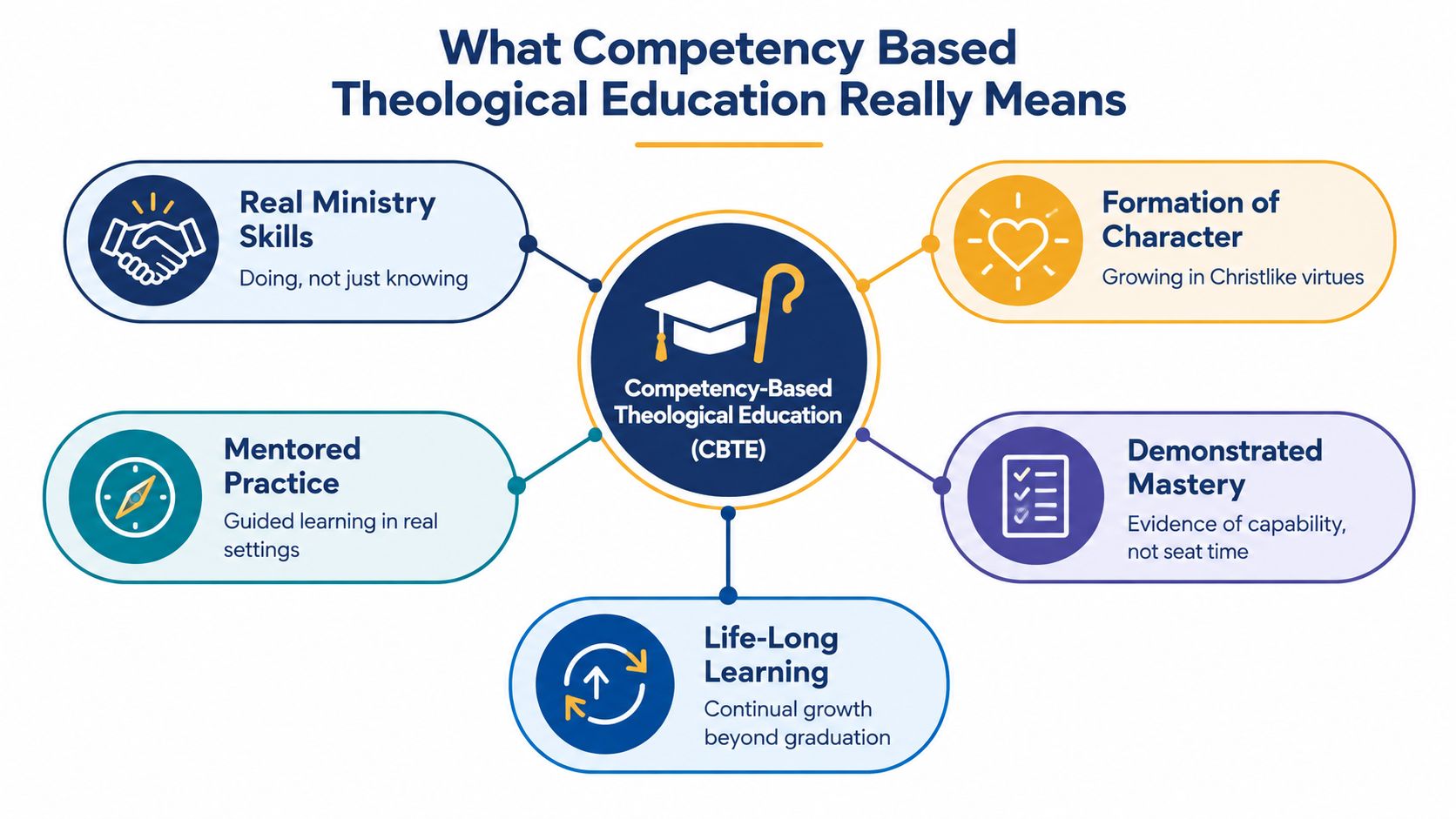
Competency based theological education addresses that question by placing demonstrated mastery at the center. It seeks to train hearts and minds for kingdom service, joining biblical knowledge with ministry skills, spiritual formation, and character. For students, pastors, churches, and ministry partners, the issue isn't whether rigorous study matters. It does. The issue is whether study leads to faithful, observable readiness.
Introduction to Competency Based Theological Education
Competency-based theological education, or CBTE, is a model in which students advance by demonstrating mastery of required knowledge, skills, and character traits. A degree is awarded only after the student has demonstrated mastery in every required competency, rather than completing a fixed set of courses or spending a prescribed amount of time in class. This definition is provided by CBTE Canada's explanation of competency-based theological education.
That distinction matters because ministry is more than information transfer. A pastor needs to interpret Scripture faithfully, but also communicate it clearly. A ministry leader needs theological judgment, but also patience, humility, courage, and practical wisdom. A shepherd needs to know what Scripture says and learn how to embody its truth when people are wounded, confused, or resistant.
Scripture holds knowledge and life together. Paul urged Timothy to continue in what he had learned, while also presenting himself as a worker who rightly handled the word of truth (2 Timothy 3:14–17; 2 Timothy 2:15). James likewise warned that teachers carry serious responsibility because Christian instruction must shape conduct, not merely conversation (James 3:1).
“Be doers of the word and not hearers only, deceiving yourselves.” (James 1:22, CSB)
CBTE doesn't make ministry mechanical, and it can't manufacture spiritual maturity through a checklist. Its promise is more disciplined and more practical. It asks seminaries to define what faithful ministry requires, provide guided opportunities to practice those responsibilities, and gather credible evidence that students can carry them out.
The modern CBTE movement reached a recognizable milestone in 2012, when Northwest and Fellowship Pacific announced the Immerse Master of Divinity program. The program launched by 2013, and the Association of Theological Schools granted experimental approval in 2014, according to CBTE Canada's brief history. The movement emerged in response to a persistent field-readiness gap, where graduates could write papers and pass exams but weren't always prepared for ministry situations.
That concern remains relevant for anyone considering seminary. You may be serving in a church already, balancing employment and family responsibilities, or discerning a call that doesn't fit a traditional educational path. CBTE offers a way to ask a more useful question than “How much time have I spent studying?” The question becomes, “What can I faithfully and competently do for the sake of Christ and his church?”
What Competency Based Theological Education Really Means
A simple analogy helps. Learning about shepherding isn't the same as demonstrating that you can care for sheep. In the same way, reading about pastoral ministry isn't identical to showing that you can listen well, apply Scripture wisely, protect the vulnerable, and lead a congregation with integrity.
CBTE begins with the ministry destination and works backward. This is called backward design. A program first identifies the competencies a graduate should demonstrate, then builds learning activities, mentoring, practice, and assessments around those outcomes. The curriculum serves the ministry task rather than allowing a calendar or course catalog to define the task.
Mastery changes the pace
Traditional programs commonly organize progress around courses, semesters, assignments, and grades. CBTE keeps the learning expectation constant while allowing time to vary. A student moves forward after demonstrating mastery, not merely after attending for a certain period. ATS guidance for CBTE programs.pdf) states that students must demonstrate every competency for the degree to be awarded.
This doesn't mean students learn without structure or accountability. Quality CBTE includes regular and substantive interaction with faculty, mentors, and a learning community. Students may move at an individualized pace, but they aren't left to handle theological study alone. Faculty guide interpretation and doctrine. Mentors help students connect learning to ministry. The community provides encouragement, correction, prayer, and shared formation.
Learning becomes observable
A competency should describe something a student can demonstrate. “Understand pastoral care” is too vague by itself. A stronger outcome might ask a student to respond to a pastoral situation, use Scripture appropriately, identify risks, communicate with compassion, and receive feedback from a qualified mentor.
This model recognizes that Christian formation includes both what a person knows and who that person is becoming. Jesus connected discipleship with abiding in him and bearing fruit (John 15:4–5). CBTE can support that vision when it treats formation as a lived process under the oversight of Scripture, mentors, and the church.
The model isn't a shortcut around scholarship. It's an attempt to make scholarship serve faithful action. A student still studies doctrine, Scripture, history, and ministry practice. The difference is that the program must show how those studies contribute to the competencies needed for service.
How Competency Frameworks Shape Ministry Training
A CBTE program depends on its competency framework. This framework is more than a list of attractive ministry values. It should describe a coherent set of outcomes across knowledge, skills, behaviors, and formation, then connect each outcome to evidence and performance standards.
The three dimensions of readiness
Knowledge includes biblical interpretation, theological foundations, church history, and the ability to reason from Scripture. A student might demonstrate this through an exegetical project, theological argument, or guided interpretation of a difficult passage.
Skills involve action. Preaching, teaching, counseling, leadership, communication, conflict engagement, and ministry planning belong here. A written description of preaching ability isn't enough. Students need opportunities to prepare and deliver sermons, receive evaluation, revise their work, and demonstrate growth.
Character concerns the qualities that shape ministry conduct. Humility, faithfulness, integrity, emotional steadiness, teachability, and compassion affect how every other competency is used. A gifted communicator who lacks integrity isn't ministry-ready just because the sermon is polished.
A useful framework also describes observable indicators. “Demonstrates humility” needs clarification. Does the student receive correction without defensiveness? Do they acknowledge limitations? Do they share credit, repair harm, and submit their preferences to the good of the church? These questions don't reduce humility to a score. They help mentors recognize patterns that require prayerful conversation and pastoral discernment.
Three voices test relevance
CBTE field guidance describes outcomes as shaped by the academy, the agency, and the assembly. The academy contributes theological and scholarly rigor. The agency represents ministry organizations and the settings where graduates serve. The assembly represents the church community that receives and evaluates ministry.
This three-stakeholder model protects against two opposite errors. A program can become academically detached from congregational realities, or it can become practically busy without theological depth. Bringing these voices together helps a seminary ask whether its graduates can interpret Scripture faithfully and serve actual churches responsibly. The CBTE peer group report emphasizes this connection between individualized learning, ministry context, and regular interaction with faculty, mentors, and community.
Standards prevent empty checklists
A framework becomes useful when it establishes what credible performance looks like. For a pastoral care competency, evidence might include a supervised conversation, a written reflection, a theological rationale, and mentor feedback. For leadership, it might include a ministry initiative that demonstrates planning, collaboration, communication, evaluation, and ethical judgment.
The framework should also leave room for culture and context. A ministry competency may look different in a rural congregation, an urban church, a chaplaincy setting, or a cross-cultural mission. The core commitments remain anchored in Scripture, while the evidence reflects the people and circumstances being served.
Benefits of Competency Based Learning for Ministry Leaders
The most important benefit of CBTE is alignment. Students don't study ministry in one place and wait until graduation to discover whether they can practice it. Their learning can be connected to a church, ministry, or other setting where real responsibilities create opportunities for application and feedback.
That flexibility can serve adult learners who are already working, parenting, serving, or leading. It also helps churches see theological education as part of ministry development rather than as a temporary departure from ministry. Individualized pacing doesn't remove community. A well-designed program keeps students connected to faculty, mentors, and fellow learners.
The historical record also shows why access and completion became central to CBTE's promise. Northwest Baptist Seminary's CBTE track had graduated 14 students by 2017, and Sioux Falls Seminary reported six graduates while reducing student debt by 67% in three years, as reported in the 2024 ICETE standards paper. Those figures belong to specific institutional experiences, not a guarantee for every program, but they illustrate the model's attention to flexible access, completion, and financial burden.
Traditional seminary model compared with CBTE
Feature | Traditional Model | Competency Based Model |
|---|---|---|
Progress | Often organized around fixed courses and academic periods | Organized around demonstrated mastery |
Assessment | Frequently centered on exams, papers, and course grades | Uses evidence connected to required competencies |
Practice | May occur separately from classroom learning | Integrated with ministry contexts where appropriate |
Pace | Commonly follows a shared academic calendar | Time can vary while learning expectations remain constant |
Formation | Supported through institutional practices and community | Intentionally connected to mentoring, practice, feedback, and character outcomes |
No model automatically produces faithful leaders. Traditional seminary education can provide deep scholarship and strong community. CBTE can become shallow if its competencies are poorly written or its assessments are weak. The question is whether a program unites scholarship, spiritual formation, and hands-on ministry under the authority of Scripture.
A wise choice: Look beyond the label. Ask how the program defines mastery, who evaluates it, how mentors are prepared, and how the church participates in formation.
For pastors and ministry leaders, CBTE can make continuing education more directly relevant to current responsibilities. For donors and church partners, it offers a clearer way to examine what graduates are expected to know, do, and embody. For prospective students, it creates a path that values both academic seriousness and faithful service.
How Assessment Works Beyond the Classroom
Assessment is where many prospective students become uncertain. If a program evaluates character and ministry ability, does that mean spiritual life gets reduced to a bureaucratic checklist? It can, if the design is careless. Responsible CBTE treats assessment as a process of gathering meaningful evidence through relationships, observation, reflection, and repeated practice.

Evidence begins with authentic ministry
A preaching competency might require a student to interpret a passage, prepare a sermon, preach to an actual congregation, receive structured feedback, and revise the sermon or reflection. The assessor isn't looking only for eloquence. They're examining faithfulness to the text, clarity, awareness of the hearers, pastoral sensitivity, and responsiveness to correction.
Pastoral care requires a different kind of evidence. A student might participate in a supervised conversation, write a theological and ethical reflection, identify appropriate boundaries, and explain how they would connect someone with further care when necessary. The assessment should honor confidentiality and protect the person receiving ministry.
Leadership evidence may come through an integrated project. The student could identify a ministry need, consult church leaders, develop a plan, communicate expectations, carry out the work, evaluate the result, and reflect on what the experience revealed about their own strengths and weaknesses.
Formation requires humility and patience
Character and spiritual formation are harder to assess than a written exam because they involve patterns over time and relationships. A single performance can't establish faithfulness. A mentor may observe how a student responds to correction, handles disagreement, treats people with less power, acknowledges failure, and follows through on commitments.
The 2025 South African study on competency frameworks for an MDiv identifies an unresolved design challenge: competencies need descriptions, performance standards, and observable indicators if different programs are to assess them consistently. That concern is especially important for spiritual formation, where cultural assumptions can distort evaluation.
The challenge is visible in other ministry contexts as well. A 2026 study on integral mission in South Sudan, discussed in the same research reference, treats a local competency gap as central to pastoral effectiveness, including trauma care, resilience, empathy, and contextual discernment. This reminds us that formation must be biblically grounded and culturally attentive. A quiet personality isn't automatically a lack of leadership, and a confident personality isn't automatically evidence of maturity.
Verification protects both students and churches
Rigorous assessment uses more than one perspective. Faculty may assess theological reasoning. Ministry mentors may observe practical leadership. Formation mentors may help identify patterns in personal and spiritual growth. The student's own reflection matters, but self-report alone isn't sufficient.
This approach preserves the difference between formation and performance. A student can learn to perform ministry tasks while still needing deeper repentance, healing, or accountability. Good mentors don't hide that reality. They help students grow in the truth that ministry flows from abiding in Christ, not from professional technique alone (John 15:5).
Assessment, then, should be personal without becoming arbitrary, structured without becoming cold, and measurable without pretending that every aspect of Christian maturity can be captured by a number.
Implementing CBTE in Seminaries With Real Examples
Launching CBTE starts with a concrete question: what ministry responsibilities must graduates carry faithfully and competently? Seminary leaders can answer it by listening to faculty, churches, agencies, and ministry partners. Their input helps distinguish genuine ministry competencies from a stack of disconnected assignments.
Leaders then work backward from each outcome. They define the expected performance, identify acceptable evidence, design learning experiences, prepare assessors, and establish feedback and reassessment. Mentor networks also need clear expectations. Without them, “mentoring” can sound formative while remaining inconsistent in practice.
CBTE's early development moved from local experimentation into wider discussion. Northwest and Fellowship Pacific announced Immerse in 2012, launched the program by 2013, and received experimental approval from ATS in 2014, as noted in the documented CBTE history. By the 2020s, the model had extended beyond that pioneering experiment. A 2024 ICETE paper reported around 30 CBTE programs in the United States, spanning bachelor's, master's, and doctoral degrees. The pattern suggests both growing interest and continued concentration among accredited providers.
Adoption also changes institutional roles. Faculty may spend less time only delivering content and more time coaching, evaluating, and mentoring. Churches must understand how to offer suitable ministry settings and supervision. Students need transparent competency descriptions, much like a map that shows both the destination and the evidence required to reach it.
Bible-centered training remains the foundation. Practical assessments should direct students toward Scripture, theological truth, prayerful dependence, and service of the church. A student preparing to preach, for example, needs more than communication technique. The work should reveal careful observation, sound interpretation, theological integration, clear proclamation, and pastoral application. Expository preaching training illustrates preparation that connects biblical study with public ministry.
The Bible Seminary offers Bible-centered graduate education, ministry-focused training, certificates, and other academic pathways in Katy, Texas. Prospective students can review its degree information and consider how the seminary's stated outcomes, faculty guidance, and ministry opportunities fit their calling.
Outcomes for Graduates and Your Next Step at The Bible Seminary
The desired outcome of CBTE isn't merely a graduate who can complete an assessment. It's a servant of Christ who can bring biblical knowledge, practical skill, and Christlike character together in a particular ministry setting.
For churches, that integration matters. A leader may need to preach on Sunday, visit the sick, guide a team meeting, respond to conflict, teach a Bible study, and make a difficult ethical decision in the same week. Competency-based preparation asks whether theological education has equipped that person for the whole pattern of service, not just one academic task.
For prospective students, the model offers a helpful way to evaluate programs. Ask these questions:
What should graduates be able to do? Look for clear outcomes connected to ministry.
How is mastery demonstrated? Ask whether assessment includes authentic practice and direct evidence.
Who provides feedback? Strong programs explain the roles of faculty, mentors, and ministry communities.
How is character addressed? Look for observable indicators, relational oversight, and humility about what assessment can and can't measure.
Does the program honor Scripture? Ministry competency must remain accountable to God's Word and the historic Christian faith.
For donors and ministry partners, this framework also clarifies kingdom impact. Supporting theological education means helping form leaders whose learning reaches congregations, families, neighborhoods, and mission fields. The work joins scholarship with spiritual formation and practical service, equipping leaders to impact the world for Christ.
CBTE isn't a universal replacement for every seminary model. It's a serious approach that asks seminaries to connect their claims about preparation with evidence of readiness. Its strongest future will depend on thoughtful frameworks, credible assessment, faithful mentors, and a deep refusal to separate ministry skill from love of God and neighbor.
The Bible Seminary offers Bible-centered graduate degree programs, certificates, and ministry-focused learning that unite scholarship, spiritual formation, and hands-on service. Visit The Bible Seminary to explore your next step in training hearts and minds for kingdom service, and discover where the Bible comes alive through archaeology, Scripture, and ministry preparation.